Salesforce and Qualified: A New Era of Agentic Marketing
Salesforce and Qualified Salesforce’s announcement that it has signed a definitive agreement to acquire Qualified, a leader in agentic AI marketing, is more than a routine acquisition. It is a strong signal of where enterprise growth, marketing, and sales execution are heading next. This move reinforces a trend that has been building steadily across the Salesforce ecosystem: the agentification of the enterprise. AI is no longer limited to analytics, copilots, or assistive automation. It is becoming an autonomous workforce that can engage buyers, qualify intent, and generate pipeline with minimal human intervention. For Salesforce customers, consultants, and partners, this acquisition raises important questions: In this article, we break down the acquisition, explore its strategic implications, and explain what it means for Salesforce customers navigating the next phase of AI-driven growth. Table of Contents Salesforce and Qualified Understanding Qualified and Its Role in Agentic Marketing Why Salesforce Acquiring Qualified Makes Strategic Sense 1. Strengthening Agentforce for Marketing and Sales 2. Closing the Gap Between Website Engagement and CRM Data 3. Reinforcing Salesforce’s AppExchange and Partner Ecosystem Strategy What Is Agentic Marketing and Why It Matters Now How This Changes the B2B Buying Experience Implications for Marketing Teams Implications for Sales Teams Governance, Trust, and Enterprise Readiness What This Means for Salesforce Customers Today How CloudVandana Helps Organizations Prepare for Agentic AI Looking Ahead: The Future of Agent-First Revenue Teams Final Thoughts YOU MIGHT ALSO LIKE Salesforce and the Acceleration of the Agentic Enterprise Salesforce has been steadily repositioning itself from a CRM company to an AI-first enterprise platform. Over the past few years, we have seen this shift unfold across multiple layers of the Salesforce stack: The acquisition of Qualified fits squarely into this evolution. As Steve Fisher, President and Chief Product Officer at Salesforce, noted, “The agentification of the enterprise continues to accelerate.” This is not a future concept. It is already happening in production environments across marketing, sales, and customer engagement functions. Salesforce’s strategy is increasingly clear:AI agents will handle initial engagement, intent detection, qualification, and routing, allowing human teams to focus on higher-value work such as relationship building, deal strategy, and closing. Understanding Qualified and Its Role in Agentic Marketing Qualified has built its reputation as a B2B pipeline generation platform designed to turn website traffic into real sales conversations. At its core, Qualified provides: Unlike traditional chatbots or static lead forms, Qualified’s AI acts as an always-on AI worker. It does not simply respond to predefined questions. It actively engages visitors, adapts conversations based on context, and drives outcomes such as meeting bookings and lead qualification. This distinction is critical. Agentic AI is not about assistance. It is about autonomy. Qualified’s technology is designed to operate independently within defined guardrails, making decisions and taking actions that directly contribute to pipeline generation. Why Salesforce Acquiring Qualified Makes Strategic Sense From a strategic standpoint, this acquisition addresses several key priorities for Salesforce. 1. Strengthening Agentforce for Marketing and Sales Agentforce is Salesforce’s vision for deploying AI agents across the enterprise. While early focus has been on service and sales productivity, marketing has emerged as a critical next frontier. Qualified brings mature, production-ready agentic marketing capabilities that Salesforce can embed directly into: This allows Salesforce to move faster than building equivalent capabilities entirely in-house. 2. Closing the Gap Between Website Engagement and CRM Data One of the long-standing challenges in B2B marketing is the disconnect between anonymous website traffic and actionable CRM data. Qualified bridges this gap by: Once integrated into Salesforce’s platform, this capability becomes even more powerful when combined with Data Cloud, CRM, and AI agents working together. 3. Reinforcing Salesforce’s AppExchange and Partner Ecosystem Strategy Qualified is already a Salesforce AppExchange partner and a Salesforce Ventures portfolio company. This acquisition demonstrates Salesforce’s continued commitment to: For Salesforce partners and ISVs, this is an important signal about the value of building natively on the Salesforce platform. What Is Agentic Marketing and Why It Matters Now Agentic marketing represents a fundamental shift in how organizations think about demand generation and buyer engagement. Traditional marketing automation relies heavily on: Agentic marketing replaces these fragmented workflows with AI agents that can act independently. These agents can: The result is a faster, more responsive buying experience that aligns with how modern B2B buyers expect to interact. This matters now because: Agentic marketing directly addresses these pressures. How This Changes the B2B Buying Experience From the buyer’s perspective, agentic marketing removes friction. Instead of: Buyers can engage in real-time conversations that feel natural, contextual, and relevant. When implemented correctly, AI agents become an extension of the brand, delivering consistent, high-quality engagement at scale. This is particularly important for: With Qualified integrated into Salesforce, these experiences can be governed, measured, and optimized directly within the CRM ecosystem. Implications for Marketing Teams Marketing teams will need to rethink how they measure success. Traditional metrics such as: Will increasingly give way to: Marketers will spend less time configuring workflows and more time: This represents a shift from execution-heavy roles to strategic orchestration. Implications for Sales Teams For sales teams, the impact is equally significant. AI agents handling early-stage engagement means: Sales teams can focus on: Rather than spending time chasing low-quality inbound leads. When combined with Agentforce Sales, the result is a more efficient, AI-augmented revenue organization. Governance, Trust, and Enterprise Readiness One of Salesforce’s core differentiators has always been its focus on trust, governance, and enterprise readiness. As agentic AI becomes more autonomous, these concerns become even more critical. By bringing Qualified into the Salesforce ecosystem, Salesforce can ensure: This is particularly important for regulated industries and large enterprises that require transparency and control over AI-driven actions. What This Means for Salesforce Customers Today While the transaction is expected to close in the first quarter of Salesforce’s fiscal year 2027, customers should already be thinking ahead. Key considerations include: Organizations that start preparing now will be better positioned to adopt agentic marketing capabilities as they become more deeply embedded into Salesforce products. How CloudVandana
How to Ensure Code Quality in Large-Scale Salesforce Projects
Introduction: Why Code Quality Becomes Fragile at Scale Salesforce projects often begin with optimism. A clean org, a focused use case, a small team, and a tight timeline. In the early stages, even loosely written code appears to work just fine. Business users are happy. Features ship quickly. The platform feels forgiving. But as Salesforce projects mature and expand across departments, regions, and integrations, that initial flexibility becomes a liability. In large-scale Salesforce projects, code quality does not fail loudly. It deteriorates incrementally. A quick fix introduced to meet a deadline becomes permanent. A trigger written for one object is reused without fully understanding its side effects. A Flow added for convenience quietly conflicts with Apex logic months later. Over time, the org becomes fragile. Small changes trigger unexpected regressions. Deployment cycles slow. Confidence erodes. At enterprise scale, Salesforce projects are no longer just CRM implementations. They are mission-critical systems supporting revenue, compliance, customer experience, and operational reporting. Code quality is no longer a technical preference. It is a business requirement. Without deliberate guardrails, even well-intentioned teams can unintentionally create systems that resist change and magnify risk. Table of Contents Introduction: Why Code Quality Becomes Fragile at Scale Understanding “Large-Scale” in the Salesforce Context The True Cost of Poor Code Quality in Salesforce Projects Establishing Clear Architectural Principles Early Choosing the Right Salesforce Architecture Patterns Governing Customization vs Configuration Apex Coding Standards That Actually Scale Designing for Bulkification from Day One Managing Governor Limits Proactively Enforcing Consistent Naming Conventions Modular Apex Design and Reusability Test Classes as a Quality System, Not a Checkbox Achieving Meaningful Test Coverage Beyond Minimum Thresholds Test Data Strategy for Enterprise Salesforce Projects Static Code Analysis and Automated Quality Gates Version Control as a Non-Negotiable Foundation CI/CD Pipelines for Large Salesforce Projects Code Reviews That Improve Quality Without Slowing Delivery Managing Technical Debt Intentionally in Salesforce Projects Refactoring Strategies for Live Salesforce Orgs Documentation That Engineers Actually Use Security, Compliance, and Secure Coding Practices Monitoring Code Quality After Deployment Scaling Teams Without Diluting Standards Preparing Salesforce Projects for Long-Term Evolution Conclusion: Code Quality as a Strategic Advantage in Salesforce Projects Partnering with CloudVandana for High-Quality, Scalable Salesforce Projects Ready to improve code quality, delivery confidence, and long-term scalability in your Salesforce projects? Frequently Asked Questions (FAQs) YOU MIGHT ALSO LIKE Understanding “Large-Scale” in the Salesforce Context Large-scale Salesforce projects are defined less by size and more by complexity. An org with a few hundred users can still be considered large-scale if it supports multiple business units, complex automation, extensive integrations, or high data throughput. Conversely, an org with thousands of users but minimal customization may remain relatively simple. Salesforce projects reach large-scale territory when multiple development teams contribute simultaneously, when release cycles overlap, and when custom logic becomes deeply intertwined with business processes. These environments often include Apex-heavy automation, Lightning Web Components, external API integrations, data migrations, and regulatory constraints. Each additional layer increases the surface area where quality issues can emerge. At this stage, Salesforce stops behaving like a low-code platform and starts functioning like an enterprise software ecosystem. Traditional software engineering principles apply fully. Without them, complexity grows faster than capability. The True Cost of Poor Code Quality in Salesforce Projects Poor code quality in Salesforce projects rarely manifests as a single catastrophic failure. Instead, it shows up as chronic friction. Developers spend excessive time debugging. Releases require multiple hotfixes. Regression testing becomes unpredictable. Simple feature requests take weeks instead of days. The business impact is significant. Stakeholders lose trust in delivery timelines. Innovation slows as teams fear touching brittle logic. Technical debt accumulates silently, inflating the cost of every future change. In regulated industries, poor code quality introduces compliance risks through inconsistent data handling, weak access controls, or insufficient audit trails. Over time, Salesforce projects with poor code quality become expensive to maintain and difficult to evolve. The platform that was meant to accelerate growth begins to constrain it. Establishing Clear Architectural Principles Early Strong Salesforce projects are guided by explicit architectural principles. These principles define how logic is structured, where responsibilities live, and how components interact. Without them, teams make isolated decisions that solve immediate problems but undermine long-term stability. Architectural clarity answers critical questions upfront. When should Apex be used instead of Flow? How are integrations orchestrated? Where does business logic reside? How is cross-object behavior managed? In large-scale Salesforce projects, ambiguity in these areas leads to duplication, inconsistency, and hidden dependencies. Clear principles do not eliminate debate. They provide a shared baseline that keeps decisions aligned as teams and requirements grow. Choosing the Right Salesforce Architecture Patterns Patterns are the backbone of maintainable Salesforce projects. Trigger frameworks, service layers, selector classes, and domain-oriented designs help isolate responsibilities and reduce coupling. These patterns ensure that changes in one area do not ripple unpredictably across the org. Thin triggers, centralized business logic, and well-defined data access layers make Apex code easier to reason about. They also enable consistent testing strategies and safer refactoring. In large Salesforce projects, patterns are not academic constructs. They are survival mechanisms. Consistency in architecture allows teams to scale without rewriting foundational logic every time a new feature is introduced. Governing Customization vs Configuration Salesforce’s declarative capabilities are powerful, but unchecked configuration can become as dangerous as poorly written code. Large Salesforce projects often suffer from an uncontrolled mix of Flows, validation rules, Process Builder remnants, and Apex, all interacting in unpredictable ways. Governance is essential. Teams must decide when configuration is sufficient and when code provides better control, testability, and transparency. Declarative automation should be documented, versioned, and reviewed with the same rigor as Apex. Balanced governance ensures that Salesforce projects remain flexible without becoming opaque. Apex Coding Standards That Actually Scale Coding standards only matter if they are enforced consistently. In large Salesforce projects, informal conventions quickly break down as teams grow and external contributors join. Effective Apex standards focus on readability, simplicity, and predictability. They define how exceptions are handled, how logging is performed,
10 Salesforce Flow Mistakes That Break Automations and How to Avoid Them
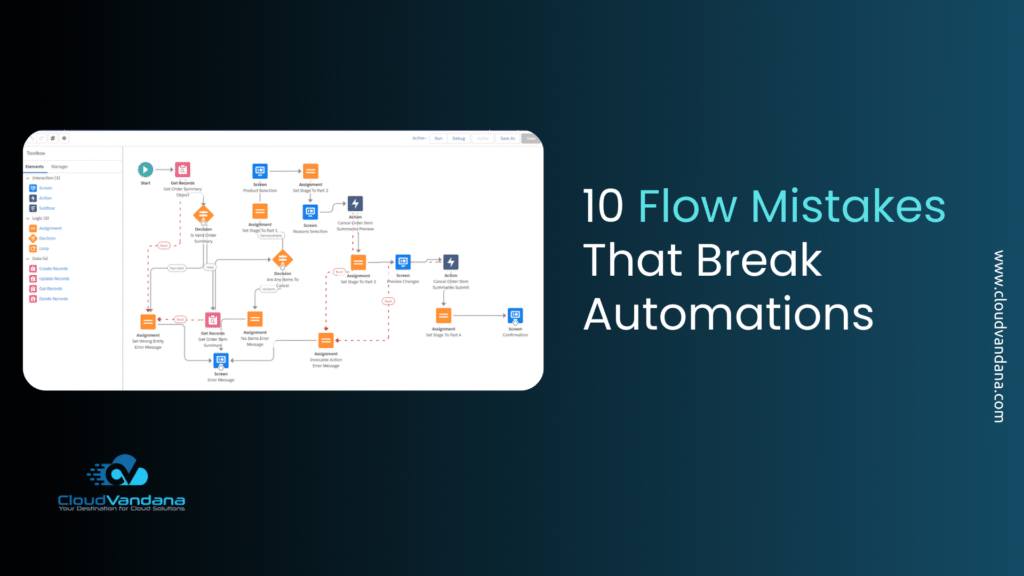
Salesforce Flow has become the most powerful automation engine in the Salesforce ecosystem. As Process Builder and Workflow Rules fade into retirement, Salesforce Flow stands as the unchallenged backbone of business logic, data processing, and operational efficiency. For many organizations, Salesforce Flow quietly powers mission-critical processes—from lead routing to approval logic, renewal cycles, customer onboarding, escalations, billing workflows, and case triage. Its visual interface empowers admins to build automation without code, but that same accessibility creates risk. When used without architectural discipline, even a seemingly harmless Salesforce Flow can introduce major system instability. The reason is simple: Salesforce Flow is powerful, but power without structure creates fragility. Broken automations do more than cause errors.They slow down user productivity, create inconsistent data, corrupt reporting, misroute leads, stall opportunity stages, disrupt integrations, and drain hours of admin time trying to diagnose failures. The cost of automation mistakes compounds quietly until a major process breaks—and suddenly the entire business feels the impact. This cornerstone guide outlines the 10 most damaging Salesforce Flow mistakes seen across real Salesforce implementations—and, more importantly, the strategies to prevent them. Each section is fully expanded to help you think like a Flow architect, not just a Flow builder. Let’s begin. Overloading a Single Salesforce Flow With Too Many Responsibilities One of the most common mistakes admins make is allowing a single flow to grow far beyond its initial purpose. A flow that begins as a simple automation often evolves into a sprawling ecosystem of branches, loops, decision nodes, and sub-paths. Over time, this “mega-flow” becomes nearly impossible to control. Every enhancement forces you to add more complexity to an already fragile structure. Why Overloaded Flows Break When a flow tries to handle multiple responsibilities, it becomes a single point of failure for several business processes. Any small update can disrupt multiple logic paths, leading to unpredictable behavior. New admins hesitate to modify the flow because the logic is dense and interconnected. Debugging becomes slow and frustrating because a single execution might trigger dozens of decisions that depend on one another. As the flow grows, performance suffers, and the risk of breaking critical processes increases dramatically. How to Avoid This Mistake The solution is simplicity through modular design. Instead of cramming every rule into one massive flow, split automations according to object, trigger type, and purpose. Create focused flows that each solve one problem well. Reusable logic should live in subflows, which make maintenance easier and promote consistency. Clear naming conventions help future admins understand your architecture instantly. A modular system is more resilient, easier to audit, and far less likely to collapse under pressure. Table of Contents Overloading a Single Salesforce Flow With Too Many Responsibilities Why Overloaded Flows Break How to Avoid This Mistake Allowing Salesforce Flows to Run Without Precise Entry Criteria Why Lack of Entry Criteria Breaks Automations How to Avoid This Mistake Why Loops Often Break Salesforce Flows How to Avoid This Mistake How Limits Break Automations How to Avoid This Mistake How Poor Queries Break Automations How to Avoid This Mistake How After-Save Misuse Causes Problems When to Use Before-Save vs After-Save How Conflicts Break Automations How to Avoid This Mistake Why Lack of Error Handling Breaks Processes How to Avoid This Mistake Why Hardcoding is Dangerous How to Avoid It How Poor Testing Breaks Automations How to Avoid This Mistake 1. What causes most Salesforce Flow failures? 2. How do I know if my Flow is too complex? 3. What’s the difference between before-save and after-save flows? 4. How can I prevent flows from overwriting each other’s updates? 5. What is the most common mistake admins make with flow loops? 6. Why are governor limits important for Flow builders? 7. How can I improve the performance of my Get Records queries? 8. Why do I need fault paths in every Flow? 9. What’s wrong with hardcoding values in Flows? 10. How should I test a Flow before deploying it? 11. How often should Flows be reviewed or audited? 12. Can multiple flows on the same object be a good thing? YOU MIGHT ALSO LIKE Allowing Salesforce Flows to Run Without Precise Entry Criteria Flows must fire only under the right conditions, yet many record-triggered flows launch on every update simply because admins did not refine their entry criteria. This creates a silent performance killer behind the scenes. Why Lack of Entry Criteria Breaks Automations When flows run too often, they operate on records even when nothing relevant has changed. This leads to CPU waste, slow save times, unintended updates, and cascading triggers of other Salesforce flows. These unnecessary executions can create automation loops where one flow triggers another, which updates the first again. Users experience confusing behavior, and admins struggle to pinpoint the origin because too many flows activate simultaneously. How to Avoid This Mistake Your flow’s entry criteria should be treated like a finely tuned security gate—opening only when conditions genuinely require the automation. Use ISCHANGED checks, value comparisons, and exclusion logic. For example: “Run only when Priority changes” or “Run only when the Stage moves to Closed Won.” By narrowing the entry, you dramatically reduce system strain and eliminate the chaos caused by unnecessary firing. Misusing Loops — the Silent Salesforce Flow Killer Loops are incredibly useful, but they are also the fastest way to trigger governor limit errors. Even a slight inefficiency inside a loop multiplies rapidly when processing large datasets. Why Loops Often Break Salesforce Flows Loops process one item at a time. If each iteration performs a SOQL query or DML operation, you will hit Salesforce’s limits almost immediately. A loop that runs smoothly when testing with 10 records may grind the system to a halt when running against 1,000 records. Nested loops amplify this risk exponentially. Every inefficiency becomes a multiplied liability, leading to limit violations and aborted transactions. How to Avoid This Mistake Effective loop design relies on bulk principles. Move queries outside the loop and retrieve all needed data in advance. Use a
How to Prepare Your Org for Salesforce AI: The Complete 2026 AI-First Readiness Guide
The Era of AI-First Salesforce Salesforce is entering a new era—one defined not by incremental enhancements, but by a fundamental re-engineering of the platform itself. In 2026, Salesforce will operate as an AI-first system, where intelligence is no longer a feature layered on top of workflows, but the very core that drives them. This shift signals the most significant architectural evolution in the platform’s history, and it will reshape how organizations design data, build processes, govern automation, train teams, and deliver customer experiences. Salesforce AI isn’t just a collection of predictive scores or conversational assistants. It represents a new operating model—one where the platform anticipates actions, identifies risks, surfaces insights, and initiates workflows without waiting for human input. Instead of reacting to user clicks, it interprets business context. Instead of relying on predefined rules, it reasons dynamically using patterns, signals, and unified data. The CRM you once configured will transform into an intelligent system capable of orchestrating interactions across sales, service, marketing, operations, and beyond. But intelligence comes with prerequisites. AI models depend on clean data, disciplined metadata, modern automations, and architecture that removes ambiguity. They cannot operate reliably on top of years of technical debt, fractured integrations, cluttered objects, or conflicting automations. Companies that fail to prepare will experience inconsistent predictions, unreliable behavior, and user distrust—while those who modernize early will unlock speed, accuracy, and entirely new levels of efficiency. Preparing for Salesforce AI is no longer optional. It is a strategic imperative. This guide breaks down the core pillars your organization must address—data integrity, automation modernization, governance, integration readiness, security, metadata structure, and user trust—to ensure you enter 2026 with an AI-ready Salesforce org capable of thriving in the next generation of enterprise intelligence. AI-First vs AI-Enabled: Why the Distinction Matters It is tempting to think, “We already use Einstein and some AI recommendations — we’re fine.” That mindset is dangerous. AI-enabled means intelligence is sprinkled around the edges of your existing processes. AI-first means intelligence is embedded into the very core of your workflows, data model, and user experiences. In an AI-enabled org, humans still make most of the decisions and ask most of the questions. AI is a helpful assistant. In an AI-first org, AI is the primary orchestrator of logic. It is constantly scanning behavioral signals, usage patterns, customer journeys, and data changes to decide what should happen next. Humans still approve, override, and refine — but they no longer have to manually initiate every step. This sounds subtle on paper, but in practice it is transformational. It demands clean, coherent data. It demands well-structured automations. It demands governance that is explicit, not informal. And it demands an architecture designed for adaptability rather than static configuration.ostly mistakes, and build an ecosystem that doesn’t just work today but scales effortlessly into the future. Table of Contents The Era of AI-First Salesforce AI-First vs AI-Enabled: Why the Distinction Matters Understanding Salesforce’s AI-First Direction What an AI-First Core Really Implies The Technology Backbone Behind the Shift Why Legacy Orgs Will Feel the Pain First The New Reality for Admins and Architects Moving from Reactive Support to Predictive Stewardship The Admin Skillset in an AI-First World Architects as AI System Designers Building the Right Data Foundation Taking Inventory of Your Data Landscape Eliminating Redundant, Obsolete, and Trivial Data Structuring Metadata for Machine Understanding The Role of a Unified Data Layer Governance for Responsible AI in Salesforce Formalizing AI Governance Structures Ethics, Transparency, and Explainability Controlling Model Access to Data Modernizing Integrations for Real-Time Intelligence Moving Beyond Batch and Point-to-Point Designing for Event-Driven Behavior Rebuilding Automation for the AI Era Retiring Legacy Automation Frameworks Designing AI-Compatible Flow Architectures Combining Event Triggers and AI Triggers Security, Compliance, and Observability in an AI-First Org Reinforcing Identity and Zero-Trust Principles Understanding Data Residency and Model Boundaries Telemetry, Logging, and Model Monitoring Budgeting, Resourcing, and Continuous Improvement Planning for Real Transformation Costs Building the Right Team Mix Establishing a Continuous Improvement Motion What a 2026-Ready Salesforce Org Looks Like Conclusion: Preparing Your Org to Thrive, Not Just Survive What an AI-First Core Really Implies The Technology Backbone Behind the Shift Why Legacy Orgs Will Feel the Pain First The New Reality for Admins and Architects Moving from Reactive Support to Predictive Stewardship The Admin Skillset in an AI-First World Architects as AI System Designers Building the Right Data Foundation Taking Inventory of Your Data Landscape Eliminating Redundant, Obsolete, and Trivial Data Structuring Metadata for Machine Understanding The Role of a Unified Data Layer Governance for Responsible AI in Salesforce Formalizing AI Governance Structures Ethics, Transparency, and Explainability Controlling Model Access to Data Modernizing Integrations for Real-Time Intelligence Moving Beyond Batch and Point-to-Point Designing for Event-Driven Behavior Rebuilding Automation for the AI Era Retiring Legacy Automation Frameworks Designing AI-Compatible Flow Architectures Combining Event Triggers and AI Triggers Security, Compliance, and Observability in an AI-First Org Reinforcing Identity and Zero-Trust Principles Understanding Data Residency and Model Boundaries Telemetry, Logging, and Model Monitoring Budgeting, Resourcing, and Continuous Improvement Planning for Real Transformation Costs Building the Right Team Mix Establishing a Continuous Improvement Motion What a 2026-Ready Salesforce Org Looks Like Conclusion: Preparing Your Org to Thrive, Not Just Survive YOU MIGHT ALSO LIKE Understanding Salesforce’s AI-First Direction What an AI-First Core Really Implies When Salesforce speaks of an AI-first core, it is pointing to an architecture where predictive and generative capabilities are tightly woven into objects, flows, data services, and user interfaces. Instead of isolated “AI features,” the platform itself behaves intelligently. That means: In this architecture, AI is not a passenger. It is effectively a second operating system layered on top of your CRM logic. The Technology Backbone Behind the Shift Under the hood, this shift is powered by several converging capabilities: real-time data unification, scalable model hosting, secure prompt and context handling, and low-code orchestration of AI-driven processes. You will see: All of this is extremely powerful — but only if your org is structurally ready to take advantage of it. Why Legacy Orgs
What Are the Key Benefits of Hiring a Salesforce Consulting Firm?
Introduction: Why Salesforce Success Isn’t Accidental Salesforce has evolved far beyond the boundaries of a traditional CRM. Today, it serves as a digital command center for thousands of organizations, enabling them to orchestrate customer relationships, automate operations, forecast revenue, and unify data at scale. Yet, despite this immense potential, many organizations fail to extract even a fraction of what Salesforce is capable of delivering. Not because they lack motivation, but because Salesforce is a powerful ecosystem—one that demands clarity, strategy, and technical discipline. The harsh truth is that Salesforce success rarely happens by accident. Companies who achieve transformative results do so because they approach Salesforce with a long-term, architectural mindset. They treat it as a growth investment, not a plug-and-play tool. This is precisely where a Salesforce consulting firm becomes not just helpful but essential. A consulting team enters with expertise, structure, and foresight—guiding the business through the labyrinth of decisions that ultimately define whether Salesforce becomes a growth engine or a costly underutilized database. In the modern era, where operational efficiency is no longer a luxury but a necessity, having expert partners by your side can be the difference between stagnation and breakthrough performance. Hiring a Salesforce consulting firm gives organizations the ability to innovate faster, avoid costly mistakes, and build an ecosystem that doesn’t just work today but scales effortlessly into the future. Table of Contents Introduction: Why Salesforce Success Isn’t Accidental Understanding the Complexity of Salesforce Ecosystems The multi-layered nature of Salesforce Why “out-of-the-box” is rarely enough Benefit #1: Strategic Clarity from Day One Aligning Salesforce with business goals Eliminating guesswork Benefit #2: Faster and Flawless Implementations Reducing setup friction Avoiding early-stage technical debt Benefit #3: Customizations That Actually Scale Building long-term architecture Designing future-proof workflows Benefit #4: Access to Certified Expertise Across Clouds Why certifications matter Multi-cloud proficiency Benefit #5: Industry-Specific Best Practices Finance Healthcare SaaS & Technology Benefit #6: Clean, Accurate, and Governed Data Data quality frameworks Master data consistency Benefit #7: Intelligent Automation and AI Enablement Salesforce Flow excellence Leveraging AI + Data Cloud Benefit #8: Stronger User Adoption and Change Enablement Training that sticks Proven adoption frameworks Benefit #9: Cost Optimization and ROI Maximization Reducing licensing waste Increasing revenue visibility Benefit #10: Robust System Security and Compliance Role hierarchies Data security & audits Benefit #11: Continuous Optimization and Support Release management Proactive monitoring Benefit #12: Integration Without Chaos API orchestration Third-party system alignment Benefit #13: Reduced Risk, Increased Operational Continuity Dependency reduction Risk mitigation strategies Benefit #14: Enhanced Reporting and Analytics Custom dashboards Actionable insights Benefit #15: Expert Guidance for Complex Projects CPQ Service Cloud transformations Benefit #16: Access to a Full Bench of Talent Admin + Developer + Architect synergy Avoiding single-point-of-failure Benefit #17: Predictable Timelines and Project Governance Milestone-based execution Strong documentation Conclusion: Why Working with a Salesforce Consulting Firm Pays for Itself 1. Why should a business hire a Salesforce consulting firm instead of doing everything in-house? 2. Are Salesforce consultants worth the investment for small and mid-sized businesses? 3. How do Salesforce consultants accelerate implementation timelines? 4. What certifications should a reliable Salesforce consulting firm have? 5. Can a consulting firm help fix an already messy or broken Salesforce setup? 6. How do consultants help improve user adoption? 7. What role do Salesforce consultants play in long-term system maintenance? 8. Do Salesforce consultants help with integrations? 9. How do consulting firms ensure Salesforce stays secure? 10. Can a Salesforce consulting firm help with automation and AI features? 11. How do consulting firms contribute to better reporting and analytics? 12. How do I choose the right Salesforce consulting partner? Why Choose CloudVandana YOU MIGHT ALSO LIKE Understanding the Complexity of Salesforce Ecosystems The multi-layered nature of Salesforce Salesforce is deceptively complex. At a glance, it looks like a clean interface with intuitive buttons and menus. But underneath lies a dense architecture of objects, relationships, automation engines, AI models, APIs, permission layers, security controls, and customizable workflows that interlock like a vast, dynamic puzzle. The platform spans multiple clouds—Sales, Service, Marketing, Experience, Commerce, CPQ, Industry Clouds—and each comes with its own set of rules and best practices. Add in AppExchange apps, third-party integrations, and industry-specific requirements, and the ecosystem becomes even more multifaceted. Understanding how these layers interact is critical. A small misconfiguration in automation can disrupt downstream processes. A poorly structured object model can create data chaos. A wrong permission assignment can expose sensitive information. The complexity isn’t meant to intimidate—it’s simply meant to illustrate why expert oversight is invaluable. Why “out-of-the-box” is rarely enough While Salesforce ships with powerful native capabilities, real-world business operations are rarely generic. Companies have unique processes, approval flows, hierarchies, compliance needs, integration touchpoints, and customer journeys. The “default” setup simply cannot reflect these nuances. Without customization, organizations encounter common symptoms: A consulting firm bridges this gap by translating business needs into architecture that is flexible, resilient, and purpose-built. They ensure that Salesforce doesn’t just mimic existing processes—it enhances them. Benefit #1: Strategic Clarity from Day One Aligning Salesforce with business goals Too many Salesforce implementations start tactically rather than strategically. Teams dive into creating fields, objects, and dashboards without clarifying why they need them in the first place. A consulting firm begins by understanding the organization’s real drivers: revenue targets, operational bottlenecks, customer pain points, compliance needs, and go-to-market priorities. From there, they architect Salesforce in a way that directly supports those objectives. Decisions become intentional rather than reactive. Every automation, every field, every dashboard exists for a reason—and that reason is tied directly to business outcomes. Eliminating guesswork Trial-and-error is expensive. Guessing how to configure Salesforce leads to inconsistencies, breaks, rework, and mounting frustration. Consultants eliminate this uncertainty. They’ve seen dozens of implementations, solved hundreds of unique problems, and understand how decisions ripple across the system. Instead of experimenting, teams execute with clarity. And clarity is powerful. It saves money, accelerates deployment, and removes friction from every stage of the Salesforce journey. Benefit #2: Faster and Flawless Implementations Reducing setup friction Implementing
How Agentforce is Changing Customer Service Automation
In today’s hyper-connected world, customer expectations are shifting rapidly. The baton has passed from mere reactive support to proactive, intelligent engagement. Service organisations are increasingly under pressure to do more — faster, smarter, with fewer resources. Enter the era of autonomous agents. Among the front-runners in this transformation is Agentforce, an AI agent platform designed to radically change how customer service automation is executed. In this article, we explore how Agentforce is rewriting the playbook for service automation, step by step. Table of Contents Understanding Agentforce: What it is and why it matters The evolution from chatbots to autonomous agents Agentforce’s core architecture: The Atlas Reasoning Engine Contextual intelligence: Leveraging 360-degree customer data Omnichannel orchestration: Breaking down silos in service Automation built for humans: Guardrails and human-in-the‐loop Self-service redefined: From FAQs to proactive resolution Intelligent case-deflection: How Agentforce reduces workload Escalation-aware routing: When human intervention kicks in Real-time decision making: Agents that act, not just respond Tailored customer journeys: Personalisation at scale Efficiency and cost-savings: The quantifiable impact Employee experience: Liberating service teams from routine Governance and trust: Ensuring safe, compliant automation Implementation considerations: Data, strategy and readiness Common pitfalls and mitigation strategies Future trends: Where autonomous service is headed Case study snapshot: Agentforce in action across industries Conclusion: Embracing the future of service automation Frequently Asked Questions (FAQs) YOU MIGHT ALSO LIKE Understanding Agentforce: What it is and why it matters Agentforce is not simply another chatbot or AI helper. It is a platform built to create autonomous agents that reason, act, and integrate with enterprise systems. According to its makers, these agents leverage the full breadth of customer data and business logic to handle tasks that go beyond scripted responses. The significance lies in two bold promises: first, to scale service operations without linear growth in personnel; second, to deliver customer experiences that approach human-level reasoning. For service teams contending with high volumes of inquiries, this shift is far from trivial. The promise is that the digital workforce doesn’t merely respond—it manages, anticipates and resolves. The evolution from chatbots to autonomous agents Traditional chatbots have served a useful role in basic customer service scenarios, but they fall short when it comes to intricate, multi-step processes or context-rich problems. Chatbots typically rely on decision trees, scripted flows, and predictable intent classifications. Their limitation: rigidity. In contrast, Agentforce represents the next step in automation evolution: the autonomous agent. These agents can make decisions, execute workflows, interface with backend systems, and learn from outcomes. This shift from reactive scripts to proactive agents marks a paradigm change in service automation. For example, instead of simply answering “What is my order status?”, an autonomous agent can interpret the entire customer context, act on the customer’s behalf (such as rescheduling a delivery or updating a subscription) and then follow-through to complete resolution. Agentforce’s core architecture: The Atlas Reasoning Engine At the heart of Agentforce lies a powerful core architecture. A key component is described as the “Atlas Reasoning Engine”. This engine breaks down user requests into smaller tasks, reasons through each step, and orchestrates actions across systems. The orchestration is critical: where older automation platforms might stop at recognising a request and giving a recommendation, Agentforce goes further—it chooses an action, executes it (for instance via an API, workflow or prompt), assesses the outcome and then iterates as needed. In effect, it becomes a digital labourer that doesn’t wait for human intervention at every turn. The architecture supports branching logic, context-tracking and dynamically adjusting the plan of action. Contextual intelligence: Leveraging 360-degree customer data One of the key differentiators is the integration with a comprehensive customer view. Agentforce is built into the broader ecosystem (for example, with Salesforce Service Cloud and Customer 360) and is able to access customer records, engagement history, purchase history, service interactions and more. This “360-degree” intelligence enables the agent to personalise interactions: it knows the customer’s prior issues, channel preferences, product history, even likely next-steps based on data. That allows for responses that aren’t generic—but bespoke—and resolutions that go further than simply “providing information”. The agent can pre-empt needs, suggest solutions before the customer even asks, and shift the service model from reactive to anticipatory. Omnichannel orchestration: Breaking down silos in service Customers expect service wherever they are — chat, email, voice, social. And they expect continuity: starting on Chat, moving to Email, then picking up on Phone and not having to repeat themselves. Agentforce facilitates true omnichannel orchestration by recognising context across channels and maintaining continuity. What makes this significant is not only the variety of channels but the depth of context carried over: the agent remembers that the customer already indicated “delivery problem on last order”, keeps that in mind regardless of the channel, and proceeds accordingly. The silos between channels are broken, giving a smoother experience and reducing friction, which is a major contributor to customer dissatisfaction. Automation built for humans: Guardrails and human-in-the‐loop Despite its autonomy, Agentforce is designed with human oversight and safety in mind. Guardrails ensure that agents don’t stray into unsafe territory, and human-in-the-loop mechanisms provide assurance. YouTube In practice, this means that when an agent encounters a scenario outside its confidence bounds, it escalates to a human or asks for human approval. This blending of automation and human judgement ensures that the organisation maintains control, avoids cascading errors, and can rely on the agent’s outputs. For service leaders, this is critical: you’re not giving up control, you’re augmenting capacity. Self-service redefined: From FAQs to proactive resolution Traditional self-service has often meant static knowledge bases, FAQs, generic responses and maybe a chat widget. That’s no longer enough. With Agentforce, self-service is elevated: the agent proactively engages users, surfaces answers based on real-time context, and completes actions on their behalf. Imagine a scenario where a user logs in to a portal, the agent already knows their unstable subscription status, prompts them with “Would you like to update your plan?” or “I see your delivery is delayed; can I reschedule or offer compensation?”
The Rise of Vibe Coding: How Agentforce Vibes Is Redefining App Development
The future of enterprise app development no longer starts with code — it starts with a conversation.At Dreamforce 2025, Salesforce introduced a technology that feels less like programming and more like collaborating with an intelligent colleague.It’s called Agentforce Vibes, and it brings to life a brand-new way to build software: Vibe Coding. Imagine describing what you want an app to do — and watching it come to life within minutes. No syntax, no manual setup, no trial-and-error debugging.Just natural language, context awareness, and intelligent creation.That’s the promise of Vibe Coding — and it’s not a concept for the future. It’s here now. Table of Contents 1. Keynote Spotlight: Humans & AI, Side by Side A rallying cry for the “Agentic Enterprise” The Intelligence Behind Agentforce Vibes From Code to Conversation Making Development Fun Again Built for the Enterprise: Governance First Seeing It in Action: The Live Demo Moment What It Means for Salesforce Teams Preparing Your Organisation for Vibe Coding A Shift in the Developer’s Role From CRM to Creative Collaboration The Bottom Line: Development Has Never Been This Human YOU MIGHT ALSO LIKE 1. Keynote Spotlight: Humans & AI, Side by Side A rallying cry for the “Agentic Enterprise” A New Way to Build: What Is Vibe Coding? When Patrick Stokes, Salesforce’s EVP of Product & Industries Marketing, took the stage to unveil Agentforce Vibes, the demo was less about technology and more about possibility.He smiled as he described it: “It’s the fastest, and frankly most fun way to build anything — just from a description.” The idea behind Vibe Coding is beautifully simple.You tell Salesforce, in plain English, what kind of app, automation, or process you want.The AI agent interprets your words, understands your intent, and generates the structure, logic, and UI — instantly. Vibe Coding is not a marketing phrase; it’s a new philosophy of creation.Coined by AI researcher Andrej Karpathy earlier this year, the term captures the essence of working with AI instead of through it.Rather than typing commands or dragging workflows, you guide an intelligent collaborator that already understands the language of your business. This isn’t low-code. This is no-code, powered by context. The Intelligence Behind Agentforce Vibes So, how does it work?Agentforce Vibes connects directly to your Salesforce org — meaning it has full awareness of your data model, fields, relationships, and metadata.When you describe what you need, the AI leverages this context to design working applications automatically. Say you tell it, “Build a customer feedback tracker that notifies managers when satisfaction scores fall below 80.” Within seconds, it will: You didn’t write a single line of code. Yet you just built a functional, enterprise-grade app. The real power comes from Salesforce’s Data Cloud foundation.Because the AI can access structured and unstructured data together, it doesn’t guess — it reasons.It builds intelligently, using the exact semantics and processes that make your business unique. From Code to Conversation If we look at how app development has evolved, Vibe Coding is the natural next step.For decades, developers wrote code manually. Then came low-code platforms, which replaced syntax with visual builders.Now, Salesforce is taking the next leap: natural-language development — where code fades into conversation. The difference is profound.Instead of thinking in terms of functions or scripts, you think in terms of intent.Instead of assembling technical components, you describe outcomes.And instead of waiting weeks for IT to prototype an idea, business teams can test it the same day. As Stokes emphasized during his demo, the key is context.Agentforce Vibes doesn’t just translate words — it understands meaning.When you say “onboard a new employee,” it knows you’re referring to HR data, permissions, tasks, and forms that already exist inside Salesforce.It connects the dots automatically. Making Development Fun Again In a world of increasing technical complexity, “fun” is a word rarely associated with enterprise software.Yet that’s exactly how Salesforce described Agentforce Vibes — and it fits. Developers aren’t being replaced; they’re being liberated.Instead of spending hours scaffolding objects or writing boilerplate logic, they can focus on architecture, performance, and innovation.Admins and business users, meanwhile, gain the ability to build safely and confidently, without fear of breaking the system. Marc Benioff, Salesforce’s Co-Chair and CEO, put it perfectly: “The AI is elevating the developer. And the AI is elevating every aspect of the enterprise.” That’s the essence of Vibe Coding.It turns development from a technical chore into a creative experience. Built for the Enterprise: Governance First Speed is powerful, but governance is non-negotiable — especially in the enterprise world.That’s why Salesforce designed Agentforce Vibes with security, compliance, and transparency built in. Every generated change is logged.Every deployment can be reviewed, tested, and rolled back if needed.Administrators can define permission scopes for what the AI can create, ensuring sensitive data or processes remain protected. For industries like finance, healthcare, and government, these safeguards mean one thing: innovation without compromise.You can move faster and stay compliant. Agentforce Vibes is also deeply integrated with Salesforce’s DevOps pipeline.From sandbox creation to test automation and release management, the entire lifecycle is observable and auditable — giving enterprises the control they expect. Seeing It in Action: The Live Demo Moment One of the most talked-about moments at Dreamforce 2025 was the live demo of Agentforce Vibes.A user simply typed: “Create an internal service app that categorises customer emails, tracks sentiment, and escalates unhappy cases to management.” Within minutes, the AI: No IDE. No setup wizard. No manual deployment steps.Just instant, working software. The crowd’s reaction said it all — it felt like watching the future of enterprise development unfold in real time. What It Means for Salesforce Teams At CloudVandana, we see this shift as a defining moment for Salesforce professionals.For years, our community has pushed the limits of what low-code could achieve.Now, Vibe Coding takes us beyond that limit — to a place where ideas flow faster than code. For admins, it means more autonomy.For developers, it means more creativity.For business leaders, it means faster results, lower costs, and fewer backlogs. The development lifecycle
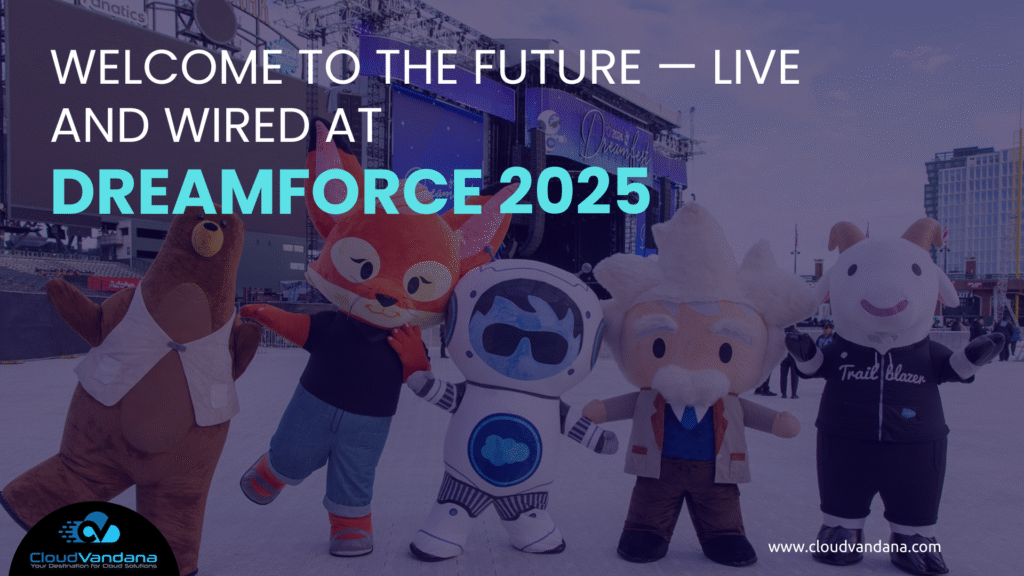
Welcome to the Future — Live and Wired at Dreamforce 2025
Three days. Thousands of Trailblazers. One unforgettable experience. That was Dreamforce 2025: the streets around the Moscone Center in San Francisco throbbled with a high-voltage mix of technology, innovation and human connection. From the moment you stepped in, the energy was unmistakable: a celebration of what comes next. Big announcements. Immersive demos. Hands-on sessions where you didn’t just hear about the future — you touched it. For CloudVandana and our community, this was more than an event — it was a compass pointing toward the next era of enterprise software, where humans + data + AI agents converge. Here’s your comprehensive, polished and engaging guide to the Key Take-Aways you absolutely can’t miss from Dreamforce 2025 — the announcements, the deeper messages, and why they matter to you. Table of Contents Three days. Thousands of Trailblazers. One unforgettable experience. 1. Keynote Spotlight: Humans & AI, Side by Side A rallying cry for the “Agentic Enterprise” Major product highlight: Agentforce 360 The underlying heartbeat: Data 360 Why this matters 2. Data 360: The Brain Behind the Agentic Enterprise From storage to activation Key features to note Implications for CloudVandana & your practice 3. Power Partnerships: OpenAI & Anthropic Fuel the Next Wave Deepened alliances What this means 4. Admin Innovation: Building Trust, Scale & Oversight Highlights from the Admin keynote Why this matters for you 5. The Bottom Line: From CRM to Cognitive Orchestration A change in frame The next challenge Why this matters for CloudVandana 6. Closer Look: What You Should Be Doing Now a) Assess Your Data Foundation b) Evaluate Your Agent-Readiness c) Build Governance, Ethics & Oversight Framework d) Rethink the Role of IT, Admins & Developers e) Re-frame Your Customer Value Story f) Organise for Adoption & Change 7. Thematic Waves from Dreamforce 2025 Theme 1: Agentic Workflows Are the Next Big Frontier Theme 2: Data is the Foundation — Not an Afterthought Theme 3: Trust, Governance & Ethics Are Non-Negotiable Theme 4: The Way We Work is Changing — Again Theme 5: Speed to Production Matters 8. Industry & Vertical Highlights Worth Noting 9. Experience, Culture & Networking — The Human Side of Dreamforce 10. Key Take-Away Summary Table 11. What’s Next: Road-Map for CloudVandana’s Community 12. Final Reflections YOU MIGHT ALSO LIKE 1. Keynote Spotlight: Humans & AI, Side by Side A rallying cry for the “Agentic Enterprise” At the opening keynote, Marc Benioff didn’t just talk about the future of CRM — he signalled a re-definition of it. The message: the world of business is shifting from “managing contacts in a database” to “orchestrating intelligent agents, human collaboration and data in seamless harmony.” That shift is captured in the phrase the keynote introduced: the Agentic Enterprise. An enterprise where the intelligence is agent-driven, but human judgement, context, ethics and trust still lead. For CloudVandana’s clients, this sets the framework: not just “implement AI” — but “integrate AI meaningfully”. Major product highlight: Agentforce 360 The anchor announcement: the general availability of Agentforce 360, which unifies across Sales, Service, Marketing, Commerce, Slack, Tableau, and MuleSoft under one agent-centric architecture. It flips the script: instead of building workflows via code or drag-and-drop, users can now prompt the AI in natural language and watch full-scale automation unfold.This was a standout moment in coverage: “Agentforce 360 … the fastest product we’ve ever launched” according to the keynote narrative. The underlying heartbeat: Data 360 But the secret sauce behind all this isn’t just the flashy UI or the agent builder. It’s the new architecture called Data 360 — a relaunch of Salesforce’s data-engine for the era of agents. It emphasises that data isn’t just a repository to query, but something to activate. The keynote stressed that agents can reason, surface insights from structured and unstructured sources, and do so under governance and transparency. Why this matters For organisations like yours that use Salesforce (or are thinking about how to use Salesforce): 2. Data 360: The Brain Behind the Agentic Enterprise From storage to activation In one of the standout sessions (and echoed across many break-outs), the message was clear: data is no longer “just there”; it must be activated. Data 360 is positioned as the engine that links structured and unstructured data, giving agents and humans a full operational picture. Think of PDFs, diagrams, sensor feeds, CRM records — all brought into one continuum so that the agent doesn’t just respond, it reasons. Key features to note Implications for CloudVandana & your practice 3. Power Partnerships: OpenAI & Anthropic Fuel the Next Wave Deepened alliances One of the biggest backend moves at Dreamforce 2025 was the expansion of partnerships with leading AI-model vendors — namely OpenAI and Anthropic. What this means 4. Admin Innovation: Building Trust, Scale & Oversight While headlines often focus on big product launches, Dreamforce 2025 also offered tangible, actionable updates for admins, builders and architects — which are critical for real-world delivery. Highlights from the Admin keynote Why this matters for you 5. The Bottom Line: From CRM to Cognitive Orchestration A change in frame At its heart, Dreamforce 2025 is signalling a shift in how we think about enterprise software. It’s not just CRM anymore. It’s not just “automate this process”. It’s about cognitive orchestration — agents working with humans, data driving decisions, workflows being fluid rather than rigid. The term “Agentic Enterprise” captures this: where the enterprise is not built around tables, tabs and roles only — it is built around agents that act, reason, escalate, collaborate. The next challenge According to the key analysts and participants this year: the real challenge isn’t adopting AI — it’s integrating it meaningfully. Adoption is table stakes. The real game: building enterprises that are not only smart — but deeply human, contextual, trustworthy. Constellation Research Inc. This means as a partner / consultant (or as a business using Salesforce) the questions become: Why this matters for CloudVandana For our community, for our clients, and for our roadmap — this moment is a turning-point. 6. Closer Look: What You Should
Salesforce and OpenAI Partnership: From Automation to Agentic Intelligence
The Next Leap in AI-Powered Business When two innovation powerhouses like Salesforce and OpenAI join forces, it’s not just another partnership — it’s a signal of where the future of work is heading. In October 2025, Salesforce — the world’s #1 AI CRM — and OpenAI — the company behind ChatGPT — announced an expanded strategic partnership designed to redefine how enterprises operate. Together, they are weaving AI deeper into the fabric of daily work, customer engagement, and commerce. This collaboration brings Salesforce’s Agentforce 360 platform directly into ChatGPT, and conversely, brings OpenAI’s frontier models, including GPT-5, into the Salesforce ecosystem. The result is a unified experience where teams can query sales records, review customer conversations, generate insights, or even build visualizations — simply by typing natural language prompts. The announcement isn’t about one more integration. It’s about collapsing the walls between where people work and where intelligence lives. Table of Contents The Next Leap in AI-Powered Business A Partnership That Bridges Two Worlds From Apps to Agents: A Paradigm Shift What’s Inside the Integration: A Unified AI Experience 1. Agentforce 360 Apps Inside ChatGPT 2. Agentforce Commerce Meets Instant Checkout 3. ChatGPT and Codex Come to Slack 4. OpenAI Capabilities Inside Agentforce Platform Why This Matters: The Evolution of the Workplace The Commerce Side: Turning Conversations Into Conversions Reimagining Workflows in Slack From Automation to Autonomy: The Agentic Enterprise Vision Quotes That Capture the Moment What It Means for Salesforce Customers and Partners Enterprise Impact: Security, Control, and Trust The Bigger Picture: AI as a Business Layer What Comes Next Final Thoughts: The Beginning of Connected Intelligence Request a Free Consultation YOU MIGHT ALSO LIKE A Partnership That Bridges Two Worlds The Salesforce and OpenAI partnership marks a defining moment in enterprise AI — one where conversation becomes the new interface of work. For years, Salesforce has powered business operations across CRM, analytics, service, and commerce. OpenAI, on the other hand, has revolutionized how humans interact with machines through language. Bringing these two together enables a new class of experiences — fluid, multimodal, and deeply contextual. Marc Benioff, Chair and CEO of Salesforce, described it best: “By uniting the world’s leading frontier AI with the world’s #1 AI CRM, we’re creating the trusted foundation for companies to become Agentic Enterprises.” That phrase — Agentic Enterprise — captures the essence of what this partnership means: a business where employees, AI agents, and systems work together as one intelligent network. From Apps to Agents: A Paradigm Shift Until now, enterprise users interacted with business systems through a patchwork of dashboards, reports, and workflows. The future, as envisioned by Salesforce and OpenAI, is different. Here, AI doesn’t just automate tasks — it collaborates. Employees will be able to: In other words, Agentforce 360 meets ChatGPT, creating an environment where enterprise data, reasoning, and execution are available in a single conversational interface. Sam Altman, Co-founder and CEO of OpenAI, said it succinctly: “Our partnership with Salesforce is about making the tools people use every day work better together, so work feels more natural and connected.” This is exactly what the modern workforce craves — less friction, more flow. What’s Inside the Integration: A Unified AI Experience This collaboration isn’t just conceptual. It introduces tangible integrations that merge the strengths of both platforms. 1. Agentforce 360 Apps Inside ChatGPT Salesforce apps will soon be available within ChatGPT’s “Apps” ecosystem, allowing users to pull CRM data, generate dashboards, or run queries — all from inside the ChatGPT interface.Imagine asking: “Show me this quarter’s top 10 opportunities by region.” And getting an instantly generated Tableau chart — powered by Salesforce data — right in ChatGPT. 2. Agentforce Commerce Meets Instant Checkout On the commerce side, Agentforce Commerce is joining the Agentic Commerce Protocol, which powers Instant Checkout in ChatGPT.This integration allows merchants to sell directly through ChatGPT’s conversational interface while keeping full control over their customer data, fulfillment, and payments — powered by Stripe and Salesforce’s secure architecture. A user searching for “best hiking boots” in ChatGPT might now see results from a Salesforce merchant, complete with product details and an Instant Checkout button — transforming search intent into purchase in seconds. 3. ChatGPT and Codex Come to Slack Slack, which already underpins millions of enterprise conversations, will now host ChatGPT and Codex integrations.Teams can ask ChatGPT to: Meanwhile, Codex, OpenAI’s programming agent, can write and debug code inside Slack threads — contextually aware of conversations, repositories, and environments. The result? A workplace where AI is a colleague, not a tool. 4. OpenAI Capabilities Inside Agentforce Platform Salesforce’s Agentforce 360 Platform will now embed OpenAI’s reasoning, voice, and multimodal intelligence natively. Customers will be able to select OpenAI as their preferred large language model (LLM) for the Atlas Reasoning Engine and Prompt Builder — making it easier than ever to build intelligent, voice-enabled, and visual-first enterprise agents. Why This Matters: The Evolution of the Workplace The announcement signals more than product synergy — it represents a philosophical shift in enterprise design. Work is no longer about switching between dozens of tools.It’s about bringing intelligence to where people already are. For employees, this means: For leaders, it means faster decisions, better visibility, and more consistent customer experiences — all while maintaining the security and governance that enterprise environments demand. Slack alone supports over 800 million weekly users and 5.2 billion messages per week. Now, each of those conversations can become a gateway to enterprise insight. The Commerce Side: Turning Conversations Into Conversions One of the most exciting aspects of this partnership is Agentic Commerce — a new architecture that redefines how shopping happens in conversational environments. Traditionally, e-commerce meant websites, product catalogs, and checkout pages.Agentic Commerce changes that by bringing secure, end-to-end transactions directly into ChatGPT. When customers express intent (“Show me the latest Nike running shoes”), Salesforce merchants using Agentforce Commerce can instantly surface their catalog — and the customer can complete a tokenized, privacy-compliant transaction without leaving ChatGPT. For businesses, this is groundbreaking.It reduces
Agentforce 360: Inside Salesforce’s Vision for the Agentic Enterprise
The Next Leap in the Salesforce Evolution Every decade, Salesforce redefines how businesses work. From pioneering cloud CRM in the 2000s to driving automation and analytics in the 2010s — and now, leading the AI revolution — Salesforce has always operated ahead of the curve. At Dreamforce 2025, the company did it again. The unveiling of Agentforce 360 marks a seismic shift in enterprise technology — not another AI feature, but an entirely new model of work: the Agentic Enterprise. In this new paradigm, AI doesn’t replace people; it elevates them. Salesforce calls it the age of augmented intelligence — where humans, AI agents, and data collaborate in one trusted ecosystem to achieve results beyond traditional limits. Table of Contents The Next Leap in the Salesforce Evolution What Is the Agentic Enterprise? Agentforce 360: The Platform Powering the Shift 1. Agentforce Platform 2. Data 360 3. Customer 360 Apps 4. Slack: The Agentic OS The Journey to Agentforce 360 Key Milestones: Human + AI = The New Workforce Model Proven in the Real World: Customer Impact Why Agentforce 360 Matters for Enterprises 1. Trust-Centered AI 2. Contextual Intelligence 3. Seamless Integration 4. Industry-Specific Depth 5. Empowered Workforce Inside the Technology: How Agentforce 360 Works Hybrid Reasoning & Atlas Engine Agent Script Agentforce Voice Agentforce Builder Agentforce Vibes Slack: The Agentic OS of the Enterprise A Thriving Partner Ecosystem Why It’s a Game-Changer for Salesforce Admins and Consultants CloudVandana’s Take: Preparing for the Agentic Future Final Thoughts YOU MIGHT ALSO LIKE What Is the Agentic Enterprise? The Agentic Enterprise represents the next evolution of the connected enterprise. It’s where every team, process, and interaction is powered by a network of intelligent agents — all grounded in trusted data. These agents don’t just automate repetitive tasks. They understand business logic, learn from data, and make decisions that enhance human performance. Imagine: That’s the Agentic Enterprise in action — always on, always learning, always elevating human potential. Agentforce 360: The Platform Powering the Shift At the heart of this transformation lies Agentforce 360, Salesforce’s new AI-first platform. It’s the culmination of four major releases over the past year — each building toward this unified system where humans, agents, and data coexist seamlessly. 1. Agentforce Platform The foundation of enterprise-grade AI agents.It introduces a conversational builder, voice capabilities, and a new hybrid reasoning engine that blends logic-based workflows with LLM intelligence. Admins can now design, test, and deploy agents using natural language — no manual configuration or coding required. 2. Data 360 Salesforce’s trusted data core has evolved into an intelligent context layer.With Intelligent Context and Tableau Semantics, every AI agent can access structured and unstructured data — from PDFs to analytics — and understand it like a human consultant would. The result: contextually aware AI that delivers grounded, personalized responses. 3. Customer 360 Apps All Salesforce apps — Sales, Service, Marketing, Commerce, Field Service, and beyond — are now agentic by design.Agents can autonomously qualify leads, create quotes, launch campaigns, or resolve support tickets while syncing seamlessly with existing workflows. 4. Slack: The Agentic OS Slack becomes the command center where humans and agents collaborate in real time.It’s no longer just a messaging app; it’s the interface where AI expertise lives — surfacing insights, summarizing updates, and executing actions through natural conversation. The Journey to Agentforce 360 The announcement of Agentforce 360 wasn’t a sudden leap. It’s the product of an entire year of iterative innovation. Salesforce didn’t just theorize about AI agents — it built and tested them across real customers and use cases. Key Milestones: With Agentforce 360, all these capabilities converge — forming a unified platform that transforms Salesforce beyond CRM. It’s now the AI Operating System of the modern enterprise. Human + AI = The New Workforce Model One of the most powerful aspects of Agentforce 360 is how it reshapes the human-AI relationship. Instead of framing AI as a replacement for people, Salesforce positions it as a partner. Agents handle routine, high-volume tasks — freeing employees to focus on creativity, strategy, and innovation. For example: Proven in the Real World: Customer Impact The proof of the Agentic Enterprise lies in its outcomes. Salesforce’s customers are already reporting remarkable efficiency gains: These numbers signal something bigger than automation — they signal transformation. Why Agentforce 360 Matters for Enterprises For Salesforce customers and partners, Agentforce 360 represents more than just a product update. It’s a strategic evolution of how organizations connect data, people, and systems. Here’s why it matters: 1. Trust-Centered AI Agentforce 360 operates entirely within Salesforce’s governed data model, ensuring reliability, compliance, and explainability. Every action an agent takes can be traced, audited, and refined. 2. Contextual Intelligence AI agents are only as good as the data they understand. With Data 360 and Tableau Semantics, enterprises can finally connect unstructured insights — from emails, tickets, or reports — into actionable knowledge. 3. Seamless Integration Because Agentforce 360 is native to the Salesforce platform, it integrates with existing Customer 360, Slack, and AppExchange infrastructure.This means faster deployments, no data silos, and full compatibility with partner ecosystems. 4. Industry-Specific Depth Salesforce has rolled out Agentforce for Industries, offering pre-built agents tailored for verticals like life sciences, manufacturing, and public sector — reducing time to value and increasing adoption speed. 5. Empowered Workforce With conversational interfaces and no-code builder tools, non-technical teams can now deploy agents that perform meaningful work. This democratizes AI — making it accessible to every department, not just IT. Inside the Technology: How Agentforce 360 Works Let’s take a closer look under the hood. Hybrid Reasoning & Atlas Engine Salesforce’s Atlas Reasoning Engine combines deterministic logic with LLM reasoning. In practice, this means agents can reason flexibly like humans, but act predictably like software. Agent Script A new scripting layer allows developers to define an agent’s capabilities, guardrails, and tool access. It’s like giving each agent a “constitution” that defines what it can and cannot do — ensuring trust and control at every step. Agentforce Voice