Salesforce AI has reached a point where intent alone is no longer enough. Over the past few years, many organizations experimented with predictive scores, Einstein recommendations, or AI-generated summaries. Some saw early wins. Many quietly stalled. The difference was never ambition. It was readiness.
In 2026, Salesforce AI is no longer positioned as a “nice-to-have enhancement.” It is embedded directly into how revenue teams qualify pipeline, how service teams resolve cases, and how marketing teams personalize engagement. With the introduction of autonomous agents, real-time data unification, and generative interfaces, Salesforce is actively redefining what a CRM system does on a day-to-day basis.
Organizations are now facing a clear fork in the road. Either Salesforce AI becomes a genuine productivity multiplier, or it becomes another layer of complexity sitting on top of already fragile processes. The deciding factor is not the AI model. It is the underlying foundation.
This guide is written for Salesforce leaders who want to adopt AI with confidence, not experimentation alone. It reflects patterns observed across real Salesforce implementations, where AI success followed disciplined preparation and AI failure followed shortcuts.
The goal of this roadmap is simple: help you prepare your Salesforce org so AI can execute reliably, responsibly, and at scale.
What Salesforce AI Really Means in 2026
Salesforce AI is often discussed as a feature set, but in practice, it is an ecosystem. Understanding this ecosystem clearly is the first step toward readiness.
At its core, Salesforce AI is built on three tightly connected pillars:
- Salesforce Einstein, which provides predictive, generative, and contextual intelligence directly inside Salesforce workflows
- Salesforce Data Cloud, which unifies, harmonizes, and activates customer data in real time
- Agentforce, which introduces goal-driven AI agents capable of observing context, reasoning through decisions, and taking action
Together, these components transform Salesforce from a passive system of record into an active system of execution.
From Insights to Autonomous Action
Earlier generations of CRM analytics focused on reporting what had already happened. Dashboards answered historical questions. Einstein shifted the conversation toward prediction, highlighting what might happen next. Agentforce completes that evolution by enabling Salesforce to act on those insights automatically.
This transition changes expectations. Users no longer want recommendations alone. They expect Salesforce AI to reduce manual effort, eliminate repetitive decisions, and move work forward without constant human intervention.
That expectation only holds when AI is built on accurate data, clear logic, and strong governance. Without those elements, autonomy quickly becomes liability.
Why Salesforce AI Initiatives Fail Without Readiness
Many Salesforce AI projects fail quietly. There is no dramatic system outage or obvious error message. Instead, users slowly disengage.
Common warning signs include AI recommendations that are ignored, summaries that feel generic or inaccurate, and automation that requires constant manual correction. In these scenarios, AI technically works, but it does not earn trust.
The underlying causes are consistent across organizations:
- Data inconsistencies that confuse AI reasoning
- Business logic that exists only in people’s heads
- Legacy automations that conflict with AI decisions
- Security and compliance teams blocking expansion due to risk
Readiness addresses these issues before AI is introduced, not after. It ensures that AI enhances existing workflows instead of exposing their weaknesses.
Phase 1: Data Readiness – The Foundation of Salesforce AI
Why Data Quality Determines AI Outcomes
Salesforce AI does not “understand” data the way humans do. It recognizes patterns, correlations, and probabilities. When the underlying data is fragmented, inconsistent, or outdated, AI conclusions become unreliable, even if the model itself is sophisticated.
In many Salesforce orgs, data problems accumulate slowly. Fields are added to solve short-term needs. Validation rules are loosened under pressure. Duplicate records are tolerated because cleaning them feels disruptive. Over time, this creates a dataset that humans can mentally compensate for but AI cannot.
AI magnifies these inconsistencies. A single misused picklist or duplicated account can cascade into incorrect predictions and actions.
Core Data Readiness Principles
True Salesforce AI readiness begins with a commitment to data discipline. This does not mean perfection, but it does mean intentionality.
Data Quality
High-quality data is complete, accurate, and current. Required fields should reflect real business requirements, not historical assumptions. Validation rules must enforce consistency without blocking legitimate edge cases. Records should be reviewed regularly to ensure that stale or irrelevant data does not distort AI insights.
Data Consistency
Consistency ensures that similar records behave similarly. This requires standardized definitions across objects, teams, and regions. An “Active Customer” should mean the same thing in Sales, Service, and Marketing. Without shared definitions, AI cannot reason reliably across departments.
Historical Integrity
Salesforce AI relies heavily on historical patterns. If past data includes obsolete processes, abandoned workflows, or incorrect outcomes, AI will learn the wrong lessons. Cleaning historical data or clearly segmenting legacy records is often necessary before training AI models.
Understanding the Role of Data Cloud
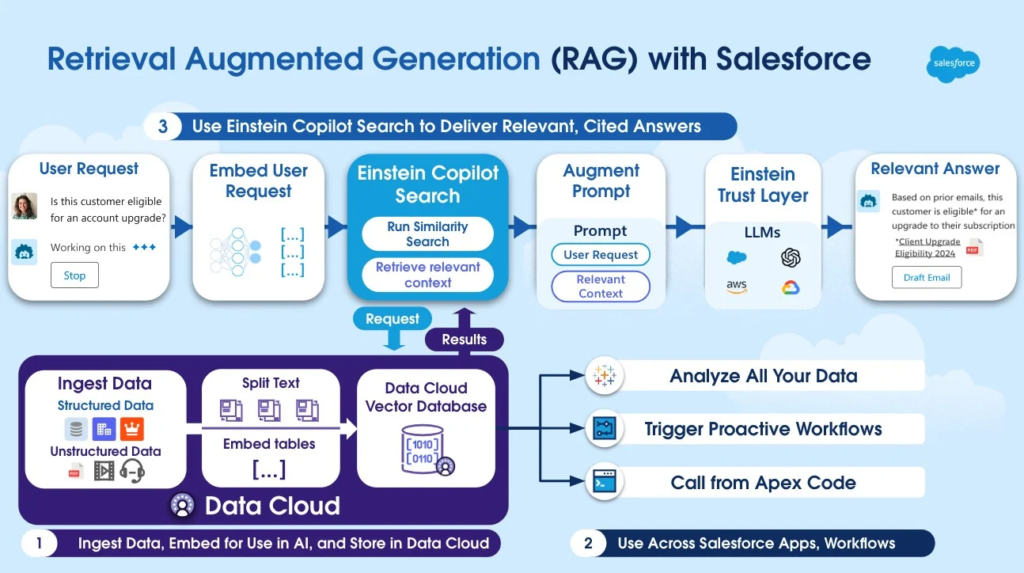
Salesforce Data Cloud is frequently misunderstood. It is not a replacement for your data warehouse, nor is it simply a storage layer for large datasets. Data Cloud is designed to unify customer data and activate it in real time.
Its value lies not in accumulation but in orchestration.
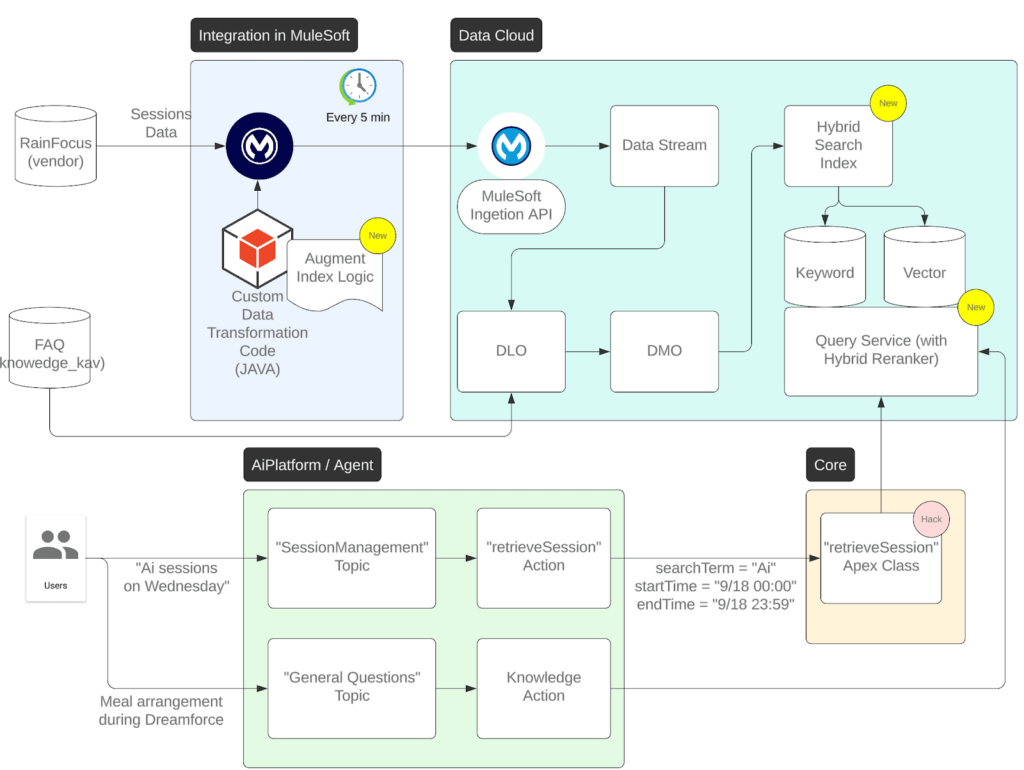
Data Cloud enables Salesforce AI to reason across multiple data sources as if they were one coherent system. This capability is essential for personalization, prediction, and autonomous action.
Preparing for a Successful Data Cloud Implementation
Readiness for Data Cloud requires strategic decisions well before ingestion begins.
Selecting the Right Data Sources
Not all data belongs in Data Cloud. High-value sources include CRM records, transactional systems, and engagement data that directly influences customer decisions. Low-value or poorly governed sources introduce noise and risk.
Organizations that ingest everything often struggle to activate anything.
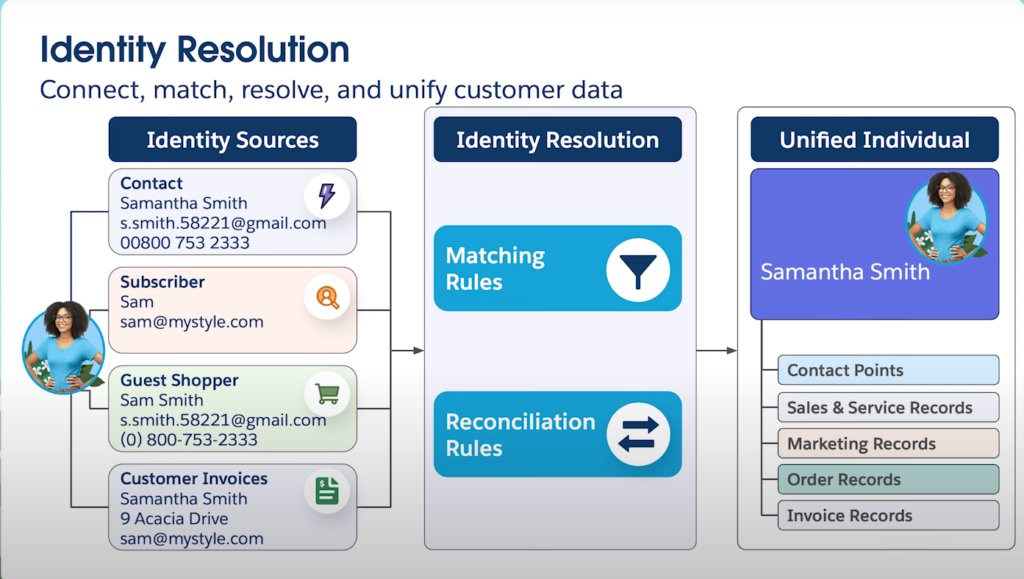
Designing Identity Resolution Carefully
Identity resolution is the backbone of Data Cloud. It determines how individual records are unified into a single customer profile. Poor identity logic results in fragmented or inaccurate profiles, which in turn mislead AI agents.
Clear rules must define which identifiers are authoritative and how conflicts are resolved. This is a business decision as much as a technical one.
Defining Activation Use Cases Early
Data Cloud should be designed backward from activation. Every dataset should support a specific AI-driven or automation-driven outcome. If a dataset cannot clearly support an action, it should be reconsidered.
Phase 3: Salesforce AI Model Readiness
Moving Beyond Feature Enablement
Salesforce AI models, particularly Einstein, operate best when they are contextualized. Enabling features without preparing training data and feedback loops often produces generic results that users quickly dismiss.
AI model readiness ensures that predictions and generative outputs align with how your organization actually operates.
Preparing Data for AI Training
AI models learn from historical outcomes. If those outcomes reflect inconsistent processes or biased decisions, AI will replicate those patterns. Before training, organizations should examine whether success and failure are clearly defined and consistently recorded.
This often requires revisiting how outcomes are tracked in Salesforce, such as opportunity stages, case resolutions, or customer satisfaction scores.
Establishing Human Feedback Loops
Salesforce AI performs best when humans remain part of the system. Feedback mechanisms allow users to validate, correct, or override AI decisions. This feedback is critical for continuous improvement and trust building.
Without feedback loops, AI stagnates. With them, it evolves.
Phase 4: Agentforce and Autonomous Workflow Readiness
Why Agentforce Changes Everything
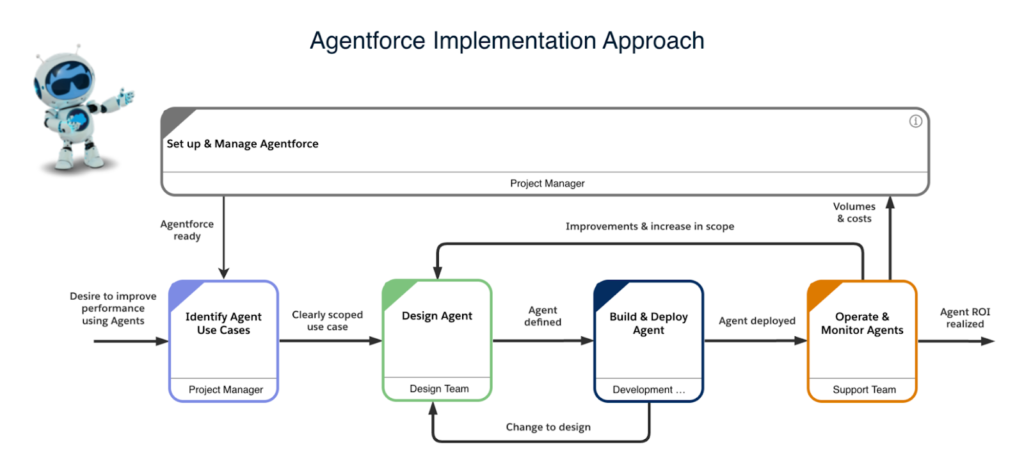
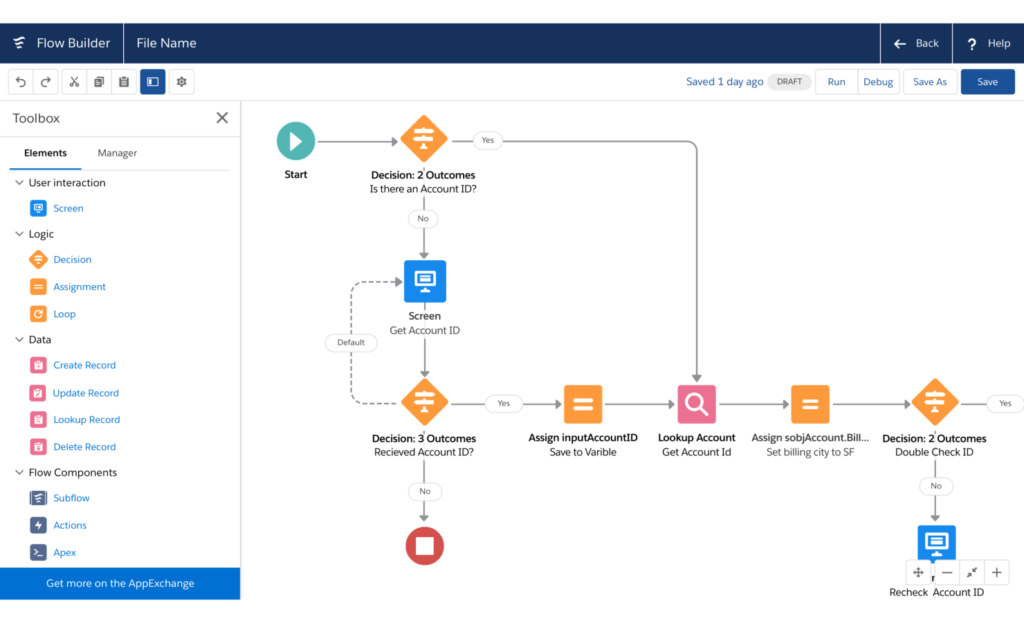
Agentforce represents a fundamental shift in how work happens inside Salesforce. Instead of static automation, organizations can deploy AI agents that operate continuously, responding to signals and executing tasks proactively.
This capability dramatically increases efficiency, but it also increases responsibility.
Defining Agent Boundaries
Before deploying Agentforce, organizations must define what agents are allowed to do independently and where human approval is required. These boundaries protect both the business and the users.
Agents should be treated like digital employees, with clearly defined roles, authority levels, and escalation paths.
Designing for Accountability and Transparency
Every agent action must be auditable. Logs should capture not only what action was taken but why it was taken. This transparency builds trust and supports compliance requirements.
Phase 5: Security, Compliance, and Trust in Salesforce AI
Why Governance Must Come First
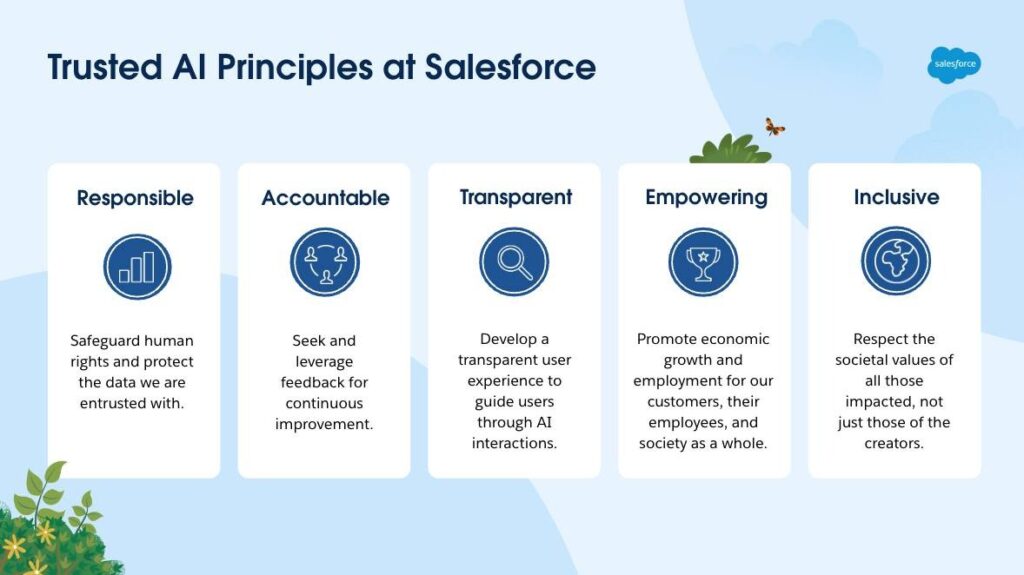
AI introduces new categories of risk. Automated decisions can affect revenue, customer relationships, and regulatory compliance. Without strong governance, these risks compound quickly.
Core Governance Pillars
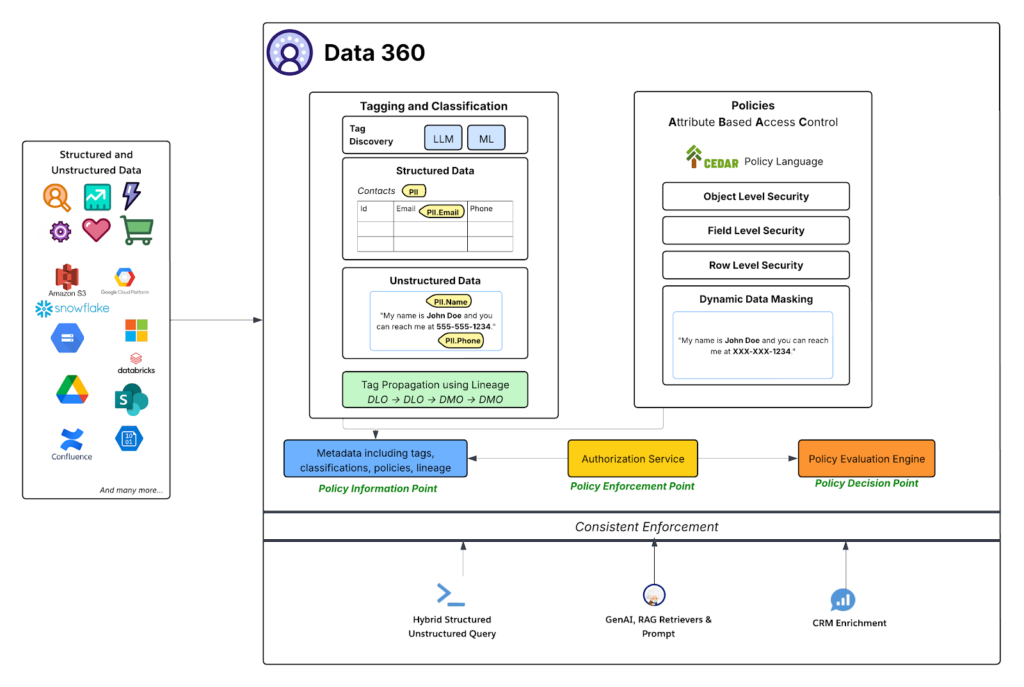
Effective Salesforce AI governance includes robust access controls, prompt governance, and regulatory alignment. Field-level security must be enforced consistently. AI prompts should be version-controlled and reviewed. Compliance requirements must be embedded directly into AI workflows.
Trust is not achieved by limiting AI. It is achieved by governing it well.
Phase 6: Operating Model and Change Management
Preparing People for AI Collaboration
Salesforce AI changes how people work. It does not eliminate human roles, but it reshapes them. Sales reps shift from data entry to relationship strategy. Service agents move from manual triage to exception handling.
Organizations must invest in training that explains not just how AI works, but how employees should work alongside it.
Clear communication about AI’s role reduces resistance and builds adoption.
The Salesforce AI Readiness Checklist (Expanded)
A Salesforce org is only truly AI-ready when all foundational dimensions work together as a single system. Salesforce AI does not operate in isolation. Each layer reinforces the next, and weakness in even one area will dilute the impact of everything built on top of it.
Below is a deep, implementation-level breakdown of the six dimensions that define real Salesforce AI readiness in 2026.
1. Clean, Consistent, and Governed Data
This is the non-negotiable foundation. Salesforce AI does not fix data problems. It amplifies them.
A data-ready Salesforce org demonstrates discipline across three layers: quality, consistency, and governance.
What “Clean” Actually Means in Practice
Clean data is not about perfection. It is about reliability at decision time.
A clean Salesforce dataset shows the following traits:
- Required fields reflect actual business requirements, not legacy assumptions
- Picklists are standardized and actively enforced
- Free-text fields are used intentionally, not as workarounds
- Duplicate records are proactively prevented, not just periodically merged
- Inactive, obsolete, or misleading records are archived or segmented
For AI, missing or ambiguous data is worse than no data at all. An incomplete opportunity record can distort forecasting models and agent decision logic.
Why Consistency Matters More Than Volume
Salesforce AI relies on patterns. Inconsistent usage breaks those patterns.
Consistency means:
- A single, agreed-upon definition for core objects like Account, Contact, Lead, and Opportunity
- Uniform stage definitions across regions and teams
- Predictable lifecycle transitions (for example, Lead → Opportunity → Closed)
- Clear ownership rules for records and updates
If one sales team uses “Closed Lost” as a holding stage and another uses it as a true loss, AI will misinterpret performance signals.
Governance as an Ongoing Discipline
Governance is what keeps data usable over time.
Strong Salesforce AI readiness includes:
- Named data owners for key objects and fields
- Change management processes for schema updates
- Regular data quality audits
- Clear policies for creating new fields, automations, and integrations
Without governance, data quality decays faster than AI models can adapt.
2. A Salesforce Data Cloud Architecture Designed for Activation
Salesforce Data Cloud readiness is not about ingestion. It is about what the data is meant to do.
AI-ready organizations design Data Cloud from the outside in, starting with activation use cases.
Activation-First Architecture
An activation-ready Data Cloud setup answers these questions clearly:
- What decisions will AI make using this data?
- What workflows will be triggered in real time?
- Which teams benefit directly from activation?
Every dataset ingested should map to a concrete outcome such as routing, prioritization, personalization, or prediction.
If a dataset cannot support an action, it should not be prioritized.
Intentional Data Source Selection
A mature Data Cloud architecture avoids “data hoarding.”
AI-ready orgs typically ingest:
- CRM data with high business signal
- Transactional systems that reflect customer behavior
- Engagement data tied to measurable outcomes
They deliberately avoid:
- Poorly governed legacy exports
- Redundant shadow systems
- Unstructured data without a defined activation path
More data does not improve Salesforce AI. Better data does.
Identity Resolution as a Strategic Decision
Identity resolution determines how Salesforce AI understands “who” the customer is.
Readiness requires:
- Clear definitions of primary and secondary identifiers
- Documented rules for resolving conflicts
- Business validation of unified profiles
If identity resolution is flawed, AI agents operate on distorted customer context, which leads to incorrect actions at scale.
3. AI Models Trained on Meaningful Outcomes
Salesforce AI is only as intelligent as the outcomes it learns from.
Many organizations enable Einstein features without ensuring their historical data actually reflects success and failure accurately.
Defining What “Good” Looks Like
AI-ready orgs have explicit definitions for outcomes such as:
- What qualifies as a successful deal
- What constitutes a resolved case
- What signals genuine customer engagement
- What behaviors precede churn or expansion
These definitions are reflected consistently in Salesforce fields and processes.
If success is subjective or inconsistently recorded, AI models cannot learn reliably.
Removing Noise From Training Data
Historical data often contains noise introduced by:
- Manual overrides
- Emergency process changes
- One-off deals
- Legacy automations
Readiness includes identifying and excluding data that no longer represents current operating reality. Training AI on outdated behavior creates misleading predictions.
Continuous Human Feedback Loops
High-performing Salesforce AI implementations always include feedback mechanisms.
These allow users to:
- Validate or reject AI recommendations
- Correct summaries or classifications
- Flag incorrect agent actions
This feedback is essential not only for model improvement but also for user trust. AI that cannot be challenged will never be trusted.
4. Autonomous Agents With Clearly Defined Boundaries
Agentforce introduces a new level of power and risk.
AI-ready organizations treat agents as digital operators, not background automations.
Clear Authority Levels
Every agent must have explicit permissions that define:
- What actions it can take independently
- What actions require human approval
- What actions are prohibited
For example, an agent may draft emails but require approval before sending, or update opportunity fields but not change contract terms.
Goal-Driven Design
Agents must operate against measurable goals, not vague instructions.
Effective goals are:
- Specific (what outcome is expected)
- Time-bound (when action should occur)
- Observable (how success is measured)
Without clear goals, agents either over-act or hesitate, both of which reduce value.
Auditability and Explainability
Every agent action must be traceable.
AI-ready orgs ensure:
- Full action logs are captured
- Decision context is stored
- Escalations are documented
This is critical for compliance, troubleshooting, and long-term trust in autonomous systems.
5. Strong Security, Compliance, and Trust Controls
Salesforce AI expands the surface area of risk. Readiness requires security to be proactive, not reactive.
Data Access and Least Privilege
AI systems must respect the same access controls as humans.
This includes:
- Field-level security enforcement
- Role-based access rules
- Context-aware permissions
AI should never expose information a user is not authorized to see.
Prompt and Model Governance
Generative AI introduces new governance challenges.
AI-ready orgs implement:
- Approved prompt libraries
- Version control for prompts
- Business and legal review cycles
Unchecked prompts can create compliance, brand, or legal risk.
Regulatory Alignment
AI must operate within regulatory boundaries from day one.
This includes:
- Consent management enforcement
- Regional data handling requirements
- Audit-ready reporting for AI actions
Trust is built when AI is visibly governed, not hidden behind complexity.
6. An Operating Model That Supports Adoption
Salesforce AI readiness ultimately succeeds or fails at the human level.
Role-Based Enablement
Different teams interact with AI differently.
AI-ready organizations provide:
- Sales-specific AI training
- Service-specific agent workflows
- Admin and architect governance education
Generic AI training leads to confusion and resistance.
Redefining Success Metrics
Traditional KPIs often fail to capture AI impact.
Readiness includes updating metrics to reflect:
- Time saved per task
- Decision quality improvements
- Reduction in manual work
- Adoption and trust indicators
If AI success is not measured, it will not be prioritized.
Cultural Alignment
Finally, leadership must set expectations clearly.
AI is not replacing judgment. It is augmenting it.
Organizations that frame Salesforce AI as a partner, not a threat, see far higher adoption and long-term value.
Why All Six Dimensions Must Work Together
Salesforce AI operates as a connected system.
- Clean data without adoption delivers no value
- Powerful agents without governance create risk
- Data Cloud without activation becomes shelfware
True Salesforce AI readiness exists only when all six dimensions reinforce one another.
This is why readiness is not a checklist you complete once. It is an operating discipline that enables Salesforce AI to scale safely, responsibly, and effectively.
When these foundations are in place, Salesforce AI stops being an experiment and starts becoming infrastructure.
Common Salesforce AI Readiness Pitfalls
Organizations frequently underestimate the importance of simplicity. Over-customization, excessive data ingestion, and poorly defined objectives slow AI adoption rather than accelerate it.
The most successful Salesforce AI implementations focus on clarity first, sophistication second.
Measuring Salesforce AI Success Over Time
AI readiness does not end at launch. Continuous measurement is essential.
Key indicators include adoption rates, override frequency, task completion times, and business outcomes. When these metrics stagnate, the solution is rarely “more AI.” It is better readiness.
The Road Ahead: Salesforce AI in 2026 and Beyond
Salesforce AI will continue to evolve toward deeper autonomy and industry-specific intelligence. Organizations that invest in readiness today will be positioned to adopt these advances with minimal disruption.
Those that delay will find themselves rebuilding foundations under pressure.
Final Perspective: Readiness Is the Real Competitive Advantage
Salesforce AI is powerful, but it is unforgiving. It rewards organizations that respect data fundamentals, design for trust, and align people with technology.
Readiness is not a delay. It is an accelerator.
When Salesforce AI is implemented on a strong foundation, it becomes a durable competitive advantage rather than a short-lived experiment.
Bring Salesforce AI From Potential to Performance
Salesforce AI is moving fast, but speed without structure creates risk.
At CloudVandana, we work with Salesforce orgs at different stages of AI maturity, from early Einstein adoption to advanced Data Cloud and agentic implementations. What separates the orgs that succeed from those that struggle is never ambition. It is preparation.
We help you move beyond experimentation and build a production-ready Salesforce AI foundation:
- Clean, governed data that AI can trust
- A Data Cloud architecture designed for real activation, not just ingestion
- AI models aligned to meaningful business outcomes
- Agentforce implementations with clear guardrails and accountability
- Security, compliance, and governance built in from day one
If you are planning Salesforce AI initiatives in 2026 and want them to deliver measurable impact, not just demos, now is the right time to focus on readiness.
Start with clarity. Build with confidence. Scale with control.
Talk to CloudVandana about making Salesforce AI work the way it was intended to.
Frequently Asked Questions (FAQs)
1. What does “Salesforce AI readiness” actually mean?
Salesforce AI readiness means your org has the data quality, architecture, governance, and operating model required for AI to deliver reliable outcomes. It goes beyond enabling Einstein features and focuses on whether AI can reason accurately, act safely, and earn user trust at scale.
2. Do we need Salesforce Data Cloud to use Salesforce AI effectively?
Not always, but for advanced use cases, yes. Salesforce Data Cloud becomes essential when AI needs real-time, unified customer context across systems. Without it, AI capabilities are limited to siloed CRM data and cannot fully support personalization, agentic workflows, or real-time decisioning.
3. Why do many Salesforce AI implementations fail after launch?
Most failures are not due to AI models. They happen because of poor data quality, inconsistent processes, unclear success definitions, and lack of governance. AI exposes weaknesses that already exist in the Salesforce org. Readiness addresses those issues before AI is deployed.
4. Is Agentforce suitable for all Salesforce orgs?
Agentforce is powerful, but it requires maturity. Orgs should deploy autonomous agents only after establishing clean data, clear business rules, and strong audit controls. Without those foundations, agents can create risk instead of value.
5. How long does it typically take to become Salesforce AI ready?
It depends on the current state of the org. Some organizations can achieve baseline readiness in a few months, while others require phased improvements over longer periods. The key is to prioritize high-impact readiness gaps first rather than attempting to fix everything at once.
6. How do we measure success after implementing Salesforce AI?
Success should be measured beyond feature usage. Strong indicators include adoption rates, reduced manual effort, improved decision quality, faster resolution times, and clear business outcomes such as pipeline efficiency or customer satisfaction improvements. If these metrics are not moving, readiness should be reassessed.
Picture Courtesy: Salesforce

Atul Gupta is CloudVandana’s founder and an 8X Salesforce Certified Professional who works with globally situated businesses to create Custom Salesforce Solutions.
Atul Gupta, a dynamic leader, directs CloudVandana’s Implementation Team, Analytics, and IT functions, ensuring seamless operations and innovative solutions.
YOU MIGHT ALSO LIKE
Salesforce Implementation Checklist for Growing Businesses
Salesforce Health Check Checklist: 15 Things Every Business Should Review Quarterly

Salesforce Consulting Services: When Should a Business Hire an Expert?
Salesforce Automation vs AI Agents: What Should Businesses Use First?
Data Cloud, Agentforce, and AI CRM: What Businesses Need to Prepare First