Beyond the Acronym
“CRM” is one of those business terms that feels universally understood. It rolls off the tongue in board meetings, vendor pitches, and annual strategy decks. Everyone nods. Everyone assumes alignment. But that assumed clarity is misleading. The term has been stretched thin by overuse, diluted by marketing slogans, and compressed into a simple line item on procurement checklists. In reality, Customer Relationship Management is not merely a software classification. It is an organizational philosophy translated into structured systems.
At its essence, CRM is about discipline. It is about ensuring that relationships are not left to memory, chance, or individual heroics. It formalizes how customer information is captured, how interactions are recorded, how opportunities are advanced, and how accountability is enforced. Technology is simply the vessel. The philosophy is the engine.
Salesforce as a CRM
When organizations say they are using Salesforce as a CRM, the interpretation can vary dramatically depending on maturity, governance, and strategic intent. In some environments, Salesforce is little more than a refined address book. Contacts are stored. Opportunities are logged. Reports are generated. Activity tracking exists, but only sporadically. Dashboards look impressive, yet they reflect inconsistent inputs. The system functions—but only at a superficial level.
In more evolved environments, Salesforce becomes something fundamentally different. It orchestrates the entire revenue lifecycle—from first marketing touchpoint to post-sale service engagement. It integrates sales processes with finance projections. It aligns marketing campaigns with pipeline velocity. It captures service insights that inform upsell strategy. It embeds analytics and AI into everyday workflows. It does not simply record the business. It shapes it.
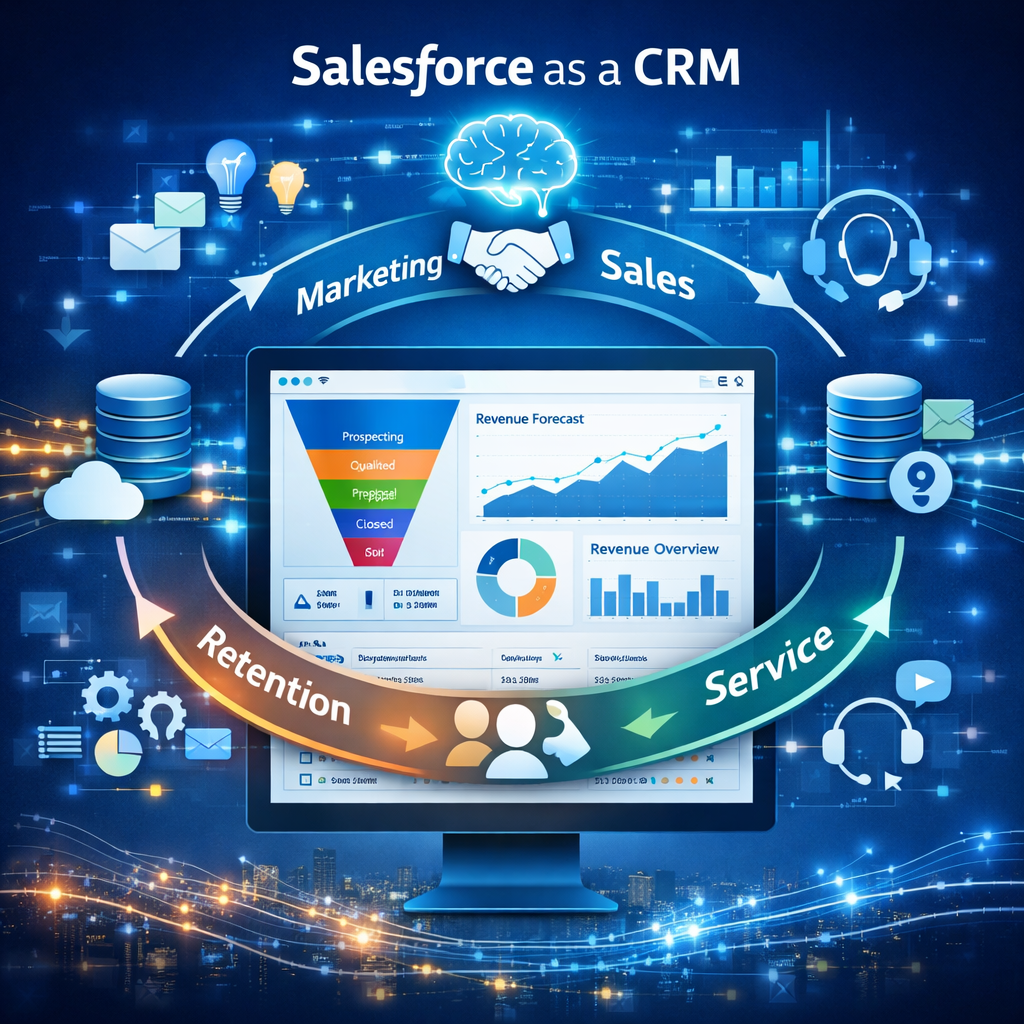
The difference between these two realities is rarely about feature availability. Salesforce, as a platform, possesses immense capability across both scenarios. The divergence lies in intentional design. It lies in whether leadership views CRM as infrastructure or as an administrative utility. It lies in whether processes are architected deliberately or allowed to evolve organically without oversight.
To use Salesforce as a CRM in its truest sense is to formalize relationship management at scale. It is a commitment to structured data capture, defined lifecycle stages, transparent forecasting, and cross-functional visibility. It means ensuring that institutional knowledge does not reside in private inboxes or individual recollection. Instead, it is embedded into the system, accessible within appropriate security boundaries, and continuously refined.
This shift—from casual usage to deliberate architecture—is subtle yet transformative. It moves CRM from passive storage to active orchestration. It transforms scattered interactions into coherent narratives. It converts customer data into institutional memory. And perhaps most importantly, it ensures that no interaction, no insight, and no opportunity is left to improvisation.
That is where real value begins.
Defining CRM in the Modern Enterprise
Customer Relationship Management, at its core, is about continuity. Not just communication. Not just storage. Continuity. It ensures that every interaction—whether a marketing touchpoint, a sales conversation, a service inquiry, or a renewal discussion—does not exist in isolation. Each engagement builds upon what came before it. Context accumulates. Insight compounds.
Without a structured CRM system, organizations default to fragmentation. Notes live in inboxes. Deal updates sit in spreadsheets. Critical details remain trapped in personal memory. This informal infrastructure may appear functional in early stages. It often works when teams are small and customer volumes are manageable. But scale exposes its fragility. Information gets lost. Accountability blurs. Customers repeat themselves. Internal alignment fractures.
Fragmented systems inevitably fail under pressure. Growth amplifies disorder.
In the modern enterprise, CRM must function in an environment defined by complexity. Digital noise is constant. Customers move fluidly across channels—email, live chat, phone calls, social media interactions, self-service portals, automated nurture sequences, community platforms. They expect continuity across all of them. They do not distinguish between departments. To them, the organization is singular.
Each interaction generates data. Each data point influences perception. A delayed response signals neglect. A repeated question signals disorganization. A personalized recommendation signals attentiveness. The CRM must capture these signals in real time and contextualize them meaningfully.
This is where traditional definitions of CRM fall short.
A contemporary CRM is not a static ledger of names and transactions. It is a living ecosystem. It aggregates structured and unstructured data. It enforces process discipline through defined workflows and validation logic. It surfaces insights through analytics and intelligent automation. It adapts as business models evolve.
Velocity matters. Insight must be produced at the speed of decision-making. Leaders cannot wait for quarterly reconciliations to understand pipeline health. Service managers cannot manually audit thousands of cases to identify escalation patterns. Sales teams cannot rely on intuition when predictive analytics can reveal buying signals.
Using Salesforce as a CRM means adopting a platform engineered to absorb this complexity without collapsing under it. It means centralizing omnichannel engagement into a single operational framework. It means structuring data in ways that make intelligence possible. It means transforming raw interaction into strategic advantage.
Most importantly, it represents a shift in posture.
Organizations move from reactive record-keeping—logging events after they occur—to proactive relationship design. They begin shaping customer journeys intentionally. They anticipate friction points. They align cross-functional processes around shared visibility.
CRM in the modern enterprise is not about managing contacts. It is about engineering continuity at scale.
The Evolution of Salesforce from Tool to Platform
When Salesforce first entered the market, its promise was straightforward and disruptive: move CRM to the cloud. At a time when enterprises relied heavily on on-premise infrastructure—costly servers, complex upgrades, and rigid deployment cycles—Salesforce offered accessibility, agility, and lower operational friction. Sales teams could log in from anywhere. Opportunities could be tracked in real time. Forecasts could be generated without waiting for IT intervention.
The early value proposition was clarity itself: eliminate hardware dependency and simplify sales automation.
But what began as a sales-centric solution did not remain confined to that domain. As customer expectations evolved and digital transformation accelerated, Salesforce expanded deliberately. Sales Cloud matured. Service Cloud introduced structured case management. Marketing Cloud enabled journey orchestration. Experience Cloud supported portals and partner ecosystems. Data Cloud unified disparate datasets. AI capabilities embedded intelligence directly into workflows.
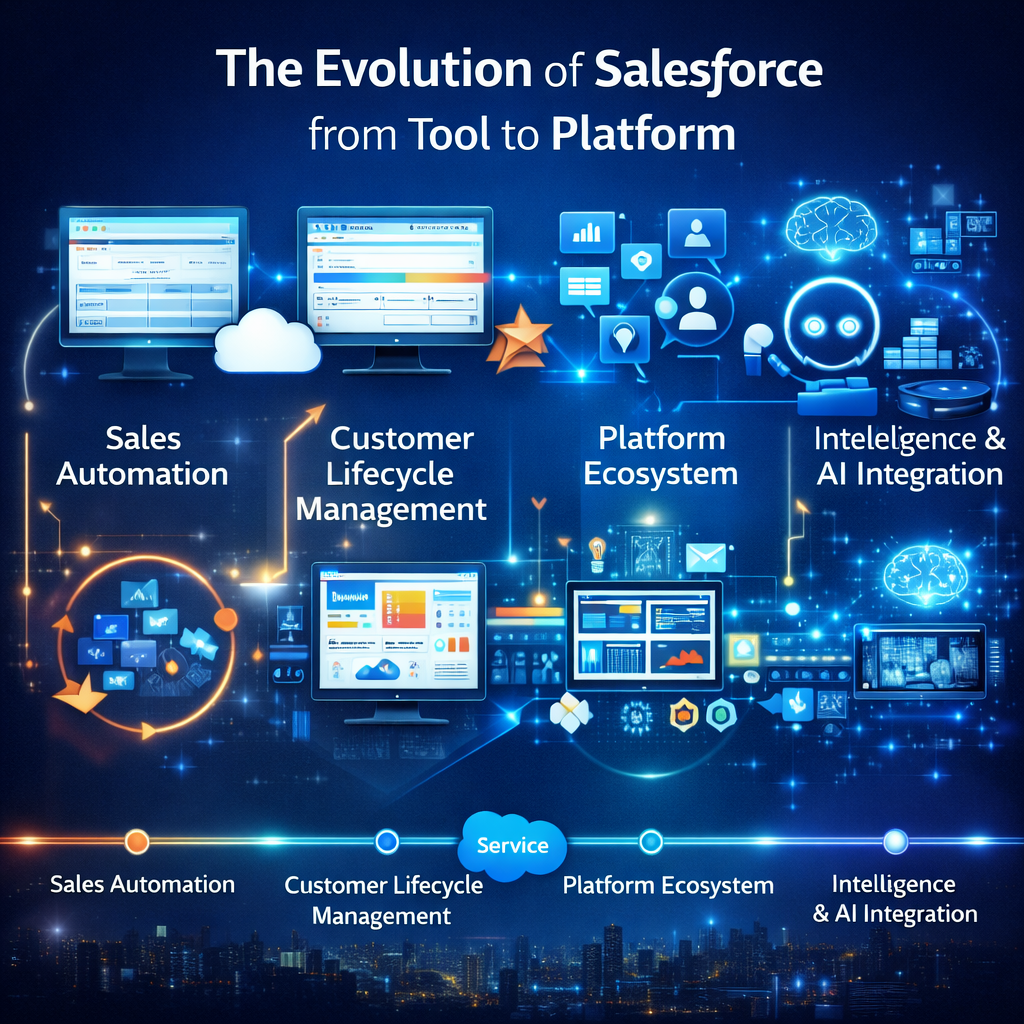
This expansion was not merely additive. It represented a structural redefinition.
Salesforce ceased being a departmental tool and became an enterprise platform. A tool supports a task. A platform supports an ecosystem. That distinction is profound. A tool can optimize pipeline tracking. A platform can synchronize marketing campaigns with sales execution, align service insights with renewal strategy, and provide executives with unified visibility across the entire customer lifecycle.
This transformation reflects a philosophical shift in how organizations approach CRM. Customer relationships no longer reside exclusively within sales. They span marketing automation, customer success programs, support operations, finance projections, and product feedback loops. A CRM confined to one department cannot sustain that breadth.
Salesforce’s evolution mirrors this reality. It now connects revenue generation, customer support, marketing orchestration, analytics, and AI-driven intelligence within a single architectural framework. Data flows across clouds. Automation triggers across departments. Insights surface at every stage of the lifecycle.
However, the platform’s depth is only valuable if it is recognized.
Organizations that treat Salesforce narrowly—restricting it to opportunity management and quarterly forecasting—leave considerable strategic value dormant. They may benefit from improved visibility within sales, but they fail to unify the broader customer ecosystem. Silos persist. Data remains fragmented. Intelligence becomes partial rather than holistic.
To truly use Salesforce as a CRM means acknowledging its breadth and structural capacity. It requires viewing the platform not as an isolated application but as a foundational layer within the enterprise’s digital architecture. It becomes the connective tissue between systems. The operational nucleus. The institutional memory that binds departments together.
In this context, Salesforce is not simply software installed for a team. It is infrastructure designed to support the entire customer journey. The transition from tool to platform is not just technical—it is conceptual. And organizations that internalize that shift unlock exponentially greater value.
Salesforce as a System of Record
At its most foundational level, Salesforce functions as a centralized repository for customer data. Accounts, contacts, leads, opportunities, cases, contracts, activities, assets—each element is structured within a defined schema. Relationships between objects are intentional. Fields are categorized. Histories are preserved. Nothing floats unanchored.
This centralization produces something deceptively simple yet strategically invaluable: a single source of truth.
Without a unified system of record, organizations operate in fragments. Sales maintains its own pipeline spreadsheet. Marketing exports campaign data into isolated reports. Service teams track issues in separate tools. Finance relies on reconciled figures that rarely match frontline projections. Each function sees only part of the picture.
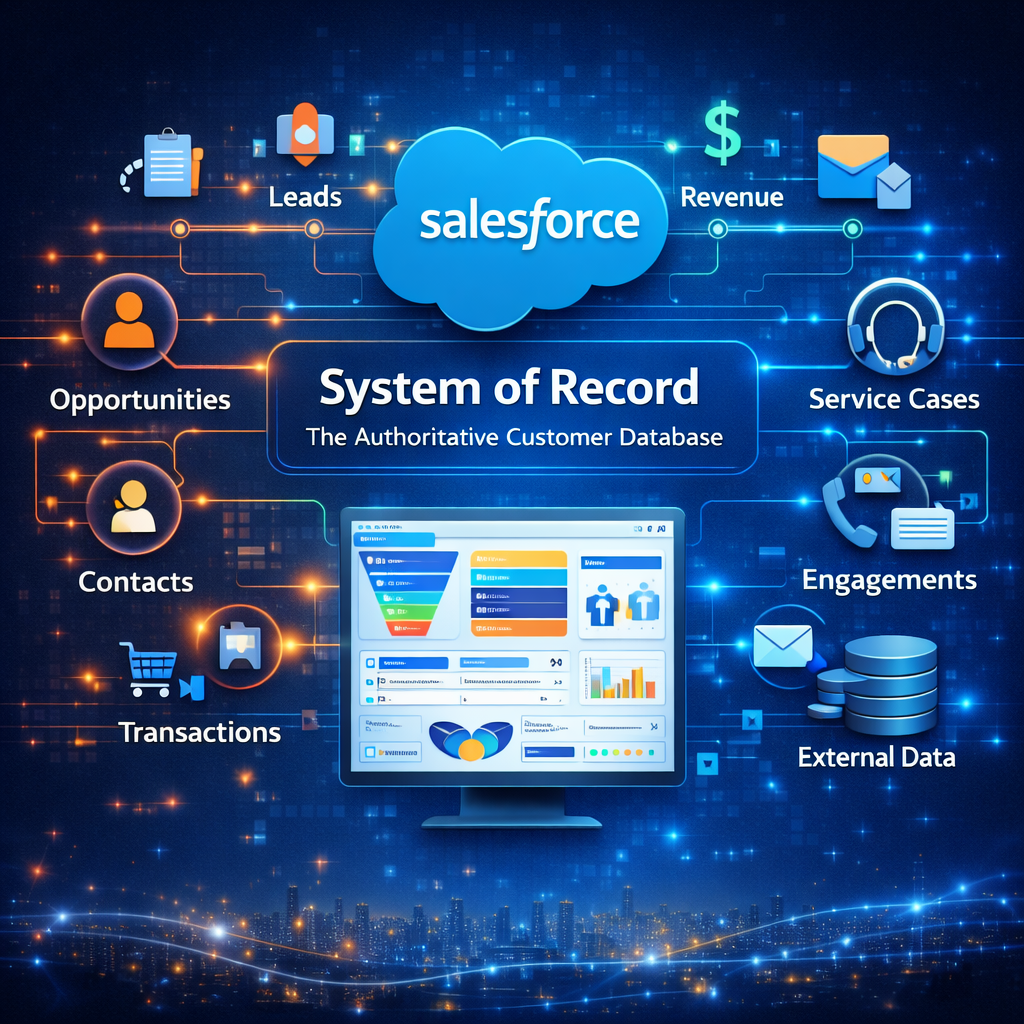
When information is dispersed across disparate systems, inconsistency is not a possibility—it is a certainty. Sales forecasts diverge from finance projections because definitions differ. Service teams lack visibility into active opportunities, leading to tone-deaf customer interactions. Leadership decisions are based on stitched-together summaries rather than coherent, real-time data integrity.
Fragmentation breeds doubt. Doubt erodes trust. Trust, once compromised, is difficult to restore.
A properly implemented Salesforce CRM eliminates much of this ambiguity. It establishes authoritative records. Each customer interaction is time-stamped. Each status change is logged. Each data modification leaves a traceable footprint. Visibility is governed by role hierarchies and security models, ensuring that access is intentional rather than accidental.
This structured transparency strengthens operational confidence. Teams no longer argue about whose numbers are correct. Definitions become standardized. Reports align with reality because they are derived from a common dataset. Decision-making shifts from subjective interpretation to evidence-based evaluation.
Clarity changes behavior.
When stakeholders trust the system, they rely on it. When they rely on it, adoption deepens. When adoption deepens, the system becomes self-reinforcing. Data quality improves because users recognize its importance. Accountability increases because ownership is visible. Performance conversations become constructive rather than defensive.
Yet a system of record does not sustain itself automatically.
Centralization alone is insufficient. Without governance, even the most carefully structured environment can decay. Duplicate records accumulate. Fields proliferate without purpose. Inconsistent naming conventions reappear. Automation overlaps. Permissions expand unchecked. Over time, entropy seeps in.
Structure is not a one-time configuration. It is an ongoing discipline.
Data must be audited. Validation rules must evolve. Archiving strategies must be defined. Field usage must be reviewed. Governance committees must periodically assess relevance and redundancy. The system of record must be curated with vigilance.
When stewarded properly, Salesforce as a system of record becomes institutional memory. It outlives personnel changes. It transcends individual recollection. It preserves historical insight in a structured, searchable, analyzable form.
And in an enterprise where continuity determines competitive advantage, that institutional memory is not merely operational—it is strategic.
Salesforce as a System of Engagement
CRM cannot remain passive. It must facilitate action. Salesforce enables engagement through activity tracking, task management, email integrations, calendar synchronization, and collaboration features.
Every interaction becomes contextualized. Sales representatives can see service histories. Support agents can reference open opportunities. Marketing teams can observe engagement patterns.
This interconnected visibility transforms isolated transactions into coherent narratives. Customer conversations no longer restart from zero. Context persists.
Using Salesforce as a CRM therefore extends beyond data storage. It orchestrates engagement continuity. It ensures that relationships evolve coherently across teams.
Salesforce as a System of Intelligence
The modern CRM must not only record and engage. It must analyze. Salesforce incorporates advanced analytics, forecasting models, and AI-driven recommendations.
Predictive lead scoring identifies high-value prospects. Opportunity insights highlight stalled deals. Forecasting adjustments account for historical patterns and behavioral signals.
This intelligence layer shifts CRM from retrospective reporting to anticipatory guidance. Leaders no longer simply review what happened. They anticipate what is likely to happen.
Using Salesforce as a CRM means embedding intelligence into everyday workflows. It transforms CRM from a mirror of past performance into a compass for future action.
Core CRM Capabilities Within Salesforce
Lead and Opportunity Management
Salesforce structures the revenue pipeline through defined stages, qualification criteria, and probability metrics. Leads convert into opportunities within standardized pathways. Each stage carries implications for forecasting and prioritization.
This structure enforces discipline. Without it, pipelines become subjective. Forecasts fluctuate based on optimism rather than evidence.
When Salesforce is fully leveraged, opportunity management becomes an analytical process. Patterns emerge. Conversion rates stabilize. Revenue predictability improves.
Account and Contact Structuring
Complex B2B ecosystems require hierarchical account modeling. Salesforce accommodates parent-child relationships, multi-location structures, and partner associations.
This granularity matters in enterprise sales cycles. Understanding decision-making hierarchies reduces misalignment. Account intelligence becomes strategic rather than superficial.
Case and Service Management
Customer support is inseparable from relationship management. Salesforce’s service capabilities enable structured case routing, SLA monitoring, knowledge base integration, and escalation pathways.
Service interactions influence retention. Retention influences lifetime value. CRM must therefore integrate service metrics into broader performance analysis.
Reporting and Forecasting
Dynamic dashboards and real-time analytics provide executive visibility. Reports can segment data by geography, product line, industry, or performance metrics.
Visibility eliminates conjecture. It replaces assumption with evidence.
The Architecture That Makes It Scalable
Salesforce operates on a multi-tenant cloud architecture, a model that fundamentally reshaped how enterprise software is delivered and maintained. In this structure, multiple customers share a common infrastructure while their data remains securely isolated. The practical outcome is significant: continuous innovation without operational disruption.
Organizations are no longer burdened by traditional software upgrade cycles. There are no weekend-long migrations. No costly hardware refreshes. No version fragmentation across departments. Updates are delivered seamlessly, security enhancements are applied centrally, and performance improvements are distributed across the ecosystem in real time.
This architectural foundation provides several strategic advantages:
- Automatic Updates: New features, security patches, and performance enhancements are deployed without manual intervention.
- Infrastructure Abstraction: Organizations do not manage servers, storage arrays, or system maintenance.
- Built-In Security Frameworks: Enterprise-grade compliance standards are embedded at the platform level.
- Global Accessibility: Cloud delivery ensures consistent access across geographies and devices.
- Elastic Resource Allocation: Infrastructure scales dynamically based on usage demands.
Scalability, in growth-oriented environments, is not optional. It is existential. As user counts expand, as customer interactions multiply, and as data volumes grow exponentially, CRM systems must remain stable and responsive. Performance degradation during expansion is unacceptable. Reliability must be constant.
Salesforce’s architecture supports elasticity without sacrificing stability. Whether an organization is onboarding dozens of users or thousands, the underlying infrastructure adapts. Data storage expands. Processing power adjusts. Availability remains uninterrupted.
However, architectural strength alone does not guarantee performance.
Scalability is not solely an infrastructure concern. It is also a design concern.
Internal configuration decisions significantly influence system health. Consider the following risk factors:
- Inefficient Automation: Overlapping flows, recursive triggers, and redundant process builders can slow transaction execution.
- Excessive Customizations: Unnecessary custom objects and fields create complexity that burdens maintenance and reporting.
- Poorly Structured Data Models: Weak object relationships compromise query efficiency and reporting accuracy.
- Unmanaged Integrations: High-frequency API calls without optimization can strain processing limits.
- Lack of Governance: Permission sprawl and unreviewed changes gradually introduce instability.
When internal architecture is misaligned, even the most robust cloud foundation cannot fully compensate. Performance bottlenecks emerge. Reporting slows. User frustration increases.
Architectural potential must be matched with thoughtful configuration. Growth demands foresight. Automation should be streamlined, not layered chaotically. Customization should solve structural problems, not introduce ornamental complexity. Data models should reflect long-term scalability, not short-term convenience.
In essence, Salesforce provides the structural elasticity. Organizations must provide the architectural discipline.
When both align—platform scalability and intentional design—the CRM becomes capable of sustaining expansion without erosion. Stability endures. Performance remains consistent. And growth, rather than straining the system, is supported by it.
Customization vs Configuration: Designing With Intent
Salesforce offers immense flexibility. Fields, objects, workflows, page layouts, and validation rules can be configured without code. Apex and custom development extend this adaptability further.
Yet flexibility introduces risk. Over-customization fragments environments. Technical debt accumulates. Maintenance complexity rises.
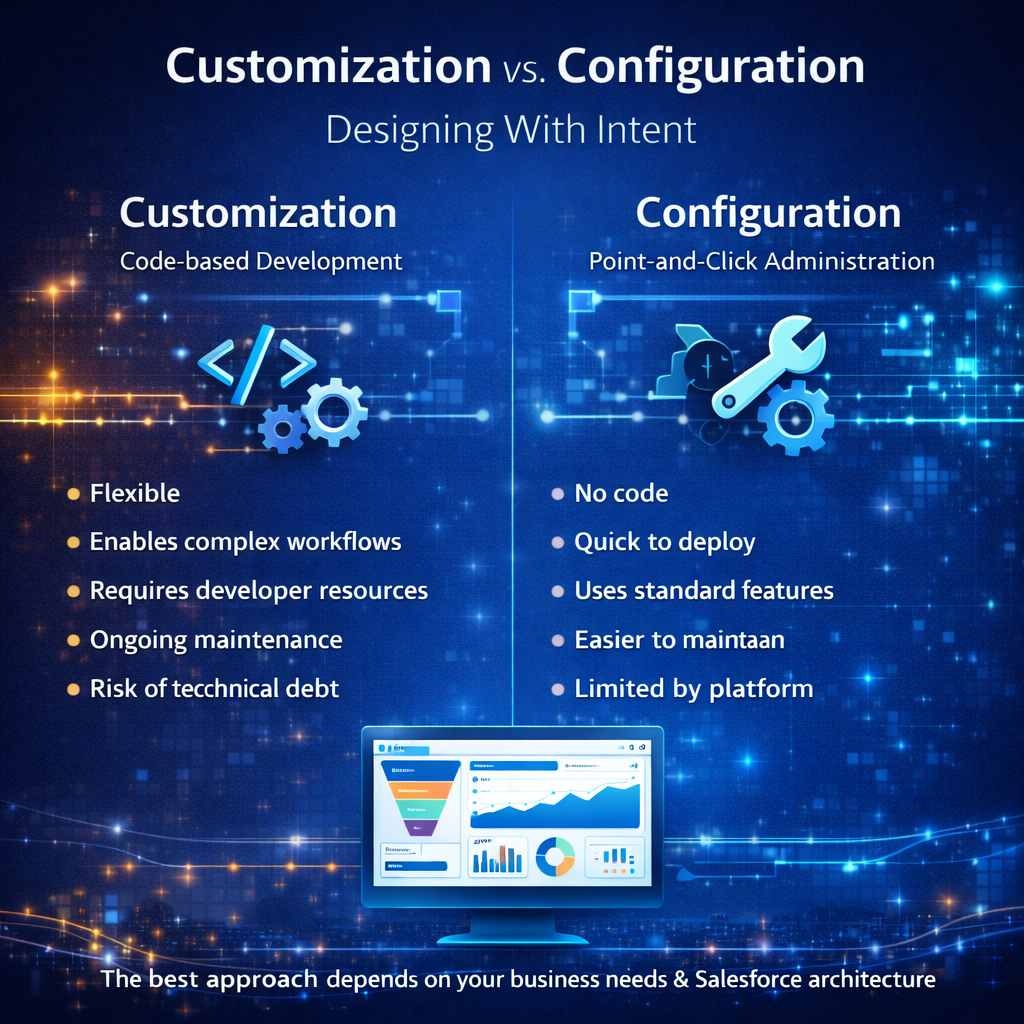
Using Salesforce as a CRM requires restraint. Customization should solve structural problems, not aesthetic preferences. Configuration should align with clearly mapped business processes.
Intentional design preserves longevity.
📊 Comparison Matrix: Configuration vs Customization in Salesforce
| Dimension | Configuration (Declarative) | Customization (Programmatic) |
| Definition | Using built-in tools without code | Extending functionality using code (Apex, LWC, APIs) |
| Technical Skill Required | Admin-level | Developer-level |
| Deployment Complexity | Low | Medium to High |
| Upgrade Compatibility | Automatically supported | Must be tested with each release |
| Maintenance Effort | Minimal | Ongoing and structured |
| Scalability Risk | Low when governed | High if poorly architected |
| Speed of Implementation | Fast | Slower due to design & testing |
| Best For | Standard workflows, validation, automation | Complex logic, integrations, advanced UI |
| Risk of Technical Debt | Moderate (if unmanaged sprawl) | High (if undocumented or overused) |
| Long-Term Stability | Strong | Strong only with disciplined governance |
Data as the Lifeblood of Salesforce CRM
In any CRM environment, data is not a byproduct. It is the core asset. Within Salesforce, every forecast, automation, dashboard, and AI-driven recommendation depends on the integrity of underlying records. If the data is compromised, the conclusions derived from it are equally compromised.
Data quality determines CRM credibility.
Duplicate records distort pipeline metrics and inflate account counts. Incomplete fields undermine forecasting accuracy because probability models rely on structured inputs. Inconsistent naming conventions fragment reporting, making segmentation unreliable. Even minor inconsistencies—such as mismatched industry values or inconsistent opportunity stages—can cascade into analytical distortion.
Over time, users begin to question the numbers. Once trust erodes, adoption declines. When adoption declines, data quality deteriorates further. The cycle compounds.
This is why disciplined data governance is not optional. It is structural.
A robust governance framework should include:
- Validation Rules: Enforcing mandatory fields, standardized formats, and logical dependencies at the point of entry.
- Deduplication Controls: Automated matching rules and merge protocols to prevent record proliferation.
- Data Stewardship Roles: Clearly defined ownership for monitoring data accuracy and resolving inconsistencies.
- Field Usage Audits: Periodic review of unused or redundant fields to reduce clutter.
- Standardized Taxonomies: Controlled picklists and naming conventions to maintain reporting consistency.
- Archival Policies: Structured handling of inactive or obsolete records to maintain system performance.
Governance introduces discipline into data creation and maintenance. It transforms CRM from an open-input repository into a curated environment.
Clean data is not an administrative detail relegated to back-office oversight. It is the substrate upon which analytics and AI operate. Predictive scoring models require historical accuracy. Revenue forecasting depends on stage consistency. Automated workflows rely on precise field triggers. AI-generated insights draw from structured behavioral patterns.
If the input is flawed, the output is deceptive.
Without reliable data, intelligence becomes illusion. Dashboards may appear sophisticated, but they reflect compromised assumptions. AI recommendations may seem advanced, but they are anchored to unstable foundations.
High-performing Salesforce environments treat data hygiene as strategic infrastructure. They invest in data audits. They implement governance committees. They enforce disciplined change management when new fields or processes are introduced.
Because in a CRM system, data is not just stored. It is interpreted. And interpretation without integrity is risk disguised as insight.
Governance: The Invisible Force Behind Stability
Governance frameworks regulate access controls, automation boundaries, and reporting standards. Without governance, Salesforce environments drift toward chaos.
Profiles multiply. Permission sets overlap. Automation collides.
Strong governance restores coherence. It defines review cycles, documentation standards, and change management protocols. Governance transforms CRM from a living experiment into a controlled ecosystem.
Automation and Workflow Orchestration
Automation tools streamline repetitive tasks—lead assignments, approval processes, alerts, and data updates. Efficiency improves.
Yet automation without orchestration creates fragmentation. Each workflow must align with strategic objectives. Redundant automation should be consolidated. Overlapping triggers must be eliminated.
Automation should simplify complexity, not amplify it.
AI and the Expanding Role of CRM
AI capabilities extend CRM into new dimensions. Predictive insights surface risks. Automated recommendations prioritize actions. Intelligent agents support routine tasks.
AI amplifies structured systems. It cannot compensate for disorganization. Therefore, AI readiness depends on governance, clean data, and well-defined processes.
Using Salesforce as a CRM in the AI era means preparing infrastructure to support autonomous decision support responsibly.
Integration: CRM as the Digital Nerve Center
Salesforce does not operate in isolation. It integrates with ERP systems, marketing automation platforms, customer support tools, finance applications, data warehouses, and external databases. Through APIs, middleware, and native connectors, information can move bidirectionally—updating records in real time or synchronizing in structured intervals.
This integration capability is not merely technical convenience. It is operational leverage.
When systems remain disconnected, duplication becomes inevitable. Sales updates revenue projections in CRM. Finance recalculates in ERP. Marketing maintains separate engagement metrics. Each department works diligently, yet alignment drifts because data does not reconcile automatically.
Integration reduces that friction.
It ensures that customer information, order details, campaign performance, and service interactions remain synchronized. A closed deal in Salesforce can trigger invoicing in ERP. A support escalation can notify account managers. Marketing engagement scores can inform pipeline prioritization.
When Salesforce becomes the digital nerve center, organizational silos begin to dissolve. Information flows fluidly rather than episodically. Decision-making accelerates because data is unified rather than reconciled. Strategic alignment strengthens—not through meetings, but through shared visibility embedded directly into systems.
In this state, CRM is no longer a departmental application. It becomes connective infrastructure.
User Adoption: The Human Variable
Technology adoption determines ROI. Complex interfaces or misaligned workflows discourage engagement.
User-centric design matters. Training programs matter. Feedback loops matter.
Adoption is not achieved through mandate. It is achieved through relevance. Salesforce must reflect how teams actually work, not how leadership imagines they work.
Security, Compliance, and Trust
Security frameworks within Salesforce include role hierarchies, field-level security, audit trails, and encryption options.
Regulatory environments demand compliance. Data privacy laws require strict controls. Trust depends on disciplined access management.
CRM cannot function without trust. Security is therefore foundational.
Common Misconceptions About Using Salesforce as a CRM
Implementation does not equal optimization. Automation does not equal efficiency. Dashboard complexity does not equal insight.
Misconceptions create false confidence. True CRM maturity requires continuous evaluation and refinement.
Implementation Realities: Strategy Over Software
Successful implementation begins with discovery. Business processes are mapped. Stakeholders align objectives. Data migration strategies are defined.
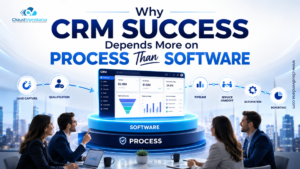
Technology configuration follows strategy. Without strategic clarity, even powerful platforms produce mediocrity.
Measuring CRM Success Beyond Vanity Metrics
Success metrics should reflect outcomes: reduced sales cycles, improved conversion rates, enhanced retention, increased revenue predictability.
Login counts and report volume are superficial metrics. Strategic metrics measure transformation.
The Cost of Underutilization
Many organizations deploy Salesforce yet use a fraction of its capabilities. This underutilization represents lost opportunity.
Inefficiencies persist. Insights remain hidden. Competitive advantages remain unrealized.
Full utilization requires deliberate stewardship.
When Salesforce Is Used Superficially
Superficial usage confines Salesforce to data entry and reporting. Strategic integration is absent.
This limited usage produces stagnation. CRM becomes administrative overhead rather than strategic infrastructure.
What Mature Salesforce CRM Usage Looks Like
Mature environments exhibit disciplined governance, integrated automation, robust analytics, and proactive AI utilization.
Processes evolve through feedback. Documentation remains current. Leadership trusts the data.
Maturity is characterized by intentional evolution.
Building a CRM Operating Model
An operating model defines ownership, review cycles, governance committees, and strategic roadmaps.
CRM becomes institutionalized. It adapts without destabilizing. It evolves without fragmentation.
Future-Proofing Salesforce as a CRM
Technological landscapes shift rapidly. AI augmentation, real-time analytics, hyper-personalization.
Future-proofing requires agility. Salesforce’s ecosystem enables expansion when guided by foresight and discipline.
Conclusion: From Software to Strategic Asset
Using Salesforce as a CRM is not a checkbox exercise. It is a structural commitment to disciplined growth, governed data, intelligent execution, and strategic clarity.
Organizations that approach Salesforce intentionally unlock compounding value. Those that treat it superficially remain constrained by their own underutilization.
The distinction lies in design.
For organizations seeking to transform Salesforce into a high-performance CRM engine—aligned with governance, AI readiness, integration strategy, and operational excellence—expert guidance accelerates progress. Strategic implementation converts potential into measurable impact.
Ready to Turn Salesforce into a High-Performance CRM Engine?
Using Salesforce as a CRM is not about activating features. It is about architecting a system that scales with your growth, enforces governance, enables AI readiness, and aligns teams around a single operational truth. That level of precision does not happen accidentally.
At CloudVandana, we help organizations transform Salesforce from a functional tool into a strategic operating system. From CRM architecture design and implementation to data governance, automation optimization, AI readiness, and large-scale integrations, our team has supported hundreds of organizations globally in building structured, scalable, and intelligent Salesforce environments.
If your CRM feels underutilized, overcomplicated, or misaligned with your growth strategy, this is the moment to recalibrate. Let’s design a Salesforce ecosystem that works the way your business actually operates—secure, scalable, and built for the future.
Connect with CloudVandana today and turn potential into performance.
Frequently Asked Questions (FAQs)
1. What does it really mean to use Salesforce as a CRM?
It means leveraging Salesforce to manage the entire customer lifecycle—sales, service, marketing, analytics, and automation—within a unified, governed system rather than using it only for contact storage.
2. Is Salesforce only suitable for large enterprises?
No. Salesforce supports businesses of all sizes. The key is configuring the platform appropriately to match operational complexity and growth plans.
3. How long does a Salesforce CRM implementation typically take?
Implementation timelines vary depending on scope, integrations, data migration complexity, and customization needs. Smaller deployments may take weeks, while enterprise rollouts can span several months.
4. What is the biggest mistake companies make with Salesforce?
Treating it as a simple database instead of designing it as a structured operating model aligned with business processes.
5. How important is data governance in Salesforce?
Critical. Without disciplined governance, data quality deteriorates, reporting becomes unreliable, and automation or AI initiatives fail to deliver accurate outcomes.
6. Can Salesforce integrate with existing ERP or marketing systems?
Yes. Salesforce offers robust API capabilities and integration frameworks that allow seamless synchronization with ERP systems, marketing platforms, and external databases.
7. Does Salesforce require coding to function effectively?
Many capabilities are configurable without code. However, complex business requirements may benefit from custom development.
8. What role does AI play in Salesforce CRM?
AI enhances forecasting accuracy, lead prioritization, customer insights, automation, and decision support when built on clean, structured data.
9. How can we measure the success of our Salesforce CRM?
Success is measured by improved forecast accuracy, reduced sales cycles, increased customer retention, higher data integrity, and stronger cross-functional alignment.
10. Why do some Salesforce CRM projects fail?
Common causes include lack of strategic planning, insufficient stakeholder alignment, poor data quality, weak governance, and low user adoption.
11. How often should Salesforce CRM architecture be reviewed?
A structured review should occur at least annually, with ongoing monitoring of automation performance, data health, and governance policies.
12. How can CloudVandana help optimize an existing Salesforce CRM?
CloudVandana provides CRM audits, architecture redesign, automation refinement, data governance implementation, AI readiness preparation, integration strategy, and end-to-end Salesforce consulting to ensure long-term scalability and performance.

Atul Gupta is CloudVandana’s founder and an 8X Salesforce Certified Professional who works with globally situated businesses to create Custom Salesforce Solutions.
Atul Gupta, a dynamic leader, directs CloudVandana’s Implementation Team, Analytics, and IT functions, ensuring seamless operations and innovative solutions.
YOU MIGHT ALSO LIKE
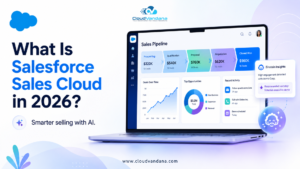
Sales Cloud in 2026: From Pipeline Tracking to Smarter Selling
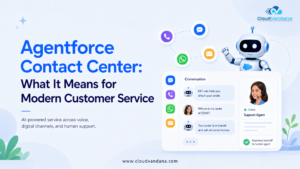
Agentforce Contact Center: What It Means for Modern Customer Service
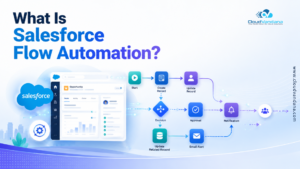
Salesforce Flow Automation: 10 Business Processes You Should Automate
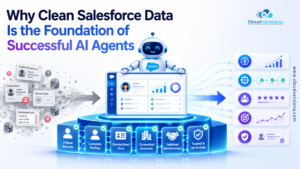
Why Clean Salesforce Data Is the Foundation of Successful AI Agents
The Rise of Agentic Workflows: What Businesses Need to Know in 2026