Automation has been part of enterprise systems for decades. Yet most organizations still experience a frustrating paradox: despite years of workflow automation, execution remains slow, brittle, and deeply dependent on human intervention. Tasks queue up. Exceptions pile higher. Dashboards look impressive, but outcomes lag behind intent.
Salesforce’s introduction of Agentforce has reopened a long-standing question in enterprise technology: are we automating tasks, or are we enabling systems to act?
This distinction is not semantic. It is architectural, operational, and strategic.
To understand the real difference between Agentforce and traditional automation, it is necessary to look beyond features and examine how work actually moves through modern CRM environments.
The Evolution of Automation in Enterprise Systems
Automation did not begin with artificial intelligence. It began with necessity.
Early enterprise systems were designed to reduce clerical burden. They automated arithmetic, standardized record creation, enforced basic validations, and ensured that repetitive tasks were executed consistently. These systems were transactional by nature. They followed strict instructions and operated within clearly defined boundaries. If a condition was met, an action occurred. If it was not, the system simply waited.
As organizations grew more complex, automation evolved alongside them. Rule engines emerged to handle conditional logic. Workflow builders introduced branching paths and approvals. Integration tools connected systems so data could move faster across departments. Together, these advancements reduced manual effort and improved operational efficiency at scale.
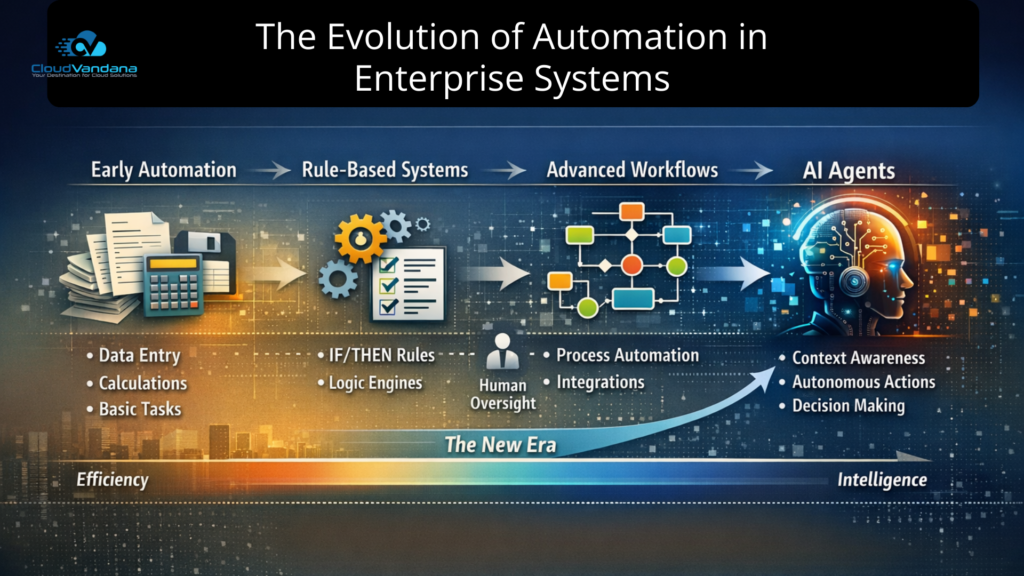
But despite their sophistication, traditional automation systems shared a fundamental limitation: they required humans to think for them.
Rules had to be anticipated in advance. Exceptions had to be manually defined. Decisions still relied on users to interpret context, assess risk, and determine the next best action. When conditions changed or edge cases appeared, workflows stalled. Automation could execute, but it could not reason.
In practice, this meant that automation optimized processes without transforming them. Work still flowed in a linear, reactive manner. Systems waited for inputs. Humans remained the orchestration layer, stepping in whenever ambiguity arose.
Efficiency improved. Execution, however, remained human-dependent.
Agentforce represents a different inflection point. It is not an extension of rules-based automation, but a departure from it. Instead of waiting for predefined triggers, Agentforce introduces autonomous agents that can observe context, evaluate intent, and take action dynamically. The shift is subtle in appearance, but profound in impact. Automation is no longer limited to doing what it is told. It begins to understand why work needs to happen, and how best to move it forward.
This is the point where automation stops assisting execution and starts participating in it.
What Traditional Automation Really Is
Traditional automation is best described as instruction-following execution.
A condition occurs.
A rule is evaluated.
A predefined action fires.
This deterministic model has powered enterprise systems for decades, particularly within Salesforce. Workflow Rules, Process Builder, Flow, scheduled jobs, and time-based automations all follow this same foundational logic. They are precise, predictable, and reliable. When the world behaves as expected, they perform exceptionally well.
The strength of traditional automation lies in its clarity. Every outcome is known in advance. Every path is intentionally designed. Compliance teams trust it. Architects can diagram it. Admins can debug it. In stable environments with well-defined processes, this model delivers consistency at scale.
But this precision comes at a cost.
Traditional automation has no awareness beyond the rules it is given. It cannot interpret nuance, adapt to shifting priorities, or reason through ambiguity. If a scenario was not explicitly anticipated during design, the automation does nothing. If conditions overlap, conflict, or evolve, the system does not resolve them. It waits.
As organizations scale, this limitation becomes visible. Exception handling explodes. Flow logic becomes dense and fragile. Small changes require re-engineering entire chains of automation. What began as efficiency tooling gradually turns into operational overhead.
Traditional automation executes instructions flawlessly.
It does not understand intent.
It does not decide what matters most next.
They work well.
Until the environment becomes dynamic, contextual, and unpredictable.
Rule-Based Logic as the Core Constraint
At the heart of traditional automation lies deterministic logic. Every outcome must be anticipated in advance. Every exception must be explicitly modeled.
If conditions change, logic must be rewritten.
If data quality degrades, automation fails silently.
If business intent evolves, workflows fracture.
This rigidity creates systems that function perfectly in controlled scenarios and collapse under real-world variability.
The Hidden Cost of Over-Automation
As organizations mature, they often respond to complexity by adding more automation. Ironically, this compounds fragility.
Over-automation leads to:
- Dense rule webs that are difficult to audit
- Conflicting triggers firing in unpredictable sequences
- Increased technical debt masked as “process maturity”
Automation becomes maintenance-heavy. Trust erodes. Teams revert to manual oversight.
Human Dependency Never Disappears
Despite sophisticated workflows, traditional automation always requires humans to:
- Interpret ambiguous scenarios
When signals are incomplete or context is unclear, automation cannot infer intent. It waits for human judgment to determine meaning and priority. - Resolve edge cases
Real operations are filled with exceptions that fall outside predefined logic. When unexpected conditions arise, automation pauses and hands control back to people. - Decide when automation should intervene
Not every action should be automated. Humans must continuously decide when a system should act, escalate, or stay silent to avoid unintended outcomes.
Automation assists work.
It does not own work.
Traditional systems execute instructions, but responsibility for outcomes remains human. Decisions, accountability, and prioritization never truly leave the user.
This is the ceiling traditional automation cannot break.
Beyond this point, efficiency gains flatten, maintenance costs rise, and execution remains reactive rather than adaptive.
Enter Agentforce: A Structural Shift
Agentforce does not simply automate tasks. It introduces autonomous execution into CRM workflows.
Instead of relying on predefined triggers and static logic paths, Agentforce agents continuously observe what is happening across the system. They evaluate context, understand objectives, and determine the most appropriate action in real time. Actions are not fired because a rule matched. They are taken because an outcome needs to be achieved.
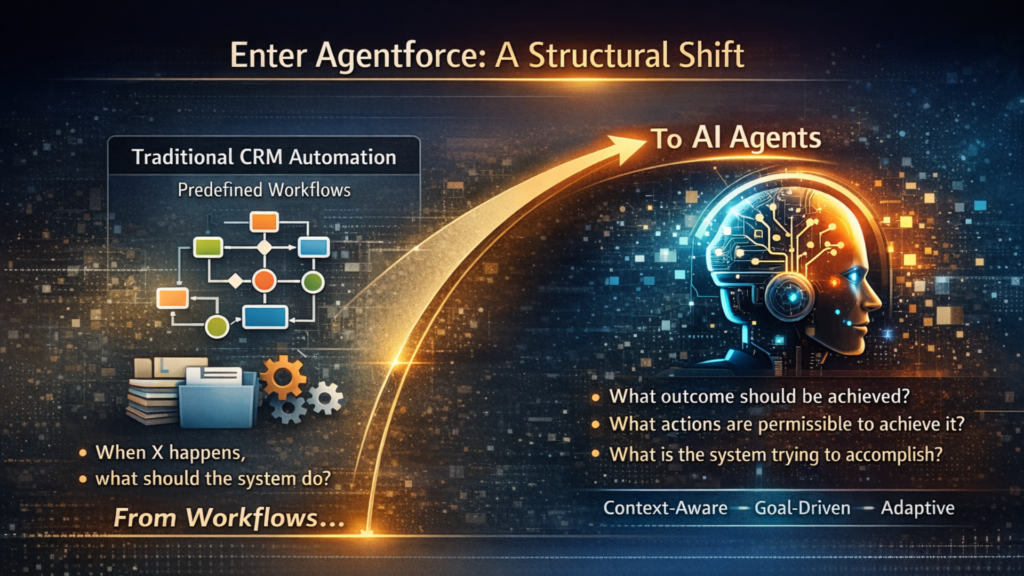
This distinction matters.
Traditional automation asks, “Did this condition occur?”
Agentforce asks, “What is the system trying to accomplish right now?”
Within Salesforce, Agentforce agents operate inside clearly defined guardrails. They are given goals, permissions, and boundaries, not step-by-step instructions. Within those constraints, they can decide when to act, when to wait, when to escalate, and when to involve a human.
This fundamentally changes how work moves through the CRM.
Execution is no longer linear and reactive. It becomes adaptive and continuous. Agents can respond to shifting priorities, incomplete information, and evolving customer signals without requiring every possible scenario to be modeled in advance.
This is not faster automation.
It is a different operating model.
Work is no longer pushed through workflows by humans who interpret signals and trigger systems. Instead, the system itself becomes an active participant in execution, carrying intent forward and managing progress until human judgment is genuinely required.
That shift, from instruction-following to outcome-driven execution, is what separates Agentforce from everything that came before it.
From Tasks to Intent
Traditional automation operates on tasks.
Agentforce operates on intent.
Traditional systems are designed around events and reactions. A trigger fires, logic evaluates, and a task is executed. The system’s role is to respond. It does not question the objective, only whether the conditions to act have been met.
Agentforce reframes the problem entirely.
Instead of asking, “When X happens, what should the system do?” it asks, “What outcome should be achieved, and what actions are permissible to achieve it?” Execution is no longer bound to a single moment in time. It becomes goal-oriented and continuous.
This distinction transforms how work is modeled inside the CRM. Tasks become means, not ends. Actions are selected based on relevance, priority, and context rather than rigid sequencing. If conditions change, the agent adapts without requiring a redesign of the workflow.
Within Salesforce, this means the system can actively manage progress toward an objective. It can decide whether to advance, pause, reroute, or escalate based on live signals rather than static rules.
This shift changes everything.
Ownership of execution begins to move from humans to the system itself. Automation stops being a collection of isolated actions and starts functioning as an operating layer, one that understands why work exists and not just how it is performed.
That is the difference between automation that assists and automation that actually executes.
How Agentforce Thinks About Work
Agentforce agents continuously evaluate:
- Current system state
- Historical patterns
- Business objectives
- Risk thresholds
They are not waiting for a single trigger. They are monitoring execution as a living process.
Work becomes adaptive instead of sequential.
Autonomy with Guardrails, Not Freedom Without Control
A common misconception is that Agentforce replaces governance with autonomy. The opposite is true.
Agentforce does not remove control. It relocates it. Instead of enforcing governance through sprawling chains of rules and brittle conditional logic, governance is established upfront through explicit boundaries that define what an agent is allowed to do, when it must stop, and when a human must take over.
Agentforce operates within clearly defined guardrails, including:
- Approved action sets
Agents can act only within a sanctioned library of actions. They cannot invent new behaviors or operate outside what has been intentionally authorized. - Escalation thresholds
When confidence drops, risk increases, or ambiguity exceeds acceptable limits, agents are required to escalate. Autonomy ends where judgment, accountability, or exception handling is needed. - Compliance constraints
Regulatory, contractual, and policy requirements are enforced as hard boundaries. Agents cannot bypass approvals, retention rules, or audit requirements. - Security boundaries
Access is governed by role, permission, and data visibility. Agents see and act only on what they are explicitly permitted to, just like any trusted system user.
Autonomy exists only inside intentional design.
This is what makes Agentforce safer, not riskier, than traditional rule-based automation. In many legacy systems, governance is fragmented across hundreds of flows, triggers, and integrations that are difficult to audit and easy to break. Control is implicit and scattered.
With Agentforce, governance is centralized, explicit, and observable. Autonomy does not mean loss of oversight. It means execution happens faster and more intelligently, without sacrificing accountability.
Control is no longer enforced by volume of rules.
It is enforced by clarity of intent and boundaries.
That is the difference.
Decision-Making vs Decision Execution
Traditional automation executes decisions made by humans.
Agentforce participates in decision-making itself.
This distinction matters in environments where timing, prioritization, and context determine outcomes.
An agent can delay, accelerate, or reroute execution based on live signals. A rule cannot.
Handling Ambiguity in Real Time
Enterprise work is rarely binary.
Customer sentiment fluctuates.
Deal risk evolves.
Operational constraints shift mid-process.
Traditional automation struggles with ambiguity. It forces binary outcomes onto non-binary realities.
Agentforce is designed to operate in gray space. It reasons probabilistically, not deterministically.
Exception Handling Becomes the Default State
In traditional automation, exceptions are treated as failures.
In Agentforce-driven systems, exceptions are expected.
Agents are designed to recognize when standard paths no longer apply and to choose alternative actions or escalate intelligently.
This dramatically reduces manual intervention.
The Role of Data Quality Changes
Traditional automation assumes clean, complete, and timely data.
Agentforce assumes reality.
Agents evaluate confidence levels, infer missing context, and adjust behavior accordingly. While data quality still matters deeply, execution no longer collapses when data is imperfect.
This resilience is one of Agentforce’s most understated advantages.
Execution Speed vs Execution Accuracy
Automation is often sold on speed.
Agentforce prioritizes accuracy first, speed second.
An agent may intentionally slow execution to gather context, validate risk, or await confirmation. This results in fewer downstream corrections and higher trust in outcomes.
Fast mistakes are still mistakes.
Governance Moves Upstream
With Agentforce, governance shifts from reactive audits to proactive design.
Instead of reviewing logs after something breaks, teams move governance upstream. Control is no longer enforced by post-incident analysis or manual oversight. It is embedded into how the system thinks and acts from the start.
Rather than asking, “Why did this automation fail?” organizations define, in advance:
- What agents are allowed to do
Actions are intentionally scoped. Agents operate only within approved capabilities, ensuring execution remains aligned with organizational policy and risk tolerance. - When human escalation is required
Clear thresholds define where autonomy ends and human judgment begins. This prevents silent failures and ensures accountability is preserved at critical decision points. - Which outcomes matter most
Success is no longer measured by task completion alone. Agents are guided by priorities such as revenue impact, customer experience, compliance, or operational continuity.
Within platforms like Salesforce, this approach changes the role of governance teams, architects, and administrators. Their responsibility shifts from maintaining brittle logic to shaping intent, boundaries, and strategic alignment.
The result is a system that executes in service of outcomes, not just processes.
Execution aligns with strategy, not merely workflow diagrams.
Automation stops optimizing steps and starts reinforcing direction.
That is the quiet but profound shift Agentforce enables.
Operational Ownership Becomes Clearer
Traditional automation often lacks clear ownership. When something breaks, responsibility is diffuse.
Agentforce clarifies ownership by tying agents to business outcomes, not technical components.
This simplifies accountability and accelerates optimization.
Scalability Without Exponential Complexity
As organizations scale, traditional automation scales linearly in volume and exponentially in complexity.
Agentforce scales differently.
New scenarios do not require new workflows. Agents adapt existing logic to new contexts. Complexity grows incrementally, not explosively.
Where Traditional Automation Still Fits
This is not a zero-sum replacement.
Traditional automation remains ideal for:
- Deterministic, high-volume tasks
- Compliance-driven workflows with fixed rules
- Simple integrations
Agentforce excels where judgment, prioritization, and adaptation are required.
The most effective systems blend both.
A New Execution Layer for CRM
Agentforce represents the emergence of an execution layer above workflows.
Flows still matter. Rules still matter. Integrations still matter.
But agents orchestrate them dynamically.
This is the architectural shift many organizations underestimate.
Why This Difference Matters Now
The rise of AI in CRM is not about intelligence. It is about agency.
Systems that can act responsibly, adaptively, and autonomously unlock entirely new operating models.
Agentforce is Salesforce’s clearest expression of that future within the broader ecosystem of Salesforce.
What This Means for Teams and Leaders
For teams, Agentforce reduces cognitive load.
For leaders, it increases execution confidence.
For organizations, it closes the gap between strategy and action.
The real difference is not technology.
It is how work gets done.
The Strategic Advantage of Getting This Right
Organizations that treat Agentforce as “advanced automation” will underutilize it.
Those that redesign execution around autonomous agents will outpace competitors still trapped in brittle workflows.
The advantage compounds quietly. Then decisively.
Final Takeaway: Automation Executes. Agents Act.
Traditional automation answers the question:
“How do we do this faster?”
Agentforce answers a different one:
“How do we do the right thing, consistently, at scale?”
That difference defines the next era of enterprise execution.
How CloudVandana Helps Organizations Execute with Confidence
Adopting Agentforce is not a toggle. It requires disciplined data foundations, intentional governance, and execution-aware architecture.
CloudVandana helps organizations design, deploy, and operationalize Agentforce responsibly. From data readiness and guardrail definition to agent orchestration and long-term optimization, CloudVandana ensures autonomy enhances control rather than eroding it.
If execution is the new competitive edge, the systems behind it must be designed to act, not just react.
Frequently Asked Questions
What is the primary difference between Agentforce and traditional automation?
Traditional automation follows predefined rules. Agentforce operates autonomously, reasoning through objectives and context to determine actions.
Does Agentforce replace Salesforce Flow and existing automation tools?
No. Agentforce orchestrates and augments existing automation rather than replacing it.
Is Agentforce risky from a compliance perspective?
When designed correctly, Agentforce is safer. Guardrails, escalation logic, and permissions are explicitly defined upfront.
Do organizations need perfect data to use Agentforce?
No. While clean data improves outcomes, Agentforce is designed to operate under real-world data conditions.
Which teams benefit most from Agentforce?
Sales, service, operations, and support teams dealing with dynamic, high-context workflows see the greatest impact.
How long does it take to implement Agentforce effectively?
Timelines vary. Success depends more on governance and design maturity than on technical deployment speed.

Atul Gupta is CloudVandana’s founder and an 8X Salesforce Certified Professional who works with globally situated businesses to create Custom Salesforce Solutions.
Atul Gupta, a dynamic leader, directs CloudVandana’s Implementation Team, Analytics, and IT functions, ensuring seamless operations and innovative solutions.
YOU MIGHT ALSO LIKE
Salesforce Implementation for for Wellington Farming Equipment
The Future of Marketing Automation with Agentforce Marketing
What is Salesforce CRM – Complete Guide for Businesses
Salesforce Financial Services Cloud: The Complete Guide for Modern Financial Institutions
Lightning Platform (UI & Development): A Practical Guide