Why Salesforce AI Readiness Is No Longer Optional
Salesforce AI has reached a point where intent alone is no longer enough. Over the past few years, many organizations experimented with predictive scores, Einstein recommendations, or AI-generated summaries. Some saw early wins. Many quietly stalled. The difference was never ambition. It was readiness. In 2026, Salesforce AI is no longer positioned as a “nice-to-have enhancement.” It is embedded directly into how revenue teams qualify pipeline, how service teams resolve cases, and how marketing teams personalize engagement. With the introduction of autonomous agents, real-time data unification, and generative interfaces, Salesforce is actively redefining what a CRM system does on a day-to-day basis. Organizations are now facing a clear fork in the road. Either Salesforce AI becomes a genuine productivity multiplier, or it becomes another layer of complexity sitting on top of already fragile processes. The deciding factor is not the AI model. It is the underlying foundation. This guide is written for Salesforce leaders who want to adopt AI with confidence, not experimentation alone. It reflects patterns observed across real Salesforce implementations, where AI success followed disciplined preparation and AI failure followed shortcuts. The goal of this roadmap is simple: help you prepare your Salesforce org so AI can execute reliably, responsibly, and at scale. Table of Contents What Salesforce AI Really Means in 2026 From Insights to Autonomous Action Why Salesforce AI Initiatives Fail Without Readiness Phase 1: Data Readiness – The Foundation of Salesforce AI Why Data Quality Determines AI Outcomes Core Data Readiness Principles Data Quality Data Consistency Historical Integrity Understanding the Role of Data Cloud Preparing for a Successful Data Cloud Implementation Selecting the Right Data Sources Designing Identity Resolution Carefully Defining Activation Use Cases Early Phase 3: Salesforce AI Model Readiness Moving Beyond Feature Enablement Preparing Data for AI Training Establishing Human Feedback Loops Phase 4: Agentforce and Autonomous Workflow Readiness Why Agentforce Changes Everything Defining Agent Boundaries Designing for Accountability and Transparency Phase 5: Security, Compliance, and Trust in Salesforce AI Why Governance Must Come First Core Governance Pillars Phase 6: Operating Model and Change Management Preparing People for AI Collaboration The Salesforce AI Readiness Checklist (Expanded) 1. Clean, Consistent, and Governed Data What “Clean” Actually Means in Practice Why Consistency Matters More Than Volume Governance as an Ongoing Discipline 2. A Salesforce Data Cloud Architecture Designed for Activation Activation-First Architecture Intentional Data Source Selection Identity Resolution as a Strategic Decision 3. AI Models Trained on Meaningful Outcomes Defining What “Good” Looks Like Removing Noise From Training Data Continuous Human Feedback Loops 4. Autonomous Agents With Clearly Defined Boundaries Clear Authority Levels Goal-Driven Design Auditability and Explainability 5. Strong Security, Compliance, and Trust Controls Data Access and Least Privilege Prompt and Model Governance Regulatory Alignment 6. An Operating Model That Supports Adoption Role-Based Enablement Redefining Success Metrics Cultural Alignment Why All Six Dimensions Must Work Together Common Salesforce AI Readiness Pitfalls Measuring Salesforce AI Success Over Time The Road Ahead: Salesforce AI in 2026 and Beyond Final Perspective: Readiness Is the Real Competitive Advantage Bring Salesforce AI From Potential to Performance Frequently Asked Questions (FAQs) 1. What does “Salesforce AI readiness” actually mean? 2. Do we need Salesforce Data Cloud to use Salesforce AI effectively? 3. Why do many Salesforce AI implementations fail after launch? 4. Is Agentforce suitable for all Salesforce orgs? 5. How long does it typically take to become Salesforce AI ready? 6. How do we measure success after implementing Salesforce AI? YOU MIGHT ALSO LIKE What Salesforce AI Really Means in 2026 Salesforce AI is often discussed as a feature set, but in practice, it is an ecosystem. Understanding this ecosystem clearly is the first step toward readiness. At its core, Salesforce AI is built on three tightly connected pillars: Together, these components transform Salesforce from a passive system of record into an active system of execution. From Insights to Autonomous Action Earlier generations of CRM analytics focused on reporting what had already happened. Dashboards answered historical questions. Einstein shifted the conversation toward prediction, highlighting what might happen next. Agentforce completes that evolution by enabling Salesforce to act on those insights automatically. This transition changes expectations. Users no longer want recommendations alone. They expect Salesforce AI to reduce manual effort, eliminate repetitive decisions, and move work forward without constant human intervention. That expectation only holds when AI is built on accurate data, clear logic, and strong governance. Without those elements, autonomy quickly becomes liability. Why Salesforce AI Initiatives Fail Without Readiness Many Salesforce AI projects fail quietly. There is no dramatic system outage or obvious error message. Instead, users slowly disengage. Common warning signs include AI recommendations that are ignored, summaries that feel generic or inaccurate, and automation that requires constant manual correction. In these scenarios, AI technically works, but it does not earn trust. The underlying causes are consistent across organizations: Readiness addresses these issues before AI is introduced, not after. It ensures that AI enhances existing workflows instead of exposing their weaknesses. Phase 1: Data Readiness – The Foundation of Salesforce AI Why Data Quality Determines AI Outcomes Salesforce AI does not “understand” data the way humans do. It recognizes patterns, correlations, and probabilities. When the underlying data is fragmented, inconsistent, or outdated, AI conclusions become unreliable, even if the model itself is sophisticated. In many Salesforce orgs, data problems accumulate slowly. Fields are added to solve short-term needs. Validation rules are loosened under pressure. Duplicate records are tolerated because cleaning them feels disruptive. Over time, this creates a dataset that humans can mentally compensate for but AI cannot. AI magnifies these inconsistencies. A single misused picklist or duplicated account can cascade into incorrect predictions and actions. Core Data Readiness Principles True Salesforce AI readiness begins with a commitment to data discipline. This does not mean perfection, but it does mean intentionality. Data Quality High-quality data is complete, accurate, and current. Required fields should reflect real business requirements, not historical assumptions. Validation rules must enforce consistency without blocking legitimate edge cases. Records should be reviewed regularly to
How Agentforce 360 Transforms Salesforce CRM Workflows With AI Agents (2026 Guide)
Agentforce 360 Customer Relationship Management has reached a genuine inflection point. What began decades ago as a way for teams to store contact details and log interactions has slowly, and almost unintentionally, been transformed into the backbone of modern enterprise operations. CRM systems today are expected to support revenue growth, service delivery, compliance, forecasting, and strategic decision-making all at once. In 2026, the tension created by this evolution has become impossible to ignore. Organizations are no longer constrained by a lack of features, integrations, or data availability. Instead, they are constrained by execution. Work piles up faster than teams can respond, decisions arrive too late, and operational complexity overwhelms even the most mature Salesforce implementations. This is the context in which Agentforce 360 enters the picture. Salesforce’s introduction of Agentforce 360 is not a cosmetic update or a marginal improvement to existing automation tools. It represents a fundamental rethinking of how work should be executed inside a CRM platform. Rather than positioning Salesforce as a system that waits for humans to act, Agentforce 360 reimagines it as a system that can act on behalf of the business itself. It redefines CRM workflows by allowing artificial intelligence to move beyond advice and recommendations and into autonomous execution, while still operating within clearly defined governance and trust boundaries. Agentforce 360 is not another automation layer stacked on top of existing workflows, nor is it a simple extension of Einstein AI. It is a structural shift in how work flows through Salesforce. Traditionally, workflows have been reactive, triggered only after a user takes an action or a scheduled process runs. With Agentforce, Salesforce introduces autonomous, goal-driven AI agents that continuously observe changes in data, interpret business context, reason through possible outcomes, take action when appropriate, and escalate decisions when uncertainty or risk exceeds acceptable thresholds. This transition moves Salesforce beyond being merely a system of record or engagement into something far more ambitious and far more consequential: a system of execution. Table of Contents Agentforce 360 Why Traditional CRM Workflows Are No Longer Enough What Is Agentforce 360? Agentforce 360 vs Einstein AI: What Actually Changed? The Architecture Behind Agentforce 360 Data Intelligence Layer (Powered by Data Cloud) Reasoning and Decision Layer Action and Execution Layer Trust, Security, and Governance Layer Why Data Cloud Is Non-Negotiable for Agentforce Success Human-in-the-Loop: How Salesforce Built Trust Into AI Execution Key CRM Workflows Agentforce 360 Is Transforming Sales Workflows Service and Support Workflows Marketing and Revenue Operations Admin and IT Operations Agentforce 360 vs Traditional Automation How to Prepare Your Salesforce Org for Agentforce 360 Common Mistakes to Avoid KPIs That Matter in an Agent-Driven CRM The Future of CRM Teams in an Agent-First World Frequently Asked Questions Final Thoughts: Why Agentforce 360 Matters in 2026 How CloudVandana Helps You Succeed With Agentforce 360 Frequently Asked Questions (FAQs) 1. What is Agentforce 360 in Salesforce? 2. How is Agentforce 360 different from Einstein AI? 3. Does Agentforce 360 replace Salesforce Flow or automation tools? 4. What Salesforce data does Agentforce 360 rely on? 5. Is Agentforce 360 safe to use for critical business processes? 6. What teams benefit the most from Agentforce 360? YOU MIGHT ALSO LIKE Why Traditional CRM Workflows Are No Longer Enough For many years, improvements in CRM productivity came through incremental automation. Workflow Rules reduced repetitive updates. Process Builder introduced conditional logic. Flow added greater flexibility and orchestration. Apex allowed developers to fill the gaps when declarative tools reached their limits. Each of these innovations reduced manual effort and improved consistency, but they did not fundamentally change how work was initiated or controlled. Humans remained the starting point. Automations simply executed predefined instructions once a human action occurred. This model worked well in environments where variability was limited, and customer interactions followed predictable paths. However, modern CRM environments are anything but predictable. Customer journeys now unfold across email, chat, social platforms, mobile apps, and in-product experiences, often simultaneously. Sales cycles are influenced by real-time intent signals that shift by the hour. Support expectations are shaped by on-demand, personalized experiences delivered by digital-first competitors. Marketing performance fluctuates continuously as campaigns respond to audience behavior in near real time. In this environment, workflows that rely on static rules and delayed human intervention introduce friction rather than efficiency. Teams find themselves reacting to events instead of anticipating them. Opportunities go cold while waiting for follow-ups. Support issues escalate because early warning signals were missed. Administrators spend more time maintaining automations than improving outcomes. The cumulative result is slower response times, hidden operational risks, and widespread burnout across sales, service, and operations teams. Agentforce 360 exists because Salesforce recognized that automation alone cannot keep pace with this level of complexity. What organizations need is not more workflows or more rules, but systems capable of independently pursuing outcomes. These systems must be able to operate continuously, adapt to context, and make decisions within clearly defined boundaries. Agentforce represents Salesforce’s answer to that need. What Is Agentforce 360? Agentforce 360 is Salesforce’s AI agent framework that enables autonomous, goal-oriented digital agents to execute CRM workflows across Sales, Service, Marketing, and Operations, while operating within human-defined trust and governance controls. Unlike traditional automation, which follows static instructions, Agentforce agents are designed to interpret context and reason about outcomes. They do not wait for users to click buttons or submit forms. Instead, they work continuously in the background, monitoring data changes, business signals, and behavioral patterns in real time. When conditions align with defined objectives, agents can initiate actions on their own, whether that involves updating records, triggering processes, communicating with customers, or escalating issues to human teams. At a practical level, Agentforce 360 allows organizations to delegate responsibility for outcomes rather than micromanaging tasks. Instead of telling Salesforce exactly how to execute each step of a process, teams can define what success looks like and allow agents to determine the most appropriate path forward. This shift reduces operational friction and enables CRM systems to operate at a speed
Salesforce Implementation in 2026: The New Success Factors That Matter
Introduction: Why Salesforce Implementation Looks Different in 2026 Salesforce implementation in 2026 represents a decisive break from the past. What organizations once considered a technology rollout has evolved into a strategic exercise that shapes how the business operates at its core. Salesforce is no longer a supporting tool sitting quietly behind sales teams. It has become the connective tissue linking revenue operations, customer experience, compliance, analytics, and artificial intelligence into a single operating framework. The implications of this shift are profound. In earlier years, implementation success was defined by timelines and feature delivery. In 2026, success is defined by relevance and endurance. Businesses operate in markets where customer expectations change faster than quarterly planning cycles, and where regulatory, competitive, and technological pressures arrive simultaneously. Salesforce is expected to absorb this volatility and translate it into clarity. An implementation that does not anticipate change is already outdated. Modern Salesforce programs are designed to be living systems, capable of learning, adapting, and scaling as the organization grows. Table of Contents Introduction: Why Salesforce Implementation Looks Different in 2026 The End of Traditional CRM Thinking From Features to Outcomes: A Strategic Shift Executive Alignment as a Non-Negotiable The Rise of AI-First CRM Architectures Data Cloud as the New Foundation Layer Identity, Consent, and Trust by Design Composable Salesforce Implementations Industry Clouds Over Generic Clouds Automation Maturity Beyond Basic Flows Human-Centered Experience Design Implementation Speed vs Implementation Longevity Governance as a Living System Security, Compliance, and Zero-Trust CRM DevOps and Release Management in Salesforce Integration-First, Not Integration-Later Measuring Value Beyond Adoption Metrics Change Management in an AI-Driven Organization Partner Selection in the 2026 Ecosystem Common Failure Patterns Still Breaking Projects The New Salesforce Implementation Blueprint Preparing Your Organization for 2026 and Beyond Conclusion: Building Salesforce for the Long Game YOU MIGHT ALSO LIKE The End of Traditional CRM Thinking Traditional CRM thinking was built around control. Capture every data point. Enforce rigid processes. Prevent deviation. While this mindset created order, it also created friction. Systems became places where data went to rest, not places where insight was born. Users complied, but rarely engaged meaningfully. In 2026, this philosophy no longer works. Salesforce is expected to be dynamic, responsive, and intelligent. Data should not merely be stored; it should flow across functions and trigger meaningful actions. Customer signals must move seamlessly from marketing to sales to service without manual intervention. Implementations that cling to static data models and inflexible workflows struggle to keep up. The modern CRM mindset embraces adaptability, autonomy, and continuous optimization, turning Salesforce into an active participant in business execution rather than a passive observer. From Features to Outcomes: A Strategic Shift For years, Salesforce projects began with exhaustive requirement documents listing features to be built. Objects, fields, flows, and reports dominated planning sessions. While thorough, this approach often produced bloated systems that were difficult to use and even harder to evolve. The underlying question of “why” was frequently lost. Outcome-driven implementation changes that narrative. In 2026, Salesforce initiatives start with business outcomes that matter at the executive level. Revenue predictability. Sales efficiency. Customer retention. Service responsiveness. These outcomes guide every architectural and configuration decision. Features become means, not ends. This shift results in leaner systems with clearer purpose, making Salesforce easier to adopt, govern, and scale. When every component supports a measurable outcome, the platform earns its place as a strategic asset. Executive Alignment as a Non-Negotiable Executive alignment has moved from a ceremonial requirement to an operational necessity. In 2026, Salesforce implementations that succeed are those where leadership is actively involved in shaping priorities and validating outcomes. Executives no longer delegate CRM decisions entirely to IT or operations teams. They engage directly because the platform influences how the business runs. When leaders use Salesforce dashboards in planning meetings, rely on forecasts generated from Salesforce data, and reference Salesforce metrics in performance discussions, the system gains authority. Teams follow leadership behavior more than policy documents. Conversely, when executives bypass Salesforce or question its accuracy, adoption erodes rapidly. Alignment ensures that Salesforce reflects the real business, not an idealized version created in workshops. The Rise of AI-First CRM Architectures AI-first architecture in 2026 does not mean automating every task indiscriminately. It means acknowledging that intelligence is now woven into the fabric of Salesforce and designing systems that can support it responsibly. Forecasting models, routing engines, recommendation systems, and generative summaries all rely on structured, trustworthy data and transparent logic. Successful implementations treat AI as an augmentation layer rather than a replacement for human judgment. Systems are designed to explain recommendations, allow human overrides, and learn from feedback. This transparency builds confidence among users. When people understand why AI suggests a particular action, they trust it. When they do not, they ignore it. AI-first architecture is ultimately about trust, not technology. Data Cloud as the New Foundation Layer Data fragmentation has long been the Achilles’ heel of CRM initiatives. Multiple systems, inconsistent identifiers, and delayed synchronization undermine confidence and limit insight. In 2026, Salesforce implementations increasingly position Data Cloud as the foundational layer that resolves these issues. By unifying customer identities across channels, harmonizing attributes, and ingesting real-time events, Data Cloud creates a shared source of truth. Sales, marketing, and service teams no longer debate whose data is correct. They operate from a continuously updated, context-rich view of the customer. This foundation enables personalization, automation, and analytics to work in concert rather than in competition, unlocking the full potential of Salesforce as an intelligence platform. Identity, Consent, and Trust by Design Trust has become a strategic differentiator. Customers are increasingly aware of how their data is used and expect transparency and control. Salesforce implementations in 2026 respond by embedding identity resolution, consent management, and preference enforcement directly into system design. This approach ensures that personalization respects boundaries and that data usage aligns with customer intent. Access is contextual, not blanket. Regulatory compliance becomes a natural outcome of system behavior rather than a reactive effort driven by audits. Trust is no longer managed
The Ultimate Guide to Migrating Legacy Automations to Salesforce Flow
Migration to Salesforce Flow Salesforce automation has reached a clear inflection point. For years, organizations built critical business logic using Workflow Rules and Process Builder. These tools powered lead routing, case updates, approvals, notifications, and countless behind-the-scenes processes that kept Salesforce running smoothly. They were dependable in their time. But the platform has moved on. Salesforce has publicly and repeatedly stated that Salesforce Flow is the present and future of automation. Legacy tools are no longer evolving. They are maintained, not enhanced. Meanwhile, Flow continues to receive performance upgrades, usability improvements, and deeper platform integration with every release. Migrating legacy automations to Salesforce Flow is no longer optional. It is a foundational step toward long-term org health, scalability, and maintainability. This guide exists to help you approach that migration methodically, without disruption, and with a clear strategic lens. Table of Contents Migration to Salesforce Flow Understanding Legacy Salesforce Automations Workflow Rules Process Builder Approval Processes Why Salesforce Flow Is the Strategic Standard One Engine, Multiple Use Cases Performance and Platform Alignment Built for the Future What Happens If You Delay Migration Migration Is Not a Lift-and-Shift Exercise Step 1: Audit Your Existing Automation Landscape Create a Full Inventory Identify Overlaps and Conflicts Step 2: Classify Automation by Business Purpose Step 3: Understand Order of Execution Implications Step 4: Choose the Right Flow Type Record-Triggered Flows Scheduled-Triggered Flows Screen Flows Autolaunched Flows Step 5: Design for Simplicity and Readability Step 6: Consolidate Automation Per Object Step 7: Rethink Time-Based Logic Step 8: Use Subflows to Reduce Duplication Step 9: Migrate in Controlled Phases Step 10: Test Beyond Ideal Scenarios Step 11: Monitor and Observe Post-Migration Step 12: Upskill Admins and Teams Step 13: Establish Automation Governance Step 14: Stay Aligned with Salesforce Releases Step 15: Tie Automation to Business Outcomes Step 16: Avoid Common Migration Pitfalls Step 17: When Expert Support Makes Sense How CloudVandana Enables Confident Migration The Flow-First Future of Salesforce Final Perspective A Smarter, Safer Path to Flow Migration with CloudVandana YOU MIGHT ALSO LIKE Understanding Legacy Salesforce Automations Before any migration begins, it is essential to understand what you are replacing and why those tools struggle in modern orgs. Workflow Rules Workflow Rules were Salesforce’s first serious attempt at declarative automation. They respond to simple conditions and perform basic actions such as field updates, email alerts, outbound messages, and task creation. Their strength lies in simplicity, but that same simplicity limits them. Workflow Rules lack branching logic, complex conditions, and orchestration capabilities. Over time, admins compensated by stacking multiple workflows on the same object, often without realizing how they interacted. This created fragmented logic that was difficult to trace or modify safely. Process Builder Process Builder attempted to address these limitations by introducing visual logic, multiple criteria nodes, and a broader set of actions. Initially, it felt like a breakthrough. In practice, many orgs used Process Builder as a dumping ground for logic that should have been re-architected. Multiple processes per object became common. Recursive updates caused performance degradation. Debugging failures required deep log analysis. As orgs grew, Process Builder became harder to govern, not easier. Approval Processes Approval Processes still serve a valid purpose, but they often trigger downstream automation or depend on legacy workflows. During migration, these dependencies must be carefully reviewed to ensure approvals continue functioning as expected. Why Salesforce Flow Is the Strategic Standard Salesforce Flow is not simply a newer tool. It represents a unified automation framework designed for scale. One Engine, Multiple Use Cases Flow consolidates record-triggered automation, scheduled logic, user-guided screens, and background orchestration into a single system. This reduces fragmentation and makes automation behavior easier to understand holistically. Performance and Platform Alignment Salesforce actively optimizes Flow at the platform level. Before-save Flows, in particular, execute faster than equivalent Process Builder logic because they update records before database commit. Legacy tools cannot benefit from these optimizations. Built for the Future New Salesforce capabilities, including AI-driven features and advanced integrations, assume Flow-first automation. Staying on legacy tools increasingly isolates your org from innovation. What Happens If You Delay Migration Postponing migration may feel safe in the short term, but it introduces hidden risk. Legacy automations accumulate technical debt. Overlapping logic becomes harder to untangle. New admins hesitate to make changes for fear of breaking something unknown. Eventually, a Salesforce release or integration exposes these weaknesses at the worst possible moment. Migration is not about reacting to deprecation. It is about proactively protecting business continuity. Migration Is Not a Lift-and-Shift Exercise One of the most common mistakes is treating migration as a mechanical conversion exercise. Simply recreating Workflow Rules or Process Builder logic inside Flow preserves old inefficiencies. Flow offers better patterns, clearer structure, and stronger governance. Migration should improve automation quality, not merely preserve behavior. Every migrated automation should be reviewed through a modern lens: is this logic still needed, and is this the best way to implement it today? Step 1: Audit Your Existing Automation Landscape A successful migration starts with complete visibility. Create a Full Inventory Document every Workflow Rule, Process Builder process, and Approval Process. Capture trigger conditions, actions, affected fields, and dependencies. Many orgs are surprised by how much automation exists once everything is visible. Identify Overlaps and Conflicts It is common to find multiple automations updating the same field or sending similar notifications. These overlaps are a major source of inconsistency. Migration is the ideal moment to consolidate and simplify. Step 2: Classify Automation by Business Purpose Automation should reflect business intent, not technical convenience. Group automations into clear categories such as data validation, notifications, lifecycle transitions, or integrations. This approach makes it easier to design modular Flows that serve a defined purpose rather than sprawling logic trees. Step 3: Understand Order of Execution Implications Order of execution is where many migrations fail quietly. Flows can run before save, after save, or asynchronously. Choosing the wrong timing can lead to unexpected results. Before-save Flows are ideal for calculations and field updates. After-save Flows are better
Salesforce and Qualified: A New Era of Agentic Marketing
Salesforce and Qualified Salesforce’s announcement that it has signed a definitive agreement to acquire Qualified, a leader in agentic AI marketing, is more than a routine acquisition. It is a strong signal of where enterprise growth, marketing, and sales execution are heading next. This move reinforces a trend that has been building steadily across the Salesforce ecosystem: the agentification of the enterprise. AI is no longer limited to analytics, copilots, or assistive automation. It is becoming an autonomous workforce that can engage buyers, qualify intent, and generate pipeline with minimal human intervention. For Salesforce customers, consultants, and partners, this acquisition raises important questions: In this article, we break down the acquisition, explore its strategic implications, and explain what it means for Salesforce customers navigating the next phase of AI-driven growth. Table of Contents Salesforce and Qualified Understanding Qualified and Its Role in Agentic Marketing Why Salesforce Acquiring Qualified Makes Strategic Sense 1. Strengthening Agentforce for Marketing and Sales 2. Closing the Gap Between Website Engagement and CRM Data 3. Reinforcing Salesforce’s AppExchange and Partner Ecosystem Strategy What Is Agentic Marketing and Why It Matters Now How This Changes the B2B Buying Experience Implications for Marketing Teams Implications for Sales Teams Governance, Trust, and Enterprise Readiness What This Means for Salesforce Customers Today How CloudVandana Helps Organizations Prepare for Agentic AI Looking Ahead: The Future of Agent-First Revenue Teams Final Thoughts YOU MIGHT ALSO LIKE Salesforce and the Acceleration of the Agentic Enterprise Salesforce has been steadily repositioning itself from a CRM company to an AI-first enterprise platform. Over the past few years, we have seen this shift unfold across multiple layers of the Salesforce stack: The acquisition of Qualified fits squarely into this evolution. As Steve Fisher, President and Chief Product Officer at Salesforce, noted, “The agentification of the enterprise continues to accelerate.” This is not a future concept. It is already happening in production environments across marketing, sales, and customer engagement functions. Salesforce’s strategy is increasingly clear:AI agents will handle initial engagement, intent detection, qualification, and routing, allowing human teams to focus on higher-value work such as relationship building, deal strategy, and closing. Understanding Qualified and Its Role in Agentic Marketing Qualified has built its reputation as a B2B pipeline generation platform designed to turn website traffic into real sales conversations. At its core, Qualified provides: Unlike traditional chatbots or static lead forms, Qualified’s AI acts as an always-on AI worker. It does not simply respond to predefined questions. It actively engages visitors, adapts conversations based on context, and drives outcomes such as meeting bookings and lead qualification. This distinction is critical. Agentic AI is not about assistance. It is about autonomy. Qualified’s technology is designed to operate independently within defined guardrails, making decisions and taking actions that directly contribute to pipeline generation. Why Salesforce Acquiring Qualified Makes Strategic Sense From a strategic standpoint, this acquisition addresses several key priorities for Salesforce. 1. Strengthening Agentforce for Marketing and Sales Agentforce is Salesforce’s vision for deploying AI agents across the enterprise. While early focus has been on service and sales productivity, marketing has emerged as a critical next frontier. Qualified brings mature, production-ready agentic marketing capabilities that Salesforce can embed directly into: This allows Salesforce to move faster than building equivalent capabilities entirely in-house. 2. Closing the Gap Between Website Engagement and CRM Data One of the long-standing challenges in B2B marketing is the disconnect between anonymous website traffic and actionable CRM data. Qualified bridges this gap by: Once integrated into Salesforce’s platform, this capability becomes even more powerful when combined with Data Cloud, CRM, and AI agents working together. 3. Reinforcing Salesforce’s AppExchange and Partner Ecosystem Strategy Qualified is already a Salesforce AppExchange partner and a Salesforce Ventures portfolio company. This acquisition demonstrates Salesforce’s continued commitment to: For Salesforce partners and ISVs, this is an important signal about the value of building natively on the Salesforce platform. What Is Agentic Marketing and Why It Matters Now Agentic marketing represents a fundamental shift in how organizations think about demand generation and buyer engagement. Traditional marketing automation relies heavily on: Agentic marketing replaces these fragmented workflows with AI agents that can act independently. These agents can: The result is a faster, more responsive buying experience that aligns with how modern B2B buyers expect to interact. This matters now because: Agentic marketing directly addresses these pressures. How This Changes the B2B Buying Experience From the buyer’s perspective, agentic marketing removes friction. Instead of: Buyers can engage in real-time conversations that feel natural, contextual, and relevant. When implemented correctly, AI agents become an extension of the brand, delivering consistent, high-quality engagement at scale. This is particularly important for: With Qualified integrated into Salesforce, these experiences can be governed, measured, and optimized directly within the CRM ecosystem. Implications for Marketing Teams Marketing teams will need to rethink how they measure success. Traditional metrics such as: Will increasingly give way to: Marketers will spend less time configuring workflows and more time: This represents a shift from execution-heavy roles to strategic orchestration. Implications for Sales Teams For sales teams, the impact is equally significant. AI agents handling early-stage engagement means: Sales teams can focus on: Rather than spending time chasing low-quality inbound leads. When combined with Agentforce Sales, the result is a more efficient, AI-augmented revenue organization. Governance, Trust, and Enterprise Readiness One of Salesforce’s core differentiators has always been its focus on trust, governance, and enterprise readiness. As agentic AI becomes more autonomous, these concerns become even more critical. By bringing Qualified into the Salesforce ecosystem, Salesforce can ensure: This is particularly important for regulated industries and large enterprises that require transparency and control over AI-driven actions. What This Means for Salesforce Customers Today While the transaction is expected to close in the first quarter of Salesforce’s fiscal year 2027, customers should already be thinking ahead. Key considerations include: Organizations that start preparing now will be better positioned to adopt agentic marketing capabilities as they become more deeply embedded into Salesforce products. How CloudVandana
How to Ensure Code Quality in Large-Scale Salesforce Projects
Introduction: Why Code Quality Becomes Fragile at Scale Salesforce projects often begin with optimism. A clean org, a focused use case, a small team, and a tight timeline. In the early stages, even loosely written code appears to work just fine. Business users are happy. Features ship quickly. The platform feels forgiving. But as Salesforce projects mature and expand across departments, regions, and integrations, that initial flexibility becomes a liability. In large-scale Salesforce projects, code quality does not fail loudly. It deteriorates incrementally. A quick fix introduced to meet a deadline becomes permanent. A trigger written for one object is reused without fully understanding its side effects. A Flow added for convenience quietly conflicts with Apex logic months later. Over time, the org becomes fragile. Small changes trigger unexpected regressions. Deployment cycles slow. Confidence erodes. At enterprise scale, Salesforce projects are no longer just CRM implementations. They are mission-critical systems supporting revenue, compliance, customer experience, and operational reporting. Code quality is no longer a technical preference. It is a business requirement. Without deliberate guardrails, even well-intentioned teams can unintentionally create systems that resist change and magnify risk. Table of Contents Introduction: Why Code Quality Becomes Fragile at Scale Understanding “Large-Scale” in the Salesforce Context The True Cost of Poor Code Quality in Salesforce Projects Establishing Clear Architectural Principles Early Choosing the Right Salesforce Architecture Patterns Governing Customization vs Configuration Apex Coding Standards That Actually Scale Designing for Bulkification from Day One Managing Governor Limits Proactively Enforcing Consistent Naming Conventions Modular Apex Design and Reusability Test Classes as a Quality System, Not a Checkbox Achieving Meaningful Test Coverage Beyond Minimum Thresholds Test Data Strategy for Enterprise Salesforce Projects Static Code Analysis and Automated Quality Gates Version Control as a Non-Negotiable Foundation CI/CD Pipelines for Large Salesforce Projects Code Reviews That Improve Quality Without Slowing Delivery Managing Technical Debt Intentionally in Salesforce Projects Refactoring Strategies for Live Salesforce Orgs Documentation That Engineers Actually Use Security, Compliance, and Secure Coding Practices Monitoring Code Quality After Deployment Scaling Teams Without Diluting Standards Preparing Salesforce Projects for Long-Term Evolution Conclusion: Code Quality as a Strategic Advantage in Salesforce Projects Partnering with CloudVandana for High-Quality, Scalable Salesforce Projects Ready to improve code quality, delivery confidence, and long-term scalability in your Salesforce projects? Frequently Asked Questions (FAQs) YOU MIGHT ALSO LIKE Understanding “Large-Scale” in the Salesforce Context Large-scale Salesforce projects are defined less by size and more by complexity. An org with a few hundred users can still be considered large-scale if it supports multiple business units, complex automation, extensive integrations, or high data throughput. Conversely, an org with thousands of users but minimal customization may remain relatively simple. Salesforce projects reach large-scale territory when multiple development teams contribute simultaneously, when release cycles overlap, and when custom logic becomes deeply intertwined with business processes. These environments often include Apex-heavy automation, Lightning Web Components, external API integrations, data migrations, and regulatory constraints. Each additional layer increases the surface area where quality issues can emerge. At this stage, Salesforce stops behaving like a low-code platform and starts functioning like an enterprise software ecosystem. Traditional software engineering principles apply fully. Without them, complexity grows faster than capability. The True Cost of Poor Code Quality in Salesforce Projects Poor code quality in Salesforce projects rarely manifests as a single catastrophic failure. Instead, it shows up as chronic friction. Developers spend excessive time debugging. Releases require multiple hotfixes. Regression testing becomes unpredictable. Simple feature requests take weeks instead of days. The business impact is significant. Stakeholders lose trust in delivery timelines. Innovation slows as teams fear touching brittle logic. Technical debt accumulates silently, inflating the cost of every future change. In regulated industries, poor code quality introduces compliance risks through inconsistent data handling, weak access controls, or insufficient audit trails. Over time, Salesforce projects with poor code quality become expensive to maintain and difficult to evolve. The platform that was meant to accelerate growth begins to constrain it. Establishing Clear Architectural Principles Early Strong Salesforce projects are guided by explicit architectural principles. These principles define how logic is structured, where responsibilities live, and how components interact. Without them, teams make isolated decisions that solve immediate problems but undermine long-term stability. Architectural clarity answers critical questions upfront. When should Apex be used instead of Flow? How are integrations orchestrated? Where does business logic reside? How is cross-object behavior managed? In large-scale Salesforce projects, ambiguity in these areas leads to duplication, inconsistency, and hidden dependencies. Clear principles do not eliminate debate. They provide a shared baseline that keeps decisions aligned as teams and requirements grow. Choosing the Right Salesforce Architecture Patterns Patterns are the backbone of maintainable Salesforce projects. Trigger frameworks, service layers, selector classes, and domain-oriented designs help isolate responsibilities and reduce coupling. These patterns ensure that changes in one area do not ripple unpredictably across the org. Thin triggers, centralized business logic, and well-defined data access layers make Apex code easier to reason about. They also enable consistent testing strategies and safer refactoring. In large Salesforce projects, patterns are not academic constructs. They are survival mechanisms. Consistency in architecture allows teams to scale without rewriting foundational logic every time a new feature is introduced. Governing Customization vs Configuration Salesforce’s declarative capabilities are powerful, but unchecked configuration can become as dangerous as poorly written code. Large Salesforce projects often suffer from an uncontrolled mix of Flows, validation rules, Process Builder remnants, and Apex, all interacting in unpredictable ways. Governance is essential. Teams must decide when configuration is sufficient and when code provides better control, testability, and transparency. Declarative automation should be documented, versioned, and reviewed with the same rigor as Apex. Balanced governance ensures that Salesforce projects remain flexible without becoming opaque. Apex Coding Standards That Actually Scale Coding standards only matter if they are enforced consistently. In large Salesforce projects, informal conventions quickly break down as teams grow and external contributors join. Effective Apex standards focus on readability, simplicity, and predictability. They define how exceptions are handled, how logging is performed,
10 Salesforce Flow Mistakes That Break Automations and How to Avoid Them
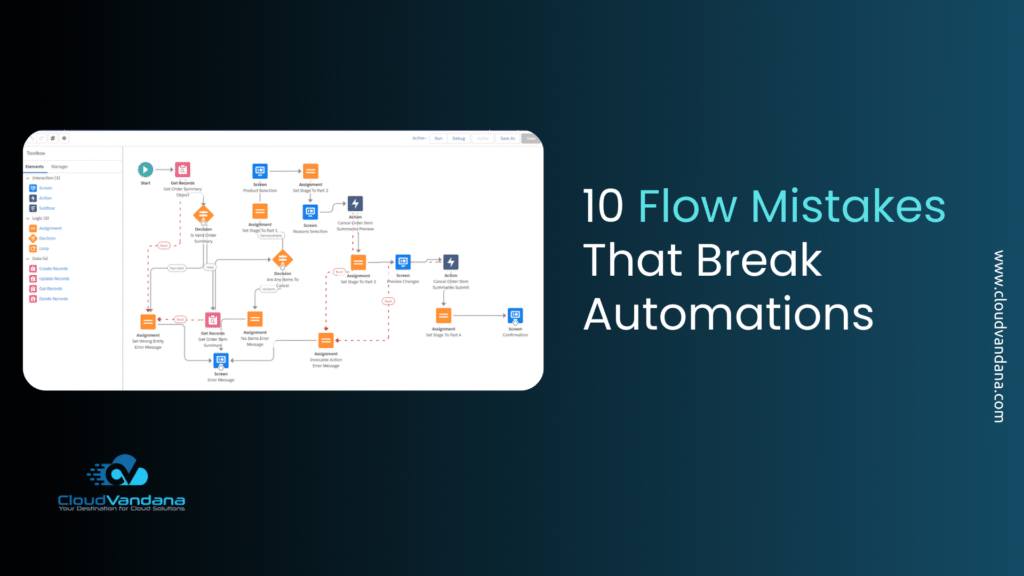
Salesforce Flow has become the most powerful automation engine in the Salesforce ecosystem. As Process Builder and Workflow Rules fade into retirement, Salesforce Flow stands as the unchallenged backbone of business logic, data processing, and operational efficiency. For many organizations, Salesforce Flow quietly powers mission-critical processes—from lead routing to approval logic, renewal cycles, customer onboarding, escalations, billing workflows, and case triage. Its visual interface empowers admins to build automation without code, but that same accessibility creates risk. When used without architectural discipline, even a seemingly harmless Salesforce Flow can introduce major system instability. The reason is simple: Salesforce Flow is powerful, but power without structure creates fragility. Broken automations do more than cause errors.They slow down user productivity, create inconsistent data, corrupt reporting, misroute leads, stall opportunity stages, disrupt integrations, and drain hours of admin time trying to diagnose failures. The cost of automation mistakes compounds quietly until a major process breaks—and suddenly the entire business feels the impact. This cornerstone guide outlines the 10 most damaging Salesforce Flow mistakes seen across real Salesforce implementations—and, more importantly, the strategies to prevent them. Each section is fully expanded to help you think like a Flow architect, not just a Flow builder. Let’s begin. Overloading a Single Salesforce Flow With Too Many Responsibilities One of the most common mistakes admins make is allowing a single flow to grow far beyond its initial purpose. A flow that begins as a simple automation often evolves into a sprawling ecosystem of branches, loops, decision nodes, and sub-paths. Over time, this “mega-flow” becomes nearly impossible to control. Every enhancement forces you to add more complexity to an already fragile structure. Why Overloaded Flows Break When a flow tries to handle multiple responsibilities, it becomes a single point of failure for several business processes. Any small update can disrupt multiple logic paths, leading to unpredictable behavior. New admins hesitate to modify the flow because the logic is dense and interconnected. Debugging becomes slow and frustrating because a single execution might trigger dozens of decisions that depend on one another. As the flow grows, performance suffers, and the risk of breaking critical processes increases dramatically. How to Avoid This Mistake The solution is simplicity through modular design. Instead of cramming every rule into one massive flow, split automations according to object, trigger type, and purpose. Create focused flows that each solve one problem well. Reusable logic should live in subflows, which make maintenance easier and promote consistency. Clear naming conventions help future admins understand your architecture instantly. A modular system is more resilient, easier to audit, and far less likely to collapse under pressure. Table of Contents Overloading a Single Salesforce Flow With Too Many Responsibilities Why Overloaded Flows Break How to Avoid This Mistake Allowing Salesforce Flows to Run Without Precise Entry Criteria Why Lack of Entry Criteria Breaks Automations How to Avoid This Mistake Why Loops Often Break Salesforce Flows How to Avoid This Mistake How Limits Break Automations How to Avoid This Mistake How Poor Queries Break Automations How to Avoid This Mistake How After-Save Misuse Causes Problems When to Use Before-Save vs After-Save How Conflicts Break Automations How to Avoid This Mistake Why Lack of Error Handling Breaks Processes How to Avoid This Mistake Why Hardcoding is Dangerous How to Avoid It How Poor Testing Breaks Automations How to Avoid This Mistake 1. What causes most Salesforce Flow failures? 2. How do I know if my Flow is too complex? 3. What’s the difference between before-save and after-save flows? 4. How can I prevent flows from overwriting each other’s updates? 5. What is the most common mistake admins make with flow loops? 6. Why are governor limits important for Flow builders? 7. How can I improve the performance of my Get Records queries? 8. Why do I need fault paths in every Flow? 9. What’s wrong with hardcoding values in Flows? 10. How should I test a Flow before deploying it? 11. How often should Flows be reviewed or audited? 12. Can multiple flows on the same object be a good thing? YOU MIGHT ALSO LIKE Allowing Salesforce Flows to Run Without Precise Entry Criteria Flows must fire only under the right conditions, yet many record-triggered flows launch on every update simply because admins did not refine their entry criteria. This creates a silent performance killer behind the scenes. Why Lack of Entry Criteria Breaks Automations When flows run too often, they operate on records even when nothing relevant has changed. This leads to CPU waste, slow save times, unintended updates, and cascading triggers of other Salesforce flows. These unnecessary executions can create automation loops where one flow triggers another, which updates the first again. Users experience confusing behavior, and admins struggle to pinpoint the origin because too many flows activate simultaneously. How to Avoid This Mistake Your flow’s entry criteria should be treated like a finely tuned security gate—opening only when conditions genuinely require the automation. Use ISCHANGED checks, value comparisons, and exclusion logic. For example: “Run only when Priority changes” or “Run only when the Stage moves to Closed Won.” By narrowing the entry, you dramatically reduce system strain and eliminate the chaos caused by unnecessary firing. Misusing Loops — the Silent Salesforce Flow Killer Loops are incredibly useful, but they are also the fastest way to trigger governor limit errors. Even a slight inefficiency inside a loop multiplies rapidly when processing large datasets. Why Loops Often Break Salesforce Flows Loops process one item at a time. If each iteration performs a SOQL query or DML operation, you will hit Salesforce’s limits almost immediately. A loop that runs smoothly when testing with 10 records may grind the system to a halt when running against 1,000 records. Nested loops amplify this risk exponentially. Every inefficiency becomes a multiplied liability, leading to limit violations and aborted transactions. How to Avoid This Mistake Effective loop design relies on bulk principles. Move queries outside the loop and retrieve all needed data in advance. Use a
How to Prepare Your Org for Salesforce AI: The Complete 2026 AI-First Readiness Guide
The Era of AI-First Salesforce Salesforce is entering a new era—one defined not by incremental enhancements, but by a fundamental re-engineering of the platform itself. In 2026, Salesforce will operate as an AI-first system, where intelligence is no longer a feature layered on top of workflows, but the very core that drives them. This shift signals the most significant architectural evolution in the platform’s history, and it will reshape how organizations design data, build processes, govern automation, train teams, and deliver customer experiences. Salesforce AI isn’t just a collection of predictive scores or conversational assistants. It represents a new operating model—one where the platform anticipates actions, identifies risks, surfaces insights, and initiates workflows without waiting for human input. Instead of reacting to user clicks, it interprets business context. Instead of relying on predefined rules, it reasons dynamically using patterns, signals, and unified data. The CRM you once configured will transform into an intelligent system capable of orchestrating interactions across sales, service, marketing, operations, and beyond. But intelligence comes with prerequisites. AI models depend on clean data, disciplined metadata, modern automations, and architecture that removes ambiguity. They cannot operate reliably on top of years of technical debt, fractured integrations, cluttered objects, or conflicting automations. Companies that fail to prepare will experience inconsistent predictions, unreliable behavior, and user distrust—while those who modernize early will unlock speed, accuracy, and entirely new levels of efficiency. Preparing for Salesforce AI is no longer optional. It is a strategic imperative. This guide breaks down the core pillars your organization must address—data integrity, automation modernization, governance, integration readiness, security, metadata structure, and user trust—to ensure you enter 2026 with an AI-ready Salesforce org capable of thriving in the next generation of enterprise intelligence. AI-First vs AI-Enabled: Why the Distinction Matters It is tempting to think, “We already use Einstein and some AI recommendations — we’re fine.” That mindset is dangerous. AI-enabled means intelligence is sprinkled around the edges of your existing processes. AI-first means intelligence is embedded into the very core of your workflows, data model, and user experiences. In an AI-enabled org, humans still make most of the decisions and ask most of the questions. AI is a helpful assistant. In an AI-first org, AI is the primary orchestrator of logic. It is constantly scanning behavioral signals, usage patterns, customer journeys, and data changes to decide what should happen next. Humans still approve, override, and refine — but they no longer have to manually initiate every step. This sounds subtle on paper, but in practice it is transformational. It demands clean, coherent data. It demands well-structured automations. It demands governance that is explicit, not informal. And it demands an architecture designed for adaptability rather than static configuration.ostly mistakes, and build an ecosystem that doesn’t just work today but scales effortlessly into the future. Table of Contents The Era of AI-First Salesforce AI-First vs AI-Enabled: Why the Distinction Matters Understanding Salesforce’s AI-First Direction What an AI-First Core Really Implies The Technology Backbone Behind the Shift Why Legacy Orgs Will Feel the Pain First The New Reality for Admins and Architects Moving from Reactive Support to Predictive Stewardship The Admin Skillset in an AI-First World Architects as AI System Designers Building the Right Data Foundation Taking Inventory of Your Data Landscape Eliminating Redundant, Obsolete, and Trivial Data Structuring Metadata for Machine Understanding The Role of a Unified Data Layer Governance for Responsible AI in Salesforce Formalizing AI Governance Structures Ethics, Transparency, and Explainability Controlling Model Access to Data Modernizing Integrations for Real-Time Intelligence Moving Beyond Batch and Point-to-Point Designing for Event-Driven Behavior Rebuilding Automation for the AI Era Retiring Legacy Automation Frameworks Designing AI-Compatible Flow Architectures Combining Event Triggers and AI Triggers Security, Compliance, and Observability in an AI-First Org Reinforcing Identity and Zero-Trust Principles Understanding Data Residency and Model Boundaries Telemetry, Logging, and Model Monitoring Budgeting, Resourcing, and Continuous Improvement Planning for Real Transformation Costs Building the Right Team Mix Establishing a Continuous Improvement Motion What a 2026-Ready Salesforce Org Looks Like Conclusion: Preparing Your Org to Thrive, Not Just Survive What an AI-First Core Really Implies The Technology Backbone Behind the Shift Why Legacy Orgs Will Feel the Pain First The New Reality for Admins and Architects Moving from Reactive Support to Predictive Stewardship The Admin Skillset in an AI-First World Architects as AI System Designers Building the Right Data Foundation Taking Inventory of Your Data Landscape Eliminating Redundant, Obsolete, and Trivial Data Structuring Metadata for Machine Understanding The Role of a Unified Data Layer Governance for Responsible AI in Salesforce Formalizing AI Governance Structures Ethics, Transparency, and Explainability Controlling Model Access to Data Modernizing Integrations for Real-Time Intelligence Moving Beyond Batch and Point-to-Point Designing for Event-Driven Behavior Rebuilding Automation for the AI Era Retiring Legacy Automation Frameworks Designing AI-Compatible Flow Architectures Combining Event Triggers and AI Triggers Security, Compliance, and Observability in an AI-First Org Reinforcing Identity and Zero-Trust Principles Understanding Data Residency and Model Boundaries Telemetry, Logging, and Model Monitoring Budgeting, Resourcing, and Continuous Improvement Planning for Real Transformation Costs Building the Right Team Mix Establishing a Continuous Improvement Motion What a 2026-Ready Salesforce Org Looks Like Conclusion: Preparing Your Org to Thrive, Not Just Survive YOU MIGHT ALSO LIKE Understanding Salesforce’s AI-First Direction What an AI-First Core Really Implies When Salesforce speaks of an AI-first core, it is pointing to an architecture where predictive and generative capabilities are tightly woven into objects, flows, data services, and user interfaces. Instead of isolated “AI features,” the platform itself behaves intelligently. That means: In this architecture, AI is not a passenger. It is effectively a second operating system layered on top of your CRM logic. The Technology Backbone Behind the Shift Under the hood, this shift is powered by several converging capabilities: real-time data unification, scalable model hosting, secure prompt and context handling, and low-code orchestration of AI-driven processes. You will see: All of this is extremely powerful — but only if your org is structurally ready to take advantage of it. Why Legacy Orgs
What Are the Key Benefits of Hiring a Salesforce Consulting Firm?
Introduction: Why Salesforce Success Isn’t Accidental Salesforce has evolved far beyond the boundaries of a traditional CRM. Today, it serves as a digital command center for thousands of organizations, enabling them to orchestrate customer relationships, automate operations, forecast revenue, and unify data at scale. Yet, despite this immense potential, many organizations fail to extract even a fraction of what Salesforce is capable of delivering. Not because they lack motivation, but because Salesforce is a powerful ecosystem—one that demands clarity, strategy, and technical discipline. The harsh truth is that Salesforce success rarely happens by accident. Companies who achieve transformative results do so because they approach Salesforce with a long-term, architectural mindset. They treat it as a growth investment, not a plug-and-play tool. This is precisely where a Salesforce consulting firm becomes not just helpful but essential. A consulting team enters with expertise, structure, and foresight—guiding the business through the labyrinth of decisions that ultimately define whether Salesforce becomes a growth engine or a costly underutilized database. In the modern era, where operational efficiency is no longer a luxury but a necessity, having expert partners by your side can be the difference between stagnation and breakthrough performance. Hiring a Salesforce consulting firm gives organizations the ability to innovate faster, avoid costly mistakes, and build an ecosystem that doesn’t just work today but scales effortlessly into the future. Table of Contents Introduction: Why Salesforce Success Isn’t Accidental Understanding the Complexity of Salesforce Ecosystems The multi-layered nature of Salesforce Why “out-of-the-box” is rarely enough Benefit #1: Strategic Clarity from Day One Aligning Salesforce with business goals Eliminating guesswork Benefit #2: Faster and Flawless Implementations Reducing setup friction Avoiding early-stage technical debt Benefit #3: Customizations That Actually Scale Building long-term architecture Designing future-proof workflows Benefit #4: Access to Certified Expertise Across Clouds Why certifications matter Multi-cloud proficiency Benefit #5: Industry-Specific Best Practices Finance Healthcare SaaS & Technology Benefit #6: Clean, Accurate, and Governed Data Data quality frameworks Master data consistency Benefit #7: Intelligent Automation and AI Enablement Salesforce Flow excellence Leveraging AI + Data Cloud Benefit #8: Stronger User Adoption and Change Enablement Training that sticks Proven adoption frameworks Benefit #9: Cost Optimization and ROI Maximization Reducing licensing waste Increasing revenue visibility Benefit #10: Robust System Security and Compliance Role hierarchies Data security & audits Benefit #11: Continuous Optimization and Support Release management Proactive monitoring Benefit #12: Integration Without Chaos API orchestration Third-party system alignment Benefit #13: Reduced Risk, Increased Operational Continuity Dependency reduction Risk mitigation strategies Benefit #14: Enhanced Reporting and Analytics Custom dashboards Actionable insights Benefit #15: Expert Guidance for Complex Projects CPQ Service Cloud transformations Benefit #16: Access to a Full Bench of Talent Admin + Developer + Architect synergy Avoiding single-point-of-failure Benefit #17: Predictable Timelines and Project Governance Milestone-based execution Strong documentation Conclusion: Why Working with a Salesforce Consulting Firm Pays for Itself 1. Why should a business hire a Salesforce consulting firm instead of doing everything in-house? 2. Are Salesforce consultants worth the investment for small and mid-sized businesses? 3. How do Salesforce consultants accelerate implementation timelines? 4. What certifications should a reliable Salesforce consulting firm have? 5. Can a consulting firm help fix an already messy or broken Salesforce setup? 6. How do consultants help improve user adoption? 7. What role do Salesforce consultants play in long-term system maintenance? 8. Do Salesforce consultants help with integrations? 9. How do consulting firms ensure Salesforce stays secure? 10. Can a Salesforce consulting firm help with automation and AI features? 11. How do consulting firms contribute to better reporting and analytics? 12. How do I choose the right Salesforce consulting partner? Why Choose CloudVandana YOU MIGHT ALSO LIKE Understanding the Complexity of Salesforce Ecosystems The multi-layered nature of Salesforce Salesforce is deceptively complex. At a glance, it looks like a clean interface with intuitive buttons and menus. But underneath lies a dense architecture of objects, relationships, automation engines, AI models, APIs, permission layers, security controls, and customizable workflows that interlock like a vast, dynamic puzzle. The platform spans multiple clouds—Sales, Service, Marketing, Experience, Commerce, CPQ, Industry Clouds—and each comes with its own set of rules and best practices. Add in AppExchange apps, third-party integrations, and industry-specific requirements, and the ecosystem becomes even more multifaceted. Understanding how these layers interact is critical. A small misconfiguration in automation can disrupt downstream processes. A poorly structured object model can create data chaos. A wrong permission assignment can expose sensitive information. The complexity isn’t meant to intimidate—it’s simply meant to illustrate why expert oversight is invaluable. Why “out-of-the-box” is rarely enough While Salesforce ships with powerful native capabilities, real-world business operations are rarely generic. Companies have unique processes, approval flows, hierarchies, compliance needs, integration touchpoints, and customer journeys. The “default” setup simply cannot reflect these nuances. Without customization, organizations encounter common symptoms: A consulting firm bridges this gap by translating business needs into architecture that is flexible, resilient, and purpose-built. They ensure that Salesforce doesn’t just mimic existing processes—it enhances them. Benefit #1: Strategic Clarity from Day One Aligning Salesforce with business goals Too many Salesforce implementations start tactically rather than strategically. Teams dive into creating fields, objects, and dashboards without clarifying why they need them in the first place. A consulting firm begins by understanding the organization’s real drivers: revenue targets, operational bottlenecks, customer pain points, compliance needs, and go-to-market priorities. From there, they architect Salesforce in a way that directly supports those objectives. Decisions become intentional rather than reactive. Every automation, every field, every dashboard exists for a reason—and that reason is tied directly to business outcomes. Eliminating guesswork Trial-and-error is expensive. Guessing how to configure Salesforce leads to inconsistencies, breaks, rework, and mounting frustration. Consultants eliminate this uncertainty. They’ve seen dozens of implementations, solved hundreds of unique problems, and understand how decisions ripple across the system. Instead of experimenting, teams execute with clarity. And clarity is powerful. It saves money, accelerates deployment, and removes friction from every stage of the Salesforce journey. Benefit #2: Faster and Flawless Implementations Reducing setup friction Implementing
How Agentforce is Changing Customer Service Automation
In today’s hyper-connected world, customer expectations are shifting rapidly. The baton has passed from mere reactive support to proactive, intelligent engagement. Service organisations are increasingly under pressure to do more — faster, smarter, with fewer resources. Enter the era of autonomous agents. Among the front-runners in this transformation is Agentforce, an AI agent platform designed to radically change how customer service automation is executed. In this article, we explore how Agentforce is rewriting the playbook for service automation, step by step. Table of Contents Understanding Agentforce: What it is and why it matters The evolution from chatbots to autonomous agents Agentforce’s core architecture: The Atlas Reasoning Engine Contextual intelligence: Leveraging 360-degree customer data Omnichannel orchestration: Breaking down silos in service Automation built for humans: Guardrails and human-in-the‐loop Self-service redefined: From FAQs to proactive resolution Intelligent case-deflection: How Agentforce reduces workload Escalation-aware routing: When human intervention kicks in Real-time decision making: Agents that act, not just respond Tailored customer journeys: Personalisation at scale Efficiency and cost-savings: The quantifiable impact Employee experience: Liberating service teams from routine Governance and trust: Ensuring safe, compliant automation Implementation considerations: Data, strategy and readiness Common pitfalls and mitigation strategies Future trends: Where autonomous service is headed Case study snapshot: Agentforce in action across industries Conclusion: Embracing the future of service automation Frequently Asked Questions (FAQs) YOU MIGHT ALSO LIKE Understanding Agentforce: What it is and why it matters Agentforce is not simply another chatbot or AI helper. It is a platform built to create autonomous agents that reason, act, and integrate with enterprise systems. According to its makers, these agents leverage the full breadth of customer data and business logic to handle tasks that go beyond scripted responses. The significance lies in two bold promises: first, to scale service operations without linear growth in personnel; second, to deliver customer experiences that approach human-level reasoning. For service teams contending with high volumes of inquiries, this shift is far from trivial. The promise is that the digital workforce doesn’t merely respond—it manages, anticipates and resolves. The evolution from chatbots to autonomous agents Traditional chatbots have served a useful role in basic customer service scenarios, but they fall short when it comes to intricate, multi-step processes or context-rich problems. Chatbots typically rely on decision trees, scripted flows, and predictable intent classifications. Their limitation: rigidity. In contrast, Agentforce represents the next step in automation evolution: the autonomous agent. These agents can make decisions, execute workflows, interface with backend systems, and learn from outcomes. This shift from reactive scripts to proactive agents marks a paradigm change in service automation. For example, instead of simply answering “What is my order status?”, an autonomous agent can interpret the entire customer context, act on the customer’s behalf (such as rescheduling a delivery or updating a subscription) and then follow-through to complete resolution. Agentforce’s core architecture: The Atlas Reasoning Engine At the heart of Agentforce lies a powerful core architecture. A key component is described as the “Atlas Reasoning Engine”. This engine breaks down user requests into smaller tasks, reasons through each step, and orchestrates actions across systems. The orchestration is critical: where older automation platforms might stop at recognising a request and giving a recommendation, Agentforce goes further—it chooses an action, executes it (for instance via an API, workflow or prompt), assesses the outcome and then iterates as needed. In effect, it becomes a digital labourer that doesn’t wait for human intervention at every turn. The architecture supports branching logic, context-tracking and dynamically adjusting the plan of action. Contextual intelligence: Leveraging 360-degree customer data One of the key differentiators is the integration with a comprehensive customer view. Agentforce is built into the broader ecosystem (for example, with Salesforce Service Cloud and Customer 360) and is able to access customer records, engagement history, purchase history, service interactions and more. This “360-degree” intelligence enables the agent to personalise interactions: it knows the customer’s prior issues, channel preferences, product history, even likely next-steps based on data. That allows for responses that aren’t generic—but bespoke—and resolutions that go further than simply “providing information”. The agent can pre-empt needs, suggest solutions before the customer even asks, and shift the service model from reactive to anticipatory. Omnichannel orchestration: Breaking down silos in service Customers expect service wherever they are — chat, email, voice, social. And they expect continuity: starting on Chat, moving to Email, then picking up on Phone and not having to repeat themselves. Agentforce facilitates true omnichannel orchestration by recognising context across channels and maintaining continuity. What makes this significant is not only the variety of channels but the depth of context carried over: the agent remembers that the customer already indicated “delivery problem on last order”, keeps that in mind regardless of the channel, and proceeds accordingly. The silos between channels are broken, giving a smoother experience and reducing friction, which is a major contributor to customer dissatisfaction. Automation built for humans: Guardrails and human-in-the‐loop Despite its autonomy, Agentforce is designed with human oversight and safety in mind. Guardrails ensure that agents don’t stray into unsafe territory, and human-in-the-loop mechanisms provide assurance. YouTube In practice, this means that when an agent encounters a scenario outside its confidence bounds, it escalates to a human or asks for human approval. This blending of automation and human judgement ensures that the organisation maintains control, avoids cascading errors, and can rely on the agent’s outputs. For service leaders, this is critical: you’re not giving up control, you’re augmenting capacity. Self-service redefined: From FAQs to proactive resolution Traditional self-service has often meant static knowledge bases, FAQs, generic responses and maybe a chat widget. That’s no longer enough. With Agentforce, self-service is elevated: the agent proactively engages users, surfaces answers based on real-time context, and completes actions on their behalf. Imagine a scenario where a user logs in to a portal, the agent already knows their unstable subscription status, prompts them with “Would you like to update your plan?” or “I see your delivery is delayed; can I reschedule or offer compensation?”