Why “Cloud Computing Google Cloud” Matters in 2026
Cloud computing is no longer a technical upgrade. It is an operating model shift.
A decade ago, cloud decisions were driven by infrastructure constraints. Data centers were expensive. Hardware refresh cycles were slow. Scaling required procurement. Today, the conversation has changed. Cloud is no longer about escaping on-prem limitations. It is about designing for intelligence, resilience, and speed from day one.
When businesses search for cloud computing Google Cloud, they are not looking for dictionary definitions. They are looking for clarity in a landscape that has become more complex, not less. They want to understand:
- How to architect systems that scale without spiraling costs
- How to build secure foundations in an AI-accelerated world
- How to align infrastructure with real business outcomes
How to avoid technical debt disguised as digital transformation
Cloud computing in 2026 sits at the intersection of infrastructure, data strategy, artificial intelligence, cybersecurity, and governance. Decisions made at the infrastructure layer now influence competitive positioning at the boardroom level.
That is where Google Cloud becomes strategically significant.
Google Cloud has evolved from being perceived as a “third option” behind other hyperscalers to becoming a deliberate architectural choice for enterprises prioritizing analytics, Kubernetes-native environments, AI integration, and global performance reliability. It is not just competing on infrastructure scale. It is competing on intelligence, automation, and developer efficiency.
Several shifts explain why cloud computing Google Cloud matters more than ever in 2026:
1. AI Has Moved from Experimentation to Execution
Artificial intelligence is no longer confined to innovation labs. It is embedded into customer service platforms, sales forecasting engines, fraud detection systems, and operational dashboards. Infrastructure must now support AI workloads natively, not as an afterthought.
Google Cloud’s investments in data infrastructure and AI platforms make it particularly relevant for enterprises that view AI as a structural capability rather than a feature add-on.
2. Data Has Become the Core Enterprise Asset
In earlier cloud migrations, applications led the conversation. Today, data does.
Organizations are consolidating fragmented systems, modernizing data warehouses, and seeking real-time insights. Scalable analytics capabilities, such as serverless data platforms, are becoming foundational rather than optional.
Cloud decisions now determine how well an enterprise can harness its own information.
3. Security Expectations Have Intensified
Regulatory environments are tightening globally. Cyber threats are becoming more sophisticated. Boards now demand demonstrable security posture visibility.
Cloud computing is no longer assumed secure simply because it is hosted by a large provider. Enterprises must architect security intentionally — with layered identity controls, policy enforcement, encryption standards, and continuous monitoring.
Google Cloud’s shared responsibility model requires organizations to design governance structures proactively. Infrastructure without governance becomes risk at scale.
4. Scalability Must Be Predictable, Not Reactive
Elastic scaling is often marketed as automatic. In reality, unmanaged elasticity can lead to unpredictable cost expansion.
Enterprises in 2026 require scalable environments that balance performance with cost governance. This demands architectural maturity. Resource tagging, budget monitoring, autoscaling policies, and FinOps practices must be built into the design phase.
Cloud computing Google Cloud matters because it provides the tooling — but the value emerges only when strategy guides implementation.
5. Globalization and Remote Operations Are Permanent
Distributed teams, global customer bases, and region-specific compliance requirements are now standard operational realities.
Google Cloud’s global infrastructure allows organizations to deploy workloads closer to users while maintaining redundancy and disaster recovery capabilities. Latency, uptime, and resilience are no longer technical KPIs. They are customer experience determinants.
What Is Cloud Computing? A Strategic Overview
Cloud computing is the delivery of computing services — servers, storage, databases, networking, analytics, and intelligence — over the internet.
But for enterprise leaders, that definition barely scratches the surface.
Cloud computing is not simply a hosting alternative. It is a shift in how organizations design, fund, operate, and evolve their technology environments. It changes not just where systems run, but how decisions are made, how risk is managed, and how innovation is delivered.
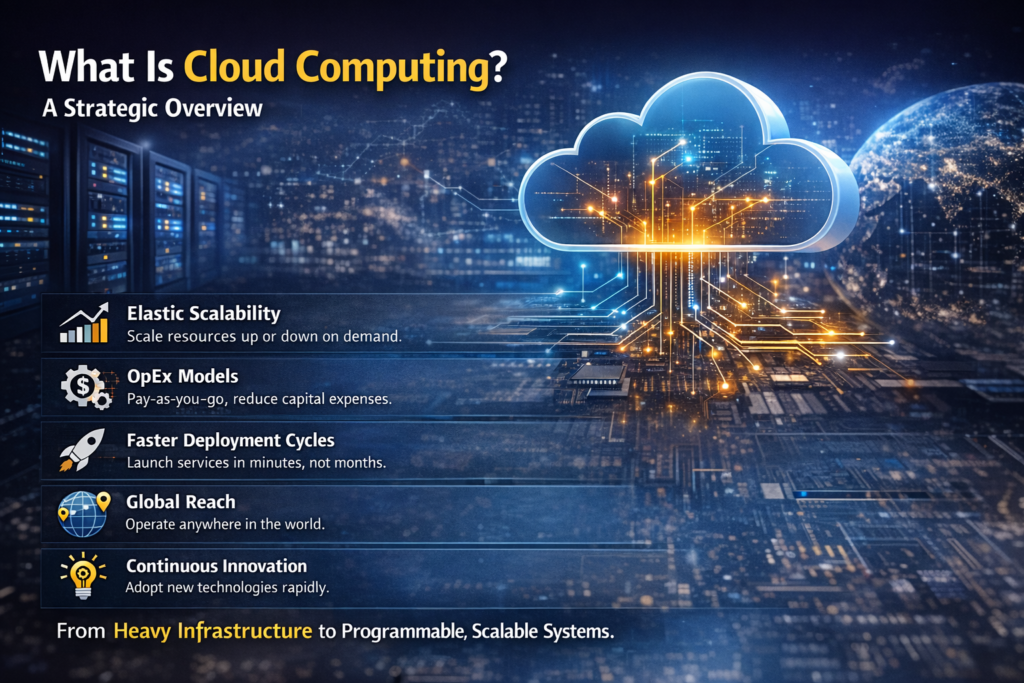
At a strategic level, cloud computing enables several structural advantages.
Elastic Scalability
Traditional infrastructure forces organizations to predict demand months or even years in advance. Overestimate, and capital is wasted. Underestimate, and performance suffers.
Cloud computing eliminates that rigidity.
Resources scale up during peak usage and scale down when demand drops. Capacity becomes dynamic rather than fixed. This elasticity is especially critical in industries with seasonal demand, product launches, digital campaigns, or unpredictable growth patterns.
Scalability becomes an architectural feature, not an operational emergency response.
Operational Expenditure Models
In traditional IT environments, infrastructure required significant capital expenditure. Hardware purchases, data center maintenance, cooling systems, and networking equipment demanded upfront investment.
Cloud computing converts infrastructure into an operational expense model. Organizations pay for what they use.
This financial shift improves cash flow flexibility, reduces procurement cycles, and aligns technology spending more closely with business growth. Infrastructure becomes an adjustable lever rather than a sunk cost.
Faster Deployment Cycles
Provisioning a new server once required procurement approvals, hardware delivery, installation, and configuration. That process could take weeks.
In cloud environments, infrastructure can be deployed in minutes.
This dramatically accelerates product development, experimentation, and time-to-market. Development teams can test new ideas without waiting for infrastructure approval. Innovation cycles compress.
Speed becomes embedded in the operating model.
Global Reach
Cloud providers operate global networks of regions and availability zones. Applications can be deployed closer to customers, reducing latency and improving user experience.
For expanding enterprises, this means entering new markets without building local data centers. Global expansion becomes a configuration decision rather than a construction project.
Geographic presence transforms from barrier to opportunity.
Continuous Innovation
Cloud platforms continuously introduce new services — analytics tools, AI capabilities, security enhancements, automation frameworks.
Organizations running on cloud infrastructure can adopt new technologies incrementally without rearchitecting entire environments.
Innovation becomes cumulative rather than disruptive.
Understanding Google Cloud Platform (GCP)
Google Cloud Platform (GCP) is Google’s comprehensive suite of cloud services designed to help organizations build, deploy, and scale applications on a global infrastructure.
At a surface level, GCP provides:
- Infrastructure as a Service (IaaS)
- Platform as a Service (PaaS)
- Serverless environments
- Data analytics tools
- AI and machine learning platforms
But those categories only describe what it offers. They do not fully explain why enterprises choose it.
Infrastructure as a Service (IaaS)
GCP’s IaaS layer allows organizations to provision virtual machines, storage, and networking resources on demand. Instead of purchasing physical servers, businesses can deploy compute instances that scale dynamically.
This model gives enterprises control over operating systems, configurations, and network architecture — while eliminating the burden of managing physical hardware.
Platform as a Service (PaaS)
For teams that prefer to focus on application logic rather than infrastructure management, GCP offers managed platforms. Developers can deploy applications without worrying about server maintenance, scaling configurations, or patch management.
This reduces operational overhead and accelerates development cycles.
Serverless Environments
Serverless services allow organizations to run code without provisioning or managing servers at all. Compute resources automatically scale based on request volume.
This model is particularly valuable for event-driven architectures, APIs, and microservices where workload patterns are unpredictable.
Serverless design reduces idle infrastructure costs and simplifies deployment pipelines.
Data Analytics Tools
One of Google Cloud’s strongest differentiators lies in its analytics capabilities.
With serverless data warehousing, real-time processing, and large-scale data querying, organizations can derive insights without managing database clusters. Advanced analytics tools enable enterprises to process structured and unstructured data at scale.
Data moves from being stored to being actively leveraged.
AI and Machine Learning Platforms
Google Cloud integrates AI capabilities directly into its platform. From pre-trained APIs to custom model training environments, enterprises can build and deploy machine learning systems without constructing underlying infrastructure from scratch.
AI becomes embedded into workflows rather than layered on top of them.
Unlike traditional hosting providers, Google Cloud is built on the same global infrastructure that powers products such as Google Search, YouTube, and Gmail. This infrastructure has been engineered for planetary-scale performance, reliability, and low latency.
That matters.
It means the backbone supporting enterprise workloads has already been tested at massive scale. Traffic spikes, distributed user bases, and real-time data demands are not edge cases. They are design assumptions.
For enterprises evaluating cloud computing Google Cloud in 2026, GCP represents more than a collection of services. It represents an ecosystem designed for:
- High availability
- Intelligent automation
- Data-first architecture
- Developer-centric deployment
- Integrated security
The platform is not merely a hosting environment. It is a programmable digital foundation capable of supporting modern applications, global operations, and AI-driven strategies.
In a cloud landscape crowded with options, GCP’s differentiation lies not only in scale — but in how seamlessly infrastructure, analytics, and intelligence are woven together.
Infrastructure as a Service (IaaS)
GCP’s IaaS layer allows organizations to provision virtual machines, storage, and networking resources on demand. Instead of purchasing physical servers, businesses can deploy compute instances that scale dynamically.
This model gives enterprises control over operating systems, configurations, and network architecture — while eliminating the burden of managing physical hardware.
Platform as a Service (PaaS)
For teams that prefer to focus on application logic rather than infrastructure management, GCP offers managed platforms. Developers can deploy applications without worrying about server maintenance, scaling configurations, or patch management.
This reduces operational overhead and accelerates development cycles.
Serverless Environments
Serverless services allow organizations to run code without provisioning or managing servers at all. Compute resources automatically scale based on request volume.
This model is particularly valuable for event-driven architectures, APIs, and microservices where workload patterns are unpredictable.
Serverless design reduces idle infrastructure costs and simplifies deployment pipelines.
Data Analytics Tools
One of Google Cloud’s strongest differentiators lies in its analytics capabilities.
With serverless data warehousing, real-time processing, and large-scale data querying, organizations can derive insights without managing database clusters. Advanced analytics tools enable enterprises to process structured and unstructured data at scale.
Data moves from being stored to being actively leveraged.
AI and Machine Learning Platforms
Google Cloud integrates AI capabilities directly into its platform. From pre-trained APIs to custom model training environments, enterprises can build and deploy machine learning systems without constructing underlying infrastructure from scratch.
AI becomes embedded into workflows rather than layered on top of them.
Unlike traditional hosting providers, Google Cloud is built on the same global infrastructure that powers products such as Google Search, YouTube, and Gmail. This infrastructure has been engineered for planetary-scale performance, reliability, and low latency.
That matters.
It means the backbone supporting enterprise workloads has already been tested at massive scale. Traffic spikes, distributed user bases, and real-time data demands are not edge cases. They are design assumptions.
For enterprises evaluating cloud computing Google Cloud in 2026, GCP represents more than a collection of services. It represents an ecosystem designed for:
- High availability
- Intelligent automation
- Data-first architecture
- Developer-centric deployment
- Integrated security
The platform is not merely a hosting environment. It is a programmable digital foundation capable of supporting modern applications, global operations, and AI-driven strategies.
In a cloud landscape crowded with options, GCP’s differentiation lies not only in scale — but in how seamlessly infrastructure, analytics, and intelligence are woven together.
The Evolution of Cloud Computing and Google’s Role
Cloud computing began as virtualization.
It evolved into elastic infrastructure.
Now, it is becoming an intelligent platform.
Google’s differentiation lies in:
- Kubernetes leadership (Google created Kubernetes)
- BigQuery for serverless analytics
- AI-first infrastructure design
Google Cloud emphasizes automation and managed services over manual configuration.
Core Components of Google Cloud Infrastructure
At its foundation, cloud computing Google Cloud rests on:
- Compute
- Storage
- Networking
- Identity
- Security
- Data services
Each layer is modular. Each can scale independently.
Google Cloud Global Architecture and Regions
Google Cloud operates across global regions and zones.
Each region contains multiple availability zones. This ensures:
- High availability
- Disaster recovery
- Reduced latency
- Geographic redundancy
Compute Services in Google Cloud
Google Cloud offers:
- Compute Engine (VMs)
- Kubernetes Engine (GKE)
- Cloud Run (serverless containers)
- App Engine (PaaS)
Each serves a different architectural purpose.
Enterprises must align compute selection with workload characteristics — not trends.
Storage Solutions in Google Cloud
Storage options include:
- Cloud Storage (object storage)
- Persistent Disk
- Filestore
- Archive tiers
Storage strategy impacts cost, performance, and compliance.
Networking in Google Cloud
Google Cloud networking includes:
- Virtual Private Cloud (VPC)
- Load balancing
- Cloud CDN
- Interconnect services
Google’s global backbone reduces latency between regions.
Google Cloud Security and Compliance Framework
Security in cloud computing Google Cloud is not a single control. It is a layered model designed to protect infrastructure, data, identities, and workloads across the entire lifecycle.
Modern enterprises cannot afford to treat security as a feature toggle. In 2026, security posture directly impacts customer trust, regulatory standing, and even AI reliability. Every architectural decision influences exposure.
Google Cloud follows a shared responsibility model. Google secures the underlying infrastructure. The customer secures configurations, access controls, workloads, and data governance.
Understanding that boundary is essential.
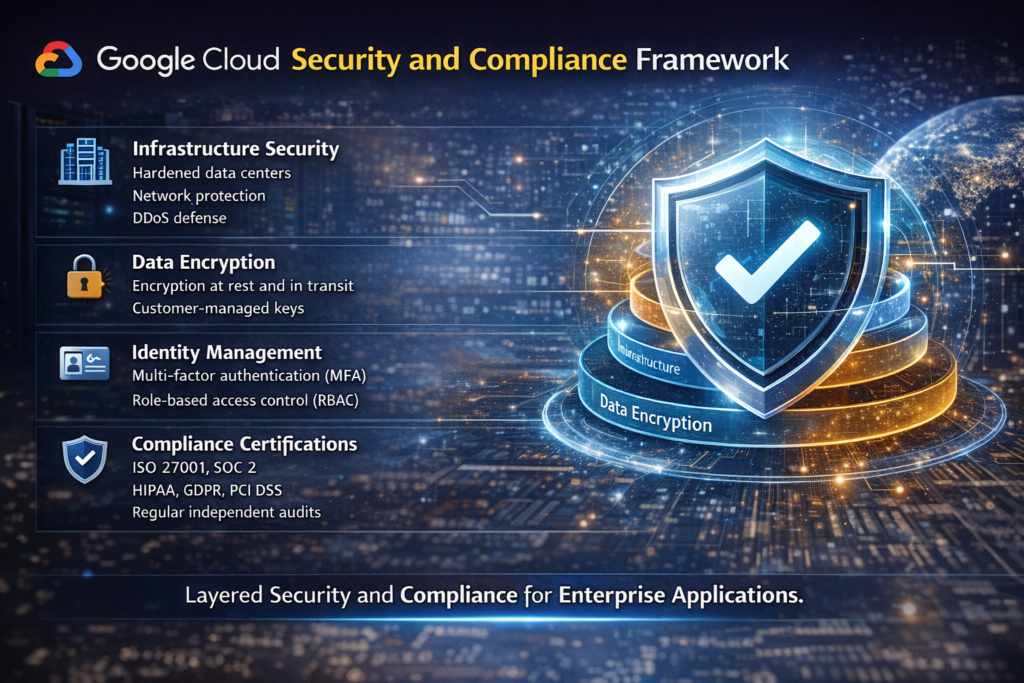
Infrastructure Security
At the foundational layer, Google Cloud secures its global infrastructure:
- Hardened data centers
- Custom-built hardware
- Secure boot processes
- Distributed denial-of-service (DDoS) protection
- Physical access controls
This infrastructure is the same backbone supporting high-scale services like search and streaming platforms. It is engineered for resilience and fault tolerance.
However, infrastructure security does not eliminate risk. It establishes the base upon which customers must build responsibly.
Data Encryption at Rest and in Transit
Data security in Google Cloud operates on two essential principles:
- Encryption at rest
- Encryption in transit
By default, data stored in Google Cloud services is encrypted at rest. Network communications between services are encrypted in transit.
Enterprises can go further by implementing:
- Customer-managed encryption keys
- Hardware security modules
- Key rotation policies
- Data classification tagging
Encryption alone does not guarantee compliance. It must be integrated into a broader governance framework.
Identity and Access Management
Identity is the new perimeter.
In distributed cloud environments, network boundaries matter less than access controls. Misconfigured permissions remain one of the most common causes of breaches in cloud environments.
Effective identity management includes:
- Role-based access control (RBAC)
- Principle of least privilege
- Multi-factor authentication
- Service account governance
- Periodic access reviews
Over-permissioning accumulates silently. Without regular audits, environments become vulnerable through privilege sprawl.
Security maturity begins with disciplined identity architecture.
Compliance Certifications and Regulatory Alignment
Google Cloud maintains compliance certifications across major global frameworks, including:
- ISO standards
- SOC reports
- HIPAA compliance support
- GDPR alignment
These certifications demonstrate infrastructure-level compliance readiness. But compliance responsibility does not transfer automatically to the customer.
Organizations must still:
- Configure audit logging
- Implement retention policies
- Document data flows
- Monitor regulatory changes
Compliance is an operational discipline, not a vendor attribute.
Identity and Access Management (IAM) Strategy
IAM defines:
- Who can access what
- Under what conditions
- With which permissions
Over-permissioned roles remain a common risk in cloud implementations.
Least privilege must be enforced from day one.
Cloud Computing Google Cloud Migration Strategy
Migration begins with assessment:
- Application inventory
- Dependency mapping
- Performance baselines
- Security review
Migration is not movement. It is redesign.
Lift-and-Shift vs Modernization
Lift-and-shift copies existing architecture.
Modernization re-architects for scalability.
Short-term speed vs long-term efficiency.
Most enterprises require hybrid approaches.
Hybrid and Multi-Cloud Architectures
Google Cloud supports a range of deployment models that reflect today’s enterprise reality. Very few organizations operate entirely in one environment. Legacy systems exist. Regulatory constraints apply. Mergers introduce overlapping infrastructures. Digital transformation rarely begins from a clean slate.
That is why Google Cloud supports:
- On-prem integrations
- Multi-cloud APIs
- Anthos for hybrid deployments
But the presence of hybrid capability does not mean hybrid should be the long-term destination.
On-Prem Integrations
Many enterprises still run mission-critical systems in their own data centers. These may include legacy ERP platforms, regulatory-bound databases, or latency-sensitive systems.
Google Cloud enables integration between on-prem environments and cloud workloads through secure connectivity options such as:
- Dedicated interconnects
- VPN connections
- Private networking configurations
This allows organizations to extend workloads into the cloud without immediately decommissioning legacy systems. Data can synchronize across environments. Applications can interact across boundaries.
Hybrid, at this stage, reduces disruption.
But integration must be intentional. Poorly mapped dependencies between on-prem and cloud environments often create latency bottlenecks and operational complexity.
Multi-Cloud APIs
Enterprises sometimes adopt multiple cloud providers, whether by design or through acquisitions. Multi-cloud strategies aim to avoid vendor lock-in, improve resilience, or leverage provider-specific strengths.
Google Cloud supports multi-cloud interaction through APIs, containerization, and Kubernetes-based portability.
However, multi-cloud introduces governance challenges:
- Consistent IAM policies
- Unified monitoring
- Cost visibility across providers
- Standardized security enforcement
Without strong architecture, multi-cloud becomes fragmentation disguised as flexibility.
Anthos for Hybrid Deployments
Google’s Anthos platform enables organizations to manage applications across on-prem data centers and multiple clouds using a unified control plane.
Built on Kubernetes principles, Anthos allows:
- Consistent policy enforcement
- Centralized management
- Application portability
- Standardized deployment pipelines
Anthos reduces operational silos between environments. It helps enforce governance uniformly.
But it does not eliminate architectural trade-offs.
Hybrid Architecture: A Phase, Not a Destination
Hybrid architecture is often transitional, not permanent.
Organizations typically adopt hybrid strategies during:
- Cloud migration phases
- Gradual modernization initiatives
- Compliance-driven partial retention of on-prem systems
- Acquisition-driven integration periods
The risk arises when hybrid becomes default rather than deliberate.
Maintaining dual infrastructures indefinitely increases:
- Operational overhead
- Security complexity
- Identity sprawl
- Cost unpredictability
- Monitoring fragmentation
Strategic cloud adoption requires clarity on which workloads belong where — and why.
In many cases, hybrid architecture should serve as a bridge toward modernization. Not as a long-term comfort zone.
Cloud computing Google Cloud provides the tooling for hybrid and multi-cloud flexibility. The competitive advantage, however, comes from architectural discipline.
Hybrid is a strategy when it is intentional.
It becomes a liability when it is accidental.
The most mature organizations treat hybrid as a step in a roadmap — not the roadmap itself.
AI and Machine Learning on Google Cloud
Google Cloud leads in:
- Vertex AI
- Pre-trained models
- Custom ML pipelines
- Data labeling services
AI without clean data fails.
Cloud AI must be outcome-driven.
Data Analytics and BigQuery
BigQuery enables:
- Serverless data warehousing
- Real-time analytics
- SQL-based querying at scale
It reduces infrastructure management overhead.
DevOps and CI/CD
Cloud-native DevOps is not simply about faster deployments. It is about building systems that are repeatable, observable, and resilient under scale.
In the context of cloud computing Google Cloud, DevOps becomes tightly integrated with infrastructure, security, and governance. The platform is designed to support continuous integration, continuous delivery, and automated operations — but tooling alone does not guarantee stability.
Google Cloud enables cloud-native DevOps through a suite of services and architectural principles.
Cloud Build
Cloud Build allows teams to automate the build and deployment process. Code changes can trigger:
- Compilation
- Container image creation
- Testing workflows
- Deployment to staging or production environments
This automation reduces manual steps and shortens release cycles.
However, speed must be accompanied by validation gates. Without defined quality thresholds and review processes, rapid deployment increases risk exposure.
Artifact Registry
Artifact Registry provides secure storage for container images, packages, and deployment artifacts.
Centralized artifact management ensures:
- Version traceability
- Controlled access
- Secure image distribution
- Reduced supply chain risk
Without a structured artifact repository, teams risk deploying unverified or outdated components.
Infrastructure as Code (IaC)
Infrastructure as Code transforms infrastructure configuration into version-controlled definitions.
Instead of manually provisioning networks or compute instances, teams define environments through code templates. These templates can be reviewed, tested, and replicated across regions.
IaC introduces consistency.
It reduces configuration drift.
It improves auditability.
It strengthens disaster recovery readiness.
But poorly written infrastructure code can propagate errors at scale. Governance and peer review are essential.
Automated Testing Pipelines
Automated testing ensures that every code change passes predefined validation checks before reaching production.
Testing pipelines typically include:
- Unit tests
- Integration tests
- Security scans
- Performance benchmarks
In cloud-native environments, automated testing protects against cascading failures introduced by rapid release cycles.
Common Implementation Mistakes
Frequent failures include:
- No tagging strategy
- Poor IAM controls
- Over-provisioned resources
- No cost monitoring
- Ignoring backup policies
These are preventable with early governance.
Governance Best Practices
Effective governance includes:
- Policy enforcement
- Budget alerts
- Access reviews
- Compliance audits
Governance enables scale.
Cost Optimization and FinOps
Cloud spending rarely becomes a problem overnight.
It grows quietly. A new environment here. A larger machine type there. A test cluster that was never deleted. A scaling rule that was never revisited.
By the time leadership asks why costs increased, the architecture has already absorbed inefficiencies.
This is where FinOps becomes essential.
In the context of cloud computing Google Cloud, FinOps is not simply cost-cutting. It is a discipline that aligns:
- Engineering
- Finance
- Operations
FinOps ensures that cloud spending reflects business value — not technical drift.
Why FinOps Matters in Google Cloud
Google Cloud operates on consumption-based pricing. This model provides flexibility, but it also removes the natural friction that once slowed infrastructure expansion.
Engineers can provision resources instantly.
Finance sees variable monthly invoices.
Operations manage uptime and performance.
Without alignment, each team optimizes for its own objective.
FinOps creates a shared accountability model.
Engineering gains cost visibility.
Finance gains technical transparency.
Operations gain performance awareness.
Cloud cost becomes a measurable performance indicator, not an afterthought.
Cloud Security Posture Management
Continuous monitoring tools detect:
- Misconfigurations
- Open ports
- Excess privileges
- Policy violations
Security is continuous, not periodic.
Real-World Use Cases
Organizations use cloud computing Google Cloud for:
- E-commerce scaling
- SaaS application hosting
- AI analytics
- Disaster recovery
- Global collaboration platforms
Future Trends in Cloud Computing and Google Cloud
Emerging trends:
- AI-native architecture
- Zero-trust security
- Serverless dominance
- Carbon-aware cloud operations
Google Cloud invests heavily in sustainability initiatives.
Why Enterprises Need a Google Cloud Consulting Partner
Cloud infrastructure is complex.
Architecture mistakes compound over time.
A consulting partner ensures:
- Strategic alignment
- Security design
- Cost control
- Migration precision
- Long-term scalability
Conclusion: Building a Future-Ready Cloud Strategy
Cloud computing Google Cloud is not about servers. It is about capability.
Enterprises that architect intentionally gain:
- Agility
- Data intelligence
- Competitive advantage
- Operational resilience
Those that migrate blindly inherit technical debt.
At CloudVandana, we help organizations design, migrate, secure, and optimize their Google Cloud environments with precision. From architecture blueprinting to AI-ready data foundations, we align cloud infrastructure with measurable business outcomes.
If you are planning a Google Cloud migration or looking to optimize your current setup, let’s build a strategy that scales intelligently.
FAQs
1. What is cloud computing Google Cloud?
Cloud computing Google Cloud refers to using Google’s cloud platform to deliver computing resources like servers, storage, networking, AI, and analytics over the internet.
2. Is Google Cloud better than AWS?
It depends on workload. Google Cloud excels in data analytics, Kubernetes, and AI-driven environments.
3. How secure is Google Cloud?
Google Cloud provides enterprise-grade encryption, IAM controls, and compliance certifications.
4. What is BigQuery used for?
BigQuery is used for serverless data warehousing and large-scale analytics.
5. How do I migrate to Google Cloud?
Begin with assessment, dependency mapping, and architectural planning.
6. What is hybrid cloud in Google Cloud?
Hybrid cloud integrates on-prem infrastructure with Google Cloud services.
7. How can I reduce Google Cloud costs?
Use rightsizing, committed use discounts, autoscaling, and cost monitoring tools.
8. Is Google Cloud good for AI?
Yes. Google Cloud offers Vertex AI and scalable ML infrastructure.

Atul Gupta is CloudVandana’s founder and an 8X Salesforce Certified Professional who works with globally situated businesses to create Custom Salesforce Solutions.
Atul Gupta, a dynamic leader, directs CloudVandana’s Implementation Team, Analytics, and IT functions, ensuring seamless operations and innovative solutions.
YOU MIGHT ALSO LIKE
Signs Your Salesforce Org Needs an Optimization Audit
Salesforce Performance Optimization Checklist for 2026
Cloud Computing Google Cloud: The Complete Enterprise Guide (2026 Edition)
What Does It Really Mean to Use Salesforce as a CRM?
Agentforce vs Traditional Automation: What’s the Real Difference?