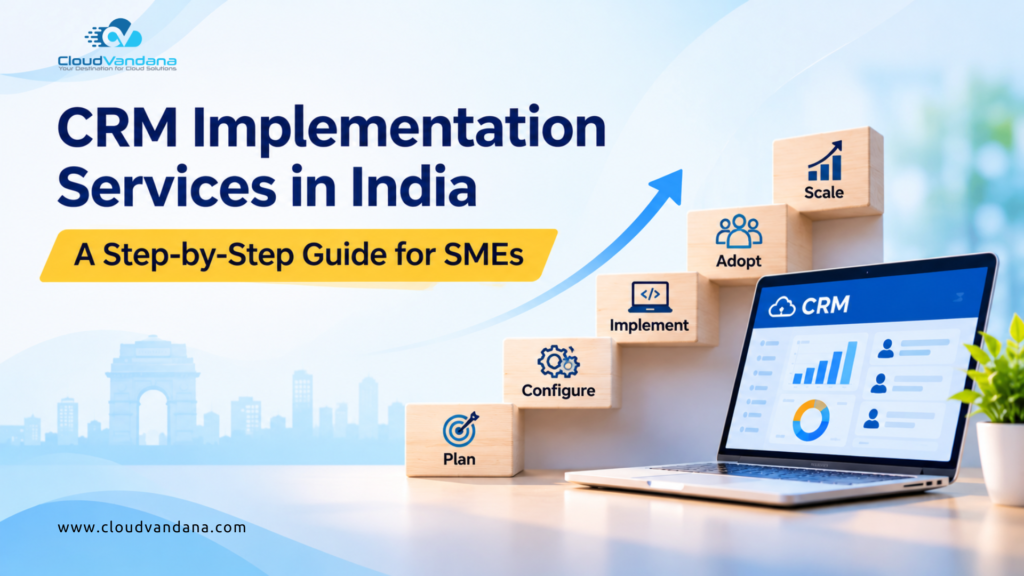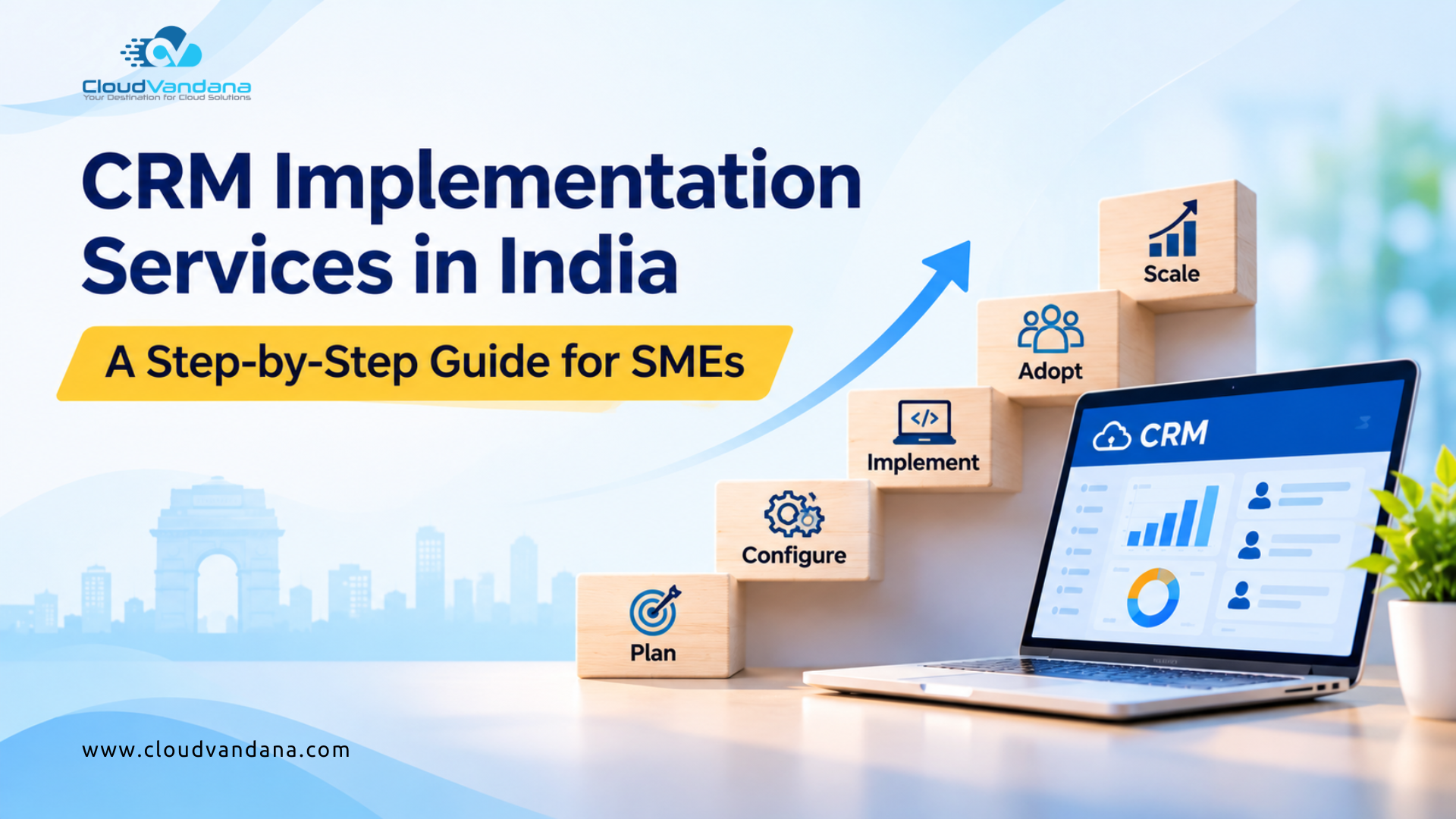
CRM Implementation Services in India
What Are CRM Implementation Services?
CRM implementation services are the end-to-end work of planning, configuring, customising, integrating, migrating data into, and training your team on a Customer Relationship Management (CRM) system, so that it fits how your business actually sells, serves and bills. For Indian SMEs, a well-run implementation typically takes 4 to 12 weeks, follows 10 clear steps (goals, process mapping, CRM selection, configuration, data migration, integrations, testing, training, go-live, optimisation), and works best when led by an experienced implementation partner rather than done in-house with no CRM expertise.
This guide walks you through every step in plain language, with the mistakes we see SMEs make most often, so you can implement a CRM that your team actually uses.
1. Why Indian SMEs Need a Structured CRM Implementation
Most small and mid-sized businesses in India start with spreadsheets, WhatsApp groups, email threads and a few disconnected tools. That works until it doesn’t: leads are lost when a salesperson leaves, quotations sit in someone’s inbox, invoices don’t match orders, and the owner has no single view of the pipeline.
A CRM fixes this, but only if it is implemented properly. Buying a licence is not implementation. A CRM that is installed with default settings and no process thinking usually ends up as an expensive contact list.
A structured implementation gives SMEs:
- One source of truth for leads, customers, quotes, orders and service history
- Faster follow-ups through automated reminders, assignment rules and workflows
- Cross-team visibility across sales, marketing, operations, finance and HR
- Reliable forecasting based on real pipeline data, not guesswork
- A foundation for automation and AI, such as lead scoring, smart suggestions and automated reporting
2. The 10-Step CRM Implementation Process for SMEs
Step 1: Define business goals and success metrics
Start with outcomes, not features. Ask: What problem are we solving? Common SME goals include reducing lead leakage, shortening the sales cycle, automating quotations and invoicing, improving collections, or getting a reliable monthly forecast.
Turn each goal into a measurable KPI, for example:
- Lead response time under 30 minutes
- Quote-to-order conversion improved by a target percentage
- Zero leads without an owner
- Weekly pipeline report generated automatically
Output of this step: a one-page goals and KPI document signed off by leadership.
Step 2: Map your current processes and pain points
Sit with the people who do the work: sales, marketing, operations, finance and support. Document how a lead currently becomes a customer, how quotes are created, who approves discounts, how orders are handed over and how payments are followed up.
This is where an experienced consultant adds the most value. Business process consulting at this stage prevents you from automating a broken process.
Output: current-state process maps, a pain-point list and a prioritised requirements list (must-have, should-have, nice-to-have).
Step 3: Choose the right CRM platform
There is no single best CRM for every SME. Evaluate on:
- Fit with your processes (lead management, quotations, invoicing, service, field sales)
- Scalability as you add users, products, entities and geographies
- Customisation and integration capability (ERP, accounting, e-commerce, WhatsApp, telephony, payment gateways)
- India-specific needs such as GST-compliant invoicing, regional language support, local data residency preferences and local support availability
- Total cost of ownership, covering licences, implementation, integrations, training and ongoing support
Popular options for Indian SMEs include Salesforce (Sales Cloud and related products), Zoho CRM, HubSpot and Microsoft Dynamics 365. A neutral partner will recommend based on your requirements, not on what they happen to resell.
Output: a CRM shortlist, a demo scorecard and a final recommendation.
Step 4: Build the implementation plan and team
Assign clear roles:
- Executive sponsor: removes blockers and protects the budget
- Project owner (internal): makes day-to-day decisions
- Implementation partner: solution design, configuration, migration, training
- Department champions: one power user per team who tests and later trains peers
Fix the scope, milestones, timeline and change-request process in writing. A phased approach (core CRM first, advanced automation later) reduces risk for SMEs.
Step 5: Design and configure the CRM
This is the core build. Typical configuration includes:
- Lead, account, contact and opportunity objects and fields
- Lead capture from your website, social media, ads and email
- Assignment, escalation and follow-up automation
- Sales stages, approval workflows and discount rules
- Quotation and proposal templates, with invoicing where required
- Role-based access, dashboards and reports
Keep it simple. Every extra mandatory field reduces adoption. Configure what the business needs on day one, and add the rest after feedback.
Step 6: Clean and migrate your data
Data migration is where many projects slip. Plan for:
- Audit: collect data from spreadsheets, accounting software, email and legacy tools
- Clean: remove duplicates, standardise phone numbers and company names, fix missing owners
- Map: match old fields to new CRM fields
- Test load: migrate a sample first, validate, then run the full load
Remember that customer data is subject to India’s Digital Personal Data Protection Act, 2023. Make sure your consent records, access controls and retention practices are set up responsibly.
Step 7: Integrate with your existing business systems
A CRM delivers the most value when it is connected to the tools your team already uses. Common integrations for Indian SMEs:
- Accounting and ERP (Tally, Zoho Books, SAP Business One and others)
- E-commerce platforms (Shopify, WooCommerce, Wix)
- WhatsApp Business, email, telephony and IVR
- Payment gateways and e-invoicing
- Website forms and marketing automation
Business systems integration removes double entry, which is one of the biggest reasons users abandon a CRM.
Step 8: Test thoroughly (UAT)
Before go-live, run User Acceptance Testing with real scenarios: a new enquiry arrives, a quote is created and approved, an order is handed over to operations, an invoice is raised, a service ticket is logged. Fix defects, confirm data accuracy and get formal sign-off from each department champion.
Step 9: Train users and manage change
Adoption decides ROI. Plan:
- Role-based training (sales, managers, operations, finance)
- Short video guides and quick-reference sheets in simple language
- A hyper-care period after go-live with fast support
- Leadership using CRM dashboards in review meetings, so the team sees that data in the CRM is the only data that counts
Step 10: Go live, measure and keep optimising
Go live in phases if possible (for example, one team or region first). Then review your KPIs at 30, 60 and 90 days. Refine fields, automation and reports based on real usage. The best CRMs evolve, adding lead scoring, AI-assisted insights, customer portals and advanced analytics as the business grows.
3. How Long Does CRM Implementation Take for an SME?
Timelines depend on scope, data quality and the number of integrations. As a practical guide:
| Scope | Typical timeline |
| Basic CRM (lead and contact management, standard pipeline, reports) | 3 to 6 weeks |
| Standard SME rollout (custom sales process, quotations, 1 to 2 integrations, migration) | 6 to 12 weeks |
| Advanced rollout (multiple departments, ERP integration, complex approvals, automation) | 3 to 6 months |
The biggest delays come from slow decisions, messy data and unclear requirements, not from technology.
4. What Does CRM Implementation Cost in India?
Costs vary widely, so beware of any partner who quotes a number before understanding your needs. Your total cost generally has five parts:
- Software licences (per user, per month, depending on the platform and edition)
- Implementation and configuration fees (driven by scope and customisation)
- Data migration (driven by volume and quality)
- Integrations (each external system adds effort)
- Training and ongoing support (managed services or annual support plans)
Tips to control cost: start with a phased scope, insist on a fixed-scope, milestone-based proposal, and ask for a clear list of what is excluded. Always compare total cost of ownership over three years, not just year-one licence prices.
5. In-House vs. Implementation Partner: Which Is Better for SMEs?
| Factor | In-house | CRM implementation partner |
| Speed | Slower, learning curve | Faster, proven methodology |
| Expertise | Limited to your team’s experience | Cross-industry best practices |
| Risk of rework | High | Lower |
| Upfront cost | Lower | Higher |
| Long-term ROI | Often weaker adoption | Typically stronger adoption and fit |
| Ongoing support | Depends on staff availability | Contracted support available |
For most SMEs without a dedicated CRM administrator, a specialist partner is the safer and often cheaper route once you count the cost of mistakes.
6. Seven Common CRM Implementation Mistakes (and How to Avoid Them)
- Buying before defining requirements. Fix: complete Steps 1 to 3 first.
- Automating a broken process. Fix: simplify the process before configuring it.
- Over-customising on day one. Fix: launch a lean version and iterate.
- Ignoring data quality. Fix: clean before you migrate.
- Skipping training. Fix: budget for role-based training and hyper-care.
- No leadership buy-in. Fix: managers must run reviews from CRM dashboards.
- No post-go-live plan. Fix: schedule 30-60-90 day reviews and a roadmap.
7. How to Choose a CRM Implementation Partner in India
Use this checklist when shortlisting partners:
- Relevant experience: have they worked with businesses of your size and industry?
- Platform certifications: for example, Salesforce-certified consultants and administrators
- Process-first approach: do they start with business process consulting, or jump straight to configuration?
- Transparent scope and pricing: milestone-based, fixed-scope proposals with exclusions listed
- Integration capability: accounting, ERP, e-commerce, WhatsApp and website
- Training and support: clear post-go-live support terms
- References and case studies: ask to speak to a similar client
- Local presence and communication: same time zone, responsive support, clear escalation path
A good partner will ask more questions than they answer in the first meeting.
8. Industry Examples: What CRM Implementation Looks Like in Practice
- Manufacturing: lead-to-quote-to-order tracking, dealer and distributor management, dispatch visibility, after-sales service.
- Wholesalers and distributors: account-wise pricing, order and payment follow-ups, field-sales visit tracking, credit and collection alerts.
- Retailers and e-commerce: unified customer profiles across store and online channels (Shopify, WooCommerce, Wix), campaign automation, loyalty and repeat-purchase tracking.
- Online services businesses: enquiry-to-proposal automation, subscription and renewal tracking, client portals.
- Healthcare: appointment and enquiry management, patient follow-ups, referral tracking, with careful attention to consent and data privacy.
9. Frequently Asked Questions (FAQs)
What is the first step in CRM implementation?
The first step is defining clear business goals and measurable KPIs, such as faster lead response, higher quote conversion or automated reporting. Only after that should you map processes and shortlist CRM platforms.
How long does it take to implement a CRM for a small business in India?
Most SMEs can go live in 4 to 12 weeks. A basic setup can take 3 to 6 weeks, while multi-department rollouts with ERP integration can take 3 to 6 months.
Which CRM is best for SMEs in India?
The best CRM depends on your processes, budget, integrations and growth plans. Salesforce, Zoho CRM, HubSpot and Microsoft Dynamics 365 are commonly shortlisted. A neutral implementation partner can help you evaluate them against your requirements.
How much do CRM implementation services cost in India?
Cost depends on the platform, number of users, customisation, data migration volume and integrations. Ask for a fixed-scope, milestone-based quote and compare three-year total cost of ownership, not only licence fees.
Can we implement a CRM without an implementation partner?
Yes, for very simple needs. But SMEs with custom sales processes, integrations or multiple departments usually get faster results, better adoption and fewer reworks by working with an experienced partner.
Why do CRM implementations fail?
The most common causes are unclear goals, poor data quality, over-customisation, weak training and lack of leadership adoption, rather than the software itself.
Is customer data in a CRM safe and compliant in India?
It can be, when access controls, consent management and retention practices are configured properly and aligned with the Digital Personal Data Protection Act, 2023. Review your CRM vendor’s security certifications and hosting options.
Can a CRM integrate with Tally, Shopify, WooCommerce or WhatsApp?
Yes. Most leading CRMs support integrations through native connectors, APIs or middleware. Your partner should scope these in the plan, since each integration adds effort and testing.
What happens after CRM go-live?
A hyper-care period, 30-60-90 day KPI reviews, user feedback and continuous optimisation, including automation, dashboards and AI-driven features as your business grows.
10. Ready to Implement a CRM That Your Team Will Actually Use?
CloudVandana is a Delhi-based CRM and business process consulting partner helping SMEs across India plan, implement and scale CRM, lead management, quotation and invoicing automation, system integration and AI-driven workflows. We offer Salesforce as well as other CRMs, chosen strictly by your requirements.
What you get in a free consultation:
- A review of your current sales, service and billing process
- A recommended CRM and implementation roadmap for your size and industry
- A realistic timeline and scope, with no obligation
👉 Fill out the form to book your free CRM consultation
Share your requirement and our CRM consultants will respond within one business day.

Digital Marketing Manager at Cloudvandana Solutions
YOU MIGHT ALSO LIKE
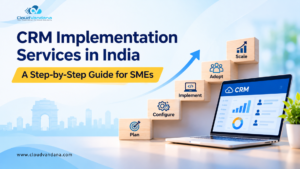
CRM Implementation Services in India: A Step-by-Step Guide for SMEs

Financial Services Cloud: A Complete Guide for Banking and Wealth Management
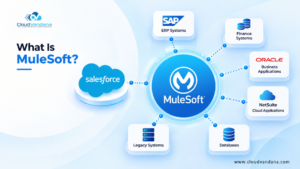
How MuleSoft Connects Salesforce With ERP, Finance and Business Systems

Salesforce Customer 360: Connecting Sales, Service and Marketing Teams

Salesforce and Anthropic Launch Claudeforce: What It Means for the Future of Enterprise AI