Financial Services Cloud: A Complete Guide for Banking and Wealth Management
Banking and wealth management have always been built on trust. Customers trust financial institutions with their savings, investments, financial plans, and long-term goals. But today, earning and maintaining that trust requires much more than offering reliable financial products.
Customers expect their banks and financial advisors to understand their needs, remember previous interactions, provide relevant recommendations, and deliver seamless experiences across digital and human channels.
The challenge? Many financial institutions still operate with disconnected systems, fragmented customer records, manual workflows, and limited visibility into customer relationships.
A relationship manager might know a client’s investment portfolio but have little information about their lending requirements. A banking service representative might see account details but not understand the customer’s broader financial relationship with the institution.
These information gaps create missed opportunities, inefficient operations, and inconsistent customer experiences.
This is where Salesforce Financial Services Cloud becomes valuable.
Financial Services Cloud (FSC) helps banks, wealth management firms, and other financial institutions bring customer relationships, financial information, business processes, and engagement activities into a connected CRM environment.
Rather than managing customers as isolated accounts or transactions, institutions can develop a more complete understanding of their financial relationships.
In this guide, we explore what Salesforce Financial Services Cloud is, how it works, its most important features, banking and wealth management use cases, implementation considerations, and how financial institutions can use it to build stronger customer relationships.
What Is Salesforce Financial Services Cloud?
Salesforce Financial Services Cloud is an industry-specific CRM solution designed to help financial institutions manage customer relationships, connect financial data, streamline operations, and deliver personalized experiences.
Built on the Salesforce platform, Financial Services Cloud extends conventional CRM capabilities with data models, workflows, and relationship-management functionality designed for financial services.
It supports organizations such as:
- Retail and commercial banks
- Wealth management firms
- Financial advisory businesses
- Lending institutions
- Insurance providers
- Other financial services organizations
A traditional CRM might show a customer’s name, contact information, communication history, and sales opportunities.
Financial Services Cloud can provide a more comprehensive relationship view, including household connections, financial accounts, financial goals, important life events, and service interactions, depending on the data and integrations configured.
For example, consider a banking customer who maintains a savings account, has a mortgage, holds investment products, and regularly communicates with a relationship manager.
Without connected systems, these relationships may exist in separate applications.
With Financial Services Cloud, the institution can bring relevant information together, allowing authorized employees to understand the customer relationship more comprehensively.
How Is Financial Services Cloud Different From a Traditional CRM?
The primary difference is its industry-specific approach.
Traditional CRM systems focus on general sales, marketing, customer service, and relationship management.
Financial Services Cloud incorporates financial-services-specific concepts, including:
- Financial account relationships
- Household and business relationship structures
- Financial goals and client life events
- Relationship management workflows
- Industry-oriented customer onboarding
- Financial service processes and analytics
This reduces the need to design every financial services capability from scratch.
However, Financial Services Cloud is not a replacement for every banking system. Core banking platforms, portfolio management solutions, payment processors, and other systems generally remain responsible for their specialized operations.
Financial Services Cloud acts as a connected customer relationship and engagement layer.
Why Banking and Wealth Management Need Industry-Specific CRM
Financial institutions manage unusually complex customer relationships.
A single customer may interact with different departments, own multiple financial products, participate in household financial decisions, and require ongoing regulatory documentation.
Managing these relationships through spreadsheets or disconnected applications becomes increasingly difficult as the organization grows.
1. Fragmented Customer Data Creates Blind Spots
Many banks operate several technology platforms simultaneously.
Customer information may be distributed across:
- Core banking systems
- Loan management applications
- Investment platforms
- Customer service software
- Marketing applications
- Document management systems
When these systems do not communicate effectively, employees must manually gather information.
This slows down customer service and increases the likelihood of incomplete records.
Financial Services Cloud can help create a consolidated relationship view by connecting relevant information from these systems.
2. Customer Expectations Have Changed
Customers increasingly compare their banking experiences with the convenience offered by modern digital services.
They expect timely responses, personalized communication, easy onboarding, and continuity between online and offline interactions.
For example, if a customer begins a loan inquiry online and later visits a branch, they should not need to explain their requirements again.
A connected CRM helps employees access previous interactions and continue the conversation with appropriate context.
3. Financial Relationships Are More Complex Than Sales Transactions
A banking relationship does not end when an account is opened.
It evolves through savings, borrowing, investments, retirement planning, family requirements, and changing financial circumstances.
Wealth management relationships are particularly complex because advisors may work with individuals, spouses, family members, trusts, and businesses.
Financial Services Cloud supports relationship structures that help institutions understand these connections.
4. Compliance Requirements Demand Better Processes
Financial institutions must manage sensitive information and operate under applicable privacy, security, and regulatory obligations.
Requirements may include customer identification, suitability assessments, documentation, consent management, and record retention.
A properly configured CRM can support consistent workflows, access controls, and documentation practices.
Nevertheless, purchasing Financial Services Cloud does not automatically make an institution compliant. Compliance depends on the implementation, operating procedures, jurisdiction, and supporting systems.
How Salesforce Financial Services Cloud Works
Financial Services Cloud brings together customer relationship information, financial data, employee workflows, and connected applications.
Its effectiveness depends on how well these components are configured around the institution’s actual business processes.
Unified Customer Profiles
A unified customer profile provides employees with a centralized view of relevant customer information.
Depending on the implementation, this may include contact details, household relationships, financial accounts, service requests, communication history, and opportunities.
Instead of navigating multiple applications, authorized employees can access a more contextual view of the customer.
This improves coordination between departments and supports more informed conversations.
Relationship and Household Mapping
Financial relationships often extend beyond individual customers.
A wealth management client may have joint accounts, dependents, family investments, trusts, or business ownership interests.
Financial Services Cloud supports modeling these connections so advisors can better understand the relationships involved.
This becomes particularly valuable when serving high-net-worth families or managing complex commercial banking relationships.
Workflow Automation and Integration
Financial institutions handle many repetitive processes, including onboarding, document collection, task assignment, follow-ups, and service escalations.
Using Salesforce automation capabilities, organizations can create workflows that guide employees through these activities.
For example, when a new banking application is submitted, an automated process may assign a relationship manager, initiate documentation tasks, and notify the appropriate team.
Integration with other systems can allow the process to continue across applications, subject to the available APIs and security requirements.
Key Features of Salesforce Financial Services Cloud
Financial Services Cloud includes industry-oriented capabilities that support relationship management and operational efficiency. Exact feature availability depends on the Salesforce edition, licensed products, and configuration.
1. Client and Household Relationship Management
Financial institutions often need to understand relationships between individuals, households, and businesses.
Financial Services Cloud supports relationship modeling that helps employees identify these connections.
For wealth managers, this can provide useful context when working with families that have shared financial objectives.
For banks, it can help relationship managers understand the broader customer relationship rather than focusing on a single account.
2. Financial Account Visibility
Financial Services Cloud can represent relevant financial account information within customer profiles.
Through appropriate integrations, institutions may display information about deposits, loans, investment holdings, or other financial products.
For example, a relationship manager could view that a customer holds multiple banking products without separately opening each operational system.
The underlying transactions and balances generally continue to be maintained by the relevant systems of record.
3. Actionable Relationship Center
Actionable Relationship Center provides a visual approach to understanding relationships between people, businesses, and financial entities.
It can help employees explore complex relationship structures and identify relevant connections.
This is particularly useful for commercial banking, private banking, and wealth management, where decision-making frequently involves multiple stakeholders.
4. Financial Goals and Life Events
Financial decisions are closely connected to personal milestones.
Customers may be planning to purchase a home, fund education, build retirement savings, or transfer wealth to the next generation.
Financial Services Cloud supports the management of financial goals and life events, allowing advisors to organize conversations around customer needs.
Rather than approaching every interaction as a product-selling opportunity, institutions can build more relevant, goal-oriented relationships.
5. Intelligent Workflow Automation
Salesforce Flow and related automation capabilities can help institutions standardize routine activities.
Common examples include:
- Assigning new inquiries to relationship managers
- Scheduling follow-up activities
- Creating onboarding tasks
- Escalating unresolved service requests
- Routing applications for review
- Generating reminders for missing documents
Automation helps reduce manual administration and creates more consistent operational processes.
For regulated workflows, organizations should incorporate approval controls, exception handling, and appropriate human oversight.
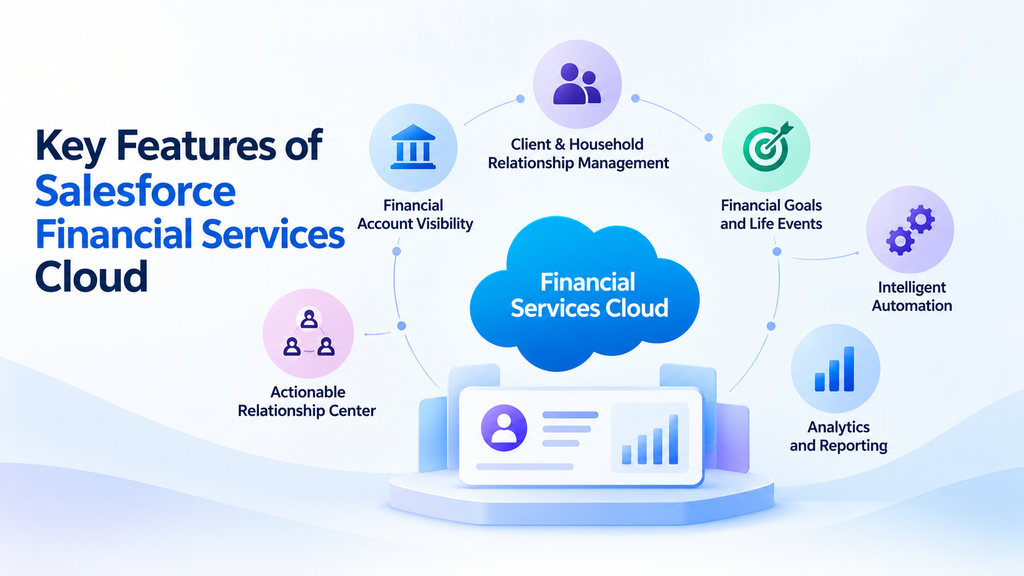
6. Analytics and Reporting
Financial institutions need visibility into customer relationships and business performance.
Salesforce reporting and analytics can support dashboards covering relationship manager activity, service requests, opportunities, onboarding progress, and other operational measures.
Advanced analytical capabilities may require additional Salesforce products or integrations.
The objective is to convert available data into information that employees and managers can use to improve decisions.
Salesforce Financial Services Cloud for Banking
Banking is one of the most important application areas for Financial Services Cloud.
Banks manage large customer populations, multiple product lines, regulatory obligations, and interactions across branches, contact centers, websites, and mobile applications.
Financial Services Cloud can help coordinate these relationships through a connected CRM.
Retail Banking
Retail banks serve customers with savings accounts, current accounts, credit cards, personal loans, mortgages, and other financial products.
These services often operate through different internal systems.
Financial Services Cloud can provide relationship managers and service representatives with a consolidated customer view.
For example, when a customer contacts a bank about a mortgage, the employee may be able to review relevant existing relationships and previous interactions.
This context helps the bank deliver more personalized assistance.
Commercial Banking
Commercial banking relationships can involve multiple business entities, directors, authorized representatives, lending facilities, and financial products.
A relationship manager may need to understand not only an individual business but also its ownership structure and related organizations.
Financial Services Cloud supports relationship modeling that can make these connections easier to manage.
It can also help teams coordinate business development activities, account reviews, and service requests.
Lending and Loan Origination
Loan processes often involve several stages, from initial inquiry to documentation, underwriting, approval, and disbursement.
Financial Services Cloud can support customer engagement and workflow coordination across these stages.
A typical process may look like this:
Example: Connected loan journey
Loan Inquiry
Customer submits a request
Qualification & Document Collection
CRM tasks and verification workflow
Credit Assessment & Approval
Connected lending and decision systems
Disbursement & Servicing
Core banking and loan servicing systems
Ongoing Customer Relationship
Follow-ups, service and retention
Financial Services Cloud does not independently replace specialized underwriting, credit decisioning, or loan servicing systems. These capabilities must be provided through appropriate Salesforce products, integrations, or external applications.
Customer Onboarding
Opening a new financial account may require identity verification, document collection, eligibility checks, and internal approvals.
Manual onboarding processes can create delays and inconsistent customer experiences.
Financial Services Cloud can help standardize customer-facing activities and coordinate tasks across departments.
For example, an onboarding workflow may track outstanding documents, assign verification activities, and notify employees when action is required.
When connected with identity verification and compliance systems, this creates a more coordinated process.
Customer Service and Retention
Customer retention depends heavily on service quality.
A customer who repeatedly explains the same problem to different departments is unlikely to view the institution as well coordinated.
Financial Services Cloud, together with Salesforce service capabilities where licensed, can help employees access customer context, manage cases, and coordinate issue resolution.
Banks can also use relationship information to identify appropriate engagement opportunities while respecting customer preferences and applicable regulations.
Salesforce Financial Services Cloud for Wealth Management
Wealth management is fundamentally relationship-driven.
Clients expect financial advisors to understand their investment objectives, risk preferences, family circumstances, and long-term financial plans.
Financial Services Cloud provides tools that can help advisors manage these relationships more systematically.
Client Relationship Management
Wealth advisors frequently manage dozens or hundreds of client relationships.
Maintaining detailed information across spreadsheets, email conversations, and portfolio applications can become difficult.
Financial Services Cloud can organize client profiles, meeting notes, relationship activities, and relevant financial information within a connected environment.
This helps advisors prepare for conversations and maintain continuity across interactions.
Portfolio and Financial Goal Visibility
A client’s investment portfolio represents only one part of their financial situation.
Advisors may also need to consider retirement goals, liquidity requirements, family obligations, and other financial priorities.
Financial Services Cloud can combine relevant CRM information with portfolio data obtained from connected systems.
This provides a more contextual foundation for client discussions.
Actual portfolio accounting, performance calculations, trading, and investment execution generally remain within specialized financial applications.
Advisor Productivity
Administrative activities can consume significant advisor time.
Preparing meeting summaries, scheduling reviews, updating records, and coordinating documentation are necessary tasks, but they reduce the time available for direct client engagement.
Workflow automation can help advisors manage these activities more efficiently.
For example, a completed client meeting could trigger follow-up tasks, documentation reminders, or internal review activities.
AI-assisted capabilities may further support summarization and preparation, subject to licensing and organizational controls.
Personalized Financial Engagement
Personalization in wealth management should reflect a client’s goals, circumstances, and preferences.
A client approaching retirement may require different conversations from someone building their first investment portfolio.
Financial Services Cloud helps advisors maintain relevant information and plan engagement accordingly.
The purpose is not to automate financial judgment, but to give qualified professionals better information and more efficient workflows.
Client Retention and Growth
Long-term wealth management relationships depend on consistent communication and trust.
When client information is scattered, important follow-ups may be missed.
A connected CRM helps teams maintain service schedules, track relationship activities, and coordinate communication.
It can also support succession planning and relationship continuity when advisors change roles or leave the organization.
Financial Services Cloud for Insurance and Other Financial Institutions
Although banking and wealth management are major use cases, Financial Services Cloud also supports broader financial services requirements.
Insurance organizations may use industry-oriented Salesforce capabilities to coordinate customer relationships, policy-related interactions, and service processes.
Lending businesses can use CRM workflows to manage inquiries, application progress, and customer engagement.
Financial advisory organizations may use relationship management functionality to coordinate clients, financial goals, and ongoing reviews.
The appropriate configuration depends on the organization’s operating model.
A retail bank, investment advisory firm, and insurance company may all require different data structures, integrations, workflows, and regulatory controls.
Therefore, implementation should begin with a detailed assessment of business requirements rather than assuming one standard configuration will suit every institution.
Salesforce Financial Services Cloud and AI
Artificial intelligence is changing how financial institutions manage information, deliver service, and support employees.
Within the Salesforce ecosystem, AI capabilities can complement Financial Services Cloud by helping teams interpret information, generate summaries, and automate selected activities.
However, financial services organizations must apply additional care when using AI because of sensitive customer data, regulatory obligations, and the consequences of inaccurate recommendations.
Einstein AI
Salesforce Einstein capabilities can support AI-assisted experiences across Salesforce products.
Depending on the products and licenses available, organizations may use AI to support activities such as summarization, prediction, or contextual recommendations.
For example, a relationship manager might benefit from a concise summary of recent customer interactions before a meeting.
The quality of these outputs depends on the available data, configuration, and safeguards.
Agentforce for Financial Services
Salesforce Agentforce enables organizations to build AI agents that can assist with defined business tasks using connected data and permitted actions.
For financial institutions, potential applications include customer inquiry assistance, employee knowledge retrieval, onboarding support, and service request routing.
Consider a customer asking about the status of a submitted banking application.
An appropriately configured AI agent could retrieve authorized status information from a connected system and provide a response or escalate the request.
More sensitive activities, such as financial advice, lending decisions, or account changes, require carefully designed controls and may need human approval.
Predictive Insights and Next Best Actions
Financial institutions can use analytics and decisioning capabilities to identify relevant opportunities and recommended follow-up activities.
For example, a relationship manager might receive a reminder to contact a client whose scheduled financial review is approaching.
Recommendations can also incorporate business rules, customer preferences, and eligibility requirements.
AI should support professional decision-making rather than replace suitability assessments or regulatory responsibilities.
Financial Services Cloud Integration With Core Banking Systems
One of the most important aspects of Financial Services Cloud implementation is integration.
Financial institutions rarely operate on a single technology platform.
They may rely on core banking software, payment applications, lending systems, investment platforms, identity verification providers, and document management solutions.
Financial Services Cloud becomes significantly more useful when relevant information can move securely between these systems.
Common Integration Requirements
Typical integrations may include:
- Core banking platforms for account information
- Loan origination and servicing applications
- Portfolio and investment management systems
- KYC and identity verification platforms
- Document management solutions
- Customer communication systems
- Data warehouses and analytics platforms
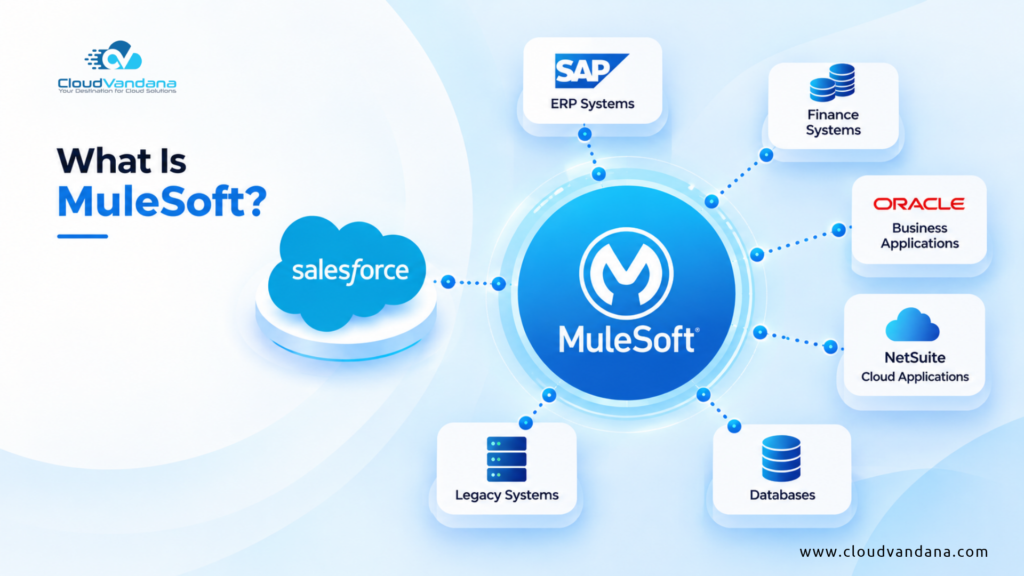
Salesforce APIs and integration technologies such as MuleSoft can help connect these applications.
Why Integration Architecture Matters
Poorly designed integrations can create duplicate records, inconsistent data, unnecessary system dependencies, and security vulnerabilities.
Institutions should define which application owns each type of information.
For example, a core banking system may remain the authoritative source for account balances, while Salesforce manages customer engagement activities.
Integration design should address data synchronization, authentication, error handling, monitoring, and access permissions.
A well-designed architecture avoids unnecessarily duplicating sensitive information and ensures employees receive relevant, current data.
Data Security, Privacy, and Regulatory Compliance
Security and compliance are essential considerations for every financial services CRM implementation.
Financial institutions manage sensitive customer information, and unauthorized access can have serious consequences.
Salesforce provides platform security capabilities, but organizations remain responsible for configuring and operating their environments appropriately.
Role-Based Access Control
Employees should access only the information necessary for their responsibilities.
A relationship manager may require access to assigned client information, while another department may need a more restricted view.
Salesforce permissions, sharing settings, and other security capabilities can help enforce these boundaries.
Data Protection and Encryption
Financial institutions should assess encryption, authentication, data retention, and monitoring requirements.
Salesforce offers security capabilities, with certain advanced functions available through additional products or licensing.
The institution must determine which controls are necessary based on its risk assessment and regulatory environment.
Regulatory Considerations
Applicable obligations vary by country, institution type, and business activity.
Examples may include GDPR, GLBA, applicable SEC or FINRA requirements, RBI regulations, and other local financial services rules.
Financial Services Cloud can support processes related to documentation, record access, and customer information management.
However, Financial Services Cloud does not automatically guarantee compliance with any particular regulation.
Institutions should involve their legal, compliance, security, and risk teams throughout implementation.
Salesforce Financial Services Cloud vs. Traditional CRM
Financial Services Cloud and general-purpose CRM solutions share many capabilities, but they are designed for different levels of specialization.
| Capability | Traditional CRM | Financial Services Cloud |
| Contact management | Standard | Standard with financial context |
| Sales opportunities | General-purpose | Financial services-oriented |
| Household relationships | Often custom-built | Industry-specific modeling |
| Financial accounts | Usually requires customization | Industry-specific structures |
| Financial goals | Usually custom-built | Supported through financial services capabilities |
| Banking workflows | Custom configuration | Industry-oriented starting points |
| Integrations | Available | Available, with financial use cases |
| Compliance | Requires configuration | Requires configuration and governance |
| Implementation complexity | Varies | Varies, often greater |
A traditional CRM may be sufficient for a small financial advisory business with straightforward contact management requirements.
Financial Services Cloud becomes more compelling when an organization needs sophisticated financial relationship structures, specialized workflows, and integration with multiple financial systems.
The decision should depend on business requirements, expected value, implementation complexity, and long-term operating costs.
Financial Services Cloud vs. Salesforce Sales Cloud
Salesforce Sales Cloud focuses on general sales processes such as lead management, opportunity tracking, forecasting, and sales productivity.
Financial Services Cloud extends Salesforce CRM capabilities for financial services organizations.
Sales Cloud can be appropriate when a financial business primarily needs straightforward lead tracking and sales pipeline management.
Financial Services Cloud may be better suited when the institution also needs financial account relationships, household structures, industry workflows, and specialized customer engagement.
The products should not be viewed simply as interchangeable alternatives.
Salesforce packaging and licensing differ, and some capabilities may overlap depending on the selected edition.
A requirements assessment helps determine which Salesforce configuration is most appropriate.
Business Benefits of Salesforce Financial Services Cloud
A successful Financial Services Cloud implementation can produce improvements across customer experience, employee productivity, and operational coordination.
1. More Complete Customer Understanding
Connected customer information helps employees understand relationships beyond individual products or transactions.
This supports more contextual conversations and reduces the need to search across disconnected systems.
2. Improved Employee Productivity
Workflow automation can reduce repetitive administrative activities.
Employees can spend less time updating spreadsheets, assigning tasks manually, or requesting information from other departments.
3. More Consistent Customer Experiences
Shared information helps employees maintain continuity across interactions.
Customers benefit when banking, advisory, and service teams have access to relevant context.
4. Better Collaboration
Financial relationships frequently involve several teams.
A connected CRM can improve coordination between relationship managers, service representatives, operations, and other authorized employees.
5. More Relevant Growth Opportunities
Understanding customer relationships can help institutions identify legitimate opportunities to offer relevant products or services.
Such activities should remain aligned with customer needs, eligibility, consent, and applicable regulations.
6. Greater Operational Visibility
Dashboards and reporting help managers monitor workflows, service performance, relationship activities, and business outcomes.
These benefits are not automatic. They depend on data quality, adoption, integration design, and effective process management.
Common Financial Services Cloud Use Cases
The following scenarios illustrate how organizations can apply Financial Services Cloud to practical business problems.
Use Case 1: Unified Customer Relationship Management
A retail bank stores deposit account information, loan details, and customer service records in separate systems.
Financial Services Cloud connects relevant information into a consolidated customer relationship view.
Employees can understand the customer’s existing relationships without manually searching multiple applications.
Use Case 2: Automated Customer Onboarding
A bank receives new account applications through its website.
Financial Services Cloud coordinates onboarding activities, assigns tasks, and tracks documentation requirements.
Connected verification systems perform the appropriate identity and compliance checks.
Use Case 3: Wealth Management Client Reviews
A wealth advisory firm needs to conduct regular client reviews.
Financial Services Cloud helps schedule activities, organize relationship information, and maintain financial goal records.
Advisors can prepare more efficiently and track follow-up commitments.
Use Case 4: Commercial Banking Relationship Mapping
A commercial bank serves businesses with multiple subsidiaries and ownership relationships.
Financial Services Cloud supports relationship mapping, helping authorized employees understand connected entities and stakeholders.
Use Case 5: AI-Assisted Customer Service
A financial institution wants to reduce repetitive customer inquiries.
An AI agent connected to approved knowledge and operational systems assists with routine requests.
Complex or sensitive issues are escalated to qualified employees.
These scenarios demonstrate that the value of Financial Services Cloud comes from improving business processes, not simply centralizing contact records.
Financial Services Cloud Implementation: A Step-by-Step Guide
Implementing Financial Services Cloud requires careful planning.
Financial institutions often operate complex technology environments, and poorly planned implementations can create unnecessary costs and operational disruption.
A structured approach helps reduce these risks.
Step 1: Define Business Objectives
Begin by identifying the problems the institution wants to solve.
Possible objectives include reducing onboarding delays, improving relationship manager productivity, increasing customer service consistency, or consolidating customer information.
Each objective should have a measurable outcome.
Step 2: Assess Existing Systems
Review the organization’s CRM, core banking, investment, lending, and customer service applications.
Identify where customer data is stored, which systems are authoritative, and where information gaps exist.
This assessment helps determine integration priorities.
Step 3: Map Customer Journeys
Document important customer journeys, including onboarding, service requests, lending inquiries, and advisory reviews.
Identify manual activities, unnecessary handoffs, and recurring delays.
The CRM should support improved processes rather than simply reproduce inefficient existing workflows.
Step 4: Design the Data Model
Financial Services Cloud implementations require careful data modeling.
The institution should define how individuals, households, organizations, financial accounts, and other relationships will be represented.
Data architecture decisions influence reporting, integration, security, and future scalability.
Step 5: Configure Workflows and Automation
Configure processes around approved business requirements.
Use Salesforce automation capabilities where appropriate, while maintaining clear approval rules and exception handling.
Avoid unnecessary customization when supported standard functionality meets the requirement.
Step 6: Integrate External Systems
Connect the CRM with required operational applications.
Define data ownership, synchronization frequency, authentication methods, and monitoring processes.
Test integrations thoroughly before production deployment.
Step 7: Migrate and Validate Data
Data migration should include profiling, cleansing, mapping, deduplication, and validation.
Financial relationship information requires particular attention because inaccurate connections can affect customer service and access permissions.
Step 8: Test Security and Business Processes
Testing should cover functional workflows, integrations, user permissions, performance, and failure scenarios.
Financial institutions should also conduct appropriate security and compliance reviews.
Step 9: Train Employees
Relationship managers, advisors, operations teams, and administrators may use the platform differently.
Training should focus on real workflows and employee responsibilities.
Practical role-based training is generally more effective than generic product demonstrations.
Step 10: Launch, Monitor, and Improve
A phased rollout can help reduce implementation risk.
After launch, monitor system adoption, data quality, workflow performance, and business outcomes.
Use employee feedback and operational metrics to guide continuous improvement.
Common Financial Services Cloud Implementation Challenges
Even well-funded CRM projects can struggle when implementation decisions are disconnected from business needs.
Poor Data Quality
Duplicate records, incomplete customer profiles, and inconsistent relationship information reduce CRM reliability.
Organizations should establish data ownership, validation rules, and ongoing quality monitoring.
Complex Legacy Integrations
Older banking systems may have limited integration capabilities.
Institutions should evaluate API availability, middleware requirements, synchronization approaches, and operational risks early.
Excessive Customization
Custom development can be necessary, but excessive customization increases maintenance complexity.
Teams should evaluate standard Financial Services Cloud capabilities before building new functionality.
Low Employee Adoption
A technically successful implementation can still fail to deliver value if employees do not use it consistently.
Early employee involvement, practical training, and simplified workflows can improve adoption.
Inadequate Governance
Financial institutions need clear responsibilities for permissions, data management, configuration changes, and regulatory controls.
Governance should be established before deployment and maintained throughout the platform lifecycle.
Salesforce Financial Services Cloud Pricing and Cost Considerations
Financial Services Cloud pricing depends on the selected Salesforce edition, licensed capabilities, number of users, and additional products.
Salesforce may offer different packages for financial services organizations, and licensing arrangements can change over time.
For current commercial details, institutions should review the official Salesforce Financial Services page and request an appropriate quote.
What Influences the Total Cost?
The total investment extends beyond software subscriptions.
Important cost factors include implementation consulting, data migration, integration development, customization, security requirements, employee training, and ongoing support.
AI capabilities, advanced analytics, additional storage, and specialized security products may involve separate costs.
How to Evaluate Cost Effectively
Rather than comparing subscription prices alone, financial institutions should assess total cost of ownership over several years.
This includes the cost of maintaining integrations, supporting users, improving workflows, and adapting the platform to changing requirements.
A phased implementation can help institutions prioritize high-value processes before expanding the solution.
How to Measure Financial Services Cloud ROI
Measuring return on investment requires clear baseline metrics and consistent monitoring.
Financial institutions should define expected outcomes before implementation.
| Business Area | Suggested KPI | Expected Direction |
| Customer onboarding | Average onboarding completion time | Decrease |
| Relationship management | Time spent on administrative work | Decrease |
| Customer service | Average case resolution time | Decrease |
| Data quality | Duplicate or incomplete customer records | Decrease |
| CRM adoption | Active user percentage | Increase |
| Sales performance | Qualified opportunity conversion rate | Increase |
| Customer experience | Customer satisfaction score | Increase |
| Operational efficiency | Manual handoffs per process | Decrease |
A basic ROI calculation is:
\[ \text{ROI (\%)}=\frac{\text{Benefits}-\text{Costs}}{\text{Costs}}\times100 \]
For example, if an institution estimates $300,000 in attributable benefits over a defined period and spends $200,000 over the same period, the calculated ROI would be 50%.
These figures are illustrative, not typical Financial Services Cloud results.
Organizations should distinguish measurable financial benefits from qualitative improvements and avoid attributing every business change directly to the CRM.
Best Practices for Successful Financial Services Cloud Adoption
Technology adoption is an ongoing organizational process.
Financial institutions can improve their chances of success by following several principles.
Start With Business Problems
Do not begin with a list of Salesforce features.
Begin with operational challenges, customer requirements, and measurable objectives.
This helps ensure the implementation solves meaningful problems.
Prioritize Data Quality
A connected CRM is only as useful as the information available within it.
Establish data standards, ownership responsibilities, and validation processes.
Design Around Employee Workflows
Relationship managers and advisors should be able to complete common tasks without unnecessary complexity.
Simple, relevant interfaces encourage consistent usage.
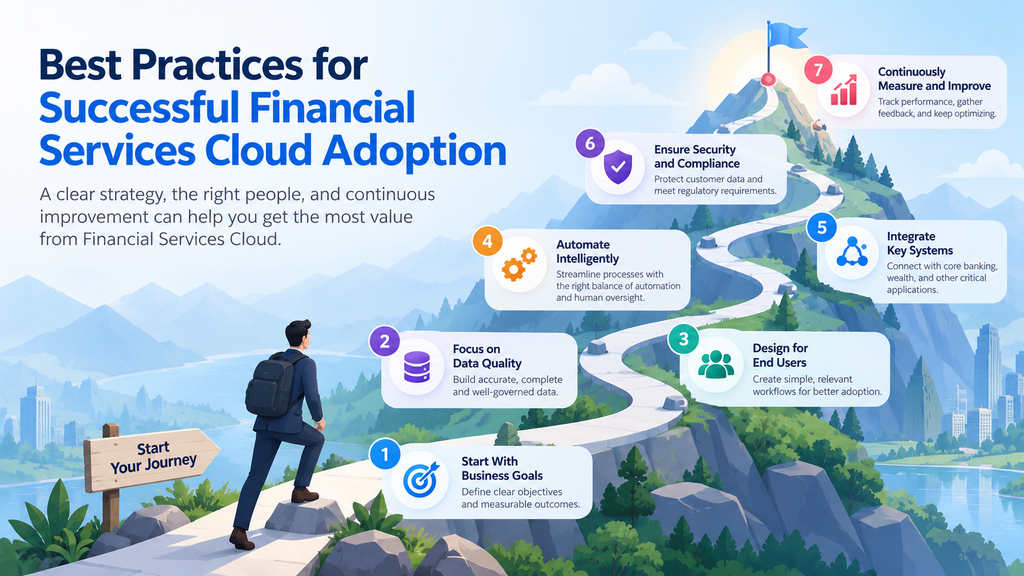
Introduce Automation Carefully
Automate repetitive and well-defined processes first.
More complex activities should include appropriate controls, approvals, and human oversight.
Plan for Continuous Improvement
Customer expectations, business requirements, and Salesforce capabilities evolve.
Institutions should review performance regularly and refine the platform based on actual usage and outcomes.
The Future of Banking and Wealth Management With AI-Powered CRM
The future of financial services CRM is moving beyond basic recordkeeping.
Banks and wealth management firms increasingly need platforms that connect customer information, support employees, coordinate processes, and enable responsible AI adoption.
Several developments are likely to shape this evolution.
More Contextual Customer Engagement
Financial institutions will increasingly use connected data to understand customer relationships across products and channels.
This can support more relevant communication and improve continuity between digital and human interactions.
Greater Workflow Intelligence
Automation will increasingly combine structured business rules with AI-assisted capabilities.
Employees may receive better summaries, contextual information, and suggested next steps.
However, financial institutions will need strong governance to prevent inappropriate automation of sensitive decisions.
Stronger Integration Between Systems
Core banking, investment management, CRM, and service platforms will continue to require secure information exchange.
Institutions that invest in reliable integration architecture will be better positioned to support new digital experiences.
Responsible AI as a Competitive Requirement
AI adoption in financial services requires more than technical capability.
Organizations must consider explainability, privacy, accuracy, security, customer consent, and human accountability.
The most sustainable approach will combine AI efficiency with strong governance and professional oversight.
Why Choose CloudVandana for Financial Services Cloud Implementation?
Implementing a financial services CRM is not simply a software configuration project.
It requires an understanding of customer journeys, relationship structures, existing systems, data requirements, and business processes.
CloudVandana helps organizations plan, implement, integrate, and optimize Salesforce solutions around their operational needs.
As a Salesforce consulting partner, CloudVandana supports businesses through different stages of CRM adoption and improvement.
Salesforce Consulting and Solution Planning
CloudVandana can help financial institutions evaluate their CRM requirements, identify process gaps, and develop an implementation roadmap.
The objective is to align Salesforce capabilities with measurable business outcomes.
Financial Services Cloud Implementation
From solution design to configuration and deployment, CloudVandana can help organizations establish a CRM environment suited to their relationship management and operational requirements.
Salesforce Integration Services
Financial institutions depend on connected applications.
CloudVandana provides Salesforce integration services to help organizations connect relevant business systems and reduce disconnected workflows.
Data Migration and CRM Optimization
Reliable customer information is essential to CRM success.
CloudVandana can assist with migration planning, data mapping, cleansing, and optimization activities.
Automation and AI Enablement
CloudVandana helps businesses explore Salesforce automation and AI capabilities, including workflow optimization and Agentforce-related solutions.
For financial services organizations, these initiatives should be designed with appropriate security, governance, and business controls.
Ongoing Salesforce Support
CRM requirements continue to evolve after launch.
CloudVandana offers Salesforce administration, development, support, and managed services to help organizations maintain and improve their Salesforce environments.
Ready to Modernize Your Banking or Wealth Management CRM?
Your customers should not have to experience the complexity of your internal systems.
Whether your institution is struggling with disconnected customer data, manual onboarding, fragmented relationship management, or inefficient service workflows, the right CRM strategy can make a meaningful difference.
CloudVandana helps financial institutions turn disconnected processes into connected customer experiences.
From Salesforce Financial Services Cloud consulting and implementation to integration, automation, and ongoing optimization, our team can help you build a solution aligned with your business goals.
Already using Salesforce? We can help you evaluate opportunities to improve your existing environment.
Exploring CRM for the first time? We can help you understand your requirements and determine an appropriate starting point.
Connect with CloudVandana to discuss your Financial Services Cloud requirements and build a practical roadmap for your business.
Build Stronger Financial Relationships With CloudVandana
Connect your customer data, streamline operations, and create better banking and wealth management experiences.
Talk to Our CRM Experts
cloudvandana.com
Conclusion
Salesforce Financial Services Cloud provides banks and wealth management firms with industry-oriented CRM capabilities designed to support complex customer relationships.
By connecting relevant customer information, organizing financial relationships, coordinating workflows, and enabling integration with operational systems, it can help institutions improve how they serve customers.
For banking organizations, the platform can support more consistent onboarding, relationship management, lending engagement, and customer service.
For wealth management firms, it can help advisors organize client relationships, maintain financial goal information, and deliver more contextual engagement.
AI and automation introduce further opportunities, but their value depends on responsible implementation, reliable data, and appropriate governance.
Ultimately, Financial Services Cloud is most valuable when it supports a clearly defined business strategy.
The goal is not simply to introduce another technology platform. It is to help financial institutions develop more connected, efficient, and customer-focused operations.
Frequently Asked Questions About Salesforce Financial Services Cloud
1. What is Salesforce Financial Services Cloud?
Salesforce Financial Services Cloud is an industry-specific CRM solution designed for banks, wealth management firms, insurance organizations, and other financial institutions. It helps organizations manage customer relationships, connect relevant financial information, and coordinate business workflows.
2. How does Salesforce Financial Services Cloud work?
Financial Services Cloud uses Salesforce CRM capabilities, industry-specific data models, workflow automation, and integrations to provide a connected view of customer relationships. It can display information from financial systems while supporting customer engagement and operational processes.
3. What is the difference between Salesforce Sales Cloud and Financial Services Cloud?
Sales Cloud focuses on general sales management, including leads, opportunities, and forecasting. Financial Services Cloud provides additional industry-oriented capabilities for financial relationships, household structures, financial account information, and specialized financial services workflows.
4. Is Salesforce Financial Services Cloud suitable for banks?
Yes. Financial Services Cloud supports banking use cases such as customer relationship management, onboarding coordination, commercial banking relationships, lending engagement, and customer service. Specific capabilities depend on the implementation and connected systems.
5. How does Financial Services Cloud help wealth management firms?
Financial Services Cloud helps wealth management firms organize client relationships, household connections, financial goals, advisor activities, and relevant financial information. This can improve advisor productivity and support more personalized client engagement.
6. Can Financial Services Cloud integrate with core banking systems?
Yes. Financial Services Cloud can integrate with core banking and other financial applications through Salesforce APIs, MuleSoft, and appropriate integration technologies. Integration requirements depend on the architecture and capabilities of the connected systems.
7. Does Financial Services Cloud support artificial intelligence?
Yes. Organizations can use compatible Salesforce AI capabilities, including Einstein and Agentforce, alongside Financial Services Cloud. Potential applications include employee assistance, information summarization, customer inquiry support, and workflow automation, subject to licensing and configuration.
8. Is Salesforce Financial Services Cloud secure?
Financial Services Cloud operates on the Salesforce platform and can use its security capabilities, including permissions, access controls, and other protections. Security effectiveness depends on configuration, organizational policies, additional controls, and ongoing governance.
9. Is Financial Services Cloud compliant with banking regulations?
Financial Services Cloud can support regulated workflows, documentation, and information governance, but it does not automatically guarantee regulatory compliance. Financial institutions must assess applicable legal requirements and implement appropriate processes and controls.
10. How much does Salesforce Financial Services Cloud cost?
Pricing depends on the selected edition, number of users, additional Salesforce products, and contractual arrangements. Implementation, integrations, migration, training, and support also contribute to total cost. Organizations should request current pricing directly from Salesforce.
11. How long does Financial Services Cloud implementation take?
Implementation timelines vary based on organizational size, requirements, data quality, integrations, and customization. A limited initial rollout may take several months, while complex enterprise programs can take considerably longer. A discovery assessment is needed to estimate a realistic timeline.
12. How can CloudVandana help with Salesforce Financial Services Cloud?
CloudVandana provides Salesforce consulting, implementation, integration, development, automation, data migration, and ongoing support services. Financial institutions can work with CloudVandana to assess CRM requirements, plan an implementation, connect business systems, and optimize Salesforce workflows.

Digital Marketing Manager at Cloudvandana Solutions
YOU MIGHT ALSO LIKE

Financial Services Cloud: A Complete Guide for Banking and Wealth Management

How MuleSoft Connects Salesforce With ERP, Finance and Business Systems

Salesforce Customer 360: Connecting Sales, Service and Marketing Teams

Salesforce and Anthropic Launch Claudeforce: What It Means for the Future of Enterprise AI

Salesforce AIforce: What It Means for the Future of Enterprise Software