Introduction to Salesforce Financial Services Cloud
Financial institutions operate in one of the most complex and regulated industries in the world. Banks, insurance companies, wealth management firms, and lending organizations manage enormous volumes of customer data, financial products, regulatory requirements, and service interactions every single day. Managing all of this through disconnected systems often leads to inefficiencies, poor customer experience, and limited visibility into business performance.
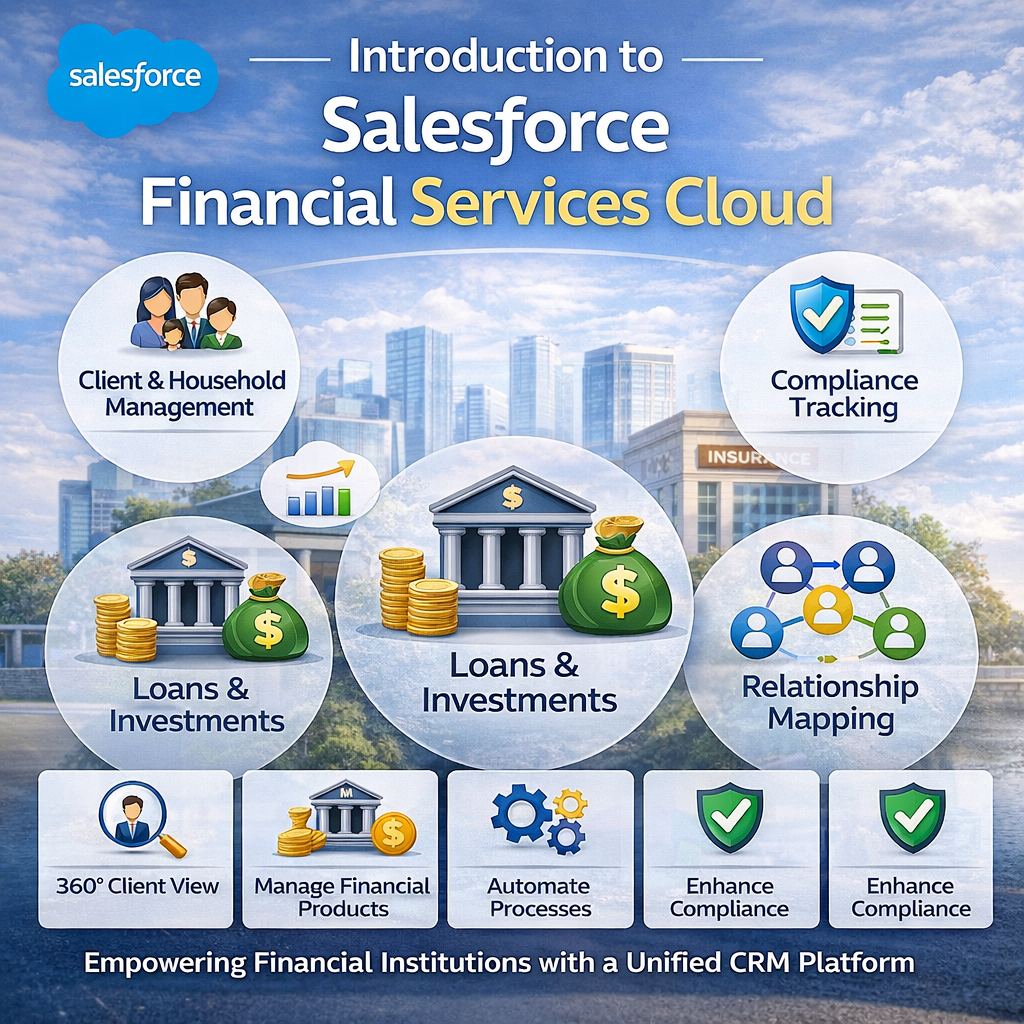
Financial Services Cloud,This is where Salesforce Financial Services Cloud becomes transformative rather than simply useful. It is not just a CRM designed for generic sales processes. It is an industry-specific platform built to manage financial relationships, portfolios, policies, loans, and customer interactions within a unified system.
Financial Services Cloud allows institutions to move from fragmented operations to a connected ecosystem where advisors, service teams, operations teams, and compliance teams work from the same platform. This unified view improves decision-making, customer engagement, and operational efficiency across the organization.
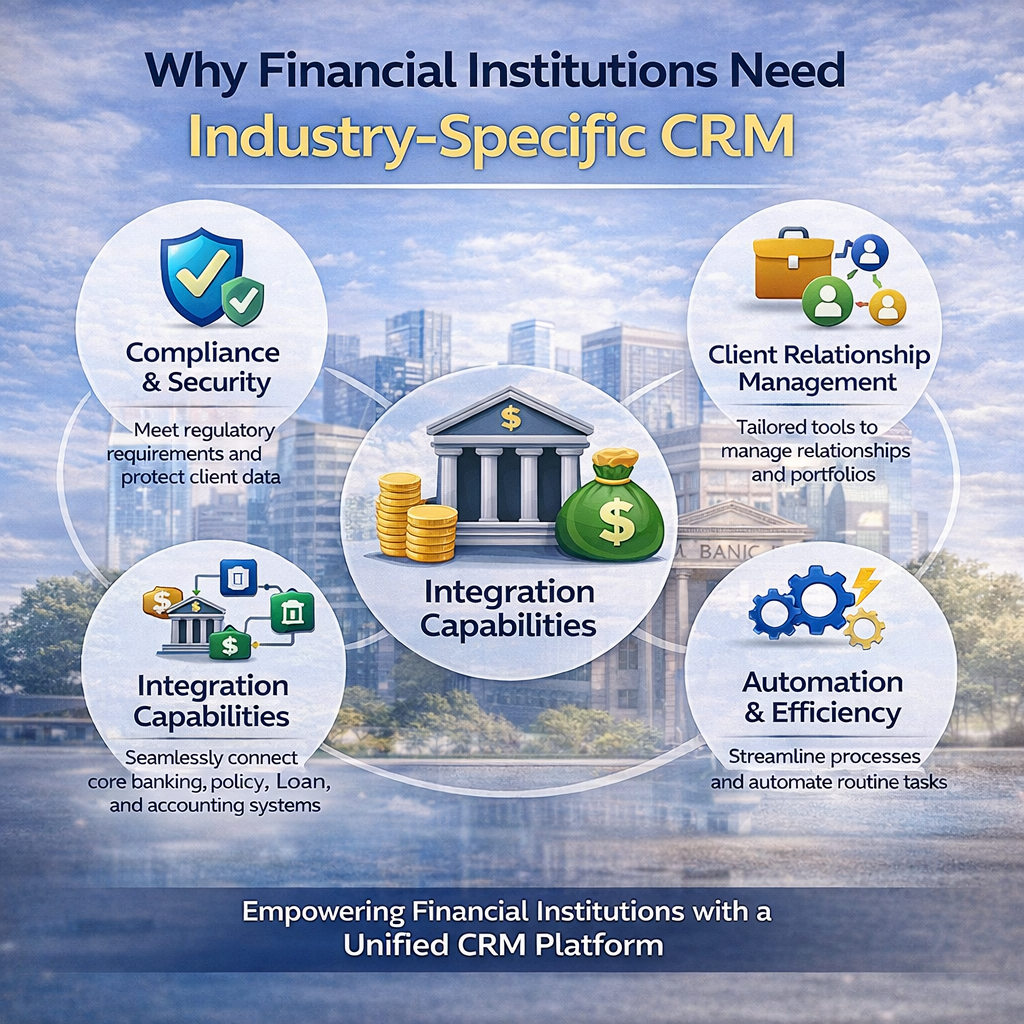
Why Financial Institutions Need Industry-Specific CRM
Traditional CRM systems were originally designed with sales teams in mind. Their primary purpose was to track leads, manage opportunities, monitor sales pipelines, and record customer interactions related to revenue generation. While this model works well for many industries, financial institutions operate in a much more complex environment where relationships, compliance, and long-term financial management play a far more significant role than simple sales tracking.
Financial institutions do not just manage customers; they manage financial relationships that can span decades. A client may have multiple accounts, loans, insurance policies, investment portfolios, and family members linked to those financial products. Advisors and relationship managers need a complete view of these relationships to provide effective service and financial guidance. A traditional CRM structure built around individual accounts and opportunities often struggles to represent this complexity without extensive customization.
Financial organizations therefore require systems that can handle industry-specific relationship structures and financial data models such as:
- Household relationships and joint accounts
Financial decisions are often made at the household level rather than by individuals, especially in wealth management and insurance scenarios - Financial portfolios and assets
Institutions need visibility into investments, assets under management, and financial holdings across multiple accounts - Policies, loans, and investments
Financial products have lifecycles that must be tracked from application to servicing and renewal - Compliance tracking and documentation
Regulatory requirements require institutions to track approvals, documents, disclosures, and audit trails - Ongoing client servicing and advisory relationships
Financial services are relationship-driven, requiring continuous engagement rather than one-time sales transactions
When organizations attempt to use a generic CRM for these purposes, they often end up heavily customizing the system. This leads to complex data models, difficult maintenance, performance issues, and long-term technical debt. Over time, the system becomes harder to manage and more expensive to maintain.
Financial Services Cloud addresses this problem by providing a pre-built industry data model, relationship structures, and financial objects specifically designed for financial institutions. Instead of forcing organizations to redesign a generic CRM to fit financial processes, the platform already includes the structures needed to manage households, financial accounts, relationships, and compliance processes from the beginning.
This significantly reduces implementation complexity, improves scalability, and allows financial institutions to focus on improving customer relationships and operations rather than constantly modifying their CRM architecture.
What Is Salesforce Financial Services Cloud?
Salesforce Financial Services Cloud is an industry-specific CRM platform built on the Salesforce Lightning Platform. It provides financial institutions with tools to manage clients, financial accounts, relationships, service processes, and compliance workflows in a single system.
It is commonly used by:
- Banks
- Credit unions
- Insurance companies
- Wealth management firms
- Mortgage and lending companies
- Investment advisory firms
The platform focuses heavily on relationship management, not just account management. This is a critical distinction because financial institutions often work with households, joint accounts, beneficiaries, and complex relationship structures rather than individual customers alone.
Core Architecture of Financial Services Cloud
Financial Services Cloud is built on top of the Salesforce Lightning Platform, which means it inherits all the core platform capabilities such as automation, security, reporting, integrations, and application development. This is one of the most important aspects of Financial Services Cloud because it combines an industry-specific data model with the flexibility and scalability of the Salesforce platform.
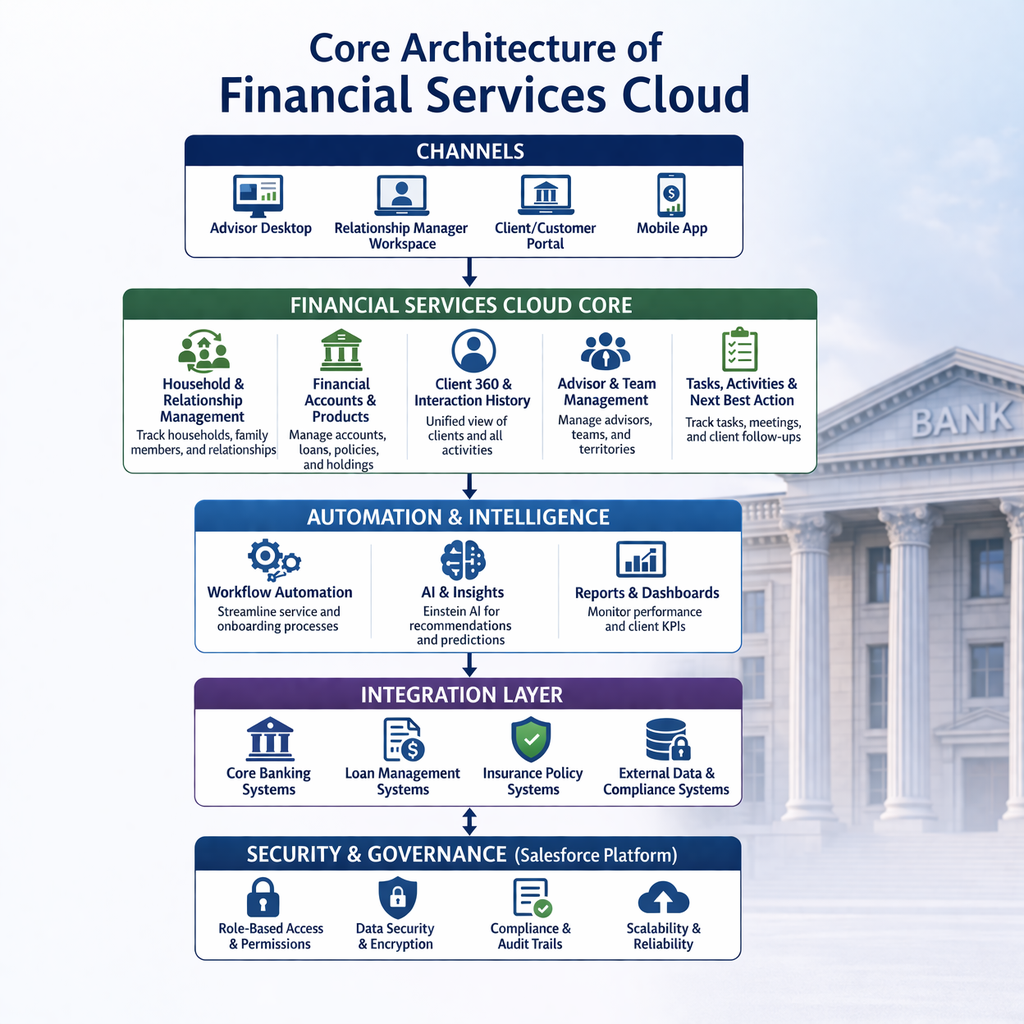
Instead of being a standalone banking or insurance system, Financial Services Cloud is built as a layered architecture. The Salesforce platform provides the foundation, and the financial services data model and features are built on top of that foundation. This allows financial institutions to use out-of-the-box industry functionality while still having the ability to customize and extend the system based on their specific processes.
The architecture typically includes several key layers:
- Standard Salesforce objects
These include core objects such as Accounts, Contacts, Opportunities, Activities, and Cases. These objects handle general CRM functionality such as customer information, sales tracking, and service management. - Industry-specific financial objects
Financial Services Cloud introduces additional objects such as Financial Accounts, Assets and Liabilities, Insurance Policies, and Client Profiles. These objects are specifically designed to represent financial products and relationships. - Relationship and household data models
One of the most important components of Financial Services Cloud is the household and relationship model. This allows organizations to track families, joint accounts, beneficiaries, business relationships, and advisor relationships in a structured way. - Automation through Flow
Salesforce Flow is used to automate financial processes such as client onboarding, loan approvals, policy renewals, compliance checks, and service workflows. Automation reduces manual work and improves process consistency. - Reporting and dashboards
The platform includes reporting and dashboard capabilities that allow organizations to monitor portfolios, pipeline performance, service metrics, compliance activities, and operational performance. - Integration capabilities
Financial institutions rarely operate with a single system. Financial Services Cloud can integrate with core banking systems, loan management systems, insurance policy systems, accounting platforms, and external data providers through APIs and middleware. - AI through Einstein
Salesforce Einstein adds artificial intelligence capabilities such as predictive insights, next best action recommendations, risk analysis, and customer engagement insights.
This layered architecture is extremely powerful because it allows financial institutions to start with industry-specific functionality while still maintaining the flexibility to customize, integrate, and extend the platform as their business grows. Instead of building everything from scratch, organizations start with a strong foundation and then tailor the system to match their operational and regulatory requirements.
Key Features Overview
Financial Services Cloud includes several key features that clearly differentiate it from standard CRM implementations. While traditional CRM systems focus mainly on sales pipelines and customer contact management, Financial Services Cloud is designed to manage financial relationships, portfolios, compliance processes, and long-term client engagement. It is built to support the entire lifecycle of a financial relationship rather than just the initial sales process.
These features are not isolated tools; they work together to create a unified platform where client data, financial products, interactions, and service processes are connected. This connected environment allows financial institutions to improve visibility, streamline operations, and deliver more personalized services.
Major features include:
- Client and household management
Allows organizations to manage individuals, families, joint accounts, and household financial relationships in a structured way - Financial account tracking
Tracks financial products such as bank accounts, loans, insurance policies, investments, and assets - Relationship mapping
Visualizes relationships between clients, households, advisors, businesses, and financial accounts - Interaction summaries
Provides a consolidated view of client meetings, calls, emails, and financial reviews - Referral tracking
Tracks internal and external referrals between departments, advisors, and partners - Lead and opportunity management
Manages pipelines for financial products such as loans, insurance policies, and investment opportunities - Service case management
Handles customer service requests, claims, support issues, and service workflows - Compliance and documentation tracking
Tracks regulatory documentation, approvals, and compliance processes - Reporting and dashboards
Provides visibility into portfolios, pipeline performance, service metrics, and business performance - Automation workflows
Automates onboarding, approvals, follow-ups, compliance checks, and service processes
Together, these features are designed to support the entire customer lifecycle, from the initial inquiry and onboarding process to long-term relationship management, portfolio tracking, service interactions, and ongoing advisory engagement. Instead of managing customers, products, and service processes in separate systems, Financial Services Cloud brings everything into a single connected platform.
Client and Household Data Model
One of the most important features of Financial Services Cloud is the household data model. Financial relationships often involve families, joint account holders, beneficiaries, and business relationships. Managing these relationships in a traditional CRM structure can be difficult.
Financial Services Cloud introduces the concept of Households, which allows organizations to group related individuals and accounts together. This provides advisors and relationship managers with a complete view of family relationships, shared financial accounts, and investment portfolios.
This model is particularly useful for wealth management and insurance companies where financial decisions are often made at the household level rather than the individual level.
Relationship Mapping and Financial Accounts
Relationship mapping is one of the most powerful and differentiating features within Financial Services Cloud. Financial institutions rarely deal with isolated customers. Instead, they manage networks of relationships involving individuals, families, businesses, beneficiaries, advisors, trustees, and multiple financial accounts. Understanding these relationships is critical for providing effective financial advice, managing risk, and identifying growth opportunities.
In traditional CRM systems, relationships are often difficult to visualize. Data may exist, but it is scattered across records and objects, making it hard for advisors or relationship managers to quickly understand how clients, accounts, and organizations are connected. Financial Services Cloud solves this by providing a structured relationship model and visual relationship mapping tools that make these connections easy to understand.
Relationship mapping allows organizations to visualize and manage:
- Client relationships
Connections between individuals such as spouses, family members, business partners, or guarantors - Household relationships
Family-level financial relationships including joint accounts, shared assets, and financial dependencies - Business relationships
Relationships between individuals and businesses, including ownership, partnerships, and corporate accounts - Financial account ownership
Who owns which accounts, policies, loans, or investment portfolios - Beneficiaries and trustees
Important for insurance policies, trusts, and investment accounts where ownership and beneficiaries differ - Advisors and relationship managers
Tracks which advisor or banker is responsible for managing specific clients or accounts
This visual relationship model gives advisors a complete financial relationship view, not just individual account information. For example, a wealth advisor can quickly see a client’s household members, business ownerships, investment accounts, insurance policies, and loans all in one place.
This level of visibility is extremely valuable because it helps advisors:
- Identify cross-selling opportunities
- Provide better financial advice
- Understand risk exposure
- Manage client relationships more effectively
- Deliver more personalized financial services
Instead of managing isolated customer records, Financial Services Cloud allows financial institutions to manage financial ecosystems centered around relationships, which is much closer to how financial services actually operate in the real world.
Interaction Tracking and Activity Management
Financial institutions interact with clients frequently through calls, meetings, emails, and service requests. Tracking these interactions is critical for maintaining strong client relationships and meeting compliance requirements.
Financial Services Cloud allows teams to log and track:
- Meetings
- Calls
- Emails
- Service interactions
- Financial reviews
- Advisory sessions
This creates a complete interaction history, allowing relationship managers to understand past conversations, follow up effectively, and provide personalized service.
Lead and Opportunity Management for Financial Services
Financial Services Cloud also includes lead and opportunity management tailored specifically for financial products such as loans, insurance policies, investment products, and advisory services. While traditional CRM opportunity management is usually focused on product sales, Financial Services Cloud adapts this concept to match the longer and more relationship-driven sales cycles common in financial institutions.
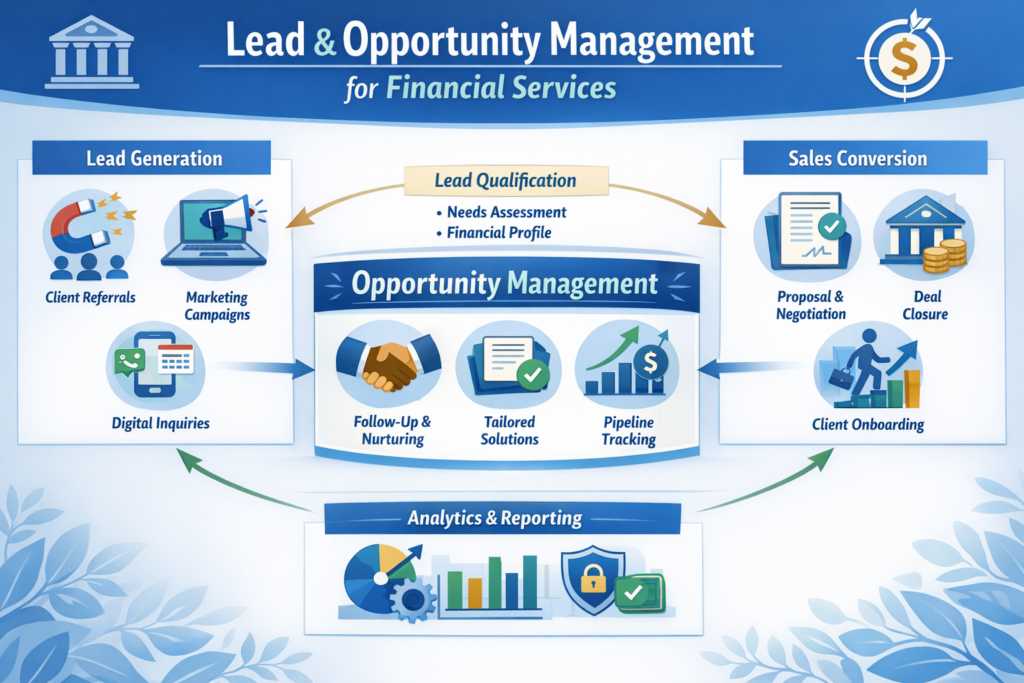
In financial services, opportunities are not always simple transactions. A loan application may go through multiple stages such as inquiry, application, underwriting, approval, and disbursement. An insurance policy may involve quotes, underwriting, approvals, and renewals. Investment opportunities may involve advisory discussions, portfolio planning, and long-term relationship management. Financial Services Cloud allows institutions to track these processes within structured pipelines.
Organizations can track various types of opportunities such as:
- Loan applications
Track loan inquiries, applications, approvals, and disbursements through defined pipeline stages - Insurance policy opportunities
Manage policy quotes, underwriting processes, approvals, and renewals - Investment opportunities
Track investment advisory opportunities, portfolio onboarding, and asset management engagements - Advisory engagements
Manage financial planning services, wealth advisory engagements, and consulting services - Referral opportunities
Track referrals between departments, advisors, partners, or external institutions
This structured opportunity tracking helps financial institutions manage their pipelines more effectively. Relationship managers and advisors can see where each opportunity stands, what actions are required, and which opportunities are likely to close. Leadership teams can also use pipeline reports and dashboards to forecast revenue, monitor performance, and track client acquisition trends.
Beyond pipeline visibility, this system also improves collaboration between teams. For example, a loan opportunity may involve sales teams, underwriting teams, compliance teams, and operations teams. Financial Services Cloud allows all teams to track the same opportunity and process within one platform, reducing communication gaps and improving process transparency.
Overall, lead and opportunity management in Financial Services Cloud helps financial institutions maintain clear visibility into revenue opportunities, client acquisition processes, and product pipelines while supporting the complex lifecycle of financial products.
Loan, Policy, and Investment Lifecycle Management
Financial institutions often manage complex product lifecycles. A loan application, for example, may go through multiple stages such as application, underwriting, approval, disbursement, and servicing.
Financial Services Cloud allows organizations to track these lifecycles and automate processes such as:
- Loan application tracking
- Policy lifecycle management
- Investment account onboarding
- Approval workflows
- Documentation tracking
This improves process visibility and reduces manual coordination between departments.
Automation and Workflow Capabilities
Automation plays a major role in Financial Services Cloud because financial institutions rely heavily on structured processes, approvals, documentation, and compliance-driven workflows. Many financial operations involve multiple steps, multiple departments, and strict regulatory requirements. Manual handling of these processes often leads to delays, errors, and inconsistent customer experiences. This is where automation becomes critical.
Using Salesforce Flow, organizations can automate a wide range of financial processes and operational workflows. Flow allows institutions to create automated processes that trigger actions, send notifications, update records, and guide users through structured steps without requiring heavy coding.
Organizations commonly automate processes such as:
- Loan approval workflows
Automating application reviews, approval steps, document verification, and notifications to applicants - Policy renewal reminders
Automatically sending renewal reminders, creating follow-up tasks, and notifying relationship managers - Compliance documentation tracking
Ensuring required documents are submitted, approvals are completed, and compliance steps are followed - Client onboarding processes
Automating onboarding tasks such as document collection, account setup, compliance checks, and welcome communications - Service request routing
Automatically assigning service requests or cases to the appropriate team or advisor - Task and notification automation
Creating tasks, sending alerts, and reminding teams about follow-ups or approvals
The biggest advantage of automation is consistency. Financial institutions must follow standardized processes to meet regulatory requirements and internal policies. Automation ensures that processes are followed the same way every time, reducing risk and improving compliance.
Automation also reduces manual work for employees. Instead of spending time on repetitive administrative tasks, teams can focus on client relationships, advisory services, and higher-value activities. This improves productivity and allows organizations to scale operations without increasing administrative workload at the same rate.
In Financial Services Cloud, automation is not just about efficiency. It is about process control, compliance, consistency, and scalability, all of which are critical in the financial services industry.
Compliance and Regulatory Tracking
Financial institutions operate in highly regulated environments. Compliance tracking is critical to ensure that organizations meet regulatory requirements and maintain proper documentation.
Financial Services Cloud can be used to track:
- Compliance documentation
- Customer verification processes
- Approval workflows
- Audit trails
- Regulatory reporting
This helps organizations maintain compliance while also improving process transparency.
Data Security and Permission Models
Security is extremely important in financial services. Financial Services Cloud uses Salesforce’s security model, including:
- Role hierarchy
- Profiles and permission sets
- Field-level security
- Record-level security
- Sharing rules
This ensures that sensitive financial data is accessible only to authorized users while maintaining visibility where necessary.
Reporting and Financial Analytics
Financial institutions rely heavily on reporting and analytics to monitor performance, customer portfolios, and operational efficiency.
Financial Services Cloud provides dashboards and reports for:
- Client portfolio performance
- Loan pipeline reports
- Policy tracking reports
- Advisor performance
- Customer service metrics
- Revenue forecasting
These reports help leadership teams make data-driven decisions.
AI and Einstein for Financial Services
Salesforce Einstein AI adds intelligence to Financial Services Cloud by providing:
- Predictive insights
- Opportunity scoring
- Next best action recommendations
- Customer engagement insights
- Risk prediction models
AI helps financial institutions move from reactive decision-making to proactive relationship management.
Integration with Core Banking and External Systems
Financial institutions rarely operate on a single system. Most organizations use multiple platforms such as core banking systems, loan management systems, insurance policy systems, accounting software, and customer portals. When these systems operate independently, data becomes fragmented, processes slow down, and teams lack a complete view of customers and financial operations.
Financial Services Cloud addresses this challenge by acting as a central platform that connects these systems together. Through APIs, middleware, and integration tools, Salesforce can exchange data with external platforms in real time or through scheduled data synchronization. This allows financial institutions to maintain a unified view of customers, financial products, and interactions without replacing their core operational systems.
Financial Services Cloud can integrate with systems such as:
- Core banking systems
For account balances, transactions, customer information, and banking operations - Loan management systems
For loan applications, approvals, repayment schedules, and loan servicing - Insurance policy systems
For policy management, claims processing, renewals, and underwriting processes - Accounting platforms
For financial reporting, invoicing, and financial data synchronization - Marketing automation tools
For customer campaigns, communications, and lead generation - Customer portals
For customer self-service, document uploads, service requests, and account access
By integrating these systems, Financial Services Cloud becomes the central relationship and interaction platform while other systems continue to handle specialized operations. This approach allows institutions to modernize their customer management and operations without completely replacing existing infrastructure.
The result is a connected ecosystem where data flows between systems, teams have complete visibility, and processes become more streamlined. Instead of operating in isolated systems, financial institutions can operate on a connected digital platform that improves efficiency, customer experience, and decision-making.
Advisor and Relationship Manager Productivity Tools
Financial Services Cloud includes a range of productivity tools specifically designed for relationship managers, advisors, and bankers who manage ongoing client relationships. In financial services, success often depends on the strength of relationships rather than one-time transactions. Advisors need quick access to client information, financial accounts, interaction history, and upcoming tasks so they can provide informed and timely financial guidance.
These productivity tools are designed to give advisors a complete view of their clients in one place, reducing the need to switch between systems or search for information across multiple records. This improves efficiency and allows advisors to focus more on client engagement and less on administrative work.
Key productivity tools include:
- Client interaction summaries
Provides a consolidated view of recent meetings, calls, emails, service requests, and financial reviews so advisors can quickly understand recent client activity - Relationship maps
Visualizes relationships between clients, households, businesses, advisors, and financial accounts, helping advisors understand the full financial relationship structure - Task and reminder tracking
Helps advisors manage follow-ups, approvals, document requests, and important client activities - Financial account overviews
Provides visibility into client accounts, portfolios, loans, policies, and financial products in one place - Meeting notes and activity tracking
Allows advisors to record meeting discussions, client preferences, financial goals, and follow-up actions
These tools significantly improve advisor productivity because they centralize client information, financial data, and activities into a single platform. Advisors no longer need to rely on separate systems, spreadsheets, or manual tracking methods to manage client relationships.
Ultimately, these productivity tools help advisors stay organized, provide better financial advice, respond to clients faster, and build stronger long-term relationships. In relationship-driven industries like banking, insurance, and wealth management, this level of visibility and organization can directly impact client satisfaction and business growth.
Customer Experience and Personalization
Modern financial customers expect personalized service and faster response times. Financial Services Cloud allows organizations to personalize services based on customer data, financial portfolios, and interaction history.
This leads to:
- Better customer engagement
- Improved client retention
- More cross-selling opportunities
- Better service experiences
Customer experience becomes a competitive advantage.
Common Use Cases in Banking, Insurance, and Wealth Management
Financial Services Cloud is used across multiple sectors:
Banking
- Loan management
- Customer onboarding
- Relationship management
Insurance
- Policy lifecycle management
- Claims tracking
- Customer service
Wealth Management
- Portfolio management
- Client advisory
- Relationship tracking
Implementation Best Practices
Successful implementations usually follow these principles:
- Design the data model carefully
- Define clear business processes
- Automate repetitive workflows
- Integrate external systems early
- Build dashboards for leadership visibility
- Train users properly
Implementation is not just technical. It is organizational transformation.
Common Challenges and How to Avoid Them
Like any enterprise platform implementation, Financial Services Cloud projects can face several challenges if they are not planned and governed properly. Many organizations assume that implementing a CRM or industry cloud is purely a technical project, but in reality, it is a business transformation initiative. Most issues do not arise from the platform itself, but from poor planning, unclear processes, or lack of governance.
Some of the most common challenges include:
- Poor data structure
If the data model is not designed properly at the beginning, organizations may face reporting issues, automation failures, duplicate data, and performance problems. A strong data architecture is critical for long-term success. - Over-customization
Many organizations try to customize everything instead of using standard features and industry data models. Over-customization increases complexity, makes upgrades difficult, and increases maintenance costs over time. - Lack of user adoption
Even the best system will fail if users do not adopt it. Poor training, complicated interfaces, or processes that do not match real workflows often lead to low adoption rates. - Integration complexity
Financial institutions often use multiple systems such as core banking, loan systems, and policy management platforms. Integrating these systems without a clear integration strategy can create data synchronization issues and operational challenges. - Poor automation design
Automation should simplify processes, but poorly designed automation can create confusion, duplicate actions, or system performance issues.
These challenges can be avoided with proper planning, governance, and implementation strategy. Organizations should focus on designing the data model carefully, minimizing unnecessary customization, planning integrations early, and ensuring users are properly trained and involved in the implementation process.
A well-planned implementation focuses not just on building the system, but on building a scalable, maintainable, and user-friendly platform that supports long-term business growth.
Financial Services Cloud vs Standard Salesforce CRM
| Feature | Standard CRM | Financial Services Cloud |
| Household Model | No | Yes |
| Financial Accounts | Limited | Yes |
| Relationship Mapping | Limited | Yes |
| Compliance Tracking | Custom | Built-in |
| Industry Data Model | No | Yes |
Financial Services Cloud is designed specifically for financial institutions, making it more suitable than standard CRM for this industry.
Future of Financial Services Cloud
The future of Financial Services Cloud will likely focus on:
- AI-driven financial insights
- Automated compliance tracking
- Personalized financial recommendations
- Integrated digital banking experiences
- Predictive risk analysis
Financial institutions will increasingly rely on platforms like Financial Services Cloud to remain competitive and compliant.
Conclusion
Salesforce Financial Services Cloud is more than a CRM. It is a relationship management platform designed specifically for financial institutions. It helps organizations unify customer data, automate processes, improve compliance, and deliver better customer experiences.
Financial institutions that implement Financial Services Cloud correctly often see improvements in operational efficiency, customer engagement, and business visibility. It becomes not just a system of record, but a system of engagement and decision-making.
At CloudVandana, we help financial institutions implement, customize, and optimize Salesforce Financial Services Cloud to streamline operations, improve customer experience, and build scalable financial systems.
If your financial organization is planning to implement Salesforce or optimize your existing system, it may be time to build a connected financial platform that supports long-term growth and efficiency.
FAQs
What is Salesforce Financial Services Cloud?
Salesforce Financial Services Cloud is an industry-specific CRM designed for financial institutions to manage clients, financial accounts, loans, policies, relationships, and compliance processes on one platform.
Who uses Financial Services Cloud?
It is used by banks, insurance companies, wealth management firms, lending companies, financial advisors, and FinTech organizations that manage financial products and long-term client relationships.
How is it different from Sales Cloud?
Sales Cloud focuses on sales pipelines, while Financial Services Cloud is designed for financial institutions with features like household management, financial accounts, relationship mapping, and compliance tracking.
Can it manage loans and policies?
Yes, Financial Services Cloud can track loans, insurance policies, and other financial products from application and approval to servicing and renewal.
Does it support compliance tracking?
Yes, it supports compliance processes by tracking documentation, approvals, audit trails, and regulatory workflows.
Can it integrate with core banking systems?
Yes, Financial Services Cloud can integrate with core banking systems, loan systems, insurance platforms, accounting software, and other enterprise systems.
Is Financial Services Cloud secure?
Yes, it uses Salesforce’s enterprise security model including role-based access, permission sets, and data security controls.
Does it support automation?
Yes, organizations can automate onboarding, approvals, reminders, service requests, and compliance processes using Salesforce Flow.
Can it track household relationships?
Yes, it includes household and relationship management to track families, joint accounts, beneficiaries, and financial relationships.
What industries use Financial Services Cloud?
It is mainly used in banking, insurance, wealth management, lending, investment advisory, and FinTech industries.
How long does implementation take?
Implementation time varies depending on complexity, integrations, and customization, but typically ranges from a few weeks to a few months.
How can CloudVandana help with Financial Services Cloud implementation?
CloudVandana helps with implementation, customization, integrations, automation, reporting, and optimization of Financial Services Cloud for financial institutions.

Atul Gupta is CloudVandana’s founder and an 8X Salesforce Certified Professional who works with globally situated businesses to create Custom Salesforce Solutions.
Atul Gupta, a dynamic leader, directs CloudVandana’s Implementation Team, Analytics, and IT functions, ensuring seamless operations and innovative solutions.
YOU MIGHT ALSO LIKE

Salesforce Financial Services Cloud: The Complete Guide for Modern Financial Institutions

Lightning Platform (UI & Development): A Practical Guide

What Does a Salesforce Partner Actually Do? A Complete Guide for Businesses

Signs Your Salesforce Org Needs an Optimization Audit

Salesforce Performance Optimization Checklist for 2026