CRM Consulting for SMEs
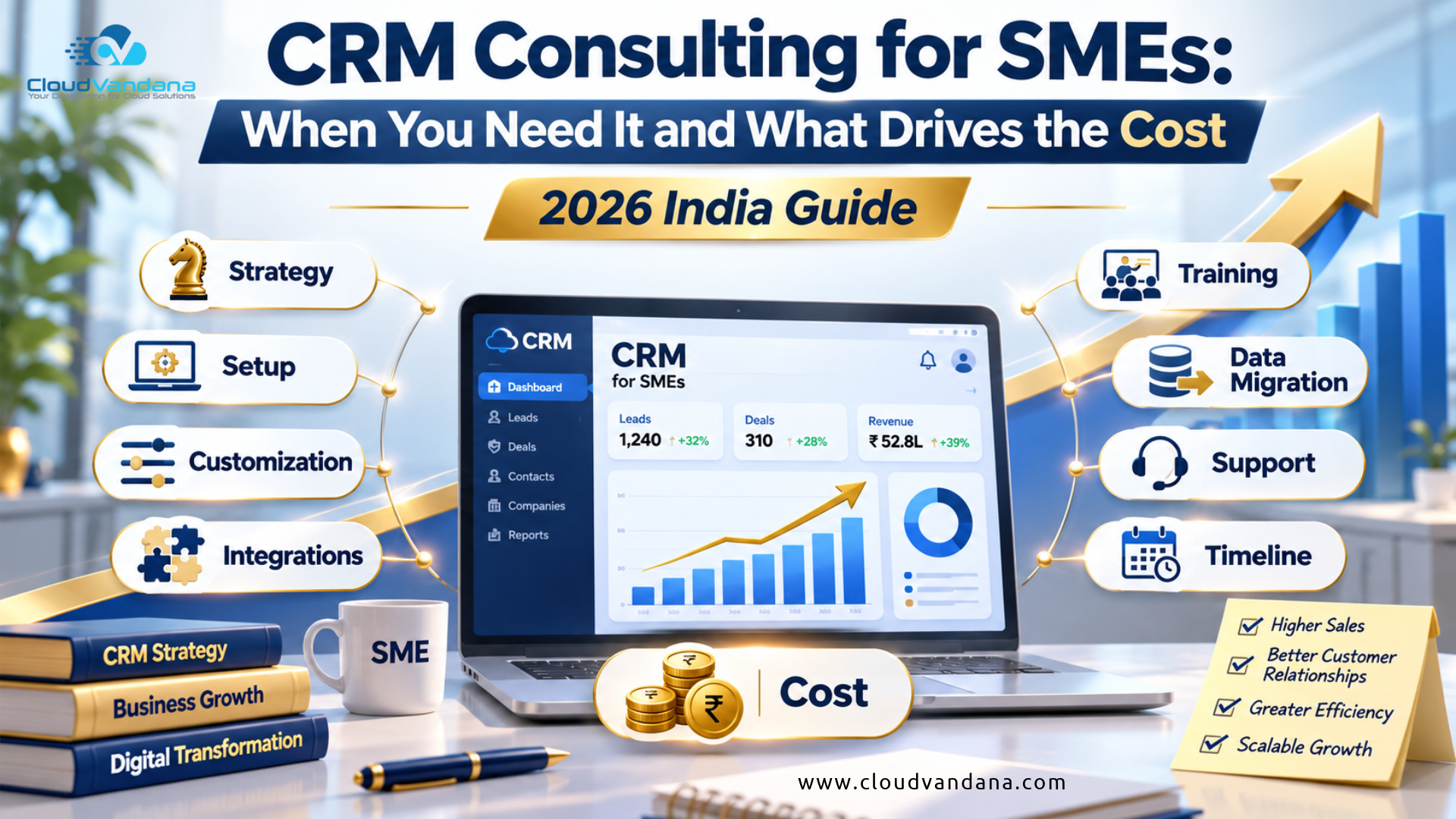
An SME needs CRM consulting when leads and customer data are scattered across WhatsApp, Excel and email, when a CRM has been bought but the team doesn’t use it, or when the business must choose between platforms such as Salesforce and Zoho. The cost depends on five factors: number of users, process complexity, integrations, data migration and platform choice. CloudVandana offers a free consulting call to scope your needs and share detailed pricing for your business.
Key takeaways
- You likely need a CRM consultant if three or more of the seven warning signs below describe your business.
- You can probably skip one if you have fewer than three users, a simple sales process and a free CRM tier will do.
- CRM cost has three layers: licences (recurring), consulting and implementation (one-time), and ongoing support and add-ons.
- Five factors set your price: users, process complexity, integrations, data migration and platform choice.
- Always ask for a discovery phase before a fixed quote. A quote without one is a guess.
- The fastest way to get an accurate price is a free consulting call, where we scope your needs and share detailed pricing.
What is CRM consulting?
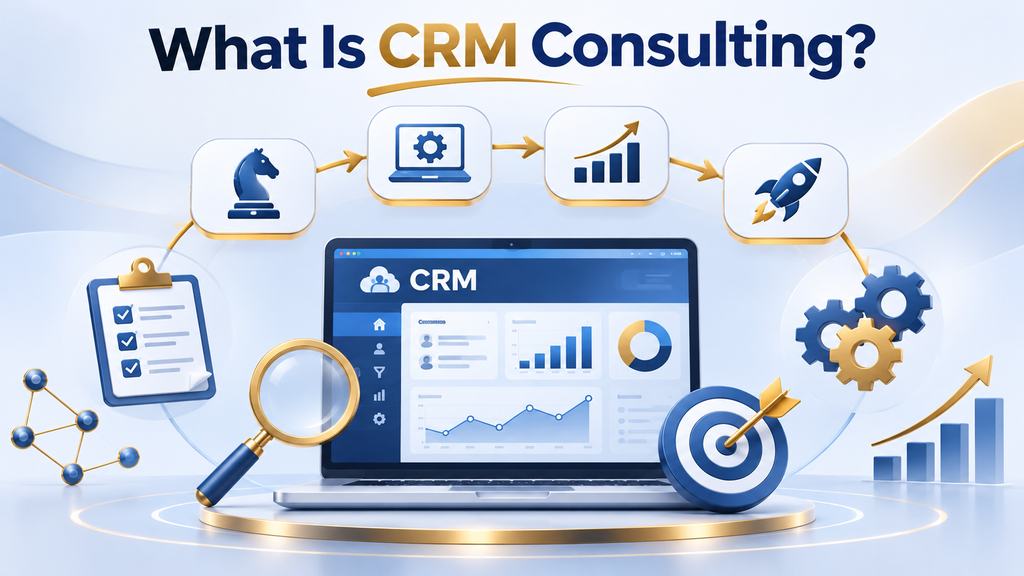
CRM consulting is a professional service that helps a business choose, design, configure, integrate and roll out a customer relationship management (CRM) system around its real sales, service and operations processes. A CRM consultant works on the business problem first (lost leads, slow quotations, no forecast) and the software second.
This is different from buying software directly from a vendor. A vendor’s sales team sells you licences. A consultant is paid to fit the tool to your process, and a good one will tell you when a cheaper tool is enough.
For SMEs, CRM consulting usually covers five things: process mapping, platform selection, configuration and automation, data migration and integration, and team training with post-go-live support.
7 signs your SME needs CRM consulting
1. Leads are leaking
Enquiries arrive from your website, IndiaMART, calls and WhatsApp, but nobody can say how many were followed up or why deals were lost. If follow-up depends on one salesperson’s memory, every resignation is a revenue risk.
2. Excel and WhatsApp are your CRM
Spreadsheets work until two people edit the same file or a salesperson leaves with their phone. If customer history lives in personal chats, you don’t own your pipeline.
3. You bought a CRM and nobody uses it
This is the most common and most expensive sign. A CRM that is configured for a generic business, not yours, gets abandoned within months. Re-implementation costs less than paying for licences nobody uses.
4. You can’t forecast
If you can’t answer “what will we close next month?” without calling every salesperson, your pipeline stages and reporting need to be designed properly.
5. Sales, operations and finance don’t share data
Quotations are made in Word, orders sit in an ERP or Tally, invoices are raised separately, and support tickets live in email. Each handover loses data. Integration is a consulting problem, not a software problem.
6. You’re growing past the founder
Once a business has more than a handful of customer-facing people, the owner becomes the bottleneck for approvals, pricing and follow-ups. A CRM with defined stages, approvals and automation lets the team run without constant escalation.
7. You’re choosing between platforms
Salesforce, Zoho CRM, HubSpot, Freshsales and Pipedrive all fit different businesses. A wrong choice is painful to reverse, because data, workflows and training are all tied to the platform. An independent assessment before you commit is the cheapest insurance in the project.
Rule of thumb: if three or more of these apply, a structured consulting engagement will likely pay for itself.
When you probably don’t need a CRM consultant
Consulting is not always the answer. You can likely manage without it if:
- You have one to three users and a simple, short sales cycle.
- A free or entry-level CRM covers your needs. Zoho CRM, for example, has a free edition for up to three users.
- You already have an in-house admin who has implemented a CRM before.
- Your process is stable and documented, and you only need a standard setup with no integrations.
In these cases, start with the vendor’s onboarding and revisit consulting when you add users, integrations or a second sales team.
What does a CRM consultant actually do?
A well-run SME engagement follows these phases:
| Phase | What happens | What you get |
| 1. Discovery | Workshops with sales, operations and finance to map how leads, quotes, orders and service work today | Process map, requirements list, success metrics |
| 2. Platform selection | Compare CRMs against your requirements, budget and users | Shortlist with a recommendation and total cost of ownership |
| 3. Design and configuration | Set up pipeline stages, fields, roles, approvals, quotation templates and automation | A CRM configured to your process, not a generic template |
| 4. Migration and integration | Clean and import data; connect email, WhatsApp, website forms, accounting or ERP | One source of truth |
| 5. Training and adoption | Role-based training, user guides, dashboards for managers | Team that actually logs activity |
| 6. Post-go-live support | Fixes, tuning, new reports, optional managed service | Stable system and a roadmap |
Scope drives the timeline. A focused SME rollout is measured in weeks, while multi-department projects with integrations take longer. Your consultant should give you dated milestones after discovery.
What drives the cost of CRM consulting?
CRM consulting cost is not a fixed number, because no two SME projects have the same scope. Five factors set your price, and a short discovery conversation is the fastest way to turn them into a firm, written figure.
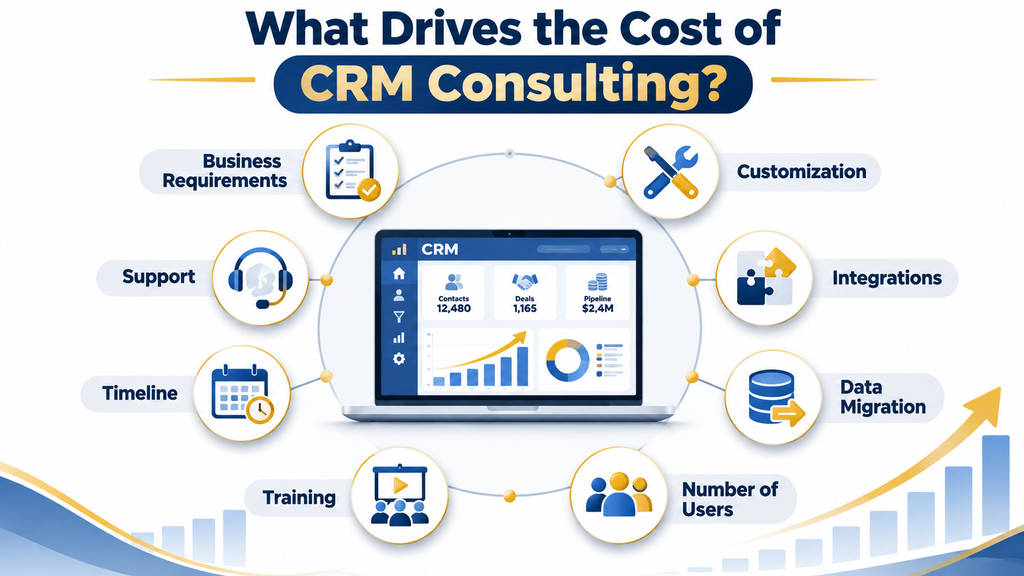
The five factors that set your price
| Cost driver | What it means | Why it matters |
| Number of users | How many people will use the CRM | Affects licences, training time and role setup |
| Process complexity | Pipeline stages, approvals, quotations, pricing rules | More business logic means more configuration and testing |
| Integrations | Accounting, ERP, WhatsApp, website forms, e-commerce stores, telephony | Each connected system adds design, build and testing work |
| Data migration | Volume and quality of existing leads and customers in Excel, Tally or another CRM | Messy data must be cleaned before it can be imported |
| Platform choice | Salesforce, Zoho CRM, HubSpot or another CRM | Licence model, customisation depth and partner effort differ |
The three layers of CRM cost
- Licences (recurring): the per-user subscription you pay the CRM vendor. It depends on the edition and the number of users.
- Consulting and implementation (one-time): discovery, configuration, data migration, integration and training.
- Ongoing costs: renewals, added users, paid apps, admin support and periodic process reviews.
Most SMEs plan only for the first layer, which is why budgets feel off later. A good consultant prices all three up front.
How CRM consultants price projects
- Fixed fee: one price for a defined scope. Best when requirements are clear after discovery.
- Time and materials: you pay for the effort used. Flexible, but needs active scope control.
- Monthly retainer: a recurring fee for ongoing configuration, minor enhancements and helpdesk.
- Bundled: licences and implementation in one annual package from a partner.
Cheaper is not automatically better. Ask who actually does the work, what certifications they hold, and what is included after go-live.
Want a clear number for your business? Book a free consulting call and we will scope your needs and share detailed pricing. [Book a free consulting call – INSERT FORM URL]
Hidden costs that blow up CRM budgets
- Data cleaning and migration. Duplicate contacts, missing phone numbers and inconsistent company names take real time to fix.
- Integrations. Each connection (accounting, WhatsApp, e-commerce store, telephony) adds scope.
- Training. Skipping it is the single biggest cause of low adoption.
- Add-ons. Paid apps and extra storage are billed on top of base licences, so ask for them to be listed in the quote.
- Internal time. Your team will spend hours in workshops and testing. That is a real cost, even if it isn’t invoiced.
- Post-go-live support. Many partners price to a go-live date and charge separately afterwards. Ask what is included and for how long.
How to measure the return
A simple way to test whether consulting is worth it:
Return = (extra deals recovered + hours saved × hourly cost + errors avoided) − (licences + consulting + internal time)
For example, if better follow-up recovers even two or three deals a year that would otherwise have been lost, compare their margin against your total project investment. Track these before and after go-live: lead response time, lead-to-quote conversion, quote turnaround time, and the share of deals logged in the CRM.
How to choose a CRM consultant: 8 questions to ask
- Will you run a paid or free discovery phase before quoting a fixed price?
- Which CRMs do you implement, and will you recommend one that isn’t your preferred tool if it fits better?
- Who will actually do the work, and what are their certifications?
- Can you show similar projects in my industry (manufacturing, distribution, retail, e-commerce, healthcare) and give references?
- What exactly is included: migration, integrations, training, documentation?
- What does post-go-live support cover, and for how long?
- How do you handle change requests and scope creep?
- Who owns the configuration and documentation if we part ways?
Red flags: no discovery phase, a quote far below the others, no mention of data migration or training, and a consultant who only knows one tool.
Which CRM suits an SME? A quick comparison
| Platform | Best for | Watch out for |
| Zoho CRM | Cost-conscious SMEs, INR billing, Indian tax compliance, linking to Zoho Books | Interface can feel busy; advanced features sit in higher editions |
| Salesforce | Growing businesses needing deep customisation, integrations and scalability | Higher total cost; USD billing; needs a skilled admin or partner |
| HubSpot, Freshsales, Pipedrive | Simple sales-led teams that want fast setup | Fewer options for complex quotation, approvals and cross-department workflows |
The right answer depends on your process, team size and growth plan. That is exactly what a platform-selection workshop is for.
How CloudVandana approaches CRM consulting for SMEs
CloudVandana is a Delhi-based CRM and business-systems consulting company. We work with small and mid-sized businesses across manufacturing, distribution, wholesale, retail, e-commerce (Shopify, Wix, WooCommerce) and healthcare. We implement Salesforce as well as other CRMs, depending on what fits the client’s requirements and budget, rather than defaulting to one tool.
Our engagements cover CRM consulting and selection, Sales Cloud and lead management, quotation and invoicing flows, business process consulting, automation, and integration with the systems you already use.
[ADD BEFORE PUBLISHING: years in business, number of CRM projects delivered, team certifications (e.g., Salesforce Certified Administrator, Zoho certifications), one or two real client examples with a measurable result and permission to publish, and a client testimonial or review link. These are the strongest E-E-A-T signals on the page, so use only facts you can verify.]
Book a free CRM consulting call for detailed pricing
Not sure whether you need consulting, which CRM to pick, or what it will take for your team size? In a free consulting call, we will understand your process, recommend the right approach, and give you detailed, written pricing for your scope.
👉 Book your free consulting call – fill out the query form – Click Here
What to expect: a focused discovery conversation, an honest view on whether you need consulting at all, and a clear next-step plan with detailed pricing. No obligation.
Frequently asked questions
When does a small business need CRM consulting?
A small business needs CRM consulting when leads are tracked in spreadsheets or chats, follow-ups are missed, a purchased CRM isn’t being used, or sales, operations and finance data must be connected. If you have fewer than three users and a simple process, a free CRM tier may be enough.
How much does CRM consulting cost for an SME?
CRM consulting cost depends on the number of users, process complexity, integrations, data migration and the CRM platform. Most consultants quote a fixed project fee after a discovery call. Book a free consulting call with CloudVandana to get detailed pricing for your business.
How much does Salesforce cost for a small business in India?
Salesforce is licensed per user per month, with editions for small teams up to large enterprises. Your total depends on the edition, number of users, add-ons and implementation scope. A free consulting call lets us size the right edition for your team and share detailed pricing.
How long does CRM implementation take for an SME?
A focused SME implementation is typically measured in weeks. Timelines grow with the number of users, integrations and data to migrate. Ask your consultant for dated milestones after discovery.
Is CRM consulting worth it for SMEs?
It is worth it when it prevents a failed rollout or recovers leads that would otherwise be lost. Measure it by lead response time, conversion rate, quotation turnaround and CRM adoption before and after go-live.
Should I choose Zoho CRM or Salesforce?
Zoho CRM suits cost-conscious SMEs that want INR billing and simple setup. Salesforce suits businesses that need deep customisation, complex workflows and room to scale. A platform-selection workshop based on your processes should decide, not the headline price.
What is the difference between a CRM consultant and a CRM vendor?
A vendor sells you the software licence. A CRM consultant advises on which platform and process design fit your business, configures it, trains your team and supports it after launch.
Sources and editorial notes
This guide draws on vendor documentation and published Indian market guides, and was last reviewed in November 2026. Platform editions, features and commercial terms change often, so confirm details with the vendor. CloudVandana does not publish fixed prices because every scope differs: book a free consulting call for detailed pricing.
👉 Fill out the form to book your free CRM consultation
Share your requirements, and our CRM consultants will respond within one business day.

Atul Gupta is CloudVandana’s founder and an 8X Salesforce Certified Professional who works with globally situated businesses to create Custom Salesforce Solutions.
Atul Gupta, a dynamic leader, directs CloudVandana’s Implementation Team, Analytics, and IT functions, ensuring seamless operations and innovative solutions.
YOU MIGHT ALSO LIKE
CRM Consulting for SMEs: When You Need It and What Drives the Cost (2026 India Guide)
CRM Implementation Services in India: A Step-by-Step Guide for SMEs

Financial Services Cloud: A Complete Guide for Banking and Wealth Management
How MuleSoft Connects Salesforce With ERP, Finance and Business Systems
Salesforce Customer 360: Connecting Sales, Service and Marketing Teams