Enterprise software is entering a new phase.
For years, businesses have invested heavily in CRM platforms, data systems, automation tools, dashboards, collaboration apps, and artificial intelligence. Yet employees still spend a surprising amount of time moving between those systems, searching for information, updating records, preparing reports, and figuring out what to do next.
Salesforce and Anthropic want to change that.
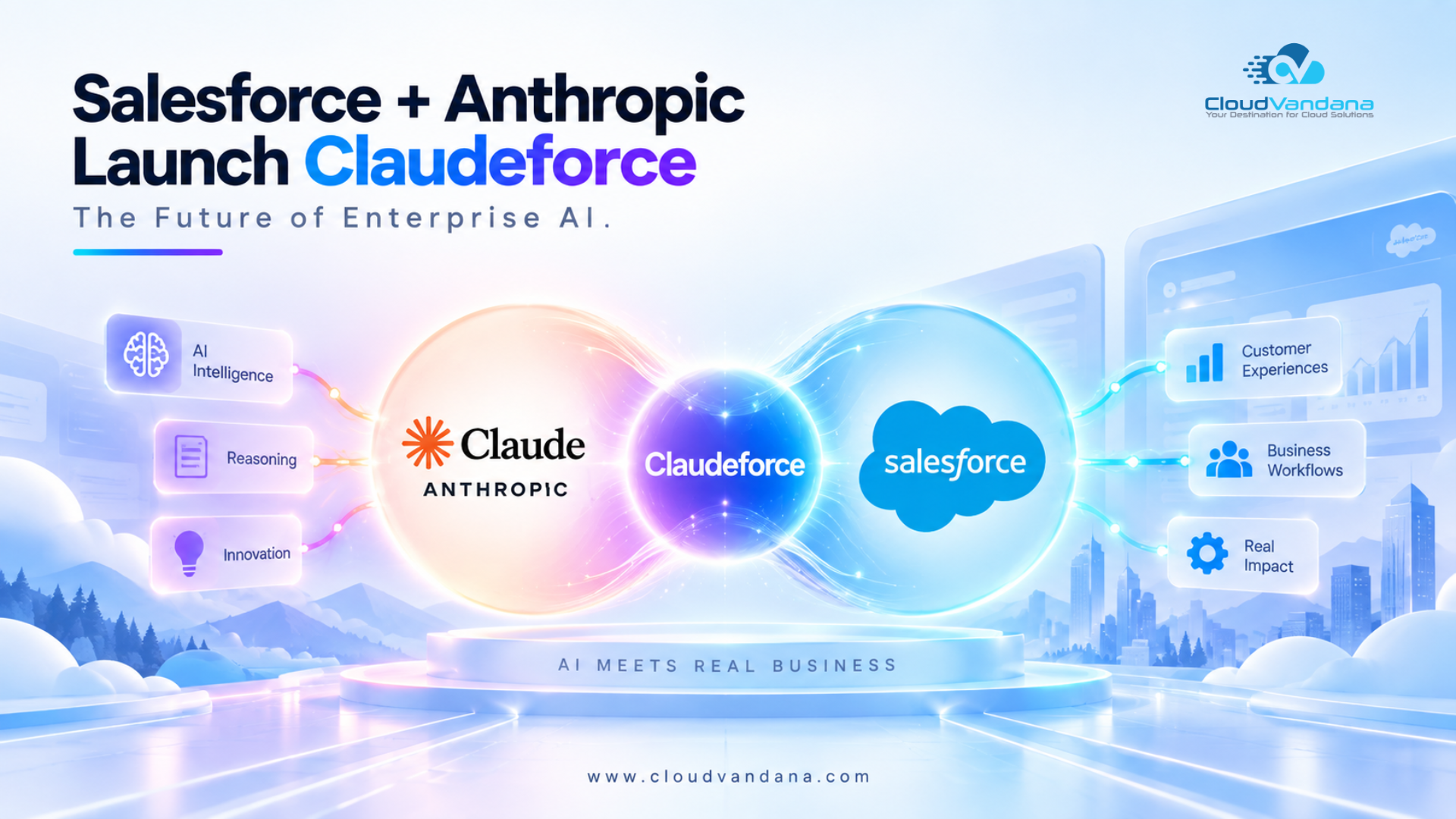
Their expanded partnership, called Claudeforce, brings Anthropic’s Claude together with Salesforce data, workflows, permissions, automation, business logic, Agentforce, and Slack.
The goal is bigger than adding another chatbot to Salesforce.
Claudeforce represents a move toward enterprise software where users can simply describe what they need and allow AI to gather the right context, reason over it, present an answer, and—when authorized—take action.
Salesforce announced Claudeforce in August 2026. Its first major product, Salesforce in Claude, includes 37 prebuilt sales skills designed around tasks such as account research, call preparation, pipeline review, deal analysis, and CRM updates. On September 15, Anthropic announced that Salesforce in Claude had entered beta.
This development could have important implications for sales teams, Salesforce administrators, business leaders, developers, consultants, and organizations planning their broader AI strategy.
So what exactly is Claudeforce? How does Salesforce in Claude work? How does it relate to Agentforce? And what should organizations do next?
Let’s break it down.
What Is Claudeforce?
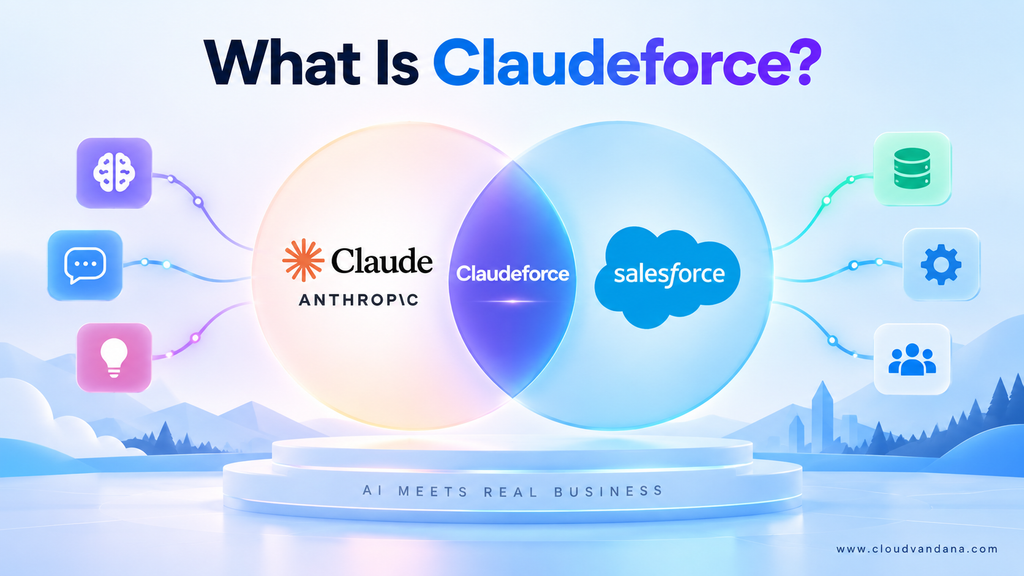
Claudeforce is the expanded strategic partnership between Salesforce and Anthropic that connects Claude’s AI reasoning capabilities with Salesforce’s enterprise data, workflows, business rules, permissions, applications, and governance.
In simpler words, it gives Claude a secure way to understand and work with business information stored in Salesforce.
Until now, an AI assistant could be extremely capable at reasoning but still know very little about a company’s actual customers, opportunities, service cases, processes, approvals, or internal policies.
Salesforce has the opposite advantage.
It can contain decades of structured business information, automation, permissions, customer history, and organizational rules—but using that information often means navigating screens, reports, dashboards, objects, and applications.
Claudeforce connects these two sides.
Claude provides the reasoning layer.
Salesforce provides the trusted business context and action layer.
Salesforce describes the partnership as enabling Claude to work with Salesforce information while respecting the permissions and business rules organizations already use.
That combination is what makes Claudeforce strategically interesting.
The objective is not simply to generate better text.
It is to create AI that understands what is happening inside a business and can help employees move from information to action.
Why Claudeforce Matters
Generative AI adoption has moved incredibly quickly.
But enterprise AI has a fundamental problem.
A model may understand language, solve complex problems, summarize documents, and reason through situations. Yet without access to trusted company context, it cannot reliably answer questions such as:
Which opportunities are most likely to need attention?
What changed in my pipeline since yesterday?
Which customer conversations should I review before today’s meetings?
Has this account raised the same support issue before?
What commitments did our team make during the last customer conversation?
Which opportunities have stalled without recent activity?
What information should be added to Salesforce after this call?
AI becomes much more useful when it understands the real state of the business.
That is precisely where Salesforce becomes important.
CRM records, customer interactions, workflows, permissions, Slack conversations, account histories, and business rules provide the context that general-purpose AI typically lacks.
Claudeforce attempts to bring these capabilities together.
Instead of asking employees to manually assemble business context before using AI, the AI can increasingly work with that context directly.
Salesforce in Claude: The First Major Claudeforce Experience
The clearest example of Claudeforce today is Salesforce in Claude.
Salesforce in Claude is a plugin jointly developed by Salesforce and Anthropic that brings Salesforce information and workflows into the Claude experience.
Its initial release focuses on sales teams.
The beta contains 37 prebuilt sales skills covering common activities such as account research, meeting preparation, pipeline analysis, and CRM updates. Anthropic says the plugin uses the Salesforce permissions employees already have.
This is important because the experience is designed around actual business tasks rather than simply giving Claude generic access to CRM data.
A salesperson might ask:
“What should I focus on today?”
Instead of producing generic sales advice, Claude could work with the seller’s actual Salesforce context.
It might identify an important deal without recent activity, an opportunity approaching its expected close date, a customer meeting scheduled later in the day, or an account where new information requires attention.
The interface begins to shift from:
Find the right CRM screen → locate the information → interpret it → decide what to do
to:
Ask what you need → review the answer → take action
That change could be much more significant than it initially appears.
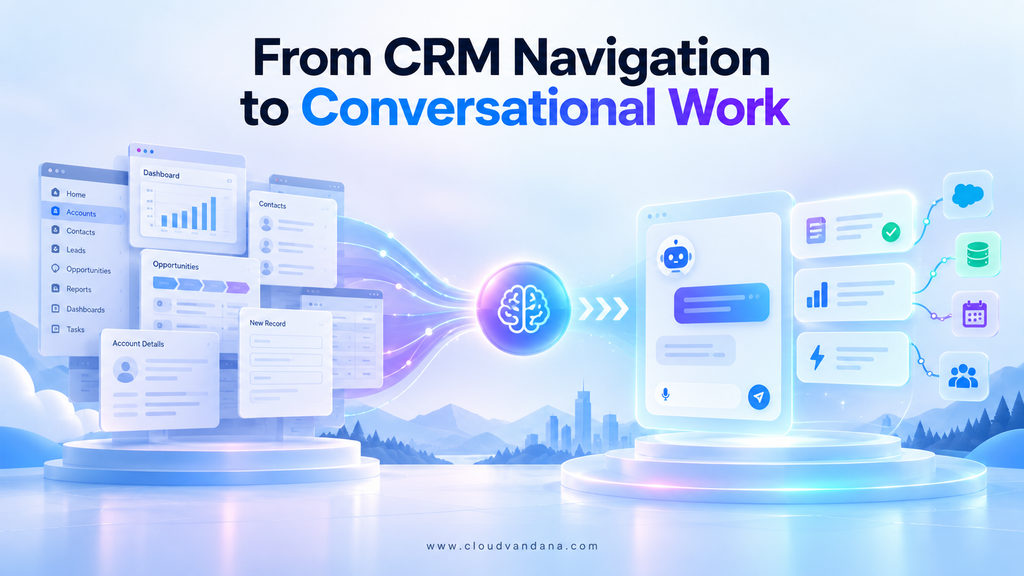
From CRM Navigation to Conversational Work
Traditional business software is largely organized around interfaces.
Users open applications.
Then they navigate menus.
They search records.
They open reports.
They switch tabs.
They filter dashboards.
They read activity histories.
Finally, they make a decision.
Generative AI offers another model.
Instead of making the employee understand exactly where the information lives, the system can potentially understand the employee’s intention.
Consider a sales executive preparing for an important customer meeting.
In a traditional workflow, that person may need to check Salesforce opportunities, account history, emails, meeting notes, recent Slack conversations, open support cases, and previous proposals.
The actual task is not “open seven systems.”
The task is:
Help me understand this customer before I speak with them.
AI-powered enterprise software attempts to organize technology around that outcome.
Salesforce’s broader Headless 360 strategy reflects the same direction. Salesforce says Headless 360 is designed to expose platform capabilities so authorized AI agents can discover and use them through open standards rather than requiring every experience to happen through the traditional application interface.
Claudeforce is one practical example of what that future can look like.
What Are the 37 Salesforce Skills in Claude?
The number “37 skills” is getting significant attention, but the more important question is what a skill actually means.
These are not simply 37 prompts.
They are packaged capabilities designed around recurring sales activities.
Salesforce says the initial skills span work from prospecting through closing and include areas such as daily briefings, pipeline reviews, forecasting, meeting preparation, account planning, and deal analysis.
Imagine a salesperson beginning the day.
Instead of opening several dashboards, they could ask Claude to review what has changed across their pipeline.
Claude could help assemble the context, highlight areas that deserve attention, and make the information easier to understand.
Before a meeting, the seller could request an account summary.
Afterward, Claude could help draft updates for Salesforce.
Anthropic says users remain involved in approving Salesforce updates produced through the plugin.
The important development here is the movement from isolated AI assistance toward AI-supported workflows.
The system is no longer useful only when someone wants to draft an email.
It becomes useful across the entire sequence of work.
Is Claudeforce an “AI CRO”?
Salesforce has used the idea of an AI CRO for every seller when describing Salesforce in Claude.
That does not mean organizations are suddenly replacing their Chief Revenue Officer.
A more practical interpretation is that the system can provide some of the visibility that revenue leaders traditionally try to create through pipeline reviews, reports, dashboards, forecasting processes, and coaching.
For example, AI may help a salesperson continuously answer:
What deserves attention?
Which deals changed?
What risks should I examine?
Which customers have gone quiet?
Where might follow-up be needed?
What happened during recent conversations?
What should I prepare before the next meeting?
The value lies in reducing the distance between business signals and employee action.
A CRM may already contain many of those signals.
The difficulty has always been finding, combining, interpreting, and acting on them quickly.
How Claudeforce Works Behind the Scenes
The user experience may feel simple, but making enterprise AI reliable requires much more than connecting an LLM to a database.
Businesses need permissions.
They need governance.
They need workflows.
They need identity management.
They need business logic.
They need reliable actions.
They need data access controls.
They need a way for AI systems to interact with enterprise applications without rebuilding every integration independently.
This is where Salesforce’s broader architecture becomes important.
AIforce and the Enterprise AI Harness
Salesforce has introduced AIforce as part of its architecture for connecting AI experiences to enterprise capabilities.
The idea is to provide a common foundation through which AI systems can understand business context, access approved capabilities, reason, and take controlled actions.
Salesforce describes its Enterprise AI Harness as bringing together the capabilities agents need to understand a business, reason about tasks, act across systems, and remain within enterprise controls.
This matters because organizations do not want every AI application to create a completely separate copy of their business rules and governance.
If a company already has rules determining who can update an opportunity, approve a discount, view customer information, or trigger a workflow, the AI should operate within those rules.
That is one of the central ideas behind Claudeforce.
What Is Headless 360?
Another important concept behind the partnership is Headless 360.
Historically, business software capabilities were strongly tied to their interfaces.
If you wanted to use Salesforce, you opened Salesforce.
Headless architecture separates capabilities from the interface.
That means an approved AI agent could potentially access Salesforce capabilities from another environment while Salesforce continues to provide the underlying data, workflow, permissions, and business logic.
Salesforce says Headless 360 is expanding capabilities across its platform so authorized agents can securely discover and use them through open standards.
That helps explain why Salesforce can appear directly inside Claude.
Salesforce does not necessarily need to own every screen where Salesforce work happens.
It can become the business engine beneath those experiences.
That is a major change in how CRM could be consumed.
The Role of MCP in Claudeforce
MCP, or Model Context Protocol, is another important piece of the architecture.
MCP provides a standardized way for AI systems to interact with external tools and information.
Think of it as a common connection layer.
Without standards like MCP, organizations might have to build many custom integrations between models, applications, databases, and workflows.
With a standardized approach, enterprise capabilities can be made available to compatible AI systems in a more reusable way.
Salesforce’s Headless 360 strategy includes MCP servers designed to expose platform capabilities to authorized AI agents.
For businesses, the long-term importance could be interoperability.
Organizations are unlikely to use one AI model for everything.
Different departments may use different models, agents, tools, and interfaces.
A more open architecture makes it easier for Salesforce to remain a central business platform while AI experiences evolve around it.
Claude Inside Salesforce: The Other Side of Claudeforce
Claudeforce is not only about putting Salesforce inside Claude.
The relationship works in the opposite direction too.
Claude has already been used within Salesforce’s broader AI ecosystem, including Agentforce.
Salesforce says Claude can serve as a reasoning model within Agentforce, while earlier collaboration between the companies also expanded Claude availability through Amazon Bedrock for certain Salesforce use cases, including regulated industries.
This creates an interesting two-way architecture.
Salesforce in Claude allows people to use Salesforce capabilities from Claude.
Claude in Salesforce allows Salesforce AI experiences to use Claude’s reasoning.
Instead of forcing companies to choose between Salesforce or Claude, the partnership is trying to make the two environments complementary.
Claudeforce vs. Agentforce: What Is the Difference?
The names can make this confusing.
Claudeforce and Agentforce are related, but they are not the same product.
Agentforce is Salesforce’s platform for creating and operating AI agents within the Salesforce ecosystem.
Claudeforce is the broader Salesforce-Anthropic partnership connecting Claude with Salesforce data, applications, workflows, AI infrastructure, and collaboration experiences.
Claude can therefore contribute to Agentforce while Salesforce capabilities can simultaneously become available inside Claude.
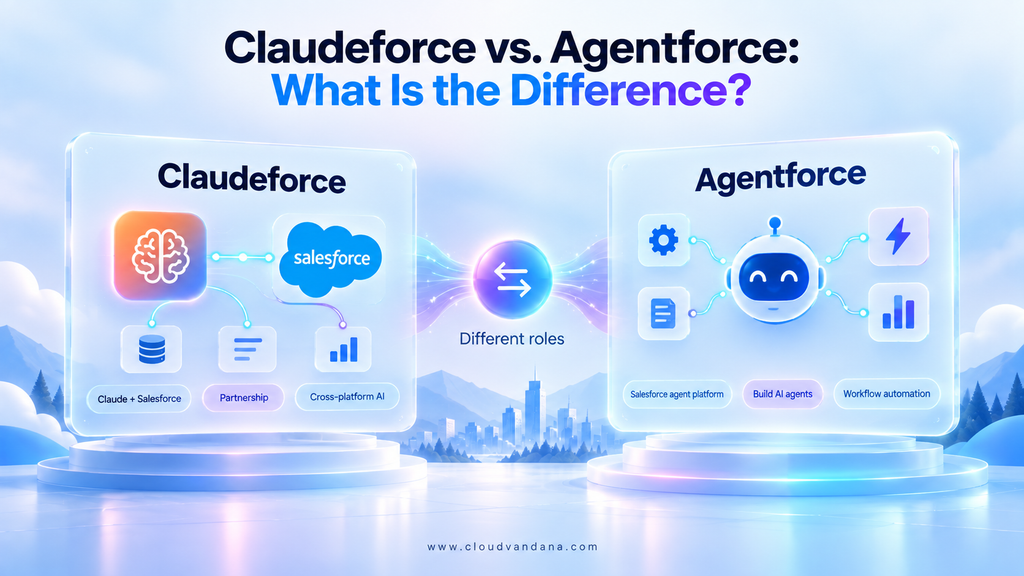
A simple way to understand the relationship is:
Agentforce helps organizations build and use enterprise agents.
Claudeforce connects Anthropic’s Claude more deeply with Salesforce’s enterprise ecosystem.
Salesforce in Claude is one of the first visible products created through that partnership.
Slack Is a Major Part of the Strategy
The partnership becomes even more interesting when Slack enters the picture.
Salesforce owns one of the world’s most important business collaboration platforms, while Anthropic increasingly sees Claude as a participant in team-based work.
Anthropic introduced Claude Tag in 2026, allowing teams to involve Claude directly within selected Slack channels. Claude can use permitted channel context and connected systems while collaborating with the people in that workspace.
Salesforce’s Claudeforce announcement goes further.
Salesforce stated that Claude would play a central role across Slack experiences, including Slackbot and other AI capabilities.
This creates a potentially powerful enterprise model.
Salesforce becomes the system of customer and operational context.
Slack becomes the collaborative workspace.
Claude becomes a reasoning layer.
Agentforce provides enterprise agents.
Employees provide judgment, context, approvals, relationships, and decision-making.
Instead of AI operating as a separate destination, it becomes embedded in the places where employees already work.
What Claudeforce Could Mean for Sales Teams
Sales is probably the easiest place to understand the potential impact.
Salespeople often struggle not because they lack information, but because they have too much information spread across too many systems.
A single account may contain years of opportunity history, activities, emails, notes, Slack messages, meetings, support interactions, contacts, proposals, and product information.
The seller does not need more data.
They need the right context at the right moment.
Claudeforce can potentially shorten that process.
Faster Account Research
Before contacting an account, a salesperson could ask Claude to assemble the most relevant Salesforce context.
That can reduce time spent manually reading records and reports.
Better Meeting Preparation
Instead of creating meeting briefs manually, AI can help summarize the account’s history, opportunities, recent activity, open issues, and relevant conversations.
More Useful Pipeline Reviews
Pipeline meetings often depend on sellers manually updating information before leadership can evaluate it.
AI-supported pipeline analysis could make stale opportunities, missing information, deal risks, and unusual changes easier to identify.
Easier CRM Updates
CRM adoption has always faced a familiar problem: sellers want to sell, not perform administrative work.
If AI can draft or prepare Salesforce updates based on actual work conversations—with the user reviewing or approving changes—the administrative burden could decrease substantially.
Better Follow-Up
After customer conversations, AI could help organize next steps, prepare summaries, draft communications, and update the appropriate records.
The result is not necessarily fewer salespeople.
It is potentially less time spent on low-value coordination around the selling process.
Why Governance Matters More Than AI Intelligence
The most powerful model does not automatically make the best enterprise system.
Businesses operate under constraints.
A salesperson should not automatically gain access to information owned by another team.
An AI assistant should not ignore approval processes.
Sensitive customer information needs protection.
Actions may need auditability.
Industry regulations may affect where and how information can be processed.
This is why Claudeforce’s connection to Salesforce permissions and business rules matters.
Salesforce says Salesforce in Claude works with the organization’s existing permissions and routes actions through Salesforce so established business logic can remain in control.
For enterprises evaluating AI, this distinction is crucial.
The question is no longer simply:
“How intelligent is the model?”
Organizations also need to ask:
“What can the model access?”
“What actions can it perform?”
“Who authorized those actions?”
“Which rules govern them?”
“What happens when information is incomplete?”
“Where should human approval remain mandatory?”
Enterprise AI architecture is increasingly about managing all of these layers together.
Will Claudeforce Replace the Salesforce Interface?
Probably not.
But it could reduce how often employees need to navigate that interface for routine work.
That distinction matters.
There will continue to be activities where dashboards, record pages, forms, visual configuration tools, analytics, and specialized Salesforce interfaces make sense.
However, an employee who simply wants an answer may not need to know which Salesforce object or report contains that information.
Similarly, someone trying to complete a common workflow may eventually be able to describe the intended outcome rather than manually navigating every step.
The future may therefore include multiple interfaces over the same Salesforce foundation.
Lightning may remain important.
Slack may become another interface.
Claude may become another.
Custom AI agents may become another.
Industry applications may add their own experiences.
Salesforce increasingly becomes the underlying business platform connecting them.
Does Claudeforce Mean Every Company Should Immediately Deploy AI Agents?
No.
The companies likely to get the most value from this shift will not simply be the companies that adopt AI fastest.
They will be companies with reasonably strong underlying business foundations.
AI becomes much more valuable when CRM data is reliable.
Processes are clearly defined.
Permissions are accurate.
Automation is maintained.
Duplicate information is controlled.
Important knowledge is accessible.
Business rules reflect how the organization actually operates.
If Salesforce contains outdated opportunities, duplicate records, missing activities, inconsistent fields, and broken automation, giving an AI system easier access to those problems does not magically solve them.
It may expose them faster.
That is why AI readiness increasingly starts with CRM readiness.
What Businesses Should Do Before Adopting Claudeforce
Organizations interested in Claudeforce should start by examining their existing Salesforce environment rather than beginning with the AI model.
First, review data quality. AI decisions and recommendations become more useful when accounts, contacts, opportunities, activities, products, and customer histories are accurate.
Second, review Salesforce permissions. AI access should reflect intentional security design rather than years of accumulated permission changes.
Third, document critical business processes. Identify where approvals, human review, compliance requirements, and exceptions exist.
Fourth, examine existing automation. Old workflows, duplicate Flows, unnecessary triggers, and inconsistent logic can become more problematic as AI begins interacting with business processes.
Fifth, identify high-value use cases. Do not implement AI merely because it exists. Start where employees repeatedly spend time searching, summarizing, updating, routing, or coordinating information.
Sixth, define the human role. Determine which actions AI can prepare, which actions it can execute, and which actions require approval.
Finally, create measurable outcomes. Useful metrics could include administrative time saved, meeting preparation time, CRM completeness, lead response time, pipeline accuracy, customer response time, or employee adoption.
The Bigger Shift: From Systems of Record to Systems of Action
For decades, CRM platforms were primarily systems of record.
They stored customer information.
Then CRM became more automated.
Workflows moved records.
Rules triggered notifications.
Analytics produced recommendations.
Agentic AI introduces another stage.
The system can potentially interpret business context and participate in the workflow itself.
A salesperson may not need to manually search for an at-risk opportunity.
An AI system may identify it.
The salesperson may not need to assemble a meeting briefing.
AI may prepare it.
The employee may not need to manually translate meeting notes into CRM fields.
AI may prepare those updates for approval.
That turns the CRM from somewhere information is stored into something that participates more actively in how work gets done.
Claudeforce is one of the clearest examples of that transition.
What Claudeforce Means for Salesforce Administrators
Salesforce administrators will remain extremely important.
Their role may simply evolve.
As AI becomes another way of interacting with Salesforce, configuration decisions become even more consequential.
Data models must make sense.
Permissions need to be intentional.
Automation needs to be reliable.
Descriptions and metadata become more important.
Business processes must be clearly represented within the platform.
Admins may increasingly spend less time optimizing individual screens and more time thinking about how humans, agents, applications, and workflows share the same enterprise foundation.
The question becomes:
Can an authorized AI system safely understand and use the Salesforce environment we have built?
That is a different architectural challenge from simply creating a better page layout.
What Claudeforce Means for Salesforce Developers
Developers will see a similar shift.
Traditional Salesforce development often focuses on interfaces, Apex logic, Lightning Web Components, integrations, and automation.
Those capabilities remain relevant.
But headless and agentic architecture introduces additional responsibilities.
Developers may increasingly build reusable capabilities that can be called from multiple AI interfaces.
APIs, MCP servers, Skills, agent actions, orchestration, observability, security, and evaluation become increasingly important.
Rather than designing only for a human clicking a button, developers may also design for an agent deciding when an action should be called.
That demands strong contracts, predictable behavior, proper error handling, and clearly defined permissions.
What Claudeforce Means for Business Leaders
For executives, the lesson is bigger than Salesforce or Claude.
AI is moving closer to the operational core of the company.
The first wave of enterprise generative AI focused heavily on content:
Write this email.
Summarize this document.
Create this presentation.
Rewrite this proposal.
The next wave increasingly focuses on business context and action:
Review my pipeline.
Prepare my meeting.
Update the opportunity.
Find accounts needing attention.
Investigate this support issue.
Trigger the appropriate workflow.
Coordinate the next step.
That is when AI begins affecting the operating model of the company rather than simply individual productivity.
Leaders therefore need an AI strategy connected to business architecture—not just a collection of AI subscriptions.
Claudeforce and the Future of the Agentic Enterprise
Claudeforce also supports Salesforce’s broader vision of the Agentic Enterprise.
In that model, employees, AI agents, business applications, customer data, automation, and collaboration platforms work together.
Humans remain responsible for judgment, relationships, creativity, accountability, and higher-level decisions.
Agents handle increasing amounts of analysis, coordination, repetitive work, and execution.
Salesforce provides business context and governed capabilities.
AI models provide reasoning.
Slack provides collaboration.
The interfaces become increasingly dynamic.
Whether every part of that vision develops exactly as expected remains to be seen.
But the direction is becoming clear.
Enterprise AI is moving away from standalone chatbots.
The next competitive advantage will come from connecting intelligence to real business context safely.
Claudeforce Availability in 2026
Salesforce originally announced that Salesforce in Claude would begin with selected pilot customers and move toward an open beta in September 2026.
On September 15, 2026, Anthropic announced the beta release of Salesforce in Claude, describing it as a plugin containing 37 skills for everyday account-executive work, including company research, call preparation, pipeline review, and CRM updates.
Salesforce has also indicated that the initial focus is sales, with additional capabilities expected to expand into other areas over time.
As with any newly released enterprise AI technology, organizations should confirm current product availability, region support, licensing, security requirements, and packaging directly before planning a production deployment.
Why Claudeforce Is Bigger Than Another AI Integration
It would be easy to describe Claudeforce as “Claude integrated with Salesforce.”
Technically, that is true.
Strategically, it misses the bigger story.
Claudeforce reflects a change in how enterprise applications may be designed and consumed.
Instead of every application forcing employees into its own interface, enterprise platforms can expose governed capabilities to intelligent systems.
Instead of AI operating without business context, models can reason over trusted organizational information.
Instead of users manually coordinating between CRM, collaboration, communication, and automation tools, agents can increasingly help orchestrate those systems.
And instead of enterprise software functioning primarily as a collection of screens, it can become an underlying layer of capabilities available wherever work happens.
That may ultimately prove to be the most important part of the Salesforce-Anthropic partnership.
Prepare Your Salesforce Environment for the Agentic AI Era with CloudVandana
AI adoption becomes much easier when the Salesforce foundation beneath it is ready.
Whether your organization is exploring Claudeforce, Salesforce in Claude, Agentforce, AI automation, Data 360, Slack integrations, or custom AI agents, the first step should be understanding where AI can create measurable business value—and whether your existing Salesforce architecture is prepared to support it.
CloudVandana can help you move from AI experimentation to practical Salesforce AI implementation.
Our Salesforce specialists can help assess your CRM environment, improve data quality, modernize automation, integrate business systems, implement Salesforce solutions, prepare Agentforce use cases, and design AI-powered workflows around your actual business processes.
The goal should not be to add AI everywhere.
The goal should be to put the right intelligence in the right workflow, connected to trusted data and governed actions.
Ready to explore what Claudeforce, Agentforce, and enterprise AI could mean for your business?
Connect with CloudVandana and build a Salesforce AI roadmap designed around your data, teams, workflows, and growth goals.
Frequently Asked Questions About Claudeforce
1. What is Claudeforce?
Claudeforce is the strategic partnership between Salesforce and Anthropic that connects Claude’s AI capabilities with Salesforce data, workflows, permissions, applications, and enterprise governance. Its first major product is Salesforce in Claude.
2. What is Salesforce in Claude?
Salesforce in Claude is a plugin that allows eligible users to work with Salesforce information and workflows from inside Claude. The initial beta focuses on sales activities and includes 37 prebuilt skills.
3. Is Claudeforce the same as Agentforce?
No. Agentforce is Salesforce’s platform for building and operating AI agents. Claudeforce is the broader Salesforce-Anthropic partnership. Claude can work within Salesforce experiences, including Agentforce, while Salesforce capabilities can also be made available inside Claude.
4. How many skills does Salesforce in Claude have?
The initial Salesforce in Claude release includes 37 prebuilt sales skills. They cover activities including account research, meeting preparation, pipeline review, deal analysis, and Salesforce updates.
5. Is Salesforce in Claude available now?
Anthropic announced the beta release of Salesforce in Claude on September 15, 2026. Availability can still depend on product access, customer eligibility, region, and packaging, so organizations should verify current availability before implementation.
6. Can Claude update Salesforce records?
Salesforce in Claude is designed to support CRM-related actions, including preparing Salesforce updates. Anthropic says sellers can review and approve updates generated through the experience.
7. Does Claudeforce follow existing Salesforce permissions?
Salesforce says the experience operates using established Salesforce permissions and business rules. This is important because AI access should not automatically give users broader access than they already have within the Salesforce environment.
8. What is Headless 360?
Headless 360 is Salesforce’s approach to making its platform capabilities available beyond the traditional Salesforce interface. Authorized AI agents can use Salesforce data, workflows, and other capabilities through open standards and APIs while Salesforce continues to provide the underlying enterprise logic and governance.
9. What role does MCP play in Claudeforce?
Model Context Protocol, or MCP, provides a standardized way for AI systems to connect with external tools and context. Salesforce’s Headless 360 strategy includes MCP capabilities designed to make enterprise functions available to authorized AI agents.
10. How is Slack connected to Claudeforce?
Slack forms another important layer of the Salesforce-Anthropic relationship. Claude capabilities are being integrated into Slack experiences, allowing people and AI to work together within collaborative workflows while drawing on connected enterprise context.
11. Will Claudeforce replace Salesforce?
Claudeforce is better understood as another way to access and use Salesforce capabilities rather than a replacement for Salesforce. Salesforce can continue functioning as the trusted data, workflow, automation, and governance platform while employees interact with those capabilities through Claude, Slack, Salesforce interfaces, and AI agents.
12. How should companies prepare for Claudeforce and agentic AI?
Start with the Salesforce foundation. Review CRM data quality, permissions, integrations, automation, business processes, security requirements, and potential AI use cases. Organizations should identify repetitive workflows where trusted AI can deliver measurable value while keeping humans involved in sensitive or high-impact decisions.
Final Thoughts
Claudeforce represents more than another partnership announcement in an increasingly crowded AI market.
It shows where enterprise technology is heading.
AI models are becoming more capable.
CRM platforms contain increasingly rich business context.
Enterprise applications are becoming more open.
Agents are beginning to participate in workflows.
And employees increasingly expect technology to understand what they want to accomplish rather than forcing them to navigate every technical step manually.
By bringing Claude’s reasoning closer to Salesforce’s customer data, workflows, permissions, automation, Agentforce ecosystem, and Slack collaboration layer, Salesforce and Anthropic are building toward a world where AI can participate much more directly in everyday business operations.
The companies that benefit most will not necessarily be those that deploy the most AI.
They will be those that connect AI to clean data, well-designed processes, strong governance, and meaningful business outcomes.
That is where Claudeforce becomes more than an interesting product announcement.
It becomes another sign that the future of CRM may not simply be a better interface.
It may be an intelligent business platform that understands context, helps people make decisions, and turns those decisions into trusted action.

Atul Gupta is CloudVandana’s founder and an 8X Salesforce Certified Professional who works with globally situated businesses to create Custom Salesforce Solutions.
Atul Gupta, a dynamic leader, directs CloudVandana’s Implementation Team, Analytics, and IT functions, ensuring seamless operations and innovative solutions.
YOU MIGHT ALSO LIKE
How MuleSoft Connects Salesforce With ERP, Finance and Business Systems
Salesforce Customer 360: Connecting Sales, Service and Marketing Teams
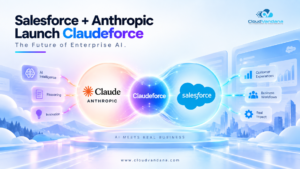
Salesforce and Anthropic Launch Claudeforce: What It Means for the Future of Enterprise AI

Salesforce AIforce: What It Means for the Future of Enterprise Software

The Biggest Dreamforce 2026 Theme: The Agentic Enterprise