Customer service is moving beyond the familiar model of customers submitting tickets, waiting in queues, and relying entirely on human representatives to resolve every issue.
The next stage is agentic customer service.
Instead of simply giving service teams another chatbot or isolated AI assistant, businesses are beginning to deploy AI agents capable of understanding customer requests, accessing relevant business information, completing approved actions, and transferring conversations to humans when human judgment is needed.
Salesforce accelerated this transition in March 2026 with the introduction of Agentforce Contact Center, positioning it as a unified contact center environment connecting voice, digital channels, CRM information, AI agents, and human service teams.
For organizations already using Salesforce, this has significant implications.
The contact center no longer needs to operate as a separate communication layer sitting beside CRM. Customer conversations, service workflows, AI agents, customer history, routing, and human support can increasingly operate from the same foundation.
So, what exactly is Agentforce Contact Center, and what does it mean for modern customer service?
What Is Agentforce Contact Center?
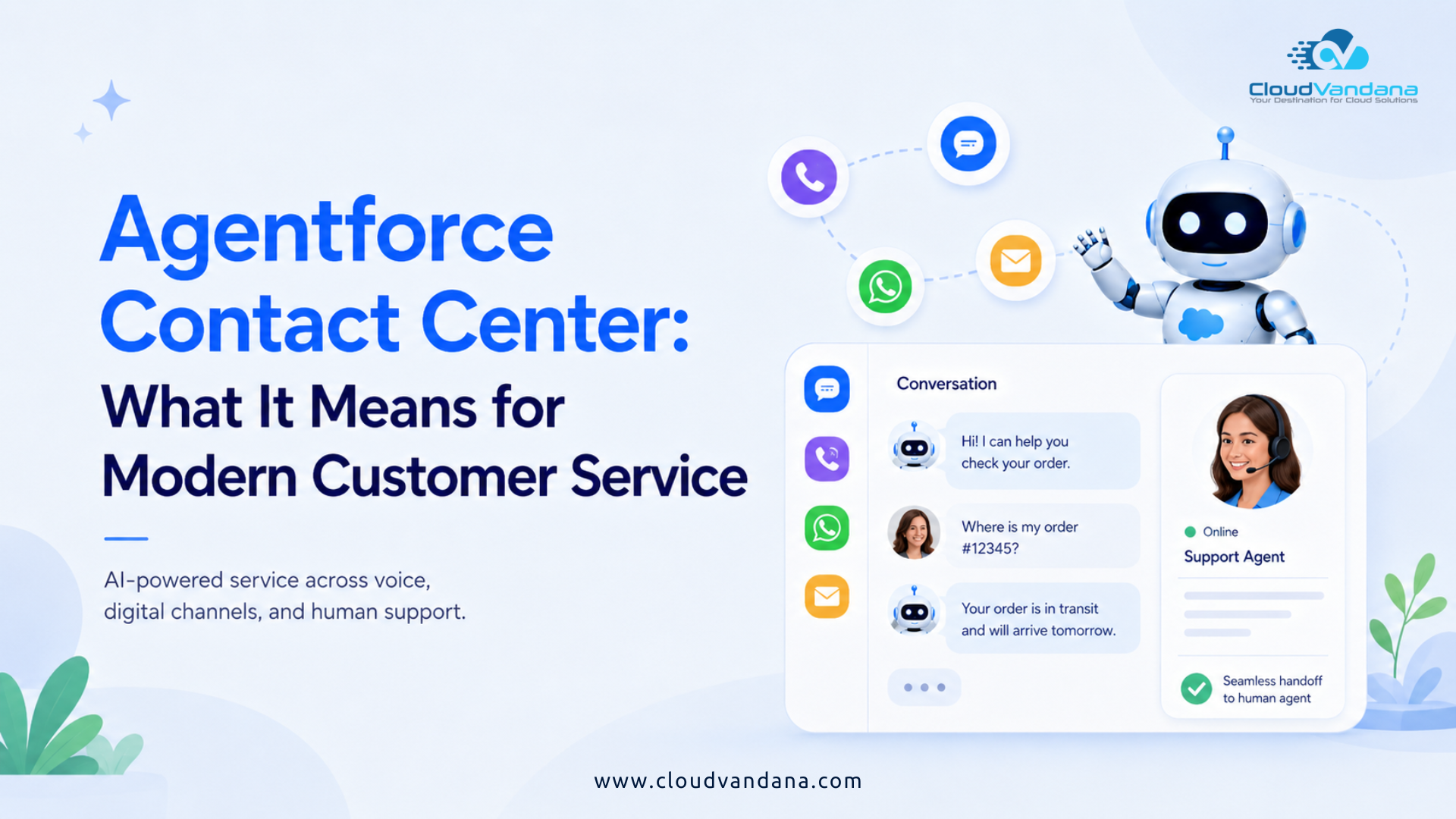
Agentforce Contact Center is Salesforce’s AI-first contact center solution that brings voice, digital channels, CRM data, automation, AI agents, and human service representatives together within Salesforce.
Salesforce describes it as a native solution designed to enable large-scale customer self-service, contextual AI-to-human handoffs, and real-time visibility across interactions.
In practical terms, imagine a customer contacting a company about an order.
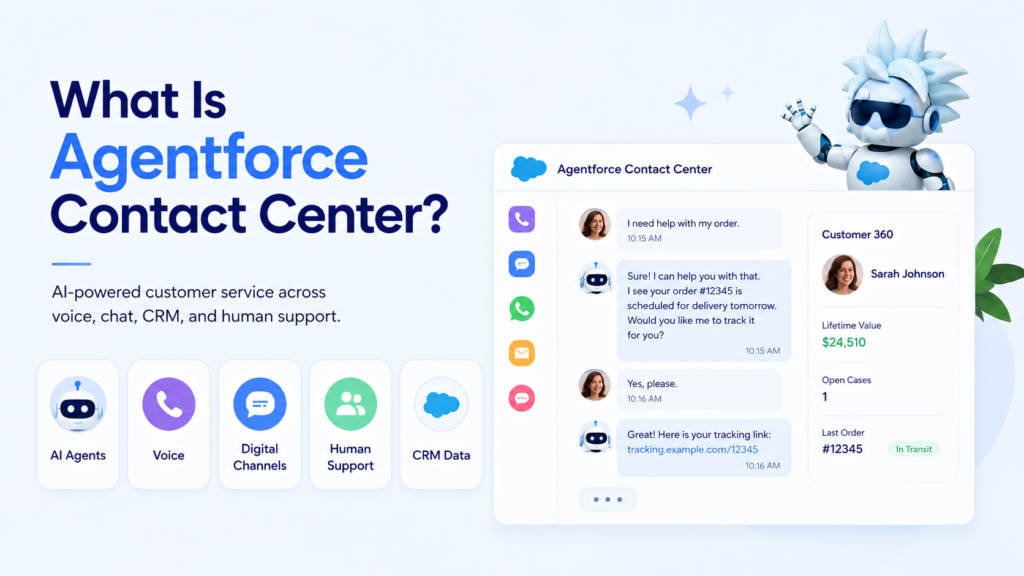
Instead of forcing the customer through several disconnected systems, an AI agent could potentially:
- Identify the customer.
- Access relevant CRM information.
- Understand the reason for the contact.
- Check order or service information.
- Perform an approved action.
- Provide an answer.
- Escalate the conversation if necessary.
- Transfer the context to a human representative.
The important distinction is that AI is not operating beside the contact center. It becomes part of the service operating model.
Why Did Salesforce Introduce Agentforce Contact Center?
Contact centers have spent years accumulating technology.
A typical enterprise might have one platform for CRM, another for telephony, another for chat, separate bots, workforce-management software, analytics tools, knowledge systems, and custom integrations holding everything together.
The result is technological fragmentation.
A customer may explain a problem in chat, call the company ten minutes later, and have to explain everything again because the phone representative cannot see what happened during the digital interaction.
Meanwhile, AI systems become less effective because they lack complete customer context.
Salesforce’s stated rationale for Agentforce Contact Center is to eliminate much of this fragmentation by bringing AI, communications channels, and CRM information into a unified environment.
That architectural change is arguably more important than adding another AI feature.
What Makes an Agentic Contact Center Different?
Traditional contact center automation generally follows predetermined logic:
If X happens → do Y.
Agentic systems can operate more dynamically.
An AI agent can interpret intent, retrieve relevant information, reason within configured boundaries, select permitted actions, execute workflows, and determine when human assistance is necessary.
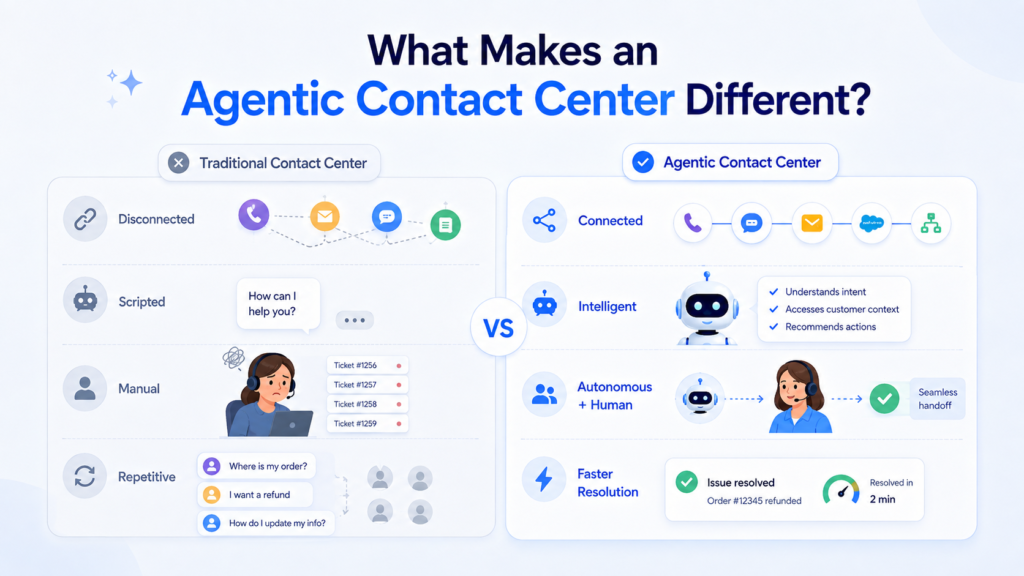
That changes customer service from primarily ticket management toward resolution orchestration.
The objective is no longer simply answering the customer quickly.
The objective is completing the customer’s request with as little unnecessary friction as possible.
How Agentforce Contact Center Works
Agentforce Contact Center combines several Salesforce capabilities into one service environment.
A simplified interaction might look like this:
Customer contacts the business → AI identifies intent → CRM context is retrieved → Agentforce attempts resolution → Salesforce automation performs required actions → issue is resolved or routed to a human → complete context follows the conversation → outcome is recorded and analyzed.
The same basic model can extend across voice and digital interactions.
That continuity matters because customers rarely think in terms of channels.
They simply think, I am talking to this company.
Modern customer service technology needs to behave accordingly.
Core Capabilities of Agentforce Contact Center
1. One Platform for Voice, Digital Channels, CRM, and AI
One of the defining characteristics of Agentforce Contact Center is consolidation.
Salesforce says the solution natively unifies voice, digital channels, CRM information, and AI agents.
Instead of continuously synchronizing multiple systems, businesses can operate more of their service environment around Salesforce.
This creates a shared source of customer context for both humans and AI.
For service leaders, it can also simplify reporting, routing, workflow automation, and governance.
2. AI Agents for 24/7 Customer Self-Service
Agentforce allows organizations to create AI agents capable of handling customer interactions autonomously within defined boundaries.
These agents can support common service scenarios such as:
- Checking order status.
- Answering product questions.
- Scheduling appointments.
- Updating customer information.
- Processing eligible requests.
- Troubleshooting common problems.
- Finding knowledge articles.
- Initiating approved workflows.
Unlike conventional scripted bots, customer service AI agents can understand conversational requests and perform specified actions rather than merely returning predefined responses. Salesforce similarly distinguishes modern AI service agents from traditional chatbots by their ability to retrieve information and take actions such as scheduling or processing returns.
This creates the possibility of genuine 24/7 resolution rather than 24/7 acknowledgment.
3. Agentforce Voice and the Future of Phone Support
Voice remains critical for customer service, particularly when issues are urgent, complex, emotional, or high value.
Agentforce Voice extends AI agents into voice interactions.
Salesforce positions Agentforce Voice as enabling businesses to build voice-enabled agents capable of conducting real-time conversations across phone, web, and mobile experiences.
A customer could therefore call outside normal business hours and interact with an AI agent that can understand the request, access relevant context, complete supported actions, and escalate when necessary.
That can fundamentally change how businesses approach after-hours service and high-volume contact periods.
4. Seamless AI-to-Human Handoffs
Automation becomes frustrating when it traps customers.
An effective AI contact center therefore needs more than autonomous resolution. It needs intelligent escalation.
Agentforce Contact Center is designed around collaboration between AI and human representatives.
When AI cannot—or should not—resolve a request, the conversation can move to a human while preserving relevant context.
Instead of:
“Can you explain your issue again?”
the representative can begin with an understanding of what the customer needs and what the AI has already attempted.
That seemingly small difference can have a major impact on customer frustration.
5. Intelligent Omni-Channel Routing
Not every service request should reach the same queue.
High-value customers, technical cases, billing disputes, multilingual requests, urgent incidents, and routine questions may all require different handling.
Salesforce’s Omni-Channel capabilities can route interactions according to factors such as skills, availability, workload, capacity, and routing logic.
Combined with AI agents, routing becomes more sophisticated.
Some requests can be resolved autonomously.
Others can be directed immediately to specialized representatives.
The goal becomes the right resolution path, not simply the shortest available queue.
6. Unified Customer Context Across Every Interaction
Personalization requires context.
A representative cannot provide genuinely personalized service if they cannot see what the customer purchased, what happened previously, what cases remain open, or what conversations already occurred.
The same limitation applies to AI.
Agentforce Contact Center connects interactions with Salesforce customer data so AI and humans can work from shared context.
If a customer begins an interaction through messaging and later switches to another supported channel, preserving context helps create continuity rather than another disconnected conversation.
That is the difference between multi-channel service and genuinely connected service.
7. AI Assistance for Human Service Representatives
Agentforce Contact Center is not only about replacing repetitive human work.
It can also augment human representatives.
Salesforce highlights AI-generated action plans, customer information, organizational knowledge, recommendations, and contextual guidance as mechanisms for accelerating resolution.
Consider a complicated warranty request.
Instead of searching across multiple screens, the representative could receive relevant account details, warranty information, previous cases, knowledge resources, and recommended steps in the service workspace.
Humans remain responsible for judgment-heavy conversations while AI handles more of the cognitive scavenging.
8. Automated Case Resolution and Service Workflows
The real value of service AI appears when conversations become actions.
Answering “Where is my order?” is useful.
Being able to investigate a delayed delivery, update the case, trigger an appropriate workflow, and communicate the outcome is considerably more valuable.
That is where Salesforce’s wider automation ecosystem becomes important.
Agentforce can interact with CRM processes and approved business actions, allowing organizations to move from conversational AI toward transactional service automation.
9. Workforce Management and Capacity Planning
Modern contact centers must coordinate human and AI capacity.
Salesforce provides workforce-management capabilities around forecasting, capacity planning, scheduling, attendance, and intraday management.
As AI handles a greater percentage of repetitive interactions, historical staffing models may need to change.
Companies may need fewer people handling predictable Tier-1 requests while requiring more specialized representatives for nuanced or higher-value cases.
AI therefore affects workforce architecture, not merely productivity.
10. Quality Management and Supervisor Visibility
Service leaders also need visibility into what both humans and AI are doing.
Contact center management increasingly requires supervisors to understand:
- Resolution rates.
- Escalation patterns.
- Average handling time.
- First-contact resolution.
- Customer sentiment.
- Representative performance.
- AI agent performance.
- Queue conditions.
- Service-level adherence.
Salesforce’s service environment includes supervisor and command-center capabilities designed to expose operational metrics across service channels.
This becomes particularly important when AI begins resolving customer issues autonomously.
Autonomy without observability is a governance problem.
11. Real-Time Customer Sentiment and Service Intelligence
Every service interaction contains useful business intelligence.
Recurring complaints may reveal a product defect.
Repeated shipping questions may indicate poor post-purchase communication.
Cancellation requests can signal retention problems.
Agentforce Contact Center can contribute to a more systematic understanding of these conversations by combining interaction information with CRM data and service analytics.
Salesforce specifically highlights real-time sentiment and interaction insights as part of its contact center capabilities.
This means contact centers can evolve from cost centers into valuable sources of customer intelligence.
Why Agentforce Contact Center Matters for Customer Experience
Customers generally do not care whether a company uses CRM, CCaaS, generative AI, automation, or an agentic architecture.
They care about outcomes.
They want:
Fast answers.
Accurate information.
Less repetition.
Shorter waits.
Consistent experiences.
Problems actually resolved.
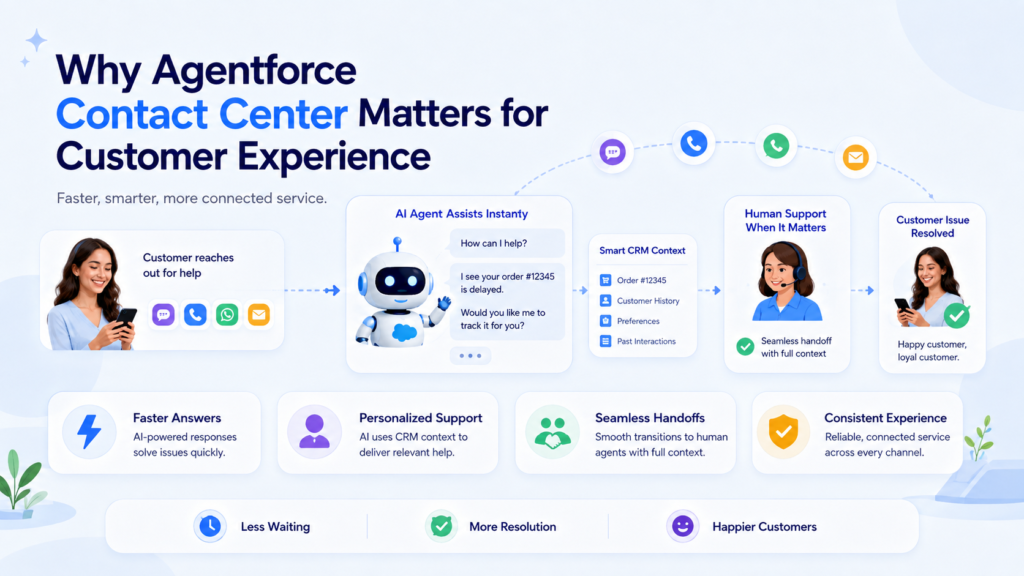
Agentforce Contact Center matters because it attempts to connect the technologies required to deliver those outcomes.
The result could be a service experience where customers encounter fewer organizational boundaries.
How It Changes the Role of Customer Service Representatives
AI does not eliminate the need for human service.
It changes where human attention creates the most value.
Repetitive tasks such as locating information, categorizing cases, writing routine summaries, answering predictable questions, or performing standardized workflows can increasingly be automated.
Human representatives can concentrate on situations requiring empathy, negotiation, exception handling, creative problem-solving, and judgment.
The future contact center representative may therefore operate less like a transactional support worker and more like an exception-resolution specialist.
That is a meaningful evolution of the role.
How Agentforce Contact Center Can Reduce Service Costs
Contact center economics traditionally scale with interaction volume.
More customers create more calls.
More calls require more representatives.
More representatives increase operational costs.
AI introduces a different scaling model.
If a meaningful proportion of routine requests can be resolved autonomously, organizations may support growing customer volumes without proportionally increasing headcount.
Additional savings can come from:
- Reduced average handling time.
- Fewer repetitive cases.
- Less manual case documentation.
- Better routing.
- Faster representative onboarding.
- Reduced system switching.
- Improved first-contact resolution.
- Better workforce forecasting.
Salesforce’s broader service research suggests AI’s share of service resolution will continue rising significantly, reinforcing why organizations are redesigning contact center operating models around human-AI collaboration.
Agentforce Contact Center vs. Traditional Contact Centers
| Traditional Contact Center | Agentforce Contact Center |
| Separate CRM and telephony environments | Voice and CRM can operate natively together |
| Humans handle most interactions | Humans and AI agents collaborate |
| Scripted self-service | Agentic, action-oriented self-service |
| Channel-specific context | Shared customer context |
| Manual information retrieval | AI-assisted recommendations and retrieval |
| Reactive service | Greater potential for proactive service |
| Complex integration architecture | More unified Salesforce architecture |
| Human-only workforce monitoring | Visibility across human and AI service |
The crucial shift is not simply manual versus automated.
It is fragmented versus orchestrated.
Agentforce Contact Center vs. Traditional Chatbots
Traditional chatbots generally answer questions using decision trees, predefined intents, or limited conversational models.
Agentforce is designed to go further.
An AI agent can potentially interpret a goal, reference trusted business information, invoke approved actions, and complete multi-step tasks.
For example:
Traditional chatbot:
“Your refund policy allows returns within 30 days.”
AI service agent:
“Your purchase was made 14 days ago and qualifies for a return. I can start the return and send your shipping instructions.”
The second interaction moves beyond information retrieval into resolution.
That distinction will increasingly define modern customer-service automation.
Practical Agentforce Contact Center Use Cases
Agentforce Contact Center can support numerous scenarios depending on an organization’s systems, data, permissions, and configured AI actions.
Retail and eCommerce
AI agents could assist with order status, returns, refunds, delivery questions, product information, and account updates.
Financial Services
Customers could receive support with appointment requests, service inquiries, document guidance, and account-related workflows where appropriate controls are configured.
Healthcare
Organizations may use AI-assisted service for appointment coordination, administrative questions, routing, or general service requests while maintaining necessary privacy and compliance controls.
Manufacturing
Manufacturers can connect service conversations with customer, equipment, warranty, distributor, order, and case information.
Telecom
High-volume scenarios such as billing questions, account requests, troubleshooting, plan information, and service-status inquiries are natural candidates for automation.
SaaS and Technology
AI agents can provide knowledge-based troubleshooting, account guidance, onboarding support, case creation, and intelligent escalation to technical specialists.
Which Businesses Can Benefit Most?
Agentforce Contact Center is particularly relevant for organizations that already have significant Salesforce service operations and experience one or more of these problems:
- High customer-contact volumes.
- Rising service costs.
- Long wait times.
- Disconnected voice and CRM platforms.
- Heavy Tier-1 support workloads.
- Repetitive service requests.
- Poor cross-channel continuity.
- Complex routing requirements.
- Limited 24/7 support.
- Fragmented customer information.
- Pressure to increase service productivity.
However, adopting AI before fixing foundational service problems can simply automate existing inefficiency.
Preparation matters.
What Businesses Should Prepare Before Implementation
Clean Salesforce Data
AI quality depends heavily on data quality.
Duplicate customer records, outdated contact information, inconsistent case fields, poorly structured knowledge, and missing integrations can impair both human and AI service.
Before deploying AI agents broadly, businesses should assess:
Accuracy → Completeness → Consistency → Accessibility → Governance.
A sophisticated AI agent operating on unreliable information can deliver unreliable service faster.
Integration and Knowledge Readiness
Customer context frequently exists beyond Salesforce.
Order information may live in ERP.
Invoices may live in finance platforms.
Subscriptions may live in billing systems.
Technical resources may exist in external knowledge repositories.
Agentforce therefore needs access to the right information and permitted actions through a carefully designed integration architecture.
Knowledge content deserves equal attention.
AI cannot consistently provide authoritative answers if internal documentation is outdated, contradictory, or poorly maintained.
Governance, Security, and AI Guardrails
Every autonomous action should have boundaries.
Businesses need to establish:
- What the AI agent can access.
- What actions it can perform.
- Which situations require confirmation.
- When human escalation is mandatory.
- Which data should never be exposed.
- How conversations are monitored.
- How AI behavior is tested.
- How exceptions are handled.
The best AI strategy is not maximum autonomy.
It is appropriate autonomy with measurable controls.
How to Start with Agentforce Contact Center
Trying to automate the entire contact center at once is rarely the best starting point.
A more disciplined implementation can follow six stages:
Step 1: Analyze Service Demand
Identify the reasons customers contact your business.
Rank them by volume, complexity, risk, average handling time, and automation suitability.
Step 2: Select High-Value Use Cases
Start with repetitive, rule-driven interactions that have clear resolution criteria.
Step 3: Prepare CRM Data and Knowledge
Clean customer information, standardize service processes, improve knowledge articles, and resolve major data gaps.
Step 4: Connect Required Systems
Ensure Agentforce can securely reach the business systems required to complete the selected use cases.
Step 5: Define AI Actions and Escalation Rules
Specify what the AI is permitted to do and when conversations must transfer to humans.
Step 6: Launch, Measure, and Expand
Pilot with selected interactions before progressively increasing automation.
Agentic transformation should be iterative.
Metrics to Measure After Implementation
Do not evaluate Agentforce only by the number of automated conversations.
Measure business outcomes.
Important KPIs can include:
- First-contact resolution.
- AI resolution rate.
- Escalation rate.
- Average handling time.
- Cost per contact.
- Customer satisfaction.
- Response time.
- Abandonment rate.
- Representative productivity.
- Repeat contact rate.
- SLA performance.
- Customer sentiment.
- Automation success rate.
For example, a high automation rate combined with a rising repeat-contact rate could indicate customers are receiving answers without genuine resolution.
The metrics should be considered together.
The Future of Agentic Customer Service
The contact center of the future will probably not be completely automated.
It will be dynamically orchestrated.
AI agents will handle a growing portion of predictable interactions.
Human specialists will manage ambiguity, empathy, exceptions, negotiation, and high-stakes decisions.
Both will operate with access to shared customer context.
Supervisors will manage mixed human-and-AI service capacity.
Customer journeys will become less dependent on queues and channels and more centered on immediate resolution.
Salesforce’s introduction of Agentforce Contact Center in 2026 is therefore important not simply because Salesforce launched another contact center product.
It reflects a larger transformation in customer service:
from managing interactions to orchestrating resolutions.
Build an AI-Ready Contact Center with CloudVandana
Deploying Agentforce Contact Center successfully requires more than enabling AI.
Your Salesforce data, Service Cloud processes, integrations, knowledge architecture, automation, routing rules, security model, and customer journeys all need to work together.
CloudVandana can help businesses evaluate, implement, integrate, and optimize Salesforce and Agentforce solutions for modern customer service.
Whether your organization wants to introduce AI-powered self-service, streamline Service Cloud, connect fragmented customer systems, improve Omni-Channel routing, prepare Salesforce data for AI, or build agentic service workflows, the right implementation strategy can determine how quickly you achieve measurable value.
Ready to Modernize Your Customer Service with Agentforce?
Talk to CloudVandana about building an Agentforce-ready customer service environment that connects your people, processes, CRM data, automation, and AI.
Book a consultation with CloudVandana and start planning your journey toward intelligent, connected, and scalable customer service.
Final Thoughts
Agentforce Contact Center represents an important shift in how organizations can approach Salesforce customer service.
Voice is becoming part of the AI experience.
AI is moving from answering questions to performing actions.
Customer context can follow interactions instead of remaining trapped inside channels.
Human representatives can spend more time on complex problems.
And contact center leaders can increasingly manage customer service as an integrated ecosystem of humans, AI agents, data, workflows, and digital channels.
But technology alone will not create excellent customer service.
Businesses that succeed will be those that combine strong Salesforce foundations with clean data, carefully designed processes, trustworthy knowledge, sensible AI guardrails, intelligent integrations, and clear customer-experience objectives.
Agentforce provides the technology.
The competitive advantage will come from how intelligently businesses put it to work.
Frequently Asked Questions
1. What is Agentforce Contact Center?
Agentforce Contact Center is Salesforce’s AI-first contact center solution designed to bring together voice, digital channels, CRM information, AI agents, automation, and human customer-service teams. It allows organizations to support autonomous customer self-service while preserving the ability to route complex interactions to human representatives with relevant customer context.
2. Is Agentforce Contact Center part of Salesforce Service Cloud?
Agentforce Contact Center works with Salesforce’s service platform and is designed to extend Salesforce customer-service operations with native voice, digital engagement, AI, and related contact-center capabilities. Edition requirements and licensing vary, so organizations should verify their Salesforce edition and required add-ons before implementation.
3. What is the difference between Agentforce and Agentforce Contact Center?
Agentforce is Salesforce’s broader platform for building and deploying AI agents across business processes. Agentforce Contact Center applies agentic capabilities specifically to customer-service environments by combining AI agents with voice, digital channels, routing, CRM context, service operations, and human representatives.
4. Can Agentforce Contact Center answer phone calls?
Yes. Salesforce’s native voice and Agentforce Voice capabilities can bring AI-powered conversational experiences to voice channels. Depending on configuration, AI agents can handle supported customer requests and transfer interactions to human representatives when necessary.
5. Does Agentforce Contact Center replace human customer-service representatives?
Not necessarily. A stronger operating model combines AI and humans. AI agents handle appropriate repetitive or predictable interactions while human representatives focus on complex, sensitive, unusual, or high-value situations requiring judgment and empathy.
6. How is Agentforce different from a chatbot?
Traditional chatbots mainly provide predefined answers or follow scripted conversational paths. Agentforce agents can be configured to interpret requests, retrieve trusted business information, invoke permitted Salesforce actions, complete workflows, and escalate when necessary. This enables task completion rather than simple question answering.
7. Can Agentforce Contact Center support multiple customer-service channels?
Yes. Agentforce Contact Center is designed around unified voice and digital customer-service channels. Salesforce’s digital service capabilities support channels including web and in-app messaging, SMS, WhatsApp, Facebook Messenger, Apple Messages for Business, LINE, and extensible channel integrations depending on configuration.
8. What are the biggest benefits of Agentforce Contact Center?
Potential benefits include faster response times, increased self-service, 24/7 support, improved representative productivity, reduced repetitive workloads, better routing, more consistent cross-channel experiences, lower service costs, improved customer context, and greater operational visibility.
Actual results depend on implementation quality, data readiness, processes, integration architecture, and selected use cases.
9. What data does Agentforce Contact Center need?
Agentforce works best when relevant Salesforce records, customer histories, cases, knowledge content, product or order information, and required external business data are accurate and accessible. Organizations should improve data quality and integration readiness before giving AI agents significant autonomy.
10. Is Agentforce Contact Center available everywhere?
Availability can vary by product, feature, and geography. Salesforce’s customer FAQ published June 22, 2026 states that Agentforce Contact Center products were currently available to customers in the United States and Canada at that time. Businesses in other regions should confirm current availability directly with Salesforce because rollout details can change.
11. How much does Agentforce Contact Center cost?
Pricing depends on edition, functionality, geography, usage, and additional Salesforce products. As of August 2026, Salesforce’s US pricing page lists Agentforce Contact Center at $125/user/month, Contact Center Plus at $250/user/month, and a Contact Center Voice option for Agentforce 1 at $75/user/month. Additional usage charges or products may apply, and Salesforce notes that pricing is subject to change.
12. How should a business prepare for Agentforce Contact Center?
Start by reviewing service processes, identifying high-volume use cases, cleaning Salesforce data, improving knowledge content, mapping required integrations, defining automation opportunities, establishing AI permissions and escalation rules, and selecting measurable KPIs. A focused pilot is usually more manageable than attempting to automate the entire customer-service operation at once.
For organizations that need support evaluating these foundations, CloudVandana can help create an Agentforce implementation roadmap covering Salesforce data, Service Cloud, integrations, automation, AI agents, and customer-service workflows.

Atul Gupta is CloudVandana’s founder and an 8X Salesforce Certified Professional who works with globally situated businesses to create Custom Salesforce Solutions.
Atul Gupta, a dynamic leader, directs CloudVandana’s Implementation Team, Analytics, and IT functions, ensuring seamless operations and innovative solutions.
YOU MIGHT ALSO LIKE
How MuleSoft Connects Salesforce With ERP, Finance and Business Systems
Salesforce Customer 360: Connecting Sales, Service and Marketing Teams
Salesforce and Anthropic Launch Claudeforce: What It Means for the Future of Enterprise AI

Salesforce AIforce: What It Means for the Future of Enterprise Software

The Biggest Dreamforce 2026 Theme: The Agentic Enterprise