COMPARISON BETWEEN 3 TYPES OF CRM
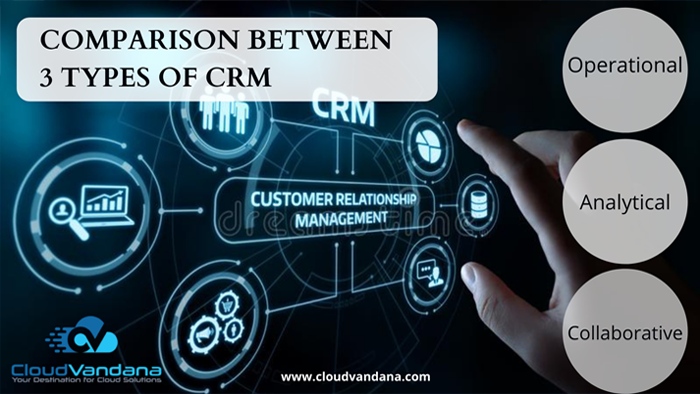
CRM or Customer relationship management is a process where organizations interact with customers, providing them a seamless customer experience, and typically use data analysis to study a vast amount of customer information. This CRM process is segmented into three categories. Today, in this log, CloudVandana will discuss the difference between the three types of customer relationship management systems. Along with the business growth, organizations discover the importance of Customer Relationship Management (CRM) software to provide a seamless experience to customers, streamline the sales processes, and manage the business operations. CRM helps centralize the leads, customers, and other essential data. The software stores interactions between customers, vendors, team members, and other business connections. Let’s look at these three CRM software features to choose the right solution. Operational CRM Operational CRM helps organizations to manage their long-term relationships with customers. It streamlines customer interaction at every step of the sales funnel. This form of CRM is best suited for customer service, salespeople, and various marketing operations. These CRMs can easily handle every touchpoint of the customer journey. Operational CRM also provides the complete order details of the customers to serve the customer instantly for any queries and increases customer satisfaction. Operational CRM manages the leads efficiently so that the leads don’t fall from the leakage. So the sales team can close deals faster. It focuses on the customer lifecycle. It gives reminders to follow up and nurture the leads. Managers can track the sales team’s performance by quickly setting up dashboards to accelerate team performance. In addition, this CRM provides proper follow-ups, drip emails, content marketing, etc., for a proper marketing automation process. Analytical CRM The primary users of this CRM software are accountants and business, intelligence professionals. Data is the core of analytical CRM. This type of CRM stores and analyzes data about the entire organization. The data includes customer, marketing, sales, and service data. All these data help to get a proper picture of the customer. This CRM system gives the team insight into the customer demographics, past purchases, and buying habits. This type of CRM maximizes the sales opportunity and provides the best solution based on artificial intelligence and natural language processing. Collaborative CRM The collaborative CRM shares important information across the organization. This includes sales, customer service, marketing interaction, technical support, and harnessing company culture. When customer information is collected, organized, and shared across the organization and gives a real insight into the customer’s needs. Sales representatives can connect with account managers to manage expectations and grow the customer base. It provides a relevant suggestion to the valued customers for their retention. Selecting The Proper CRM Selecting the right CRM for your organization might be a challenging task. However, with the help of the right CRM software, companies can achieve the desired results. So selecting the proper CRM is essential to enhance the work process. CloudVandana, the registered Salesforce Partner, can assist you in choosing and implementing the appropriate solution to boost your business. In addition, you can select experienced developers who will take care of your CRM to give you the best results. So call us today, and stay one step ahead of your competitors. Request a Free Consultation YOU MIGHT ALSO LIKE
8 KEY BENEFITS OF SALESFORCE SERVICE CLOUD

Salesforce Service Cloud is one of the highly-rated CRM solutions. Customer support software helps agents and customers to connect and solve customer problems. Customer service holds the secret to uplifting the brand value of an organization. Customized customer support quickly gains the trust and attention of the target customers. Considering this to engage with customers and provide them a seamless customer experience, Salesforce introduced the Salesforce service cloud. Today, in this blog, CloudVandana will discuss the key benefits of Salesforce Service Cloud. Salesforce Service Cloud can scale business operations quickly and efficiently to meet the organizational requirements. The platform provides in-app support, live agent support, self-service communities, etc., for a customized, personalized, and seamless customer experience. Salesforce’s integration with Slack has created an enhanced future for customer service operations. Now businesses can deal with customers more efficiently and can collaborate with them in a faster and seamless manner and automates all the work process. Let’s look at the benefits of Salesforce Service Cloud implementation for your organization. Benefits Of Salesforce Service Cloud Salesforce Service Cloud is the critical tool that helps the agent efficiently manage customers on any channel. 1. The platform enhances agent productivity with the help of the Lightning Console tool. It merges the agent experience and provides information regarding customer profiles, and case histories, to the dashboards. 2. Onmi Channel activates automatic routing of the workflow to the most relevant agent. This lets administrators configure Salesforce Service Cloud to distribute workload depending on employee skill set, availability, and ability to handle incoming work. As a result, it increases efficiency, transparency, and speed. It also ensures that high-priority work receives immediate action. 3. Live Agent feature allows the customers to connect to a service agent through the web in real-time and provides multilingual support. In addition, it will enable 1:1 chat instantly from any device. 4. This platform supports mobile accessibility. Users can access this platform from anywhere, anytime. It allows Field-Sevice agents to solve the case remotely, and managers and executives can monitor real-time metrics with the Salesforce Service Cloud mobile app. 5. Service Wave Analytics is the first app to bring the power of wave analytics to Salesforce Service Cloud. It allows every service manager to check on case management quickly, agents efficiently, and channel optimization anywhere. 6. The communities give the customer a platform to find the answers required more quickly from anywhere. This provides the sales team with better customer engagement and faster problem-solving. 7. Salesforce Service Cloud delivers social customer service for scaling. It helps the customer service team create and operate social media platforms efficiently. 8. The SOS feature helps to work beyond traditional support channels whenever required. The live agent tool provides video support, screen sharing, two-way audio, and on-screen support in mobile applications to provide a seamless experience to the customers. Are you interested in experiencing all these features to enhance your customer support system, but your organization lacks the in-house resources to make it happen? Please feel free to schedule a call with CloudVandana to hire experienced on-demand developers for your organization. Request a Free Consultation YOU MIGHT ALSO LIKE
HOW TO AVOID BAD CRM DATA THAT DECREASE THE PERFORMANCE

Bad CRM Data indicates those poor data flow that creates a barrier in B2B lead generation. As a result, the sales team faces difficulties building a pipeline, the sales forecasts get off, and the projections fail. Organizations use CRM solutions to manage the clients efficiently, so any lacking may lead to decreased performance and lower conversion rates. Today, in this blog, CloudVandana will discuss a few points to avoid insufficient CRM data that can affect CRM performance and brand reputation. What Is Bad CRM Data Bad CRM data includes corrupt records and incompatible file formats. Inaccurate data is a part of this, but wrong CRM is much more than that. It may contain erroneous information that wastes time. For example, high bounce rates, inappropriate phone calls, and perplexing conversations are insufficient data. If incorrect data isn’t identified correctly, various problems might arise. Let’s look at the causes that may lead to insufficient CRM data. 1. Data Degradation Data degradation is the gradual corruption of computer data due to an accumulation of non-critical failures in a data storage device. It is a struggle for every salesperson to keep the data up-to-date. 2. Duplicate Data Duplicate data might decrease the CRM performance, and the platform fails to provide a seamless experience to the customers. As a result of duplicated data, the sales team sometimes sends the same email to duplicate records twice. So it affects the reporting as well. 3. Incorrect Email Addresses Incorrect email addresses can enter into the system if clients put the wrong contact information. This might be either unintentional or purposeful. Sometimes salesperson can make a mistake by inputting insufficient data into the system. So, these kinds of errors can lead to decreased performance. 4. Temporary Addresses Many people do not feel comfortable disclosing their contact information, so they create temporary addresses to register for a conference or receive any materials. So when those addresses get inactive, insufficient data gets generated. Impact Of Bad CRM Data From the above discussion, we can say that bad data leads to missed opportunities. Insufficient data influence the return on investment for email marketing. The communication of email marketing depends on precise data, so the more accurate the data will be, the more satisfied they will be with the contact. Inaccurate CRM data can’t capture the exact customer journey, so the lead nurturing process becomes challenging. Sometimes insufficient data leads to revenue loss. It negatively affects the sales funnel. Bad data can impact sales, marketing, customer service, customer retention, and another aspect of the business. Salespeople always attempt to reach out to potential customers to convert them into potential customers. Salespeople can get an understanding of the pain points of their customers, as well as interest, based on their activities in their journey. Tips To Improve The CRM Data Organizations invest a lot of time, effort, and resources in developing the CRM system, but the performance will be highest if only high-quality data is collected and all the information gets stored in a centralized location for better accessibility. Poor data always can be avoided if handled with more efficiency. Let’s have a look at some fundamental guidelines to ensure accurate data in the CRM system. Even if the sales team is confident with the present data, still, they can follow these easy steps to avoid any challenges in the end. 1. It is recommended to connect the CRM solution to other applications. It reduces the difficulties of maintaining solid CRM data. Combining data with other platforms will help the salespeople to make the data reliable and pure. 2. The salespeople should audit the CRM data regularly to get rid of bad data. 3. Salespeople should include as much information as possible. A lack of data is as disturbing as inaccurate data. So salespeople should fill the database with as much customer information as possible. 4. The database should be updated frequently. The chances of missing or overlooking important information are high if the sales team waits too long to update CRM data. Are you struggling to manage your CRM data or looking for a customized Salesforce implementation for your organization? Please feel free to schedule a free consultation call with the expert Salesforce developers of CloudVandana and stay one step ahead of the competitors. Request a Free Consultation YOU MIGHT ALSO LIKE
KEY REASONS BEHIND THE POPULARITY OF SALESFORCE CRM
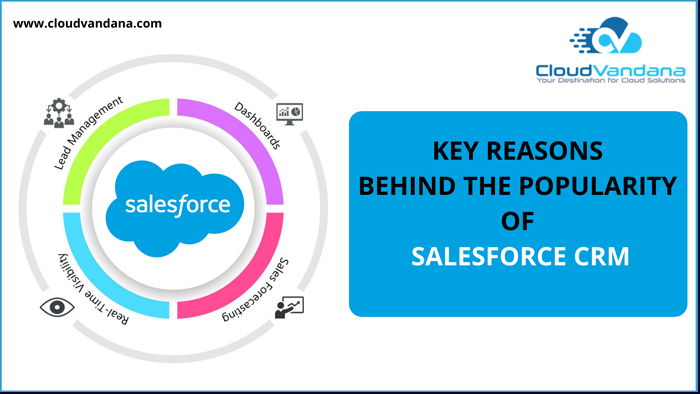
Salesforce C RM is the most popular CRM across the world, and this CRM technology is always dedicated to offering a customer-centric approach to organizations. It has robust features that can handle any kind of task. Today, in this blog, CloudVandana will describe the key reasons behind the popularity of Salesforce CRM. Companies worldwide choose Salesforce as their essential tool for data processing and app development. Let’s drive into the reasons for the vast popularity of Salesforce CRM. Cloud Technology The most important reason for adopting Salesforce is that it is a cloud-based platform. In today’s digital world, cloud-based software always stays one step ahead because of its easy accessibility. A cloud-based solution can be accessed from anywhere; just an internet connection is needed to operate. Even Salesforce is accessible from tablets and smartphones so that the sales team can assist the customers whenever required. In addition, Salesforce always keeps on updating its offering and releases three updates each year. So the tools and constantly updated and ensures cutting-edge technology. Customizable Organizations can customize their Salesforce CRM depending upon the needs and the size of the organization. Users can personalize the solution as per their requirements and business niche. Through this solution, the sales team can send out personalized emails to customers and follow up on the leads, which are essential to enhance the brand’s reputation. Users can add workflow, add custom fields, and create new sales processes in this CRM system. The scalable functionality is also an added advantage for the start-ups as they can quickly scale the solution based on their needs anytime. Data Security Security is the main point of concern for every business. Lots of customer data is stored in the CRM system, which is confidential and should be accessible only to authorized users. Salesforce assures a high level of security to protect these crucial data. As Salesforce prioritizes data security most, it has introduced several pre-installed data security features. Business owners can specify the users for specific data categories through these features. Upgrades Salesforce always works round the clock to provide betterment to existing software so that users can experience a seamless journey. The Salesforce team regularly connects with the customers and, depending upon their feedback, incorporates new features into the software. This up-gradation and addition happen without interrupting the workflow. Innovation Salesforce business leaders are continuously looking for ways to improve the products and services, including partnerships with companies and investing in product improvements by incorporating the latest like AI, Bigdata, and ML to improve the product’s performance. Collaboration And Accessibility Salesforce CRM is an expansive ecosystem that consists of customers, developers, and partners. This technology enables the employees of the various departments to exchange data seamlessly. As a result, the team can always be up to date with the latest information and stay connected with their clients. Salesforce is a place for developers and vendors, so the solution always supports customers from software implementation and application development. Many other functionalities are involved with this customer relationship management platform that helps Salesforce be the #1 CRM solution. Are you looking for a customized Salesforce Implementation to experience all the benefits of this platform? Then, please schedule a free consultation call with the Salesforce Developers of CloudVandana and get the total ROI of your Salesforce investment. Request a Free Consultation YOU MIGHT ALSO LIKE
How to Identify Trailblazing Salesforce Talents for Your Business
Salesforce is considered the #1 customer relationship management platform worldwide, and organizations need to find out the best Salesforce Talents for a successful Salesforce implementation and maintenance procedure to provide a seamless journey to the customers. Today, in this blog, CloudVandana will describe the three leading Trailblazing characteristics organizations should consider while selecting the best talents for their organization. Let’s have a look at the characteristics of the Salesforce Talents- 1. They Interact With The Trailblazer Community Experts generally actively participate in the Trailblazing Community group meetings and various events to increase their knowledge and career path. In addition, the candidates utilize their time to learn more and share their thoughts with other Trailblazers in the community. They have also developed a built-in support system to solve complex problems by giving them advice throughout their career journey. Candidates can join from anywhere, any part of the globe, as there is no physical limit to the groups. If an organization shortlists passionate, talented, and motivated Trailblazers for the open Salesforce positions, the candidate should be more interested in working with the organization to boost their career in Salesforce Ecosystem. Participants focus their time and energy on skilling up and learning the platforms to solve complex problems. 2. They Actively Skill Up With Trailhead They have the drive and motivation to succeed. Trailhead helps to skill up the future and learn the most in-demand skills to stay at the top of the ecosystem. While learning, their response to setbacks is an excellent indicator of how they will perform when facing real-world challenges in the Salesforce role. 3. Work Experience Outside Of Salesforce Organizations can experience that bring to their jobs as Administrators. Unfortunately, many people landed in admin roles accidentally, without much technical experience. A candidate’s past skills will help them perform their career path. Experts should learn the importance of being customer-centric and know how to anticipate client needs and proactively suggest improvements. Salesforce experts are experienced in prioritizing requests and determining their value. They are the problem-solvers who want to boost the customer experience. In addition, their certification adds value to their career path, and gaining more certificates shows their commitment and dedication to their expertise. Are you looking for Experts with all the Trailblazing characteristics for your organization? Your search is over now. Please feel free to schedule a consultation call with CloudVandana today and hire on-demand developers for your organization. Request a Free Consultation YOU MIGHT ALSO LIKE
How to Use Salesforce Marketing Cloud Einstein to Boost Your Marketing Campaign
Salesforce Marketing Cloud has a very smart and important feature called Einstein feature, which provides “insights and data” and “content and timings” for the marketing activities. Using this artificial intelligence feature we can understand the engagement and behavior of the market. Einstein features are available in the corporate and Enterprise editions. The Einstein features provided by Salesforce Marketing cloud are Let us discuss the top four Einstein features which will improve your marketing ROI. Einstein Engagement Scoring Einstein Engagement Scoring feature helps to target the customer to increase engagement and communications. This feature assigns scores for the subscribes’ interest to continue as subscribed, open, clicked, and convert on a website. This helps to know the predictive factors which influence the actions of the customers upon the email received. Einstein Engagement Scoring has the capability to target the subscriber through an E-mail studio, Journey builder, Advertising studio, or Audience builder. In addition to assigning scores Einstein groups the customers into four personas Loyalists: Subscribers with very high engagement, click, open chance. In these personas, there will be subscribers who engage often. Selective Subscribers: Subscribers with a very low open chance but they might click Window Shoppers: Subscribers who open regularly but very rarely clicked. Dormant/Winback: Subscribers who are very unlikely to engage come under this persona. Einstein Messeging Insights Using the feature of messaging insights alerts on the email or the journey send performance. This feature monitors the send metrics like open, click, or unsubscribed. Using this feature the hidden insights are available without comparing the metrics with previous campaigns in the traditional way. Einstein Send Time Optimization This feature in Salesforce Marketing Cloud Einstein helps you to send an email when a subscriber might likely open it. With the help of this feature analytics that predicts future message engagement can be displayed. Also visualizes the optimal predicted send time in day or hour. Einstein Send Time Optimization (STO) uses machine learning to understand the best time to send a message so that the change of opening the message is more. Einstein Copy Insights Einstein Copy Insights get the insights from the Subject lines of the messages to send. This feature evaluates the best subject lines based on the maximum open rate. This helps to understand the most effective phrases or words that can be used to increase engagement. Einstein Copy Insights analyze English language subject line only. Are you looking for a registered Salesforce consulting partner for a successful Salesforce marketing cloud implementation? Please feel free to schedule a consultation call with the Salesforce experts of CloudVandana and hire the best talent for your project needs. Request a Free Consultation YOU MIGHT ALSO LIKE
5 KEY BENEFITS OF CUSTOMER RELATIONSHIP MANAGEMENT(CRM) SOLUTION
Customer Relationship Management (CRM) is a process in which a business or other organization interacts with the customers, generally using data analysis to gather a large amount of data. Most organizations worldwide purchase a Customer Relationship Management (CRM) system to manage the whole work process. Today in this blog, CloudVandana will describe the key benefits of using Customer Relationship Management (CRM) software. CRM can bring a lot of advantages to the work process. Through this solution, organizations can keep track of their competitors, provide extra support to the administrative process, and achieve enhanced conversion rates and revenue. CRM can maintain all the data centrally and provide it in an easily accessible way to authorized users. It also helps the sales managers to track the sales processes, and employee performance and finally optimize sales. Customer Relationship Management CRM is a tool for businesses to enhance customer satisfaction and revenues. This tool allows the employees to keep track of clients and potential customers. CRM enables businesses to create a strong bond with their clients, which leads to increased customer loyalty and retention. A CRM system provides a seamless user experience for data gathering that enables businesses to communicate with customers sustainably. Customer Relationship Management software improves customer satisfaction by simplifying various complicated customer interactions. This technology solves any complex issues and deals with different other critical challenges. Varieties Of Customer Relationship Management Customer Relationship Management can be segmented mainly into three categories. Operational CRM, Collaborative CRM, and Analytical CRM. Operational CRM deals with marketing, sales, and services. This type of CRM usually deals with primary customer data like previous marketing efforts, purchases, and satisfaction with services. It is an essential tool for lead creation. The next type of CRM is called collaborative CRM. When firms exchange consumer information with other organizations and businesses, this is referred to as collaborative CRM. Again, it is a perfect tool for marketers where innovation and new product creation are critical for success. Another essential form of CRM is called analytical CRM to analyze customer data and to manage and gain a better understanding of market trends and consumer requirements. It works well for organizations in higher-priced industries with a lot of competitors. The Benefits Of Customer Relationship Management 1. Marketing Via Email This process can be done in various ways. It includes websites, social media, mobile phones, email, and many more marketing materials. It is helpful for businesses of every size because of its easy adaptability. Any kind of marketing task can be performed using this CRM. This will not only save time but also give them a vital insight into the sales funnel, focussing their outreach efforts. CRM tool provides the foundation for a scalable sales and marketing strategy. It helps organizations but automating operations. It simplifies the business process, including sales, marketing strategies, business analytics, and customer information. 2. Better Management Process CRM can be used to monitor initial sales, but they are unaware of the platform’s opportunities, especially in terms of relationship building and upselling. The whole customer journey can be managed with the proper CRM. 3. Provides A Secured Storage Area CRM always helps salespeople retain their contacts, sales, activities, and plans to access a secured database from various locations. It makes sure that critical information won’t be lost. This platform maintains essential contact information like phone numbers, email addresses, and other details. 4. Keeps Updated CRM keeps the members together and updated by integrating shared calendars, document formats, and e-mails. Salespeople can understand the best-suited technique and facilitate knowledge exchange between sales representatives and management. It helps salespeople in differentiating data and recognizing valuable prospects. 5. Saves Time And Money CRM reduces human error and saves time. CRM can assist salespeople in reducing their mistakes. Rectifying those mistakes could take a long time and huge money. It simplifies various tasks by automating them. It provides a strategic edge over the competitors. There are many other benefits of customer relationship management that organizations can avail implementing the Salesforce CRM into their workflow. Are you looking for a registered Salesforce partner for successful implementation and maintenance? Please feel free to schedule a consultation call with the Salesforce experts of CloudVandana to get started. Request a Free Consultation YOU MIGHT ALSO LIKE
SALESFORCE CRM FOR ENHANCED SALES CONVERSION
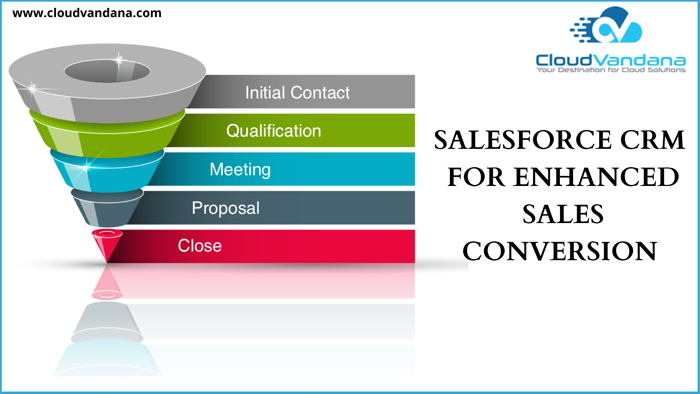
Salesforce is a leading provider of customer relationship management across the world. It helps thousands of organizations to convert leads into potential customers and enhance sales possibilities in innovative ways. The main focus of every organization is to create more leads and convert the leads into customers to acquire more business and more revenue. Today, in this blog, CloudVandana will discuss the benefits of Salesforce CRM for enhanced sales conversion. It is the best practices that make the conversion process more accessible. Most businesses face challenges in keeping track of customer data and understanding their behavior to increase the conversion rate. It gives a better understanding of their customer. Lead creation is considered an essential part of sales and marketing strategy. Nurturing the leads properly leads to more potential customers and, finally, more satisfied and loyal customers. This journey is not at all easy for the sales team. Pushing a lead through the sales funnel and converting them successfully into customers requires various stages. It is not always straightforward and successful conversion is not always guaranteed. A salesperson needs to perform multiple works, so the sales team sometimes lacks nurturing of the leads and a proper follow-up process. So the leads fall through these cracks and do not move towards the conversion. A successful sale requires continuous follow-ups with leads. Salesforce comes as a savior to manage the whole sales procedure efficiently. Automation is one of the main functionalities offered by Salesforce, and through this automation, all the repetitive tasks can be completed without investing time and effort. Let’s look at the benefits of Salesforce CRM for enhanced sales conversion. 1. CRM Helps To Understand The Leads CRM tracks and stores all the contact information in a centralized location, which can be accessed anytime, from any site. It also helps to select suitable leads for the sales funnel and those relevant to the niche. The platform automates various operations like identifying, analyzing, managing, and offering the product or services brilliantly. 2. CRM Provides A Complete Customer Information With the help of CRM software, salespeople can be assured that all the data will be stored and collected in a single consolidated interface. Any authorized person in the team can access the data from any location so that the person can always be connected with the customers and prospects. CRM also provides auto-generated real-time reports to track customer activities and their touchpoints in the journey. Organizations can adapt these strategies to close deals faster. 3. Seamless Customer Experience CRM tracks and saves customer databases which the organization can utilize to provide a seamless and personalized customer experience. In addition, this platform allows customer communication and ensures client satisfaction. Customer satisfaction drives business growth, boosting sales volume and revenue. 4. Automation To Nurture The Leads Lead nurturing is the essential process for a better conversion rate. With the help of CRM, salespeople can concentrate on the existing customers and their requirements, leaving the lead nurturing strategy to the automation provided by Salesforce CRM. After a particular phase, they can focus on the prospect as well. This way, they can manage the whole process more efficiently. 5. It Provides A Quick Access The authorized team members can access the lead database. It creates a collaboration between the departments, and the operations can be done from anywhere. CRM is very mobile-friendly. As a result, salespeople can always be connected to their customers and give them a quick response whenever required. There are many other benefits of a CRM software like Salesforce if implemented and maintained correctly with the help of Salesforce experts. Are you looking for a customized Salesforce solution to experience all these features, but your organization lacks the in-house resources to make the process happen? A Salesforce partner like CloudVandana helps organizations perform the tasks efficiently by providing experienced Salesforce professionals. Please schedule a consultation call with CloudVandana today to get started and stay one step ahead of your competitors. Request a Free Consultation YOU MIGHT ALSO LIKE
A Comprehensive Guide to Salesforce API and Their Functionality
Salesforce API stands for Application Programming Interface. Salesforce provides programmatic access to the organization’s information using easy, powerful and secured application programming interfaces. APIs are a way for other applications to access data within the org, in a secured way. Today, in this blog, CloudVandana will give an overview of Salesforce APIs that allow access to Salesforce data. Most of the time, the users need to connect the org to an internal or external system. There comes the requirement of APIs. Users can interact with the data via the user interface and API. There are various kinds of APIs, offered by Salesforce. Those APIs are- SOAP API, REST API, Apex REST API, Apex SOAP API, Bulk API, Metadata API, Chatter REST API, Streaming API, and Tooling API. Among these numerous APIs, we will discuss the two elementary APIs, SAP API, and REST API. SOAP API SOAP stands for Simple ObjectAccess Protocol and it is an XML-based messaging protocol. SOAP is an old integration methodology and many legacy applications only support SOAP integrations. Salesforce lets the user create, retrieve, and update operations to Salesforce data from an external application. The platform provides two kinds of WSDLs. Enterprise Web Services, WSDL, and Partner Web Services WSDL. Enterprise WSDLs are created for customers and their ISV for integrations specific to their Org. Partner WSDL is created for App Development partners and it can work with various orgs. REST API REST stands for Representational State Transfer, which is considered to be a lightweight alternative to SOAP, and preferred by modern web & mobile-based applications. Benefits Of Salesforce APIs After discussing an overview, let’s have a look at the benefits of Salesforce APIs. This #1CRM platform always takes an API-driven approach to develop a huge range of functionalities on the platform and offers the ability to connect and interact with the cloud platform. Are you interested to experience these features but your organization lacks the in-house resources to complete the process successfully? CloudVandana can provide you with all the expertise that you need to make the whole process happen. Please feel free to take a consultation call for a staff augmentation service today. Request a Free Consultation YOU MIGHT ALSO LIKE
FUNDAMENTALS OF SALESFORCE CAMPAIGNS
Salesforce Campaigns are a group of leads and contacts exposed to specific marketing communications. In addition, it stores essential performance data so that salespeople can easily see the customers and prospects to provide marketing activity. In this blog, CloudVandana will discuss the fundamentals of Salesforce Campaigns. Companies worldwide are using Salesforce to increase sales and increase ROI. So companies are adopting Salesforce to stay ahead of their competitors, but most users are not confident enough to understand the features offered by this platform. Let’s look at the overview of Salesforce campaigns. Salesforce Campaigns Salesforce Campaign is a feature offered by Salesforce that allows organizations to plan, manage, and track outbound marketing efforts. This feature links Salesforce Contacts, Leads, and opportunities to the marketing campaigns that help to generate more leads or opportunities to move them further down the funnel. Outbound Marketing can create a lot of challenges for marketers. So Salesforce Campaigns can help get the actual return on the marketing investment. If it is set up correctly, this platform provides valuable information that marketers can take back and consider while optimizing the current campaigns and planning. Campaigns functionality makes the process easy and fast. A new record is created under the Campaigns tab for every marketing effort. Then, various attributes are selected for each new record, like campaign type, start and end dates, budgeted and actual costs, etc. After this process, the ‘Campaign Members’ are selected. These Members can be existing Salesforce leads, or bulk lists can be imported with the help of the Salesforce API data loader. All members can be assigned a status indicating their position in the company’s sale cycle. Once a lead responds to the marketing campaign, the organization’s Salesforce user indicates a ‘response’ on the newly-created member record. Campaigns also help marketers track if the marketing efforts impact current opportunities and measure ROI more effectively. ROI Tracking With the campaign’s features, the marketing and sales team can easily indicate the expected budget spend, the response rate, and the campaign’s impact. Salesforce Campaign’s ‘influence’ is essential for companies running various outbound efforts to the same members. Hierarchy functionality tracks the ROI practically, allowing marketing teams to segment various marketing efforts together in ‘Parent Campaigns.’ Although campaigns offer a lot for marketing teams to track the effectiveness of their marketing efforts, the feature tracks and manages efforts deployed outside of Salesforce. So, campaigns are essential for ROI tracking, but they do not automate the marketing process. Salesforce offers various tools to automate every business process. For example, multiple tools like MailChimp, and Pardot are available to automate the outbound marketing process. Sounds great? Can you also avail of the benefits of the Salesforce platform to achieve the desired position of your business? Please feel free to take a consultation call with the Salesforce Consulting Partner CloudVandana for a customized Salesforce Solution. Request a Free Consultation YOU MIGHT ALSO LIKE