7 KEY BENEFITS OF SALESFORCE REVENUE CLOUD
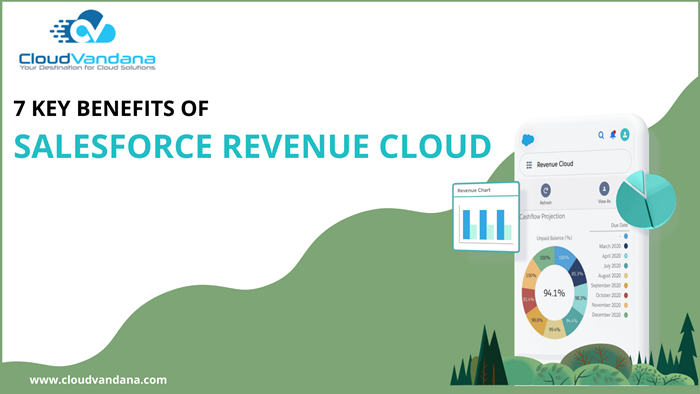
Salesforce Revenue Cloud merges CPQ and Billing, Partner Relationship Management and B2B Commerce capabilities for business enhancement and authorizes their revenue growth across every channel. Salesforce Revenue Cloud makes the buying process easier and faster and enhances revenue efficiency. Being a part of the Salesforce Customer 360 Platform, Revenue Cloud allows companies to connect sales, partners, operations, and finance departments to create a single source of revenue and customer transactions. Today in this blog, CloudVandana will discuss the benefits of Salesforce Revenue Cloud to give customers the ability to manage different sales channels seamlessly. Let’s have a look at the key benefits of Salesforce Revenue Cloud. Enhance B2B Customer Experience Through this platform, customers can fill their online cart with specific configurations or services and then reach out to a sales representative to ask any questions. Representatives can view the entire customer journey for a smooth transaction. As a result, they can be engaged better with their clients, decrease sales costs, and ensure revenue growth. The marketing team’s involvement is not limited to lead generation now. They need to nurture the leads and the customers for a long-term relationship. Focuses On Partner Ecosystem Organizations that obtain maximum sales from partners should nurture the partner ecosystem. To perform this process better, companies can bring professionals in post-sales services to align partners to specific aspects of the customer journey maintaining transparent relationships. A Self-Service Catalog This platform offers a catalog of products and services. Prospects can browse through it. Salesforce Revenue Cloud helps them engage with the brands of their choice. Buyers can place the orders anytime, from anywhere. Increases Interaction Buyers always expect real-time interaction with their vendors across the whole purchase process. As representatives can view the entire customer journey, they can interact with the customers anytime. In addition, the platform offers a unified database to support a seamless customer experience. Merging The Power Of Analytics In Sales Sales Analytics plays an essential role in the whole process. While implementing the virtual first approach, it is necessary to bring marketing and sales teams together on the same page. Faster Sales Salesforce revenue cloud helps to close deals faster and increase the conversion rate. In addition, it makes the documentation easy with clear terms, route pricing, application of loyalty discounts, and numerous packages to fasten the closure. Enhanced Sales Strategy With the help of Salesforce Salesforce Revenue Cloud, organizations can offer preference-based discounts to their customers. In addition, the Salesforce Marketing Revenue users ensure better customer satisfaction as it enhances the automated billing and invoice systems and tracking of various clouds on a single platform. Are you looking for a customized Salesforce Revenue Cloud solution to take your organization to the next level? CloudVandana, a Salesforce consulting partner from India offers a huge range of customized Salesforce implementation and maintenance services depending upon the size of your organization. So, please don’t wait and take a free consultation call today. Request a Free Consultation YOU MIGHT ALSO LIKE
A Guide To Salesforce Marketing Cloud Journey Builder
Salesforce Marketing Cloud Journey Builder is the fastest way to create customized customer journeys that deliver personalized content through multiple channels. SFMC Journey builder is a tool that helps marketers to have 1 to 1 customer experiences across different channels. Salesforce Marketing Cloud Journey Builder has many connectors from Marketing cloud and Sales. Each funnel has a specific pre-build task that helps to define the customer journey. These tasks help the users to reach the goal. From the perspective of the marketer, Journey Builder makes it easy to discover relevant audiences and also to understand their interests. Using Journey Builder, it is easy to understand the reason behind any action of the customer and on what basis they make purchase decisions. Using this tool we get a clear image of the customer lifecycle. Having all these data will help to make good marketing strategies in the future. Features of Salesforce Marketing Cloud Journey Builder Advantages of Salesforce Marketing Cloud Journey Builder Building a Journey in SFMC Journey Builder Using Journey Builder, we have an option to build a journey from scratch, or we can use existing journey templates. Mainly the process of creating a journey using Journey Builder is straightforward. Under the Activity tab, we can choose activities like Messages(Email SMS) and include them in our journey definition as needed. There is some flow also controls available that we can be used in journeys, like wait by duration, Engagement split, Decision split, and so on. We can include relevant activities for our journey by just dragging and dropping. Once the activity is dropped to the journey, we can define them as per the requirements. Tips to remember It will be a good practice to chart your journey down on paper or any other visual media before we build it in Journey Builder. This will give a more clear picture of the journey and also track the errors. When we create a big repetitive journey it is always good to use the ‘Copy’ option. We can copy only specific activities and also the whole journey. We have to make sure the journey is saved after every iteration since there is no autosave option in SFMC Journey Builder. Are you looking for a registered Salesforce Partner for a customized Salesforce Marketing Cloud Solution? Please feel free to contact CloudVandana, the registered Salesforce Partner from India, and always stay one step ahead of your competitors. Request a Free Consultation YOU MIGHT ALSO LIKE
PARDOT MIGRATION BEST PRACTICES

Pardot Migration is a process of migrating data from one Pardot account to another. Pardot is a lead generation and automation solution offered by Salesforce. It is a part of Salesforce Marketing Cloud. It helps to track user behavior and helps the marketers to personalize content across various channels based on the customers’ requirements. Today, in this blog, CloudVandana will describe the Pardot migration best practices. Most of the time, users purchase Pardot to automate the business process. To migrate the existing plan and implement Pardot, a proper migration strategy should be there. To migrate the email plans, Pardot experts are required to think and set up the landing page templates, forms, programs, and campaigns. All the existing files can not move to the new platform automatically. So each and every element should be operated with attention. A proper mapping should be there to move things from one place to another. This mapping will migrate all emails and landing pages. Data Data is the first thing that needs to be focused on by updating a data dictionary. This dictionary contains fields that can e moved to the new system and may work as a reference for other functions in the future. Marketing automation specialists can include field names, types, values, etc in the dictionary. In addition, experts are needed to check if the field can live in Pardot or it can be synced to the CRM. Landing Pages The list of the pages should be documented in a proper way along with the names and location if any form is attached or not, or other important information such as the URL of a landing page, images, etc. Pardot forms allow sharing thank you content upon completion. So there is no need of migrating an extra landing page into Pardot. Rather, the body copy can be saved from the thank you landing page and plugged into the thank you content in the form wizard. Emails It is recommended to create a matrix to arrange the database properly. So the assets can be tracked easily. In the matrix, Pardot specialists can name the emails that they need to migrate, their location in the old system, and a tag should be there with this if it is a part of a program/campaign. Autoresponder emails can be listed in another segment for future lead nurturing. Forms There are many things involved to migrate forms. Among many things, form name and fields are the two most important things. There are other important things such as field API names, Field types, etc. These are important items needed for the migration process. Segmentation There are three lists included in this section. Static List, Dynamic Lists, and Test Lists. Static lists are easy and straightforward. Pardot experts just need to be sure to include email addresses as Pardot initially uses email addresses as the unique identifier. Dynamic lists are more complicated than Static List. Next comes the test lists. They are simple in nature. Templates It is over the Pardot experts that they want to migrate the old templates or need to build from scratch. If the Pardot expert has not started doing the templates, it is recommended to build responsive templates for better mobile optimization. They can just click on the Testing tab after building the templates, scroll down to the button, then select the + New Render button then check out all the renders Pardot displays for the users’ convenience. Dynamic Content Dynamic content changes depending on the audience. It shows content based on the interests and industries of the customers. Database The database is a very important thing to consider during migration. The Pardot experts just need to be ensured to remove junk, duplicates, or information those are no longer in use. It is recommended to review the data regularly to keep it clean and synced. These are some of the features that need to be considered while migrating Pardot. But there are a few other things like Workflow, Campaigns, etc that experts should also consider. Are you looking for a registered Salesforce partner for a successful Pardot implementation or migration? Please feel to take a consultation call with CloudVandana, the registered Salesforce partner from India, and get a hassle-free Pardot migration without interrupting the workflow. Request a Free Consultation YOU MIGHT ALSO LIKE
SALESFORCE TESTING FOR A SUCCESSFUL IMPLEMENTATION

Salesforce testing authenticates the configuration and customization performed in vanilla SDFC. This process ensures that a tester checks the code that has been customized in the area of testing built-in salesforce functionality. Salesforce, the world’s #1 CRM solution, provides enhanced systems, technologies, practices, and strategies to organizations of all sizes. Salesforce implementation help companies to manage their customer and customer data efficiently. Today, in this blog, CloudVandana will give an overview of Salesforce testing for a successful Salesforce implementation. Salesforce provides excellent customer support and marketing automation solutions, making this CRM platform the most preferred solution for organizations of all sizes. Apart from these solutions, Salesforce provides cross-selling and upselling opportunities, sustainable growth opportunities, and seamless customer collaboration. Quality testing is essential to ensure the continuous quality maintenance of this CRM tool. Salesforce Testing Salesforce testing framework can e segmented into two parts. Manual Testing and Automated Testing. Manual testing checks the basic functionalities. But getting the desired result with manual testing is difficult. Moreover, as human errors can change any result, the efficiency might be reduced. On the other hand, automated testing is very effective in testing the functionalities and system. In addition, it has excellent proficiency in the implementation process. It can be seen that shorter development cycles have more difficulties associated with these apps. So a comprehensive testing strategy is essential. There are various other reasons for Salesforce testing. Reasons are as follows- 1. Check the functionalities and the condition of the system. 2. Quickly detect the bugs and the errors to rectify them immediately. 3. Checking the time-based event functionalities. 4. Scrutinizing the finished system and its capability to integrate business processes effortlessly. Testing Strategies The Salesforce testing process focuses more on customizable features rather than built-in functionalities. There are mainly given processes associated with the Salesforce testing strategy. Let’s have a look at the details of this strategy. 1. Unit Testing As Salesforce is developed on Apex, the platform development language provides a range of built-in unit test cases for code validation. Unit testing is arranged by APEX developers who incorporate written clauses within the code. 2. Functional Testing This is the first step of the Salesforce testing strategy. In this phase, each new feature is thoroughly reviewed, and a check occurs for bugs. This app system undergoes end-to-end testing. As a result, it boosts the test coverage. The focus is to ensure the performance of the developed apps to preserve the client’s existing app functionalities with its related security models. Functional Testing can be segmented into three categories: system Testing, Production Testing, and Regression Testing. System testing covers the technical processes end to end. Testers can quickly troubleshoot problems of their automated processes through this script. At the same time, production testing takes place in a production environment. It checks if the configuration and the code have been deployed from the Sandbox to the production environment. Finally, the regression test contains how the code and configuration changes affect the existing user system processes. 3. UAT Testing After the functional testing process, the Salesforce app passes through UAT or User Acceptance Testing. This step checks the Salesforce app to see if the app is capable of supporting the required business process or not. After discussing the testing strategies, let’s look into the best practices for SalesforceTesting. SalesforceTesting Best Practices 1. Test Strategy And Planning Successful Salesforce testing requires a proper test strategy and planning. During this process, an admin should define the high-level objectives. The different phases and tools involved in this testing should be documented. A successful test strategy can assist businesses in identifying the drawbacks. 2. Test Environment An integrated test environment is another essential element in any testing project. These systems should be integrated so that proper integration testing can be performed. All the steps should be done at the correct development phase; otherwise, the process will take more cost if discovered later on. 3. Automated Test Scripts Automated testing can be performed by using a variety of test automation tools. Salesforce collaborates with various types of API endpoints. These can be used for automation testing later on. 4. Fix Problems The early identification of the problems can save lots of effort, time, and implementation costs. Smaller deployment and testing can make this process work correctly. 5. Stakeholders Involvement In UAT Testing Stakeholders should be associated with the User Acceptance Testing(UAT). Their involvement helps the test engineers to verify that the developed code meets their expectations. Salesforce development and software testing are complex procedures. So organizations should go ahead with the assistance of registered Salesforce Partners like CloudVandana for a successful Salesforce implementation. Request a Free Consultation YOU MIGHT ALSO LIKE
3 KEY BENEFITS OF THE LIGHTNING WEB COMPONENTS(LWC) FOR ORGANIZATIONS
Lightning Web Components is a practical programming model for developing web applications. It is well-matched with the Aura programming model and can coexist with the Aura component in the platform. Moreover, the performance is outstanding, which provides an endless advantage to the users. In this blog, CloudVandana describes three key benefits of the Lightning Web Component for any organization. Web components support elements, shadow DOM, modules, templates, and various language constructs in ECMAScript 7 and more. In addition, it can boost the Salesforce lightning platform to develop UI components. Benefits Of Lightning Web Components Salesforce Lightning Web Components increase the speed and security of the platform. It helps the admins or business owners from a dedicated layer of Salesforce service on the core stack. Services include Data Service, base lightning components, and user interface. As this component is lightweight, it is very compatible with browsers for increased security. Accelerated Development Salesforce Lightning Web Components enhances the team efforts by updating components to work without hassle with any device like mobile and desktop. This updated lightning platform helps users to create generic components for enhanced performance. Admins can just drag and drop the generic component during the implementation of Lightning App Builder. Users can avoid ViewState Error and can experience the two-way binding process. Enhanced Performance The platform provides an enhanced performance than Aura Components. It is the prime advantage of this framework. When a user works with the LWC JScontroller through Javascript, the data to the Javascript controller can be manipulated. So without making a server call, users can display the same as per the requirements. It also provides a boosted DOM render engine. So users can experience an increased speed in component rendering. The workflow becomes amplified than the workflow of Aura. Compatible Solution LWC provides a seamless experience to the users, deploying responsive design(Salesforce Lightning Design System). It supports the most updated browser technologies like CSS3 and HTML5. Lightning Design System (SLDS) helps business leaders to customize their components as per their requirements. Are you finding these benefits useful for your business? CloudVandana has introduced a new service. Salesforce LWC Developers as a Service. Organizations can hire on-demand LWC developers for a seamless experience at a flat rate. Please check out onlylwc.com for more details. Request a Free Consultation YOU MIGHT ALSO LIKE
What is Salesforce

Salesforce is the #1 customer relationship management software across the world. It is a cloud-based platform, so the Salesforce data is accessible anytime, from any device. It also permits live data tracking and correct real-time updates. Today, in this blog, CloudVandana, a registered Salesforce Partner from India will share a basic concept and work process of Salesforce. The CRM platform offered by Salesforce helps companies of all sizes and categories to give them a seamless experience and enhance the business process. Salesforce assists organizations in customer acquisition and intends to produce more happy and satisfied customers to build a strong brand impression. In addition, the platform always helps leaders by suggesting the best solutions to take the business to the next level. Salesforce provides thousands of pre-built applications to its app marketplace AppExchange, like an expanded platform. These tools help in every business process like closing deals faster, automating the marketing and process, organizing the business data and files more efficiently, etc. What Is Salesforce Used For Salesforce hosts various cloud platforms to provide different services to customers of every size. In addition, Salesforce provides a complete view of the customers to the organizations that help them to offer a personalized customer experience. Let’s have a quick look at the different Cloud platforms provided by Salesforce. 1. Salesforce Sales Cloud Salesforce sales cloud is designed to manage the organizational sales process. It is considered the first product of Salesforce. The main objects in this platform are lead, account, contact, opportunity. It means a lead can be converted into Account, Contact, and Opportunity, and different stages can scale these objects. 2. Salesforce Service Cloud This is a service platform that provides service to the customers and gives constant support to the team. The feature of this platform includes ticket assignment, queue Management, live chat, and knowledge base. 3. Salesforce Marketing Cloud Salesforce Marketing Cloud is an effective marketing platform where marketers can connect with customers, track the customer touchpoints in their journey across various channels. This platform helps create the social media presence, email marketing, advertising campaigns, data analysis, etc. This platform provides powerful marketing tools like Pardot, Journey Builder, Email Studio, Mobile Studio, Customer 360 Audience, Advertising studio, Interaction Studio, and social studio. 4. Salesforce App Cloud Salesforce App Cloud provides a vast range of development tools that can be used to develop custom applications. 5. Salesforce Commerce Cloud This platform provides the best features and functionality to provide superb customer service and experience. 6. Salesforce Financial Service Cloud This platform is an integrated platform for financial organizations to drive stronger client relationships. This platform is powered by Lightning and makes it easy for financial organizations to deliver exceptional customer-centric service. 7 Salesforce Community Cloud This platform is designed for external collaboration and custom portal creation. This platform helps users exchange documents, images, and other data. 8. Salesforce Analytics Cloud Salesforce Analytics Cloud is a platform for business intelligence. It is well optimized for mobile users and flexible for integration with other Salesforce Clouds. Besides these cloud platforms, Salesforce provides various industrial solutions for every business need. Benefits Of Salesforce Cloud After discussing the various platforms provided by this technology, we focus on a few benefits of Salesforce. Comprehensive Solutions Salesforce is capable of meeting all the technical requirements of the CRM process and can be integrated with other Salesforce-friendly third-party tools. Scalable For Every Business Salesforce is scalable as per the business requirements. This platform can expand or scale down without any software disruption. Flexible CRM System Salesforce is very flexible for all the business sectors as it keeps on improving the products and services to make them user-friendly and customized. So this platform can meet all the requirements of any business. Easy Accessibility Salesforce has introduced the Salesforce Anywhere app that allows users to access the platform anytime, anywhere. The mobile app provides the same features as a desktop. This platform offers endless offerings to serve any organization with best practices. Are you looking for a registered Salesforce Partner to get the best advice for your business? Please feel free to contact CloudVandana and get all the best-suited benefits of the holistic platform Salesforce. Follow CloudVandana on LinkedIn for unlimited Salesforce updates. Picture Courtesy: Salesforce Request a Free Consultation YOU MIGHT ALSO LIKE
5 IMPORTANT TOOLS FOR LIGHTNING COMPONENTS CREATION
The lightning component framework is a UI framework for developing a single-page application for mobile and desktop devices. Lightning components offer scalable, powerful, and user-friendly solutions. So before the implementation process, developers should have a clear understanding of tools that support building Lightning Components. Developers should have the proper knowledge to create highly scalable solutions. Today, in this blog, CloudVandana will discuss the tools that are involved in creating Lightning Components. Previously Aura Component was the only framework, but presently Lightning Web Components has simplified development in various ways. The below-mentioned tools can make the development process simpler for developers. 5 Effective Tools For Lightning Components Creation Salesforce development is composed of a lot of features but Lightning Components make the steps simplified. Let’s have a look at the development tools that are essential to creating these components. 1. Google Chrome Developer Tools Developers need to perform a lot of tasks to build Lightning components and they need to deal a lot with Javascript. So there should be an understanding of the tools that can help them to perform various tasks. Google Chrome Developer Tools assists the developers to access multiple tools to work on different tasks to track monitor requests or to replace CSS. 2. Visual Studio Code Code editor plays a vital role in the creation of Lightning Components. Salesforce offers ‘Salesforce Extension Pack’ full of various features that make the process easier for developers to work on Lightning Component Framework. 3. Lightning Debug Mode Salesforce developers can activate debug mode for debugging the complex JavaScript code for Lightning Components. This function helps the developers to obtain a detailed output of their code. This mode leverages the errors and warnings in detail in Salesforce Org. 4. Lightning Component Library Developers should have a look at Lightning Component Library before building Lightning Component. Developers can find all the relevant components and their specifications in this library. Developers can find a preview of the functions of the components. 5. Develop Locally Local Development Server can help the developers with testing and preview components. It is a Salesforce CLI plug-in that helps the developers to develop Lightning Components and also enables them to view the changes without publishing them. Are you looking for experienced Lightning Web Components developers for your organization? CloudVandana has launched a new service, “LWC Developers as a Service”. Now organizations can have unlimited LWC remote developers at a flat rate. To know more about this service, please visit onlylwc.com. Request a Free Consultation YOU MIGHT ALSO LIKE
5 COMMON ISSUES THAT DECREASE SALESFORCE PERFORMANCE
Salesforce is the most renowned cloud-based solution across the globe. So any Salesforce performance issue can affect thousands of users. Salesforce provides online status dashboards so that users can check if the application is working to expectations or not. However, it doesn’t show the details of the Salesforce delivery path. As it is a complex application with various functionalities, it is essential to track the Salesforce performance issues to avoid unwanted circumstances affecting the work process. In addition, sometimes, many problems are not specific to Salesforce. Instead, they are simply SaaS service within the customer base, and the ecosystem of plugins are larger with Salesforce than other SaaS providers. Today in this article, CloudVandana will discuss five issues that can decrease speed and performance. Slow performance and slow loading pages can cause frustration in users and lead to a drain on business resources. Let’s look at the problems that affect Salesforce Performance issues and slow down the load speed. 5 Common Issues With Salesforce Performance There are various issues associated with Salesforce’s low performance. Among those numerous reasons, CloudVandana shares five key points. 1. Low-Quality Bandwidth If a SaaS application such as Salesforce performs poorly, many organizations think of investing much in bandwidth. So, before upgrading the bandwidth, the experts should find out if the problem is holding back the Salesforce performance or not. But getting more bandwidth is not a solution for making this platform faster for better performance. Instead, developers should get higher-quality bandwidth. As web applications are TCP-based, even a small amount of packet loss can significantly impact the performance. As a result, many big organizations upgrade their editions for better equipment, better tolerance, and a low chance of packet loss. 2. Intelligent Caching Salesforce provides a rich user experience with the help of JavaScript and CSS files. So, users will have to download 3,4 or 5 MB of JavaScript files, which takes a long time if users are facing packet loss. A single page used by the sales team can be composed of various plugins of size 5 MB. Users can activate caching on the network and create a cached derivative stored locally. Thus users can download larger files experiencing better performance. 3. Impact Of Recreational Traffic Nowadays, people are using mobile devices to work. This can result in bandwidth capacity being consumed. So, complex applications like Salesforce require resources. An effective way to solve this problem is to set up a different wireless network for other devices. This system helps the developers to allocate bandwidth to every network. 4. Plugin Usage Users need to install many plugins within the Salesforce instance. Sometimes these plugins can hurt the overall end-user experience. These external plugins manage most data transfer, sales, marketing, and accounting capabilities. So developers should consider the number of bandwidths that the plugins are using as too much usage of plugins can affect the performance of Salesforce. 5. Technical Debt Technical debt is another challenge that can affect the load speed. It can be produced by many new fields, backdated Workflows, Apex Code, Process Builder, or old workarounds. These are the main issues that can cause low Salesforce performance. Are you facing these problems in your Salesforce Org? Please feel to take a consultation call with the registered partner CloudVandana and get all these issues resolved by our experts. Request a Free Consultation YOU MIGHT ALSO LIKE
KEY BENEFITS OF SALESFORCE AppExchange
Salesforce AppExchange is a marketplace for Salesforce Applications. It offers thousands of solutions and services. Salesforce AppExchange helps ISV partners and consultants by providing all the solutions or services offered by those partners or consultants to customers. Salesforce is an extensive customer relationship management tool that helps the organization of every sector to boost their productivity and increase the workflow. The AppExchange is a store with pre-integrated apps and numerous products that organizations can choose as per their organizational needs. Today in this blog, CloudVandana will describe the benefits of Salesforce AppExchange. Please go through another blog on Top 16 Salesforce AppExchange Apps by CloudVandana. Salesforce AppExchange is consists of more than three thousand apps. Organizations can select the apps as per their requirements. Users can find solutions components, Flow, Bolt Solutions, and Lightning Data. Independent Software Vendors (ISV) Some of the apps of AppExchange are developed by the developers of Salesforce, but the maximum apps are developed by ISVs like CloudVandana. Every app on the AppExchange is available for Salesforce customers, either free or on subscription. ISV Partners can increase their contribution towards this platform by providing innovative and useful apps. Benefits Of Salesforce AppExchange Enterprise-Level Reliability All the apps listed in AppExchange are accurate and qualified before listing on the AppExchange marketplace. These apps are highly secured and available on cloud platforms. So clients can trust these apps for their business enhancement. Native Salesforce apps host the customer data within the Salesforce server. Personalized Recommendations The AppExchange platform provides personalized recommendations to the clients based on their installation history, location, and browsing history. So organizations can avail the best-suited apps for their business. Categories And Filters Each app is listed in the AppExchange as per their category and their solution. A filter sorts these apps by solution types and differentiates them between Salesforce native apps, mobile-optimized, managed solutions, and Lightning components. Testing And Production Every app installation is connected to the Salesforce server. So, clients can only run tests and arrange a training program to train the employees for best practices for adoption. The functionalities run through a sandbox server deployed away from the production. Ready To Use The AppExchange apps include Enterprise Resource Planning (ERP), and the functionalities are pre-installed. So customers can select the ready apps as per their requirements. This feature leads to immediate access of the customers without any configuration delays. Ranking The ranking of an application depends on the installations, customer ratings, and page views. Customers can post their reviews and ratings to help other organizations choose the best solution. This enhances the customer experience and trust. Are you looking for a suitable app that can enhance your work process? Please feel to contact the AppExchange partner CloudVandana to get the best guidance for your Salesforce apps installation. Request a Free Consultation YOU MIGHT ALSO LIKE
4 EFFECTIVE SALESFORCE TRENDS TO CHECK OUT IN 2022

Salesforce is the most renowned customer relationship management platform and has made a lasting contribution to the digital transformation of today’s world. Companies worldwide are adopting the new digital-first, work-from-anywhere landscape. So, they faced many challenges in managing various systems and setups outside of the traditional office environment. The Salesforce platform’s contribution and adaptability are so vast that it has become an inseparable part of most organizations across the globe. Salesforce has solutions for organizations of all sizes and sectors. In addition, Salesforce is continuously changing its characteristics to increase the adoption process and work efficiency. Table of Contents Salesforce Trends 1. Slack-First Customer 360 2. Health Cloud 2.0 3. Flow Orchestrator 4. Hyperforce YOU MIGHT ALSO LIKE Today, CloudVandana will give an overview of what users can expect in 2022 and beyond in this blog. Salesforce Trends 1. Slack-First Customer 360 After the Salesforce Slack acquisition, Slack is Salesforce’s top priority. The pandemic has vastly introduced the remote work culture, so a considerable number of companies across the globe are planning to adopt remote work in the future. They need technologies that can help them to navigate a hybrid work environment. So, here comes the Slack-first 360, which solves all the challenges and enables all the members of an organization to communicate, collaborate, and take action across Salesforce and other business applications within Slack. Through this innovation, every department of an organization can collaborate, uniting the team to streamline workflow and build a single, shared, 360-degree view of a customer. This makes the work process simple, productive, and flexible. With the help of Slack Connect, companies can work securely with external vendors, partners, and customers, making the work process seamless. 2. Health Cloud 2.0 This new Health Cloud 2.0 is designed to prepare companies for a post-COVID-19 world, with updated features for vaccine management, wellness assistance, contact tracing, etc. Health Cloud 2.0 was announced in the Dreamforce 2021, enabling COVID-19 safety protocols for in-person attendees. The platform will manage the proof of vaccination and deliver automated personalized communication. It will provide a value-based healthcare experience from any time anywhere. 3. Flow Orchestrator Workflow requirements are complicated processes. As teams are more distributed, there is more potential for costly gaps to materialize, which finally leads to lost revenue, lower customer satisfaction, and reduced productivity. Salesforce created Flow Orchestrator to manage these challenges, helping admins configure, deploy, and manage seamless business workflows easily. No complex coding is required to proceed with this process. The platform has introduced two new features called steps and stages. Implementing orchestrations into the record pages provides the users with valuable context. Admins can track the bottlenecks in business processes and opportunities in Orchestrator. 4. Hyperforce Hyperforce empowers organizations across the world with the power of the public cloud. This new architecture helps public cloud partners to expand their business faster and meet the local data storage requirements with standard tools, development processes, and security practices. With the help of the public cloud, Salesforce can scale its flexibilities and efficiencies faster. Previously, the method used to take months, but now it can be done in a few days. Salesforce targets to have Hyperforce live in 16 countries by the end of 2022, so we can expect more news and updates about this innovation. Are you looking for a registered Salesforce Partner to avail all the new features to your organization? Then, please schedule a free consultation call with CloudVandana and stay one step ahead of your competitors. Request a Free Consultation YOU MIGHT ALSO LIKE