For years, business automation followed a relatively simple formula: define a rule, select a trigger, and execute a predetermined action.
When a customer completed a form, the system created a lead. When an invoice became overdue, an email was sent. When a support ticket contained a particular keyword, it was assigned to a specific queue.
These workflows improved efficiency, but they remained rigid. They could not interpret ambiguity, reconsider a decision, collect missing information, or adapt their actions when circumstances changed.
Agentic workflows represent the next stage of this evolution.
Instead of merely executing predefined instructions, agentic systems can understand objectives, gather context, reason through multiple steps, use business applications, evaluate results, and decide what to do next. They bring intelligence into the operational fabric of an organization.
By 2026, this transition is no longer limited to experimental innovation teams. Businesses are beginning to deploy AI agents in sales, customer service, finance, IT, marketing, human resources, legal operations, and supply chain management.
Anthropic’s 2026 State of AI Agents Report, based on insights from more than 500 technical leaders, states that 80% of surveyed organizations are reporting measurable returns from AI agents. The report also describes a movement from single-step automation toward multi-stage workflows that cross departmental boundaries.
The critical question for business leaders is therefore changing.
It is no longer simply, “Should we use AI?”
It is, “Which business processes should become agentic, and how can we deploy them safely?”
- What Are Agentic Workflows?
- The Difference Between Generative AI and Agentic AI
- Traditional Automation vs. Agentic Workflows
- Why 2026 Is a Turning Point for Agentic AI
- The Core Components of an Agentic Workflow
- How an Agentic Workflow Operates
- Common Agentic Workflow Architecture Patterns
- Business Benefits of Agentic Workflows
- Agentic Workflows in Sales
- Agentic Workflows in Customer Service
- Agentic Workflows in Marketing
- Agentic Workflows in IT and Operations
- Agentic Workflows in Finance
- Agentic Workflows in Human Resources
- Agentic Workflows in Legal and Compliance
- Agentic Workflows in Supply Chain Management
- The Role of Salesforce and Agentforce
- Why Data Readiness Determines Agent Performance
- The Importance of System Integration
- Agentic AI Security and Governance Risks
- Why Human-in-the-Loop Design Still Matters
- How to Identify the Right Agentic Use Cases
- Build vs. Buy: Choosing an Agentic AI Approach
- A Practical Agentic Workflow Implementation Roadmap
- Step 1: Define the Business Outcome
- Step 2: Map the Current Workflow
- Step 3: Classify the Risk
- Step 4: Prepare the Data
- Step 5: Design the Tools
- Step 6: Start With the Simplest Architecture
- Step 7: Establish Evaluations
- Step 8: Pilot With Human Oversight
- Step 9: Improve Before Expanding
- Step 10: Scale Through Governance
- How to Measure Agentic Workflow Performance
- Common Agentic AI Implementation Mistakes
- What the Future of Agentic Work Will Look Like
- Build Reliable Agentic Workflows With CloudVandana
- Frequently Asked Questions About Agentic Workflows
- 1. What is an agentic workflow?
- 2. What is the difference between an AI agent and an agentic workflow?
- 3. How are agentic workflows different from traditional automation?
- 4. Will agentic AI replace robotic process automation?
- 5. What are the best business use cases for AI agents?
- 6. Are agentic workflows safe for enterprise use?
- 7. Do businesses need clean data before implementing AI agents?
- 8. What is human-in-the-loop agentic AI?
- 9. What is a multi-agent workflow?
- 10. How does Salesforce Agentforce support agentic workflows?
- 11. How should businesses measure the ROI of agentic workflows?
- 12. How should a business begin its agentic AI journey?
- YOU MIGHT ALSO LIKE
What Are Agentic Workflows?
An agentic workflow is a business process in which one or more AI agents work toward a defined goal by reasoning, making decisions, using tools, accessing data, and completing multiple related actions.
The agent does not merely generate content. It participates in the execution of work.
For example, a conventional AI assistant may draft a follow-up email after a sales meeting. An agentic sales workflow could go considerably further. It may:
- Review the meeting transcript.
- Identify customer requirements and objections.
- Update the CRM opportunity.
- recommend the next sales action.
- Prepare a personalized proposal.
- Schedule a follow-up task.
- Alert a manager if commercial approval is required.
- Monitor whether the prospect responds.
- Adjust the next action based on that response.
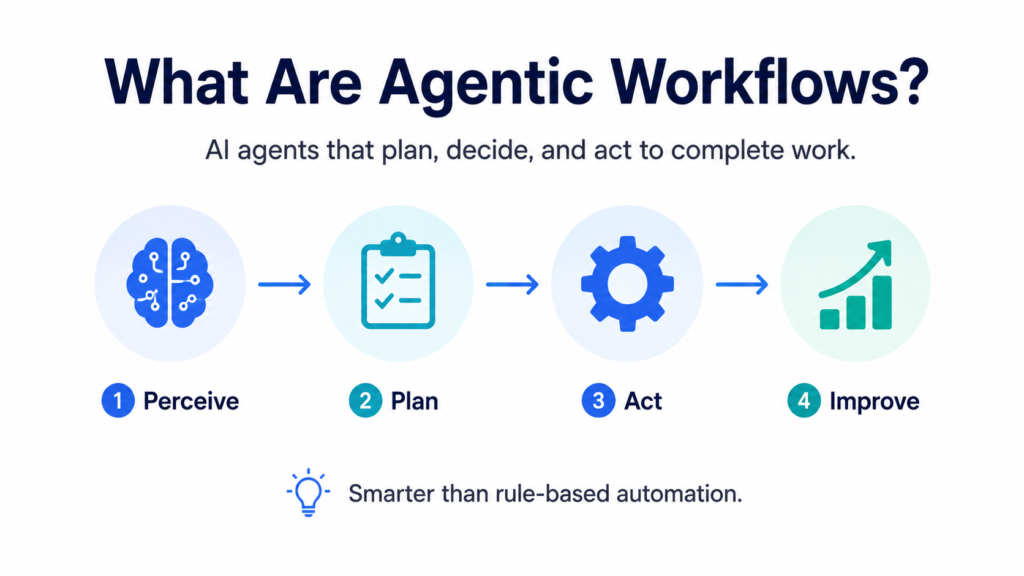
The workflow is “agentic” because the system has a degree of agency. It can determine how to pursue an objective within its authorized boundaries.
Google defines AI agents as software systems that use AI to pursue goals and complete tasks on behalf of users, often using reasoning, planning, memory, and a level of decision-making autonomy. (Googl e Cloud)
The Difference Between Generative AI and Agentic AI
Generative AI primarily creates outputs.
It can produce text, summarize documents, generate images, write code, answer questions, and transform information from one format into another.
Agentic AI is oriented toward outcomes.
It may use generative AI during its work, but content generation is only one part of the process. An agentic system can also interact with tools, retrieve business data, update records, coordinate tasks, verify results, and continue working until it reaches a completion condition.
Consider the difference:
Generative AI request:
“Write a response to this customer complaint.”
Agentic workflow objective:
“Resolve this customer complaint according to our service policy.”
The second instruction may require the system to identify the customer, review previous cases, verify the product warranty, assess the complaint, select an approved resolution, update the service record, send a response, and escalate the matter when its authority is insufficient.
Generative AI produces an answer. Agentic AI advances the work.
Traditional Automation vs. Agentic Workflows
Traditional automation and agentic workflows should not be treated as competing technologies. In mature enterprise systems, they will frequently operate together.
| Traditional Automation | Agentic Workflow |
| Follows fixed rules | Pursues defined goals |
| Works best with predictable inputs | Handles structured and unstructured information |
| Uses predetermined paths | Selects or adapts its path |
| Requires every condition to be designed | Can reason through unfamiliar combinations |
| Executes a specific action | Coordinates a sequence of actions |
| Usually deterministic | Often probabilistic |
| Limited ability to manage exceptions | Can investigate and respond to exceptions |
| Measured mainly by execution success | Measured by outcome quality and execution quality |
Traditional automation remains preferable when a process is stable, repetitive, low-risk, and governed by unambiguous rules.
There is little value in asking an AI agent to calculate a standard tax field or copy an approved value between two systems when deterministic software can perform the task faster, more cheaply, and more predictably.
Agentic workflows become valuable when processes involve judgment, incomplete information, changing conditions, multiple systems, unstructured content, or numerous exceptions.
The best architecture is often hybrid: deterministic automation provides the operational rails, while AI agents manage interpretation, planning, exception handling, and decision support.
Why 2026 Is a Turning Point for Agentic AI
Several technological and organizational developments have converged.
First, AI models have become more capable of reasoning through multi-step tasks. They can interpret different content types, use tools, review intermediate results, and revise their approach.
Second, agent-building platforms have matured. OpenAI, Microsoft, Google, Salesforce, Anthropic, and other technology providers now offer tools for orchestration, evaluation, tracing, guardrails, memory, and system integration.
Third, interoperability is improving. The Model Context Protocol, commonly known as MCP, provides a standardized way to connect AI applications with external data sources and tools. (Model Context Protocol)
The Agent2Agent protocol, or A2A, focuses on communication and coordination between agents created with different frameworks or by different vendors. Google describes A2A and MCP as complementary: MCP connects agents with tools and context, while A2A helps agents communicate and collaborate. (Google Developers Blog)
Finally, organizations have moved beyond isolated AI demonstrations. Leadership teams increasingly want AI investments to influence measurable operational outcomes such as resolution time, conversion rates, processing costs, employee capacity, and customer satisfaction.
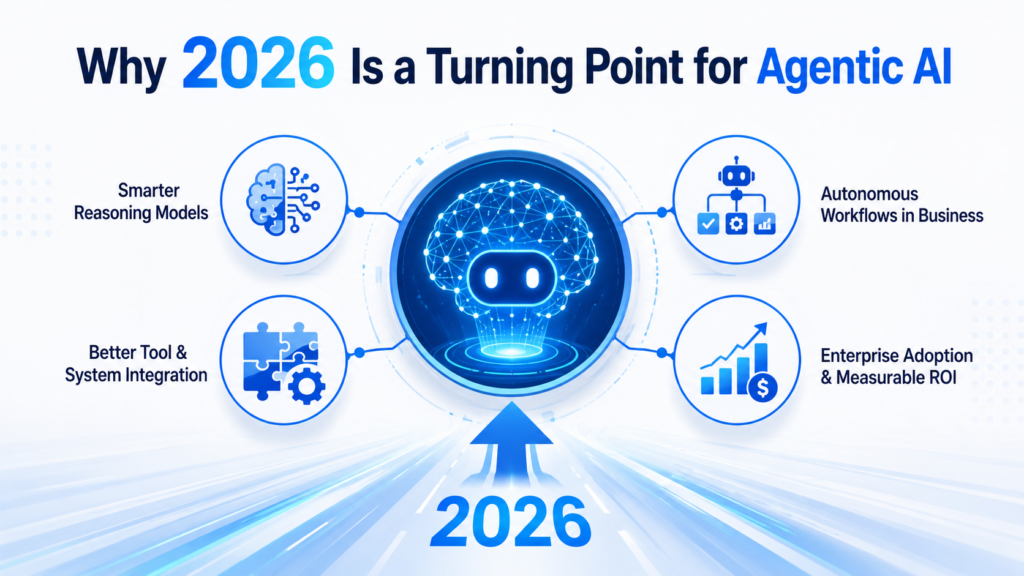
This combination makes 2026 an important transition year—from conversational AI experimentation to operational AI execution.
The Core Components of an Agentic Workflow
An agentic workflow is not simply a language model connected to a business application. Reliable systems require several interdependent components.
Business Goals and Triggers
Every workflow must begin with a clearly defined objective.
“Help the sales team” is too broad.
“Research newly assigned enterprise leads and prepare an account brief before the first sales call” is measurable and constrained.
The trigger may be an employee request, a customer interaction, a scheduled event, a CRM update, an incoming document, a threshold violation, or an external system notification.
Clear goals prevent the agent from wandering into irrelevant actions.
Context and Enterprise Data
Agents require accurate contextual information to make useful decisions.
This may include CRM records, policy documents, product information, pricing rules, emails, contracts, support histories, transaction records, knowledge articles, data warehouse information, and previous workflow activity.
Context must also be selective. Giving an agent access to every available document may create noise, increase processing costs, expose sensitive information, and reduce response quality.
The objective is not maximum context. It is relevant, trustworthy, permission-aware context.
Reasoning and Planning
Reasoning allows an agent to determine which steps are required to achieve its objective.
The agent may decompose a complex goal into smaller tasks, select tools, sequence actions, review intermediate information, and modify the plan when new evidence emerges.
OpenAI describes agent execution as a loop that can continue through tool calls, structured outputs, handoffs, errors, or other steps until an exit condition is reached. (OpenAI)
This iterative structure distinguishes an agent from a single prompt-and-response interaction.
Tools, APIs, and Business Systems
Tools allow agents to act.
An agent may need tools to search a knowledge base, create a CRM record, query inventory, calculate a discount, send an email, book a meeting, generate a document, open a support case, or request managerial approval.
Well-designed tools have precise names, clearly defined parameters, controlled permissions, predictable outputs, and robust error handling.
Tool quality can be more important than prompt cleverness. An intelligent agent equipped with confusing or overlapping tools will still make poor operational decisions.
Memory and State Management
Business processes frequently extend across multiple interactions or several days.
An agent therefore needs an appropriate method for maintaining state. It may need to remember what has already been completed, which approvals are pending, what the customer previously requested, or why a particular decision was made.
Memory should not be indiscriminate. Organizations must define what can be retained, where it is stored, who can access it, and when it should be deleted.
Guardrails and Permissions
Guardrails define what an agent may and may not do.
They can restrict accessible data, approved tools, transaction values, communication channels, prohibited topics, geographic regions, or actions requiring human authorization.
An agent might be permitted to recommend a refund but not issue one above $500. It may draft a contract clause but not send a finalized agreement. It may create a purchase request but not approve the expenditure.
The principle of least privilege is fundamental: every agent should receive only the access required for its designated role.
Human Oversight
Autonomy should be calibrated according to risk.
Low-risk actions can be completed automatically. Medium-risk decisions may require review after execution. High-risk actions should require human approval before execution.
Human intervention is especially important for financial commitments, legal decisions, employee matters, regulated communications, safety concerns, and irreversible system changes.
The objective is not to remove humans indiscriminately. It is to reserve human judgment for decisions where judgment creates the greatest value.
Observability and Evaluation
Traditional software monitoring focuses on metrics such as uptime, latency, errors, and throughput. Those indicators remain useful, but they do not reveal whether an AI agent made a sound decision.
Microsoft notes that agentic systems are probabilistic and may behave differently depending on prompts, retrieved context, tool outputs, and guardrail decisions. Consequently, organizations need AI-native observability covering execution traces, tool calls, permissions, provenance, quality, safety, and behavioral deviations. (Microsoft Learn)
Businesses need to understand not only whether the agent ran, but what it considered, which tools it used, what actions it performed, and whether the final outcome was correct.
How an Agentic Workflow Operates
Although implementations vary, a typical agentic workflow follows this operational cycle:
- A request, event, or system update triggers the workflow.
- The agent interprets the desired objective.
- It retrieves relevant data and business context.
- It creates or selects an execution plan.
- It calls the necessary tools.
- It evaluates the output from each action.
- It adjusts its plan when required.
- It requests human input when authority or confidence is insufficient.
- It completes the task or reaches a defined stopping condition.
- It records the actions, decisions, and outcome for evaluation.
This cycle may take seconds for a simple service request or continue across several days for a procurement, onboarding, research, or account-management process.
Common Agentic Workflow Architecture Patterns
Not every agentic workflow requires a complex network of autonomous agents. In fact, unnecessary sophistication often creates avoidable cost and fragility.
Anthropic recommends increasing complexity gradually, beginning with augmented language models and compositional workflows before moving toward highly autonomous agents.
Sequential Workflows
In a sequential workflow, one step follows another.
A document may be classified, summarized, checked against policy, entered into a system, and routed for approval.
This pattern is suitable when the process follows a clear order but individual steps require AI interpretation.
Routing Workflows
A routing agent examines an incoming request and sends it to the correct workflow, tool, team, or specialized agent.
For example, an insurance inquiry may be routed differently depending on whether it concerns a new policy, claim, payment, renewal, or complaint.
Parallel Workflows
Parallel workflows divide work into independent tasks that can run simultaneously.
An account research agent might investigate company information, industry developments, CRM history, stakeholder profiles, and potential risks at the same time before consolidating the results.
Parallel execution can reduce completion time but requires careful reconciliation when outputs conflict.
Orchestrator-Worker Workflows
An orchestrator interprets the overall objective, divides it into tasks, and assigns those tasks to specialized workers.
A proposal-generation orchestrator could delegate pricing analysis, solution design, customer research, compliance review, and document creation to separate components.
The orchestrator then assembles and verifies the final result.
Evaluator-Optimizer Workflows
One component creates an output while another evaluates it against defined criteria.
The system may repeatedly revise the result until it meets an approved threshold.
This pattern is useful for quality-sensitive tasks such as policy responses, technical documentation, customer communications, code generation, and proposal creation.
Multi-Agent Workflows
Multi-agent systems use several specialized agents that coordinate through a manager or transfer work between one another.
OpenAI identifies two common approaches: a manager pattern, in which one central agent coordinates specialists, and a decentralized pattern, in which peer agents hand tasks to one another based on their responsibilities. It also recommends maximizing a single agent’s capabilities before introducing additional agents because multi-agent architectures create extra operational complexity. (OpenAI)
Multi-agent workflows are appropriate when responsibilities are genuinely distinct—not merely because multiple agents sound more advanced.
Business Benefits of Agentic Workflows
The value of agentic workflows comes from their ability to handle work that traditional automation cannot easily absorb.
Greater Process Completion
Many organizations automate individual tasks without automating the complete process.
An agentic workflow can connect research, decision-making, data entry, communication, approvals, and follow-up into one continuous operational chain.
Faster Response Times
Agents can monitor events and begin work immediately, reducing delays caused by inboxes, queue backlogs, shift changes, and manual handoffs.
Better Use of Employee Capacity
Employees spend considerable time collecting information, transferring data, checking statuses, preparing routine communications, and coordinating tasks.
Agents can manage this connective tissue, allowing employees to focus on relationships, strategy, negotiation, creativity, and complex judgment.
More Consistent Execution
When properly governed, agents can apply approved procedures consistently across thousands of interactions.
They do not eliminate operational variation automatically, but they can make deviations visible and enforce standardized checkpoints.
Scalable Personalization
Traditional personalization is difficult to maintain at scale.
Agents can use account history, customer behavior, preferences, service records, industry context, and current intent to tailor actions without requiring employees to manually assemble every detail.
Continuous Improvement
Because agentic workflows generate execution traces, organizations can identify where agents hesitate, select the wrong tools, require human intervention, or fail to reach the desired outcome.
Those insights can improve instructions, integrations, policies, data quality, and process design.
Agentic Workflows in Sales
Sales teams are strong candidates for agentic automation because their work combines structured CRM data with unstructured conversations, emails, documents, and market information.
A sales agent can:
- Research companies and decision-makers.
- Enrich CRM records.
- Prioritize leads.
- Prepare pre-call briefs.
- Summarize meetings.
- Update opportunities.
- Recommend next-best actions.
- Draft personalized follow-ups.
- Generate proposals.
- Monitor inactive opportunities.
- Alert managers to deal risks.
- Coordinate approvals.
The greatest value does not come from sending more automated messages. It comes from helping sales professionals act with better context and fewer administrative delays.
Poorly governed sales agents can produce generic outreach, contact unsuitable prospects, or damage customer relationships. Quality controls and human approval should therefore be stricter for external communication than for internal research.
Agentic Workflows in Customer Service
Customer service contains many multi-stage processes that extend beyond answering questions.
An agent may authenticate a customer, retrieve account information, identify the issue, review previous interactions, consult product documentation, perform troubleshooting, execute an approved action, update the case, and confirm resolution.
Complex or emotionally sensitive cases can be transferred to human representatives with a complete summary of the steps already taken.
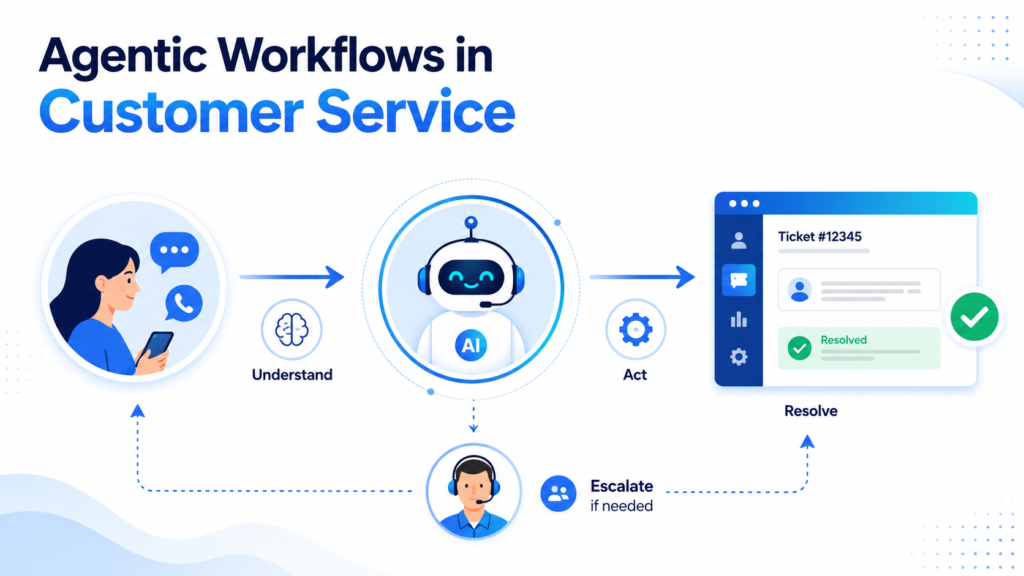
This creates a more fluid service model. Customers do not have to repeatedly explain the problem, and employees receive a structured picture of the case rather than an unprocessed conversation history.
Agentic Workflows in Marketing
Agentic marketing workflows can connect research, segmentation, content, campaign operations, and performance analysis.
An agent might identify an audience segment, study engagement patterns, recommend a campaign, produce channel-specific content, create tasks, monitor results, and suggest optimization actions.
However, brand governance remains essential. Marketing agents should operate from approved messaging frameworks, audience rules, legal requirements, and content standards.
A system capable of generating thousands of assets can also generate thousands of inconsistencies. Scale magnifies both quality and error.
Agentic Workflows in IT and Operations
IT operations involve constant investigation, prioritization, remediation, documentation, and communication.
An IT agent may review an alert, collect system telemetry, compare the incident with historical cases, recommend a remediation, execute an approved diagnostic action, open or update a ticket, and notify affected users.
In software development, agents can assist with issue analysis, code changes, testing, documentation, and review preparation.
These use cases require strong permission boundaries. An agent capable of modifying infrastructure or production code must have constrained credentials, detailed logging, rollback procedures, and deterministic approval gates.
Agentic Workflows in Finance
Finance teams can use agents for invoice processing, reconciliation, expense reviews, collections, financial reporting, variance analysis, and audit preparation.
For example, an accounts receivable agent could identify an overdue invoice, review the account’s payment history, verify unresolved disputes, prepare an appropriate reminder, create a follow-up task, and escalate high-value risks.
Financial agents should not be given unrestricted authority. Monetary thresholds, segregation of duties, approval workflows, and transaction-level audit records remain indispensable.
Agentic Workflows in Human Resources
HR agents can support candidate screening, interview coordination, employee onboarding, policy navigation, learning recommendations, and routine employee requests.
An onboarding workflow may collect documentation, create accounts, assign training, schedule introductions, update the HR system, and alert managers about incomplete tasks.
Sensitive employee decisions should remain human-led. Agents may support analysis, but hiring, disciplinary, compensation, health-related, and termination decisions demand careful legal, ethical, and organizational oversight.
Agentic Workflows in Legal and Compliance
Legal work often requires document review, information retrieval, structured analysis, deadline management, and procedural consistency.
Agents can classify contracts, extract clauses, compare language with approved playbooks, identify deviations, prepare summaries, track obligations, and route high-risk issues to legal professionals.
The system should clearly distinguish assistance from authorization. An agent may highlight a contractual risk, but a qualified professional should make consequential legal decisions.
Agentic Workflows in Supply Chain Management
Supply chains operate through interconnected variables: suppliers, inventory, customer demand, logistics, contracts, lead times, pricing, weather, and operational disruptions.
An agentic workflow can monitor these signals, investigate anomalies, recommend alternatives, contact approved stakeholders, update planning systems, and initiate escalation procedures.
This creates an adaptive operational layer. Instead of waiting for employees to discover every disruption manually, the agent can detect, contextualize, and prepare a response.
The Role of Salesforce and Agentforce
Salesforce environments are particularly relevant to agentic workflows because CRM systems already contain customer data, workflow logic, permissions, business processes, and operational history.
Salesforce describes Agentforce as combining three fundamental elements: data, reasoning, and actions. Agents can retrieve relevant information, build action plans, and use workflows, automation, or APIs to complete tasks within organizational guardrails. (Salesforce)
Agentforce can work alongside existing Salesforce capabilities such as:
- Sales Cloud
- Service Cloud
- Marketing Cloud
- Commerce Cloud
- Salesforce Flow
- Data 360
- MuleSoft
- Apex
- Lightning components
- External APIs and enterprise applications
The most effective Salesforce agents do not sit above a disorganized CRM and magically correct it. They depend on well-designed objects, accurate data, secure permissions, documented processes, reliable integrations, and maintainable automation.
Agentforce readiness is therefore partly an AI initiative and partly a Salesforce architecture initiative.
Why Data Readiness Determines Agent Performance
An agent’s reasoning is only as useful as the information available to it.
Duplicate customer records can cause inconsistent actions. Missing fields can distort recommendations. Obsolete policies can produce incorrect answers. Fragmented data can prevent the agent from understanding the complete customer relationship.
Businesses preparing for agentic workflows should assess:
- Data accuracy
- Duplicate records
- Ownership
- Field completeness
- Data freshness
- Structured and unstructured data sources
- Consent and privacy requirements
- Access permissions
- Retention policies
- Knowledge article quality
- Metadata consistency
- Source provenance
Data preparation may appear less exciting than launching an AI agent, but it frequently determines whether the agent becomes a trustworthy operational asset or an eloquent source of confusion.
The Importance of System Integration
Agents create value when they can move beyond observation and participate in real business processes.
That requires integration.
A customer service agent may need CRM, order management, billing, inventory, identity, logistics, and knowledge systems. A sales agent may need email, calendars, CRM records, proposal tools, pricing applications, and external research sources.
Without integration, the agent becomes another disconnected interface that employees must manually support.
Organizations should prioritize reusable, governed integrations instead of creating one-off connections for every agent. Standardized APIs, MuleSoft connections, MCP servers, event-driven architecture, and controlled tool registries can reduce duplication and improve maintainability.
Agentic AI Security and Governance Risks
Agentic systems introduce a distinctive risk: they do not merely process data. They may also take action with delegated authority.
Major risks include:
- Unauthorized data access
- Excessive permissions
- Prompt injection
- Data exfiltration
- Incorrect tool selection
- Fabricated information
- Unapproved financial actions
- Inappropriate customer communication
- Endless execution loops
- Unexpected consumption costs
- Weak auditability
- Unclear ownership
- Third-party integration vulnerabilities
- Regulatory noncompliance
Microsoft recommends organization-wide governance covering agent ownership, identity, lifecycle management, observability, data access, compliance, security, and approved development standards. It also emphasizes that leaders should know which agents exist, who owns them, what they can access, and how the organization can intervene. (Microsoft Learn)
Each production agent should therefore have an owner, purpose, risk classification, access policy, approved tools, escalation path, monitoring standard, evaluation suite, and retirement process.
Why Human-in-the-Loop Design Still Matters
Human involvement is not evidence that an agentic workflow has failed.
It is a deliberate control mechanism.
The correct level of autonomy depends on the consequences of error. A system that categorizes internal documents can operate with greater independence than one that approves payments, modifies a contract, or communicates a medical decision.
Human oversight can take several forms:
- Approval before action
- Review after action
- Escalation when confidence is low
- Escalation when values exceed a threshold
- Random quality sampling
- Specialist review for regulated subjects
- Emergency suspension controls
Over time, high-performing actions may receive greater autonomy. Weak or high-risk actions should remain supervised.
This progressive model allows businesses to build confidence through evidence rather than assumption.
How to Identify the Right Agentic Use Cases
Not every business process should become agentic.
Strong candidates usually have several of the following characteristics:
- The process involves multiple steps.
- Employees must gather information from different systems.
- Inputs frequently include emails, documents, conversations, or images.
- Exceptions are common.
- The process requires contextual judgment.
- Delays create meaningful costs or poor customer experiences.
- Employees repeat similar analytical work.
- The outcome can be measured.
- The organization has reliable data.
- Actions can be constrained with clear permissions.
Avoid beginning with the most politically sensitive, legally consequential, or architecturally chaotic process in the company.
A better first project is valuable enough to matter, narrow enough to govern, frequent enough to evaluate, and safe enough to improve iteratively.
Build vs. Buy: Choosing an Agentic AI Approach
Businesses generally have three options.
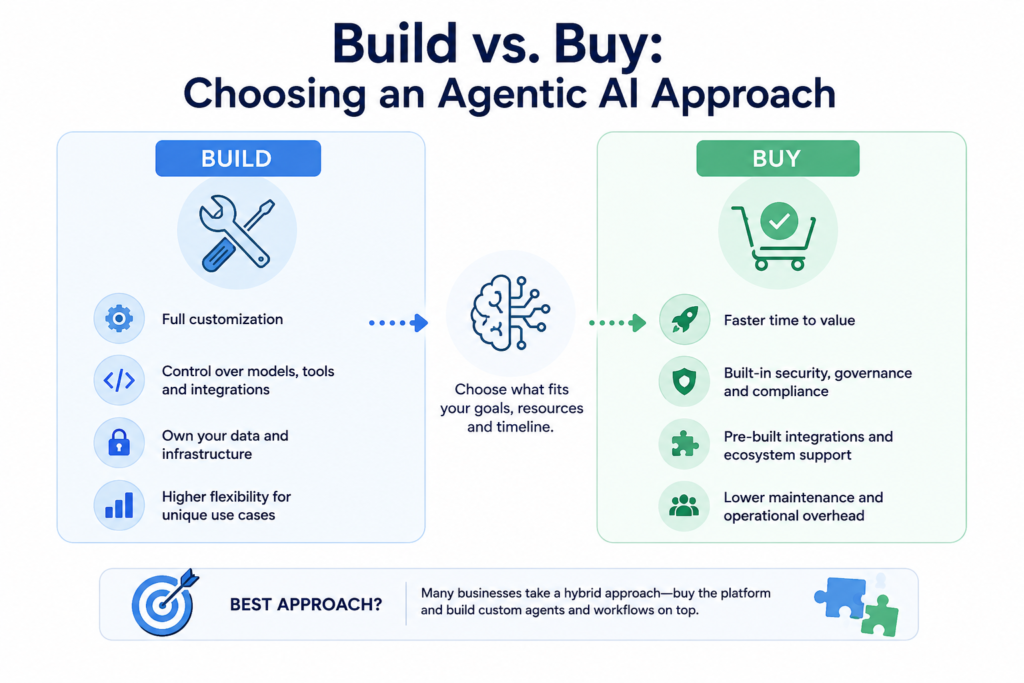
Use a Platform-Based Agent
Platforms such as Salesforce Agentforce or Microsoft Copilot provide agent-building capabilities, identity controls, integrations, governance tools, and enterprise support.
This approach is suitable when the workflow is closely connected to an existing platform.
Build a Custom Agent
Custom development provides greater control over models, tools, orchestration, interfaces, and deployment architecture.
It is useful when the workflow is highly differentiated or spans specialized systems.
However, custom agents require internal capabilities for security, evaluation, observability, maintenance, and model lifecycle management.
Adopt a Hybrid Approach
Many organizations will use platform agents for common business processes and custom components for proprietary logic.
The decision should be based on business differentiation, integration requirements, governance, total cost of ownership, internal expertise, and the expected rate of change.
A Practical Agentic Workflow Implementation Roadmap
Step 1: Define the Business Outcome
Select a measurable operational problem.
Examples include reducing case resolution time, increasing qualified meeting bookings, shortening proposal preparation, or decreasing invoice-processing effort.
Step 2: Map the Current Workflow
Document triggers, inputs, decisions, systems, exceptions, approvals, outputs, and responsible teams.
Do not automate an undocumented process and expect the agent to resolve its contradictions.
Step 3: Classify the Risk
Determine what could happen if the agent is wrong.
Use this assessment to set permissions, thresholds, approval requirements, and monitoring intensity.
Step 4: Prepare the Data
Identify authoritative sources, remove obvious duplication, improve missing information, define access rules, and establish source ownership.
Step 5: Design the Tools
Create clear, narrow, reusable tools for each approved action.
Avoid giving the agent unrestricted application access when a constrained API action will suffice.
Step 6: Start With the Simplest Architecture
Begin with a single workflow or agent.
Introduce multi-agent orchestration only when responsibilities, tool sets, or context requirements genuinely demand separation.
Step 7: Establish Evaluations
Create realistic test cases covering successful scenarios, edge cases, adversarial inputs, permission boundaries, and expected escalations.
Anthropic emphasizes that evaluations help teams detect behavioral problems before they reach users and become increasingly valuable throughout an agent’s lifecycle. (Anthropic)
Step 8: Pilot With Human Oversight
Deploy the workflow to a controlled user group. Review decisions, tool calls, outcomes, costs, and intervention patterns.
Step 9: Improve Before Expanding
Resolve recurring failures before increasing volume, data access, or autonomy.
Step 10: Scale Through Governance
Register production agents, assign ownership, monitor performance, control versions, review permissions, and maintain an auditable lifecycle.
How to Measure Agentic Workflow Performance
Agentic workflows require broader metrics than conventional automation.
Business Outcome Metrics
- Revenue influenced
- Conversion rate
- Resolution time
- Cost per completed process
- Customer satisfaction
- Employee hours returned
- Processing capacity
- Error reduction
- Revenue leakage prevented
Agent Quality Metrics
- Task completion rate
- Decision accuracy
- Tool-selection accuracy
- Groundedness
- Policy compliance
- Escalation accuracy
- Human acceptance rate
- Rework rate
Operational Metrics
- Total execution time
- Number of tool calls
- Tool failure rate
- Model and infrastructure costs
- Token consumption
- Integration latency
- Workflow abandonment
- Human intervention frequency
Risk Metrics
- Unauthorized action attempts
- Sensitive data exposure
- Guardrail activations
- Prompt-injection incidents
- Policy violations
- Audit completeness
- High-risk action approval rates
The most impressive demonstration is not always the most valuable workflow. Business success should be measured by dependable outcomes, not by how human the agent appears.
Common Agentic AI Implementation Mistakes
Starting With Technology Instead of Process
Buying an agent platform without selecting a measurable business problem usually creates impressive demonstrations with little operational adoption.
Automating a Broken Workflow
Agents amplify the processes and information they receive. They do not automatically repair contradictory policies, unclear ownership, or poor data architecture.
Granting Excessive Access
Broad permissions may accelerate prototyping but create unacceptable production risk.
Using Multiple Agents Too Early
A network of specialized agents is harder to evaluate, secure, trace, and maintain than a focused single-agent workflow.
Ignoring Evaluation
Testing a few prompts manually is not a production evaluation strategy.
Measuring Activity Instead of Outcomes
More generated emails, summaries, tool calls, or conversations do not automatically create business value.
Removing Humans Too Quickly
Autonomy should increase only when performance evidence, risk controls, and organizational confidence justify it.
Treating Deployment as Completion
Agentic systems require continuous monitoring, evaluation, data maintenance, security review, and process improvement.
What the Future of Agentic Work Will Look Like
The future workplace will not be divided neatly between humans and AI.
It will consist of hybrid operating systems in which employees, deterministic automation, specialized agents, enterprise platforms, and external partners coordinate work.
Employees will increasingly assign objectives instead of manually executing every step. Managers will supervise portfolios of human and digital capacity. IT teams will govern agents as operational identities. Business analysts will design workflows that combine rules with reasoning. Security teams will monitor not only users and applications but also autonomous actions.
Open protocols such as MCP and A2A indicate that this future may involve agents operating across multiple platforms rather than remaining inside one vendor ecosystem. The result could be an interoperable agentic layer spanning CRM, ERP, collaboration, analytics, service, finance, and industry-specific applications. (Model Context Protocol)
Yet the competitive advantage will not come from deploying the highest number of agents.
It will come from designing the most reliable workflows.
Businesses that combine trusted data, clear processes, thoughtful integration, human accountability, security, and continuous evaluation will generate sustainable value. Organizations that deploy agents without these foundations may simply automate confusion at unprecedented speed.
Build Reliable Agentic Workflows With CloudVandana
Agentic AI has the potential to transform how sales, service, marketing, operations, and internal teams complete work. But successful adoption requires more than selecting an AI model or activating a new platform feature.
Businesses need the right processes, connected data, secure integrations, measurable use cases, reliable automation, and clearly defined governance.
CloudVandana helps organizations design and implement intelligent business workflows using Salesforce, Agentforce, Data 360, Salesforce Flow, MuleSoft, custom development, AI agents, and enterprise integrations.
Whether your organization is evaluating its first AI agent or preparing to scale agentic workflows across multiple departments, CloudVandana can help you:
- Assess agentic AI readiness
- Identify high-value workflow opportunities
- Prepare Salesforce and enterprise data
- Design secure Agentforce solutions
- Integrate CRM, ERP, service, and operational systems
- Build human-in-the-loop controls
- Establish agent monitoring and governance
- Optimize existing automation
- Support agents after deployment
Do not automate isolated tasks when you can redesign the entire business outcome.
Contact CloudVandana today to explore how secure, connected, and business-ready agentic workflows can help your organization operate more intelligently in 2026.
Frequently Asked Questions About Agentic Workflows
1. What is an agentic workflow?
An agentic workflow is a business process in which an AI agent uses data, reasoning, tools, and multiple actions to achieve a defined objective. Unlike basic automation, it can adapt its approach according to context and intermediate results.
2. What is the difference between an AI agent and an agentic workflow?
An AI agent is the software component that reasons and takes actions. An agentic workflow is the complete business process in which the agent operates, including triggers, data, tools, approvals, guardrails, integrations, and outcome measurement.
3. How are agentic workflows different from traditional automation?
Traditional automation follows predetermined rules and paths. Agentic workflows can interpret unstructured information, plan multiple steps, manage exceptions, choose tools, and adapt their actions while working toward an objective.
4. Will agentic AI replace robotic process automation?
Agentic AI is unlikely to eliminate robotic process automation or deterministic workflow tools. The technologies are complementary. Rules-based automation is preferable for predictable actions, while agents are better suited to interpretation, judgment, planning, and exception management.
5. What are the best business use cases for AI agents?
Strong use cases include lead research, sales preparation, customer service resolution, IT incident investigation, invoice processing, contract analysis, employee onboarding, supply chain exception management, and cross-system operational coordination.
6. Are agentic workflows safe for enterprise use?
They can be deployed safely when organizations use least-privilege access, approved tools, data controls, human approval gates, detailed logging, continuous evaluations, clear ownership, and incident-response procedures.
7. Do businesses need clean data before implementing AI agents?
Businesses do not need perfect data, but they do need trustworthy and identifiable authoritative sources. Duplicate, incomplete, outdated, or poorly governed data can significantly reduce agent accuracy and consistency.
8. What is human-in-the-loop agentic AI?
Human-in-the-loop agentic AI requires employees to review, approve, correct, or take over selected decisions. Human involvement is usually determined by risk, confidence, financial value, regulatory requirements, or the reversibility of an action.
9. What is a multi-agent workflow?
A multi-agent workflow uses several specialized AI agents that collaborate. One agent may coordinate the process while others handle research, analysis, communication, compliance, or execution. Multi-agent designs are most useful when responsibilities are genuinely distinct.
10. How does Salesforce Agentforce support agentic workflows?
Salesforce Agentforce allows organizations to create agents that use CRM information, enterprise data, reasoning, Salesforce Flow, APIs, MuleSoft integrations, and custom actions to complete customer- and employee-facing tasks within defined guardrails.
11. How should businesses measure the ROI of agentic workflows?
ROI should be measured through business outcomes such as revenue influenced, processing costs, employee time saved, conversion rates, customer satisfaction, resolution speed, error reduction, and total cost per successfully completed workflow.
12. How should a business begin its agentic AI journey?
Begin with one measurable, moderately complex, low-to-medium-risk workflow. Map the current process, prepare the required data, define tools and permissions, create test cases, deploy with human oversight, measure results, and expand autonomy only after the workflow performs reliably.

Atul Gupta is CloudVandana’s founder and an 8X Salesforce Certified Professional who works with globally situated businesses to create Custom Salesforce Solutions.
Atul Gupta, a dynamic leader, directs CloudVandana’s Implementation Team, Analytics, and IT functions, ensuring seamless operations and innovative solutions.
YOU MIGHT ALSO LIKE

Financial Services Cloud: A Complete Guide for Banking and Wealth Management
How MuleSoft Connects Salesforce With ERP, Finance and Business Systems
Salesforce Customer 360: Connecting Sales, Service and Marketing Teams
Salesforce and Anthropic Launch Claudeforce: What It Means for the Future of Enterprise AI

Salesforce AIforce: What It Means for the Future of Enterprise Software