Salesforce has grown from a simple CRM into one of the most influential enterprise technology platforms in the world. Today, it powers sales teams, service operations, marketing automation, analytics, AI initiatives, and complex enterprise workflows across industries.
Yet many organizations quickly discover something unexpected after purchasing Salesforce licenses.
The platform is powerful. But unlocking its full potential requires expertise.
This is where Salesforce Partners enter the picture.
Businesses often hear terms like consulting partner, implementation partner, AppExchange partner, or integration partner. However, the exact role of a Salesforce partner can feel unclear, especially for organizations exploring Salesforce for the first time.
What exactly do these partners do?
Why do so many companies rely on them?
And how can the right partner determine the success or failure of a Salesforce initiative?
This comprehensive guide explains what Salesforce partners actually do, how they work, when businesses need them, and how to choose the right one.
Introduction to the Salesforce Ecosystem
Salesforce sits at the center of one of the most expansive and influential enterprise technology ecosystems in the world. What began as a cloud-based CRM platform has steadily matured into a broad digital foundation that supports sales, service, marketing, analytics, automation, AI, and industry-specific operations. In many organizations, Salesforce is no longer viewed as just a software purchase. It is treated as a strategic business platform that helps teams manage customer relationships, streamline internal processes, and create more connected digital experiences across the company.
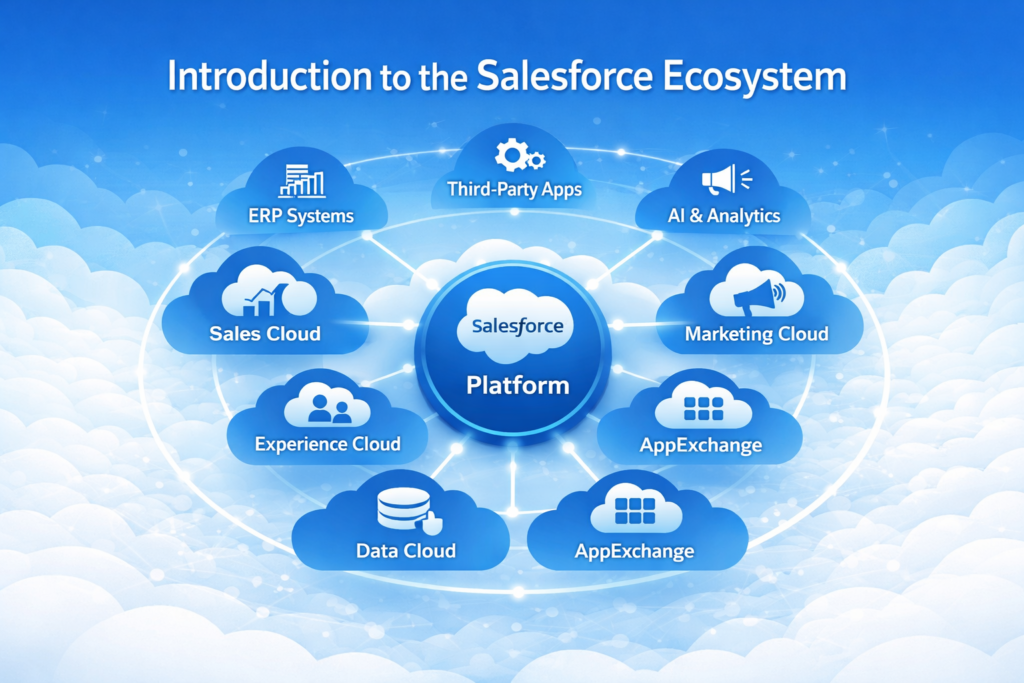
Today, businesses use Salesforce to manage a wide range of core functions, including:
Customer relationships
Salesforce helps organizations maintain a centralized view of customers, prospects, partners, and accounts. Instead of storing information in disconnected spreadsheets or scattered systems, teams can access a unified record of interactions, preferences, history, and engagement.
Sales pipelines
Sales teams use Salesforce to track leads, opportunities, deals, follow-ups, and forecasts in a structured way. This gives leaders clearer visibility into pipeline health, expected revenue, bottlenecks, and rep performance.
Customer support
Service teams rely on Salesforce to manage cases, service requests, escalations, and support workflows across multiple channels. It enables faster issue resolution, better accountability, and more consistent customer experiences.
Marketing campaigns
Salesforce supports campaign planning, lead nurturing, segmentation, and performance tracking across different stages of the buyer journey. This allows marketing teams to move beyond guesswork and make decisions based on actual engagement data.
Data analytics
Organizations use Salesforce dashboards and reports to monitor KPIs, identify trends, and make more informed operational decisions. When configured well, the platform turns business data into actionable intelligence rather than static records.
AI-powered insights
With growing AI capabilities across the Salesforce ecosystem, businesses can surface predictions, recommendations, and next-best actions directly within their workflows. This helps teams work more proactively instead of reacting after problems or opportunities appear.
Field operations
For organizations with distributed teams, on-site service staff, or mobile workforces, Salesforce can coordinate scheduling, work orders, service history, and real-time updates. This improves efficiency in the field while keeping head office teams informed.
Revenue management
Salesforce can also support pricing, quoting, contract workflows, renewals, subscriptions, and broader revenue operations. That makes it valuable not only for front-end sales activity but also for the downstream processes that influence long-term profitability.
But Salesforce itself is not a single product. It is a platform composed of dozens of specialized clouds and capabilities, each designed to address a particular business need. Some of the most widely used include:
Sales Cloud
Sales Cloud is focused on helping revenue teams manage leads, accounts, contacts, opportunities, and forecasting. It is often the starting point for businesses adopting Salesforce because it brings structure and visibility to the sales process.
Service Cloud
Service Cloud is designed for customer support and case management. It helps service teams handle inquiries efficiently, automate routing and escalations, and deliver support across channels such as email, chat, and phone.
Marketing Cloud
Marketing Cloud enables businesses to create personalized customer journeys, manage campaigns, and automate communications at scale. It is especially useful for organizations that want to improve targeting, engagement, and lead nurturing.
Commerce Cloud
Commerce Cloud supports digital commerce experiences across B2C and B2B environments. It helps businesses manage online storefronts, product experiences, customer journeys, and digital transactions in a more connected way.
Experience Cloud
Experience Cloud allows organizations to build customer portals, partner portals, self-service communities, and branded digital experiences. It extends Salesforce beyond internal users and makes the platform more interactive for external stakeholders.
Data Cloud
Data Cloud helps unify customer data from multiple systems into a more connected, usable model. As businesses adopt more tools and channels, Data Cloud becomes increasingly important for creating a reliable and comprehensive customer view.
Industry Clouds
Salesforce also offers industry-specific solutions tailored for sectors such as healthcare, financial services, manufacturing, nonprofit, education, and more. These clouds bring prebuilt workflows, data models, and features designed around the realities of specific industries.
Each of these solutions brings immense capability, but that capability also introduces complexity. The more powerful a platform becomes, the more important it is to make careful decisions about architecture, configuration, data structure, integrations, automation, and user adoption. Salesforce can do a great deal, but knowing what it can do is very different from knowing what it should do for a specific business.
That complexity is precisely why Salesforce built such a strong partner ecosystem.
Salesforce partners help businesses implement, customize, integrate, and optimize Salesforce solutions in ways that align with real operational needs. They do not simply configure software. They interpret business goals, translate them into platform design, and help organizations avoid costly mistakes that often happen when powerful systems are deployed without a clear strategy. In that sense, Salesforce partners serve as the bridge between the platform’s technical potential and the day-to-day realities of how a business actually works.
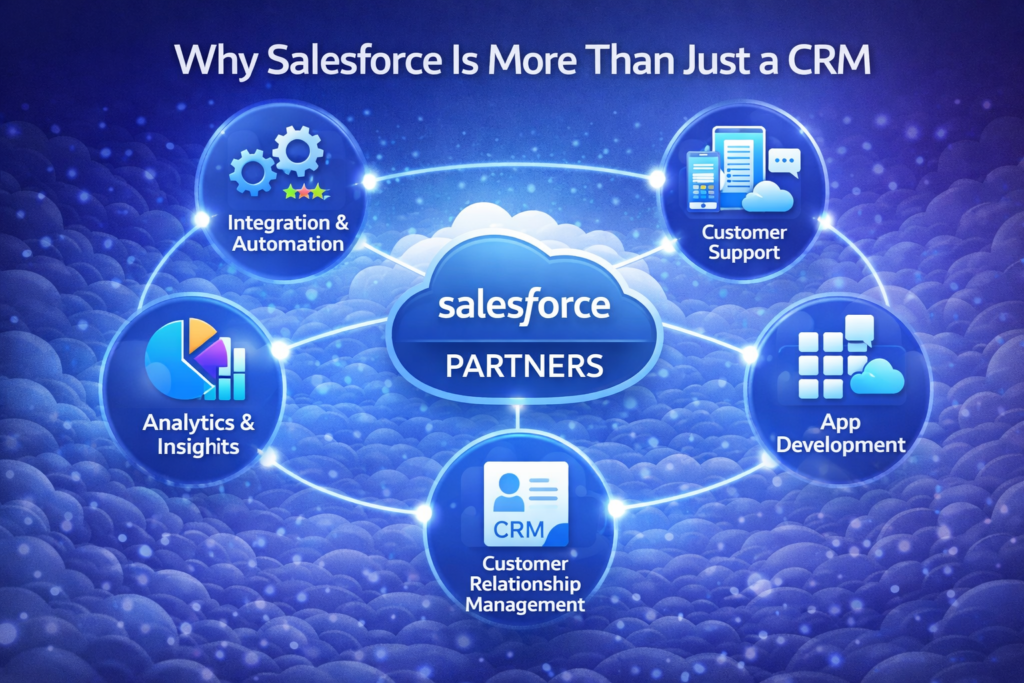
Why Salesforce Is More Than Just a CRM
Many businesses initially approach Salesforce with the expectation that it functions like a traditional CRM system. They assume it will simply store customer details, track deals, and provide a basic view of sales activity. While Salesforce certainly performs these functions, organizations often discover very quickly that the platform is far more sophisticated than a conventional CRM database.
Salesforce is fundamentally a business platform, not just a customer information repository. Over the years, it has evolved into an extensible ecosystem capable of supporting complex operational workflows across multiple departments. Instead of serving only sales teams, Salesforce can act as the digital backbone of an entire organization, connecting processes, data, and teams in a unified environment.
What makes Salesforce particularly powerful is its ability to support customized operational systems tailored to a company’s unique processes. Rather than forcing businesses to adapt to rigid software structures, the platform allows organizations to design workflows that mirror how their teams actually operate. This flexibility enables companies to build highly specialized systems that support their growth and operational efficiency.
Organizations commonly use Salesforce to build capabilities such as:
Automated lead routing
Salesforce can automatically assign incoming leads to the appropriate sales representatives based on criteria such as geography, product interest, industry, or deal size. This ensures that prospects are handled quickly and by the most relevant team members, improving response time and increasing the likelihood of conversion.
Multi-channel customer support
Through Service Cloud and related tools, Salesforce enables businesses to manage support interactions across email, phone, chat, social media, and web portals. Support teams can view the complete history of customer interactions in one place, allowing them to resolve issues faster and deliver more personalized service.
Real-time analytics dashboards
Salesforce provides robust reporting and dashboard capabilities that give leaders instant visibility into key performance metrics. Sales pipelines, service response times, marketing campaign performance, and revenue forecasts can all be monitored in real time, enabling better data-driven decision-making.
Workflow automation
Manual processes often slow down business operations and introduce errors. Salesforce allows organizations to automate routine tasks such as follow-up reminders, approval processes, notifications, and data updates. This reduces administrative work for employees and ensures that important actions happen consistently.
AI-powered predictions
With built-in artificial intelligence capabilities such as Einstein AI, Salesforce can analyze historical data to predict outcomes and recommend next steps. Sales teams can receive suggestions on which deals are most likely to close, service teams can identify potential churn risks, and marketing teams can optimize campaign targeting.
Partner portals
Many companies rely on distributors, resellers, or external partners to expand their market reach. Salesforce allows organizations to build secure partner portals where external collaborators can access relevant data, submit deals, track opportunities, and communicate with internal teams.
Internal productivity tools
Salesforce can also support internal collaboration and productivity by centralizing project data, operational workflows, and team communication. Teams can track tasks, monitor progress, and maintain shared visibility across departments without relying on disconnected tools.
This level of flexibility is one of Salesforce’s greatest strengths. However, it also introduces an important challenge. Because the platform can be configured in so many ways, every Salesforce environment must be designed with clear intention and structure. Without thoughtful planning, organizations may create systems that become overly complex, cluttered with redundant fields, and difficult for users to navigate.
When Salesforce environments grow without a defined architecture, performance can degrade, automation can conflict, and reporting becomes unreliable. In such situations, the platform begins to lose the very efficiency it was meant to provide.
This is where experienced Salesforce partners become invaluable. They bring the architectural discipline and implementation expertise needed to design Salesforce systems correctly from the beginning. By aligning the platform with business objectives, partners help ensure that Salesforce remains scalable, efficient, and adaptable as organizations continue to grow and evolve.
Understanding the Salesforce Partner Ecosystem
Salesforce operates one of the most mature partner ecosystems in the technology industry.
Thousands of organizations worldwide participate in the Salesforce Partner Program, offering services and solutions that extend the platform’s capabilities.
These partners typically fall into several categories:
- Consulting partners
- Implementation partners
- Integration specialists
- Managed services providers
- AppExchange developers
Each type of partner plays a distinct role in helping customers succeed.
The ecosystem exists because Salesforce recognizes an essential truth: software alone does not deliver transformation. Expertise does.
Types of Salesforce Partners Explained
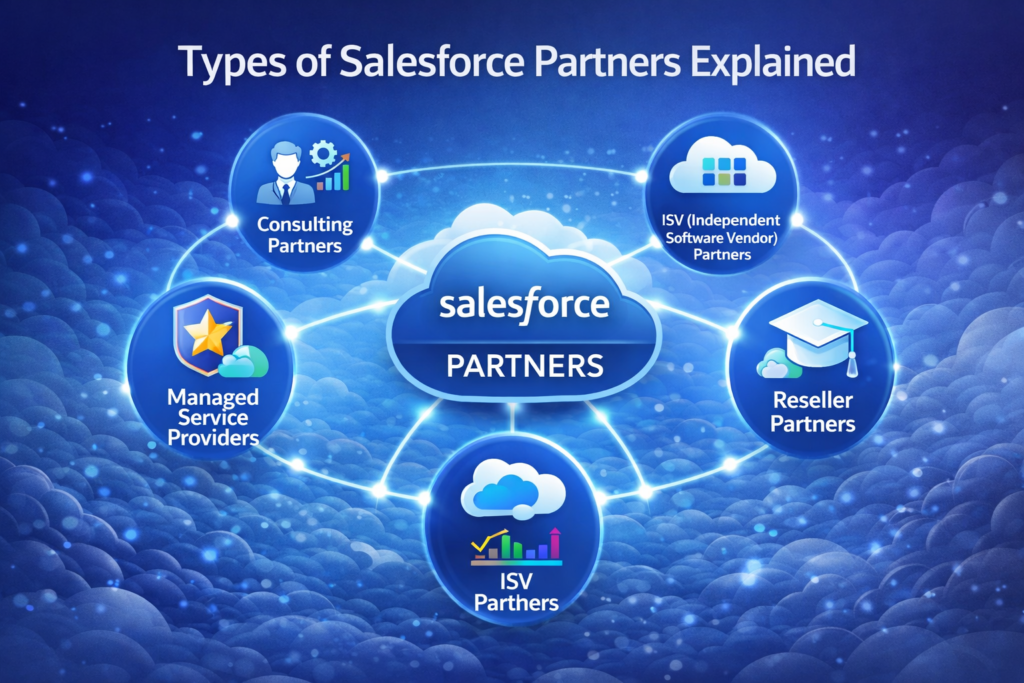
The Salesforce partner ecosystem can appear complex at first glance. However, most partners fall into five major categories.
Understanding these categories helps businesses determine the type of support they actually need.
Consulting Partners
These organizations focus on strategy and architecture. They analyze business processes and design Salesforce solutions aligned with long-term goals.
Implementation Partners
Implementation partners take architectural plans and turn them into working Salesforce systems.
Integration Partners
These specialists connect Salesforce with other enterprise applications such as ERPs, marketing platforms, and financial systems.
AppExchange Partners
AppExchange partners build specialized applications that extend Salesforce functionality.
Managed Service Partners
These providers offer ongoing administration, support, and optimization after Salesforce is deployed.
Many organizations combine several of these roles.
Salesforce Consulting Partners
Salesforce consulting partners operate at the strategic layer of Salesforce initiatives, helping organizations define how the platform should support their broader business goals. Their involvement typically begins long before any technical configuration or system setup takes place. Instead of focusing immediately on fields, objects, or workflows, consulting partners concentrate on understanding the business itself. They analyze how teams operate, where inefficiencies exist, and how Salesforce can be structured to improve processes, visibility, and decision-making.
At this stage, the objective is not simply to deploy software but to establish a clear roadmap for how Salesforce will contribute to organizational success. Many companies make the mistake of rushing into implementation without first defining what outcomes they expect from the platform. Consulting partners prevent this by helping leadership teams clarify priorities and align technology investments with measurable business results.
During this strategic phase, consulting partners help organizations answer several critical questions:
What business problems should Salesforce solve?
Salesforce is capable of addressing a wide range of challenges, from fragmented customer data to inefficient sales processes or disconnected support systems. A consulting partner works with leadership to identify the most pressing operational problems and determine how Salesforce can address them effectively.
Which Salesforce clouds are actually necessary?
The Salesforce ecosystem includes many specialized products such as Sales Cloud, Service Cloud, Marketing Cloud, and Industry Clouds. Not every organization needs all of them. Consulting partners evaluate business requirements and recommend the most relevant solutions to avoid unnecessary complexity or cost.
What data architecture should support the system?
Data is the foundation of Salesforce. Consulting partners design a data structure that organizes accounts, contacts, opportunities, service cases, and other objects in a logical and scalable way. This ensures that reporting, automation, and analytics function correctly as the system grows.
How will teams adopt the platform?
Even the most technically sophisticated Salesforce implementation will fail if employees do not use it effectively. Consulting partners develop adoption strategies that include training programs, user experience design, and change management initiatives to ensure the platform becomes an integral part of daily workflows.
A skilled consulting partner spends significant time studying internal workflows, departmental interactions, and long-term business objectives. This often involves interviews with stakeholders across sales, marketing, customer service, operations, and executive leadership. By understanding how each department interacts with customers and data, consultants can design a Salesforce strategy that connects these functions more efficiently.
This discovery process is essential because it prevents a common and costly mistake: implementing technology before defining the outcomes it should deliver. Many organizations rush to deploy new systems without fully understanding how those systems should support their processes. The result is often a platform that feels disconnected from real business needs.
Management thinker Peter Drucker captured this distinction clearly when he wrote:
“Efficiency is doing things right. Effectiveness is doing the right things.”
Salesforce consulting partners help organizations focus on effectiveness first. By ensuring that Salesforce initiatives are aligned with business priorities from the outset, they create a foundation for implementations that deliver real strategic value rather than simply adding another piece of software to the technology stack.
Salesforce Implementation Partners
Once a strategy has been defined, implementation partners begin the technical work of building the Salesforce environment.
Their responsibilities typically include:
- configuring Salesforce objects and fields
- creating page layouts and user interfaces
- setting up workflows and automation
- establishing security models
- building reports and dashboards
Implementation partners translate business requirements into functioning Salesforce systems.
This stage often requires collaboration between multiple stakeholders including sales leaders, service managers, IT teams, and executive sponsors.
Successful implementations balance technical precision with business usability.
Salesforce Integration Partners
Modern businesses rarely operate a single system.
Most organizations use a complex landscape of applications including:
- ERP platforms
- marketing automation tools
- finance software
- data warehouses
- customer support systems
Salesforce integration partners ensure these systems communicate effectively.
Integration work may involve:
- API architecture
- middleware platforms
- real-time data synchronization
- batch data processing
- event-driven architectures
When integrations fail, organizations often experience data silos, inconsistent reporting, and operational inefficiencies.
Integration partners eliminate these problems by creating a unified digital ecosystem.
Salesforce AppExchange Partners
The Salesforce AppExchange is one of the largest enterprise application marketplaces in the world.
Thousands of applications extend Salesforce capabilities across areas such as:
- document management
- data quality
- CPQ automation
- analytics enhancements
- workflow automation
- industry-specific solutions
AppExchange partners develop these specialized applications.
These apps allow businesses to adopt new capabilities without building everything from scratch.
For example, CloudVandana’s CV Files application helps organizations manage Salesforce files more efficiently by integrating external cloud storage platforms such as Google Drive and OneDrive.
Such solutions fill practical gaps that arise in real-world deployments.
Salesforce Managed Service Partners
Launching Salesforce is only the beginning of a much longer journey. While implementation establishes the foundation of the platform, businesses quickly realize that Salesforce must continuously evolve in order to remain effective. As organizations grow, processes change, teams expand, and new capabilities become necessary. Without ongoing attention and optimization, even a well-designed Salesforce environment can gradually become outdated or inefficient.
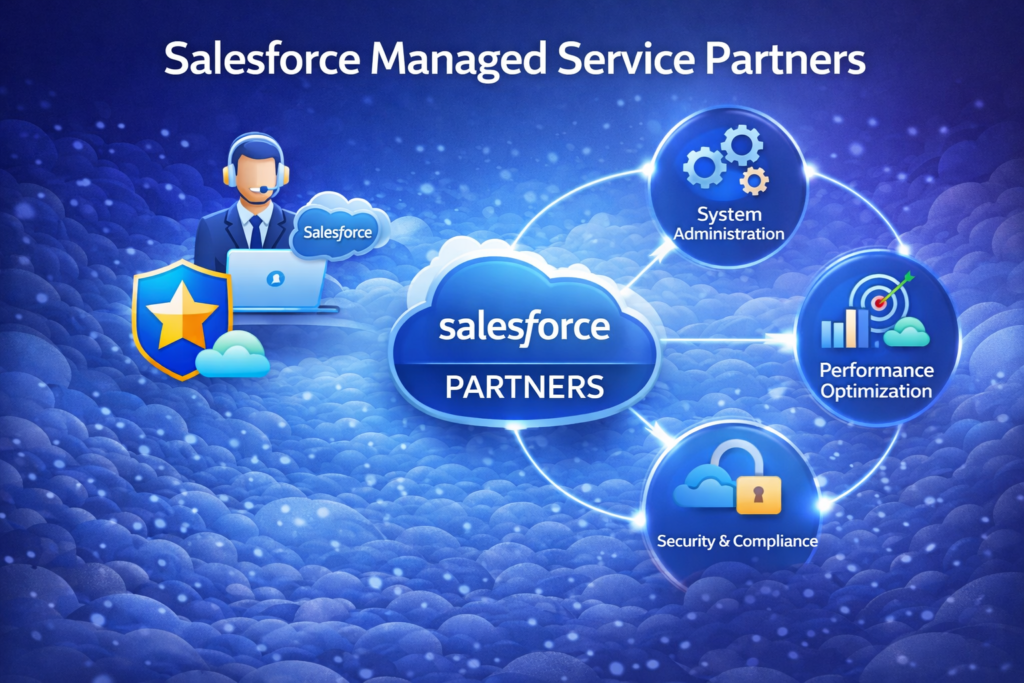
Over time, businesses typically require several types of improvements and updates to keep their Salesforce systems running smoothly:
System updates
Salesforce releases three major platform updates every year, introducing new features, security enhancements, and performance improvements. Organizations must review these updates carefully to ensure compatibility with existing configurations and to take advantage of relevant new capabilities.
New features
As companies evolve, they often discover new opportunities to expand how they use Salesforce. This may include adding new objects, building additional dashboards, introducing automation, or integrating new tools that support changing business requirements.
Automation improvements
Business processes rarely remain static. Sales pipelines may evolve, approval processes may change, and support workflows may require refinement. Automation rules and flows must be periodically reviewed and improved to ensure they still reflect how teams operate.
Performance optimization
As data volumes increase and more users rely on Salesforce daily, system performance can become an important consideration. Managed service partners monitor performance indicators, identify inefficiencies, and implement improvements that keep the system fast and responsive.
Security updates
Protecting sensitive customer and business data is critical. Security policies, permission models, and access controls must be regularly reviewed to ensure compliance with internal governance policies and industry regulations.
This ongoing maintenance and improvement work is where Salesforce managed service partners play a vital role. Rather than treating Salesforce as a one-time implementation project, managed service partners help organizations maintain a healthy, well-governed platform that continues to evolve alongside the business.
These managed service engagements often include a wide range of operational and technical responsibilities, such as:
Salesforce administration
Managed service teams handle day-to-day administrative tasks including user management, permission updates, data maintenance, and configuration changes. This ensures the platform remains organized and easy to manage.
Troubleshooting
When users encounter system errors, automation failures, or integration issues, managed service partners diagnose the problem and implement solutions quickly to minimize operational disruption.
Feature enhancements
As new opportunities arise, managed service partners help organizations add new functionality to Salesforce. This may involve building new workflows, creating additional reports, or expanding integrations with other systems.
Performance monitoring
Managed service teams monitor system performance, automation efficiency, and data quality. By identifying potential issues early, they prevent small technical problems from turning into larger operational challenges.
Release management
With Salesforce introducing multiple platform updates every year, managed service partners evaluate new releases, test features in sandbox environments, and guide organizations on how to adopt improvements safely.
Ultimately, managed services transform Salesforce from a static implementation into a continuously evolving platform. Instead of remaining frozen in the state it was originally deployed, Salesforce becomes a dynamic system that adapts to new business needs, technological advancements, and growth opportunities over time.
The Strategic Role of a Salesforce Partner
A common misconception is that Salesforce partners simply configure software.
In reality, they often function as digital transformation advisors.
Their work spans several strategic dimensions:
- business process improvement
- technology architecture
- change management
- data governance
- analytics strategy
Successful Salesforce initiatives rarely focus on software alone. They reshape how organizations operate.
Partners provide the expertise needed to navigate this transformation responsibly.
Discovery and Business Process Analysis
The most critical stage of any Salesforce project occurs before a single field or workflow is created.
This stage is called discovery.
During discovery, partners analyze how the organization currently operates.
This typically involves:
- stakeholder interviews
- workflow mapping
- process audits
- data analysis
- technology landscape reviews
The objective is simple yet profound: understand how work actually happens.
Only then can Salesforce be configured to support those processes effectively.
Skipping this stage is one of the most common causes of failed CRM projects.
Salesforce Architecture and Solution Design
Once discovery concludes, partners design the Salesforce architecture.
Architecture determines how information flows through the platform.
It includes decisions about:
- object models
- automation structures
- data relationships
- security frameworks
- integration patterns
Strong architecture ensures the platform remains scalable for years.
Poor architecture leads to slow performance, technical debt, and constant rework.
Salesforce partners bring architectural discipline developed through experience across many projects.
Salesforce Implementation and Deployment
Implementation is the phase where strategy becomes operational reality.
This stage includes:
- configuring Salesforce environments
- building custom objects and workflows
- integrating external systems
- creating dashboards and reports
- preparing deployment pipelines
Testing is equally important.
Partners conduct multiple testing cycles including:
- unit testing
- system testing
- user acceptance testing
These safeguards ensure the system behaves correctly before it reaches end users.
Customization vs Configuration in Salesforce
One of the most important principles in Salesforce development is knowing when to configure and when to customize.
Configuration refers to no-code or low-code features such as:
- workflows
- flows
- page layouts
- validation rules
Customization involves deeper development using tools like:
- Apex
- Lightning Web Components
- APIs
Experienced partners prioritize configuration whenever possible.
Configuration keeps systems easier to maintain and upgrade.
Customization should be used strategically when business requirements demand advanced functionality.
Integration with Other Business Systems
Integration remains one of the most technically demanding aspects of Salesforce projects.
Partners must design systems that reliably connect Salesforce with other enterprise platforms.
These integrations may involve:
- real-time API calls
- middleware orchestration
- event streaming
- data pipelines
When integrations function smoothly, organizations gain something invaluable: a single source of truth.
When they fail, operational confusion quickly follows.
Data Migration and Data Governance
Organizations adopting Salesforce rarely start with empty systems.
They typically migrate data from legacy CRMs, spreadsheets, and various databases.
Data migration involves several steps:
- Data extraction
- Data cleansing
- Data transformation
- Data validation
- Final migration
Partners also establish data governance policies to prevent long-term data quality problems.
Clean data is the foundation of reliable analytics and automation.
Automation and Workflow Optimization
Salesforce excels at automation.
Partners design workflows that eliminate manual work across departments.
Examples include:
- automatic lead assignment
- deal approval processes
- case escalation rules
- marketing campaign automation
Automation improves efficiency while reducing operational errors.
When implemented thoughtfully, it transforms Salesforce into an intelligent operational engine.
Salesforce AI, Analytics, and Data Insights
Modern Salesforce environments increasingly incorporate AI and predictive analytics.
Tools like Einstein AI and Data Cloud allow businesses to:
- predict sales outcomes
- identify churn risk
- recommend next best actions
- analyze customer behavior
Partners help organizations design data models that support these advanced capabilities.
Without reliable data architecture, AI initiatives struggle to produce meaningful results.
User Training and Adoption Strategies
Technology adoption determines whether Salesforce succeeds or fails.
Partners play a critical role in preparing teams for new systems.
Training programs may include:
- role-based training sessions
- documentation and user guides
- onboarding workshops
- internal champion programs
When users understand how Salesforce improves their daily work, adoption increases dramatically.
Post-Implementation Support and Optimization
Even the best Salesforce implementation evolves over time.
Business processes change. New tools emerge. Data volumes grow.
Partners provide ongoing optimization services including:
- performance audits
- automation improvements
- new feature development
- reporting enhancements
Continuous improvement ensures Salesforce remains aligned with business growth.
Why Many Salesforce Projects Fail Without Partners
Industry research consistently reveals a troubling pattern.
CRM implementations fail at surprisingly high rates.
Common causes include:
- unclear business objectives
- poor data migration
- lack of user training
- weak governance models
Salesforce partners help organizations avoid these pitfalls.
Their experience across multiple implementations enables them to anticipate challenges before they escalate.
Industry Insights on Salesforce Partner Value
Industry analysts consistently emphasize the importance of partner ecosystems.
According to IDC research, over 70% of Salesforce implementations involve partners.
The reason is straightforward.
Salesforce’s flexibility creates enormous opportunity but also demands expertise.
Partners accelerate implementation timelines, reduce risk, and maximize platform value.
How to Choose the Right Salesforce Partner
Selecting the right partner can significantly influence project outcomes.
Businesses should evaluate partners based on:
- industry expertise
- certified Salesforce professionals
- implementation methodology
- client case studies
- post-launch support capabilities
Transparency and communication style are equally important.
The best partners function as long-term collaborators rather than short-term vendors.
Red Flags When Selecting a Salesforce Partner
Certain warning signs indicate potential problems.
Businesses should be cautious if a partner:
- skips discovery phases
- promises unrealistic timelines
- recommends excessive customization
- lacks certified Salesforce professionals
- provides vague pricing models
Successful Salesforce partnerships require both technical expertise and operational maturity.
The Future of Salesforce Partnerships
Salesforce continues expanding into AI, data platforms, and industry-specific solutions.
As the platform evolves, partner roles will become even more important.
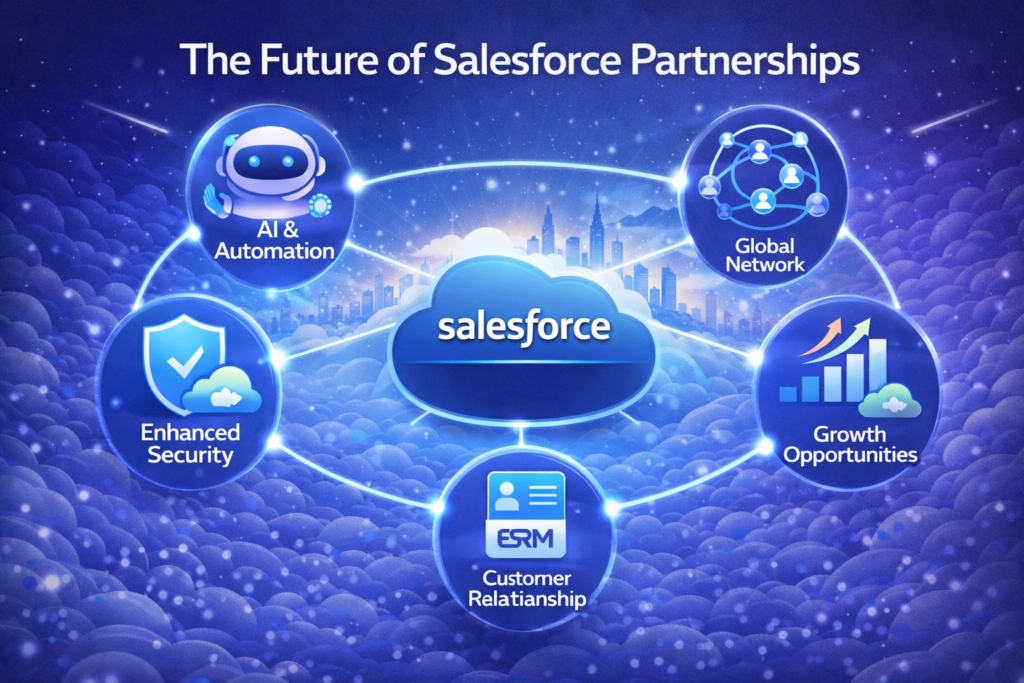
Future partner services will likely include:
- AI readiness assessments
- data governance architecture
- cross-cloud integrations
- industry cloud specialization
Organizations that leverage experienced partners will adapt more quickly to these innovations.
Why Businesses Work with CloudVandana
CloudVandana is a trusted Salesforce consulting and technology partner helping organizations unlock the full value of the Salesforce platform.
With deep expertise across Salesforce architecture, integrations, automation, and AppExchange development, CloudVandana helps businesses build scalable digital ecosystems.
CloudVandana solutions include:
- Salesforce consulting and implementation
- advanced integrations with enterprise systems
- automation and workflow optimization
- AppExchange applications such as CV Files
- AI-driven solutions and analytics
The focus is simple: transform Salesforce from a tool into a strategic growth platform.
Businesses seeking to modernize operations, streamline customer engagement, and build intelligent workflows can benefit from expert guidance.
Explore Salesforce solutions with CloudVandana:
https://cloudvandana.com
Conclusion
Salesforce is one of the most powerful enterprise platforms available today. But its true value emerges only when technology aligns with business strategy.
Salesforce partners provide the expertise needed to bridge this gap.
From strategy and architecture to implementation and ongoing optimization, partners play a central role in helping organizations succeed.
For businesses navigating the complexities of modern CRM ecosystems, a trusted Salesforce partner can make the difference between a system that merely stores data and one that drives meaningful transformation.
Frequently Asked Questions
1. What is a Salesforce Partner?
A Salesforce partner is a certified company that provides consulting, implementation, integration, or development services related to Salesforce solutions.
2. Why do companies hire Salesforce partners?
Organizations hire partners to ensure Salesforce implementations are designed correctly, deployed efficiently, and aligned with business objectives.
3. What is the difference between a Salesforce consultant and a partner?
Consultants often work independently, while Salesforce partners are certified organizations recognized by Salesforce with multiple experts and capabilities.
4. Do small businesses need Salesforce partners?
Yes. Small businesses often benefit even more from expert guidance because internal Salesforce expertise may be limited.
5. How long does a Salesforce implementation take?
Implementation timelines vary widely but typically range from several weeks to several months depending on complexity.
6. What certifications should a Salesforce partner have?
Partners typically hold certifications such as Salesforce Administrator, Platform Developer, Sales Cloud Consultant, and Integration Architect.
7. What is Salesforce AppExchange?
AppExchange is Salesforce’s marketplace for third-party applications that extend platform capabilities.
8. How much does a Salesforce partner cost?
Costs vary based on project scope, complexity, and the level of ongoing support required.
9. Can Salesforce partners build custom apps?
Yes. Many partners develop custom applications using Salesforce development tools.
10. What industries use Salesforce partners?
Virtually every industry uses Salesforce, including healthcare, manufacturing, finance, retail, and technology.
11. Do Salesforce partners provide ongoing support?
Yes. Many partners offer managed services to maintain and optimize Salesforce environments after launch.
12. How do I start working with a Salesforce partner?
Businesses typically begin with a consultation to assess requirements, define goals, and outline a roadmap for implementation.

Atul Gupta is CloudVandana’s founder and an 8X Salesforce Certified Professional who works with globally situated businesses to create Custom Salesforce Solutions.
Atul Gupta, a dynamic leader, directs CloudVandana’s Implementation Team, Analytics, and IT functions, ensuring seamless operations and innovative solutions.
YOU MIGHT ALSO LIKE
What is Salesforce CRM – Complete Guide for Businesses
Salesforce Financial Services Cloud: The Complete Guide for Modern Financial Institutions

Lightning Platform (UI & Development): A Practical Guide

What Does a Salesforce Partner Actually Do? A Complete Guide for Businesses

Signs Your Salesforce Org Needs an Optimization Audit