SALESFORCE IMPLEMENTATION BEST PRACTICES
Salesforce is the leading CRM (Customer Relationship Management) solution provider with unlimited possibilities. Salesforce aims to manage complex business challenges and enhance businesses. But to get all the benefits, organizations need to implement Salesforce properly; otherwise, companies cannot touch the desired goal. In this blog, CloudVandana will discuss the best practices of Salesforce and the stages involved in this implementation process. Though the implementation process is user-friendly, still, it is highly recommended to hire a registered Salesforce partner for a successful implementation. The time taken in this implementation process depends on the requirements and size of the organization. Generally, it takes 15-20 days, but this span can be extended for a more customized and intensive implementation. Before going for an implementation process, organizations need to understand the basic steps and strategies involved. This understanding will help the organization increase speed and reduce costs. Following are the best practices and strategies to implement Salesforce for an organization. 1. Planning Planning is the first step involved in any process. So similarly, for Salesforce implementation, proper planning should be there depending on the needs and scalability of the organization. The implementation process mainly depends on the type of business. So for B2B or B2C companies, the implementation process should be based on the customers’ pain points so that a customized solution can be delivered. 2. Set The Timeline After the planning, organizations need to set the timeline to avoid the project overlapping. So maintaining a project schedule is very much essential. In addition, admins can target short-term achievements for better implementation assessments. These short-term goals will help to achieve significant milestones. 3. Calculate The Cost For a successful implementation, organizations need to calculate the cost related to the performance to calculate the ROI correctly. The implementation cost includes consultation fees of the registered Consulting Partner’s consultation fees and data migration and customization expenses. In addition, after the successful implementation, training program costs and maintenance charges should be added to the list. Organizations can select the Salesforce edition depending on the number of users in the organization. There are four editions available- Sales Essentials, Professional, Enterprise, and Unlimited. In addition, organizations can select based on their needs and budget. 4. Set The Goal Admins should set significant goals and objectives depending on the organizational workflow. The goals should be measurable, time-based, and realistic. 5. Deploy Before the deployment, admins can customize the CRM solution as per the organizational process. But it is highly recommended to keep the first deployment as simple as possible. Then, added features can be included in the ecosystem whenever needed later on based on customer feedback. The admins should coordinate with the users in the organization to help them overcome the challenges and adopt the new ecosystem. 6. Training For Proper Adoption After the successful implementation, companies should conduct a training process for successful adoption and running the CRM without any human error. These were the basic implementation processes. But there are many other steps involved in post-implementation. For example, Salesforce releases three updates per year to enhance user experience. Therefore, organizations should update the editions with all three outs with the help of the Salesforce consulting partners to avoid any unnecessary complications. Are you looking for a registered Salesforce partner for a successful Salesforce implementation? Please feel free to contact CloudVandana for all your Salesforce needs and get the total ROI of your Salesforce investments. Request a Free Consultation YOU MIGHT ALSO LIKE
OUTSOURCING AND ITS VARIOUS STAGES
Outsourcing is a very well-known way to boost the productivity of an organization. This augmented process can be segmented into different categories per organizational needs. In this article, CloudVandana will describe the various types associated with this process and give a detailed description of the offerings of this hiring process so that companies can decide which model suits them the best. Outsourcing It is a business process of hiring a third party outside an organization to perform services for a specific term traditionally performed by in-house employees and staff. It is a practice undertaken by companies as a cost-cutting measure. This process cuts costs and frees up time to focus on more essential areas or tasks to achieve the target. This process is of four types. Let’s have a look at the various segments of outsourcing. Onshoring Onshoring is the process of sourcing or relocating an organization’s production operation or resources within domestic and national borders. It is the practice of getting an external team to help in the work process from the same country. The benefits of onshoring are- However, this hiring process has a significant drawback: no cuts in the organization’s cost. Offshoring Offshoring is a business process from one country to another. It is getting an external team from a distant land to help in the organizational process. It is a well-known and widespread practice among multinationals as well as startups. The essential benefits of this process are as follows- Though this is not a big drawback, the outsourcing process can differ in style and structure. But with time, these differences go away. Nearshoring Nearshoring hires an external team to help in the organizational process, but the team is located in a neighboring country or a country within the same region. The benefits of nearshoring are as follows- This process has a few drawbacks, like different work cultures and lack of clear communication. But again, these challenges can be overcome in the practice of a few months. After discussing the three segments of this process, CloudVandana focuses on the fourth process. Staff augmentation. Please go through another blog on Staff Augmentation by CloudVandana. Staff Augmentation Staff Augmentation is an outsourced process used to complete a project or any other organizational process and respond to the business objectives. The technique evaluates the existing staff and determines the additional skills to include depending upon the business needs. It may leverage existing resources as well as utilize outsourced services. It is mainly the process of hiring highly skilled contractors who may come from anywhere to enhance a business, boost their specific expertise, and contribute to a particular task within the allotted time. Staff augmentation is specifically recommended for short-term projects. So, these were the overview of the various services offered through its outsourced process. Are you looking to hire outsourced resources for your organization? CloudVandana provides staff augmentation services on technologies like Salesforce, Java, Python, PHP Laravel, React JS, and Node JS. We can help you solve cost-effectiveness and quality with the help of the offshore team and on-demand technical workforce. Call us now. Request a Free Consultation YOU MIGHT ALSO LIKE
What Is Salesforce Data Migration?
Salesforce Data migration is the process of transforming CRM data from one computer storage system to another. If the Salesforce data needs to be used in some other platform, what is the way to avail it? Moving Salesforce Data to other platforms where it is required is known as Salesforce Data Migration. Salesforce Data Migration is not an easy task. However, it is a core task for any data storage professional’ You should understand the structure of the data to be migrated; in addition, the process of Salesforce Data migration has to be carried out step by step methodically. During data migration, there is an opportunity to cleanse the data. The migrated data should have some characteristics like Accuracy(Details should be accurate), Relevancy (only the information needed should be migrated ), Accessibility (the data once migrated should be available whenever required), and Uniqueness (no duplication of data should exist). Why is Data Migration Important? There are so many benefits of Salesforce Data migration. Whatever may be the exact target of the data migration, generally, data migration should be to improve productivity and performance. Data Migration is a critical component to upgrade the storage and server. It also helps to update the data-intensive applications like databases and data warehouses. Salesforce Data migration also helps to reduce storage costs. Finally, to reduce unwanted interruptions, data migration helps. To get the benefits of Salesforce Data Migration properly, a few points need to be considered. Best practices in Salesforce Data migration Identify the data to be migrated. It is essential to determine the scope of the project. There should not be any confusion on what data to be migrated. For example, it should be decided first that the contact information of each account should be relocated or all account information of a specific contract should be migrated. We should handle what data should be migrated, then document existing and the targeted formats. Create and commit a proper Data governance plan. An essential part of the migration is to address the compatibility of the migration plan. All the stakeholders should be on the same page about the data migration. So it’s essential to create a proper data governance plan and commit it. The data to be migrated may be encrypted or might need specific requirements to be handled before migration. These requirements should be addressed before the data migration process is initiated. In addition, there should be done that the data migrated to an enterprise should fit into their data management strategies. Create templates for the data and populate it. Once the data to be migrated is decided, we have to create excel templates for each data to be migrated. Then, from Data Loader using data export templates can be made. The next step is to populate the templates created. Before settling the templates, the data should be reviewed to avoid further delays. For example, one record can be loaded and check the results. If it gives the expected result, you can continue with other data. Decide the time frame for the migration. Good planning is necessary to reduce the delays and disturbances that can occur during migration. The data should be moved with minimal disruption to the current business operations. A realistic date should be set for the migration. If the planning is done carefully, it can avoid unwanted delays and cost overruns. Monitor and validate the data migrated. Constant monitoring is required to ensure that the data migrated meets the standard set. Also, a check should be done to ensure that all data has been completely and accurately migrated. It can be done using any integration tool which will alert you if any data issues are identified. Another way to validate the data is to run the expectation reports and check what information is migrated. Are you looking for a data migration process for your organization? Please feel free to contact CloudVandana to get started. Request a Free Consultation YOU MIGHT ALSO LIKE
10 KEY BENEFITS OF HIRING A SALESFORCE CONSULTING PARTNER

Salesforce is a cloud-based CRM solution that enhances the relationship between organizations and customers. Customer relationship is the key to success for every business. So, to create a long-term relationship with customers and improve efficiency in productivity, Salesforce comes in. Salesforce has various tools and solutions for every business, that help organizations to achieve the target and increase revenue. In this article, CloudVandana will discuss the benefits of hiring a Salesforce Consulting partner to increase the profitability of a company. Salesforce is the best CRM that can manage the entire organization from initial requests to data collection and automate all the business process to save time to increase productivity. Salesforce implementation can optimize the sales process, boost productivity and upgrade the sales performance for a better conversion rate. The Work Process Of Salesforce Salesforce efficiently manages the leads and the customers. Through this platform Sales managers can view the customer journey and their touchpoints. Following are the 10 key benefits of Hiring A Salesforce Consulting Partner. Benefits Of Hiring A Salesforce Consulting Partner Though the interface of Salesforce implementation is user-friendly, it is always advised to hire a registered Salesforce Partner for all the benefits. 1. Improves The Work Process A registered Salesforce Partner offers interactive training sessions, Organized Sales, Planned marketing campaigns, automated marketing processes, and finally improves the ROI of the industry. 2. Offers The Best Solution There is no one-fits-for-all strategy for the organization as it doesn’t work well every time. A reliable Salesforce Consulting Partner like CloudVandana will guide the organization to choose the best CRM solution as per the size and requirements of the organization. They will assure the full return on investment of their Salesforce investment. A skilled Salesforce Partner will do all the needful to implement the best solution to fit all the needs of the organization. 3. Automation Salesforce experts of CloudVandana can assist the organizations to pick the effective functionality from the various flatforms of Salesforce, like Sales Cloud, Service Cloud, Marketing Cloud, etc. All these platforms offer automated processes to reduce repetitive manual tasks and eliminate all human errors and enhance productivity and performance. As a result, the revenue grows perfectly in an increased manner. 4. Training And Support The team may find the use of a new system like Salesforce if the organization has recently migrated from a different platform. With the assistance of a skilled and expert Salesforce implementation partner, companies can run a training program for better Salesforce adoption. The partner company will offer the required training for running the new CRM in the best way. 5. Takes Care Of The Budget A Certified Salesforce Consultant can recommend the right tool in a specific way as per the size of the project. It helps the organizations from purchasing all the tools and helps to maintain their budget. They also take care of the budget as per the company size when their customers are willing to go for a Salesforce integration or Data Migration. So Salesforce experts are inseparable as they show the right way to pick the right tool to boost the organization. 6. Efficient Implementation Process of a Salesforce Consulting Partner A Certified Salesforce Consulting Firm helps the clients to implement Salesforce Ecosystem in an efficient manner so that the customers get the full ROI of their Salesforce investment. If the implementation process goes wrong, there will be many difficulties in the upcoming processes. So organizations should always trust the registered Salesforce partner to uplift the business. 7. Updates About Everything Companies can just sit back and focus on the core business strategies giving the other CRM-oriented responsibilities to a consulting partner like CloudVandana. They keep track of everything from implementation to maintenance and keep on updating the business owners about all the processes in detail. 8. Proper Decision Making Top Salesforce Consulting Partners engages with the brands to come out with the right strategies or plans for the implementation as per the business needs. Organizations with various sizes and any domain can experience the benefits with the assistance of a supportive and experienced Salesforce Partner. 9. Save Time A highly skilled Salesforce Consultant takes care of all the errors and problems in a faster way, so it helps the company to save valuable time. As they are well trained and certified, they can resolve any issue faster. 10. Customer-Centric Approach Customers are considered the backbone of any organization. So all the approaches should be customer-centric. A reputed consulting partner like CloudVandana helps the clients with strategic planning as per the project needs and the budget of the project. An organization without an expert consulting partner produces trouble and errors that lead to decreased conversion rate. Therefore, a professional Salesforce consulting partner is always necessary for every business organization. Witnessing all the upper mentioned benefits are you planning to hire a Registered Salesforce Partner for your Salesforce implementation and maintenance? Please feel free to contact CloudVandana and get the full ROI of your Salesforce investment. Request a Free Consultation YOU MIGHT ALSO LIKE
Salesforce Marketing Cloud AMP Scripting
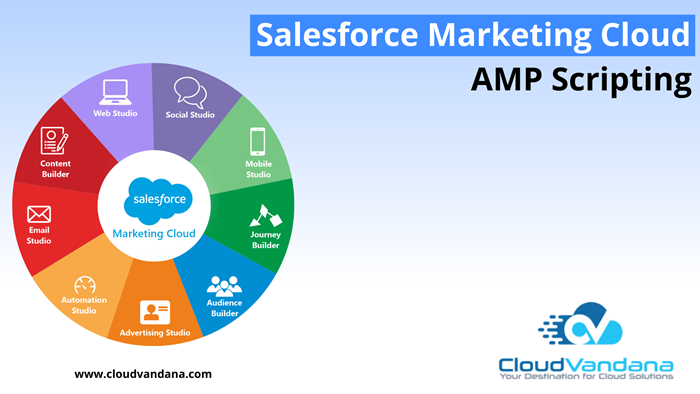
Why AMP Scripting? It is essential to create and deliver one-to-one personalized communications by digital marketers. The lines between digital marketing and Customer Relationship Management (CRM) are blurring because the need for highly personalized communication is more significant now. Today’s big challenge in digital marketing is to deliver sophisticated personalized touch across multiple channels.AMP Script is designed to meet these challenges.AMP Script helps expand the marketing cloud’s functionality by creating one-to-one personalized communications. What is AMP Scripting? AMP Script is a scripting language used in Salesforce Marketing Cloud for creating advanced dynamic content in emails, landing pages, SMS, and push messages. AMP Script is used to personalize the emails using Subscriber or Contact data. AMP Script is also used to add real-time information to emails like dates or times. AMP Script can be embedded within HTML code. When the system processes the code, we have included the AMP Script in the message; it will render the content on a subscriber-by subscriber basis. AMP Script code can be used to update the data extensions utilizing the information from landing pages. In addition, the data from data extensions can also be retrieved using AMP Script. How to write AMP Script? AMP Script is an interpreted language and runs on the server-side. AMP Script code is contained within a character sequence that opens and closes with double percentage marks. An inner bracket([]) delimiter is used for AMP Script blocks, and an equality character (=) is used for inline AMP Scripting. AMP Script blocks help us to declare and set variables. Using the AMP Script block, we can define what we want to do step by step.AMP Script blocks can do a little more than Inline AMPScripts. Inline AMP Script can be used to use a single function. The output of the process is displayed where the inline AMP Script code appears.AMP Script can also be written inside the script tag. The use of variables is mandatory in AMPScript.When any functions need variables, they can be used. AMP Script is an interpreted language; hence the declaration of the variables to be used should be made first. Functions are called either within an AMP Script block or inline AMPScript, at the place where they should appear on the page or in the message. Conditional and loop statements are supported in AMPScript. Marketing Cloud uses link redirection before sending to a destination link to provide tracking. AMP Script enables us to do dynamic link tracking. Using AMP Script, we can include dynamic content as an attribute in HTML anchor links within an HTML email content. Marketing cloud supports two types of personalization strings: attribute-based and system-based. Personalization strings can be used in the AMP Script block. For example, a system personalization string can be used to different messages or text based on the day of a week or an extra month. Another use of system personalization is to pass identifiers such as an email id or a subscriber id in order to track the subscriber behavior. In AMP Script, the personalization string calls should not be inside the double percentage marks. AMP Script uses predefined functions, which help display, store, or update customer data.AMP Script functions are pure functions, which take some input and display output based on the information. Some of the AMP Script functions are organized by category like API, Date/ Time, Math, Encryption, etc. There are some miscellaneous functions in AMP Script which help to check the value of the variable is null or not. In addition, AMP Script supports certain functions that support social sharing functions. And finally, the Sales and Service Cloud function connects us to Salesforce data. Let’s discuss some real-time scenarios where AMP Script can be used. For example, suppose an organization needs to send a monthly newsletter that displays the reward points of the subscriber and also shows a new coupon for the next purchase. In that case, AMP Script can get personal information from the subscriber’s DE and from Purchase DE other details regarding reward points. Of course, this would not be easy without using AMP Script. AMP Script can be used to make sure that your data is client-friendly. The ProperCase function helps clean up the presentation of the data. Compared to other scripting languages, AMP Script is developed for a one-to-one environment. The content is displayed only after the script is processed and interpreted. The hand can be embedded with HTML emails, landing pages, SMS messages, and push messages. AMP Script uses straightforward syntax, so it’s easy to learn and code. As a result, it is clear for marketers to understand the language and create relevant, personalized content. Are you looking for a registered Salesforce partner to enhance your business process? Please feel free to take a consultation call with CloudVandana to get started. Request a Free Consultation YOU MIGHT ALSO LIKE
Benefits Of Integrating Salesforce With MS Outlook
Salesforce and Outlook are the most powerful tools that help make us more successful and efficient. Salesforce makes it easy to manage the contact information that salespersons can retrieve and make better business decisions. Microsoft Outlook helps the team members to communicate internally by sending and receiving emails. In addition, it acts as a personal information manager from Microsoft. It provides many functionalities to manage personal data like calendar appointments and similar entries, tasks, contacts, notes, and events. Why Is Redundancy a problem? Data Redundancy occurs when the same information is stored in two different places. For example, Salesforce and Outlook have some similar functionalities. When both are used individually, then there can be a chance of data redundancy. For example, both can store, retrieve contact information. If Outlook and Salesforce store the same information, data redundancy occurs. The more redundancy, the greater difficulty in data maintenance. The companies with lots of data will get more severe issues like inconsistent data due to redundancy. Here comes the use of Data Integration. Data Integration combines data from different sources and provides a consolidated view of the combined data. This combined data can be used to query, manipulate, and derive analytics and statistics. The benefit of integrating Salesforce and Outlook is the elimination of redundancy in data. An added advantage is that data entry errors can also be minimized. When Outlook is integrated with Salesforce, the Sales reps can see relevant Salesforce data from Outlook. They can include emails relevant to sales so that the Salesforce team is also aware of the happenings. This will help in boosting Salesforce adoption among the Sales Team. Since the features of Salesforce can be accessed from Outlook, the sales reps need not leave the Outlook page to search for any Salesforce records. Even to create Salesforce records like leads, opportunities, accounts, and contacts, sales reps can do this within the Outlook page. Let’s discuss some best features and benefits of Salesforce Outlook integration. Reduce Redundancy: As discussed earlier, Outlook and Salesforce have many standard features. This can be a reason for data redundancy. When you integrate SAlesforce and Outlook we eliminate the chance of data redundancy. Improve Customer Service: After integration, the features of Salesforce can be accessed from Outlook without leaving the page. This will help save the sales reps time in entering data and switching between two applications. The sales team will find it easy to understand the communication history and understand that the customer. The sales team can deliver a good customer experience when dealing with long-time customers. Excellent customer service is essential to retain valuable customers. Improved Data Integrity: When Outlook is integrated with Salesforce, the integrity of data is also improved. When data is created or stored manually in two different places, there are chances of any error. This will reduce the data integrity. If integration is done only once the data is stored, it is automatically added in other applications, which reduces the errors. This makes it easy to rely on the data and make data-driven decisions. The Salesforce integration with Outlook is a suite of products that give sales reps the power to work from their email applications while keeping Salesforce data up to date. The integration provides Salesforce data directly within Outlook and logs, emails, and events to Salesforce records. Are you looking for a seamless integration process for your organizational enhancements? Please feel free to take a consultation call with CloudVandana to get started. Request a Free Consultation YOU MIGHT ALSO LIKE
5 BEST SALESFORCE ADOPTION STRATEGIES TO BOOST THE ROI

Salesforce adoption is the simple act of enabling a user to use SFDC’s full CRM capabilities by creating various strategies around onboarding, training, and continued development. It is not another empty metric for organizations and not as easy as it sounds. The process of Salesforce adoption strategy creation time consuming, complex, and in some cases, leads to low ROI. However, various adoption strategies can help to find a better ROI. As a result, as per a report by Salesforce, Salesforce implementation increases the sales rate by 26% and sales revenue y 28 %. How ROI Depends On The Salesforce Adoption The best part of the Salesforce adoption strategy is that it helps the users to get started right away, irrespective of their standing point in the journey. So no matter if the user is new or using Salesforce for a long time, the adoption process would be reasonably similar. Salesforce always provides a total ROI if the CRM is implemented correctly, but to maximize the ROI, Salesforce admins need to follow a proper Salesforce adoption strategy. 5 Best Salesforce Adoption Strategies Following are a few must-have strategies for an enhanced ROI. 1. Leadership Leaders should understand the change and adopt them. If they can’t assume the new system, it will be difficult to expect a better result from the employees. So, support from the influential senior-level team members is the best way to employ the adoption strategies. This will work as a motivation among the team members. Leaders can guide the team members to start conversations in Chatter, sharing reports and insights by analytics, regularly reviewing Salesforce adoption metrics, etc. 2. Learn From The End-Users Understanding the end-users is the first and most crucial step of Salesforce Adoption. It empowers them to do their jobs in an enhanced way with Salesforce. Leaders need to make the team understand the solutions that Salesforce will provide to face the challenges before the migration process. Employees should understand the benefits of this tool to overcome the common problems they meet all the time. Feedback of the employees will help the Salesforce admin to offer a more customized Salesforce Solution. This leads to more adoption. In addition, admins can demonstrate the specific functionalities of this CRM platform to particular individuals or departments. For example, if the sales team uses LinkedIn for lead generation, Salesforce admin can emphasize the training for LinkedIn integration that pulls leads directly into Salesforce. 3. Training Program Organizations should arrange a training program by breaking training into easier-to-digest segments. First, the training should slowly focus on all the areas, including basic knowledge, managing individual accounts, and navigating the Salesforce menu in a segmented manner. Then the advanced training can be provided based on the profile and duties of the team members. An additional or follow-up training should be given to the employees for better adoption. 4. Point The Disadvantages To Not Using Salesforce Admins or team leaders should highlight the challenges if the team fails to adopt Salesforce. It is considered as the motivation technique. Admins can use Salesforce for essential tasks so that employees who do not use the system risk missing out on important information. Following are a few ways to encourage the use of Salesforce. 5. Identify Automation Opportunities Employees lose their enthusiasm by doing repetitive, low-value tasks. If they get accustomed to the automation process of Salesforce, their productivity will increase, leaving repetitive tasks on Salesforce. For example, the Sales team can focus on lead generation and lead nurturing, leaving tasks like quotation making, follow-up processes on automation. So the conversion rate increases. Are you looking for a Registered Salesforce Partner for a successful Salesforce implementation? Please feel free to take a free consultation call with the Salesforce experts of CloudVandana and get the total ROI of your Salesforce investment. Request a Free Consultation YOU MIGHT ALSO LIKE
A GUIDE TO SALESFORCE DIGITAL ENGAGEMENT

Salesforce Digital Engagement is a process to respond to messages through different channels, including WhatsApp, SMS, Facebook Messenger, and Webchat. Digital Engagement is an essential process in today’s digital world, ensuring the proper customer support through the various communication processes. It is helpful for sales procedures as well. Digital Engagement is the practice of finding out customers’ touchpoints and providing a personalized experience. Today in this blog, Cloudvandana will give an overview of the Salesforce Digital Engagement. A customer’s journey includes marketing, selling, and providing service in such a way that it switches between multiple channels without any interruptions. Features Of Salesforce digital Engagement Digital Engagement features are applied to Salesforce Service Cloud and Sales Cloud. Omni-channel unifies and manages sales representatives’ workload. How Does Salesforce Digital Engagement Work A message is sent to a company at the higher level, which is then forwarded onto Salesforce to the route. Then as per the skills and accessibility, OmniChannel decides the agents to push for incoming messages. Developers can avail the add-on facility of Digital Engagement by paying extra costs. Digital Engagement Channel Behaviour It is essential to consider the behavior when Salesforce routes messages via different channels. For example, messages can be sent through various platforms, and once received, they are added to a queue. Salesforce Digital Engagement provides a seamless experience and engagement to the customers from any device, anytime. Sales representatives who use the lightning sales console can use digital channels to be connected with customers and prospects. In addition, high-Velocity Sales users can use digital media from the workflow queue. This was an overview of Salesforce’s digital engagement. If you have any further queries, please post your valuable comments in the comment section below or book a free consultation call with the Salesforce experts of CloudVandana. Request a Free Consultation YOU MIGHT ALSO LIKE
6 KEY BENEFITS OF HIRING OUTSOURCED PYTHON PROGRAMMERS

Python is a high-level programming language designed to emphasize code reliability with significant indentation. Its language and object-oriented approach help programmers to write clear, logical code for small and large-scale projects. Today, in this blog, CloudVandana will describe the benefits of hiring outsourced Python programmers. Building an in-house team is a long process that needs sourcing the best candidates, conducting a recruitment drive, and providing employees the required resources to work. As this is a long-term process, it needs a lot of time and money to spend on the other sector of a startup. As a result, many startups turn to outsourcing a dedicated team. Outsourcing enables the startups to focus on the business and avoid spending valuable time building a team of programmers and developers to create the project infrastructure. The Benefits Of Outsourcing For Startups Nowadays, many businesses choose to outsource their development teams looking at the startup development trends. Following are the several reasons – More Skilled Professionals Companies can get more talented and skilled people from a more enormous talent poo through this outsourcing process. Saves Money Setting up a proper workspace and investing in resources for the in-house team can be expensive. So, outsourcing is much more cost-effective. Saves Time When companies choose outsourcing services, they will be free from additional work pressure and focus on the other priorities. Access To The Most Advanced Tools Companies can access advanced technology and tools through outsourced developers and programmers that the organization may not have internally. As a result, companies do not need to invest in new tools or new hires t speed up the team. Low-Risk Scaling brings about various challenges and risks for startups, including losing money and effort. However, with the help of the outsourced team, startups can avoid multiple risks and grow with confidence. The Benefits Of Python For Startups For these reasons, a startup often will go for an established programming language such as Python. We will now discuss the key benefits of hiring outsourced Python Developers. 1. User-Friendly Developers enjoy the language because of its simplicity. In addition, it is ideal for fast and effective development for startups that can’t spend time training. 2. Versatility The minimal effort required to add features to code is versatile. It is one of the best choices for developers who need code to work across platforms such as mac-OS and Windows. 3. Seamless Integration Process This programming can be easily integrated with other languages such as C++, Java, and many more. 4. Robust Solutions Startups are web-based applications and driven by big data. This factor is synonymous with the complexity and intricacies of processing. However, it is well-equipped to deal with the challenges, making it an excellent solution for beginners. 5. Innovation Developers prefer Python over other languages; many large and reputable companies such as Instagram and Google rely on its code. This programming language is innovative, allowing businesses to elevate their service and stand out among competitors. 6. Scalability Scalability is one of the essential processes that any startup must consider. As a result, it is a great solution. So hiring skilled outsourced developers is an excellent choice to boost any startup. Are you looking for skilled and experienced Python developers to enhance your organization? Please feel free to take a consultation call with CloudVandana to get started. Request a Free Consultation YOU MIGHT ALSO LIKE
A GUIDE TO SALESFORCE SANDBOXES -Salesforce org in separate environments
Salesforce Sandboxes are the test spaces for developers to try out new things such as objects, fields, workflow processes, and page layouts without any changes in the existing configuration. Salesforce sandbox contains all the configuration, customization, apps, and metadata a developer has made to the production environment. Sandbox types can even include some of the production data sometimes. As a result, developers can perform any task without any risk of harm to the configuration. How To Use Sandboxes The uses of Sandboxes depend on the developers and their needs, but the following are some of the expected benefits. Learning Suppose an organization has a new team member who is still learning Salesforce administration and development. In that case, the team lead can insist on practicing in their own sandbox, not harming the existing configuration by any human error. Training New users can practice in a safe environment without the risk of making mistakes or entering incorrect data. If the Salesforce license type provides a partial copy of full copy Sandboxes, these are ideal for training. Development If developers or admins need to make any changes and improvements to the production, the changes should be done in the sandbox first and then copied to show after completion. For example, various sandboxes may be used to develop new features, like development, interaction testing, quality assurance, and user acceptance testing. When the new feature is developed and tested, then it is moved from one environment to another. Experiment When a developer wants to try a new app in the AppExchange, a Sandbox platform is a perfect place to do this. Developers can try the free AppExchange apps installed into a sandbox for this purpose. Likewise, if developers want to try new automation, the sandbox is the perfect solution. designed Different Sandbox Types The number of Sandboxes that developers can have depends on the type of Salesforce license. However, Sandbox functionalities are not applicable within a free Developer Salesforce org. There are mainly four types of Sandboxes with various features. Developer Sandbox It is created for development and testing purposes in a remote environment. It contains the metadata of an organization. Developer Pro Sandbox This sandbox can adopt a larger data set than a developer sandbox. It is used to manage the development and quality assurance functions for testing and training. Partial Copy Sandbox A partial copy sandbox is generally used as a testing environment. This environment contains the metadata and a sample of the production org’s data. This sandbox is mainly used for user acceptance testing, integration testing, and training. Full Sandbox This sandbox is also used as a testing environment. Only this sandbox supports performance testing, load testing, and staging. A full sandbox is a copy of the production org that includes all the data( object records and attachments, metadata). The developer and Developer Pro sandboxes could be refreshed as per the developers’ needs. The partial copy is every five days, and the full Sandbox is once in 29 days. So this was an overview of the Salesforce Sandboxes. If you have any further queries, please feel free to take a consultation call with the Salesforce experts of CloudVandana, the registered Salesforce Partner. Request a Free Consultation YOU MIGHT ALSO LIKE