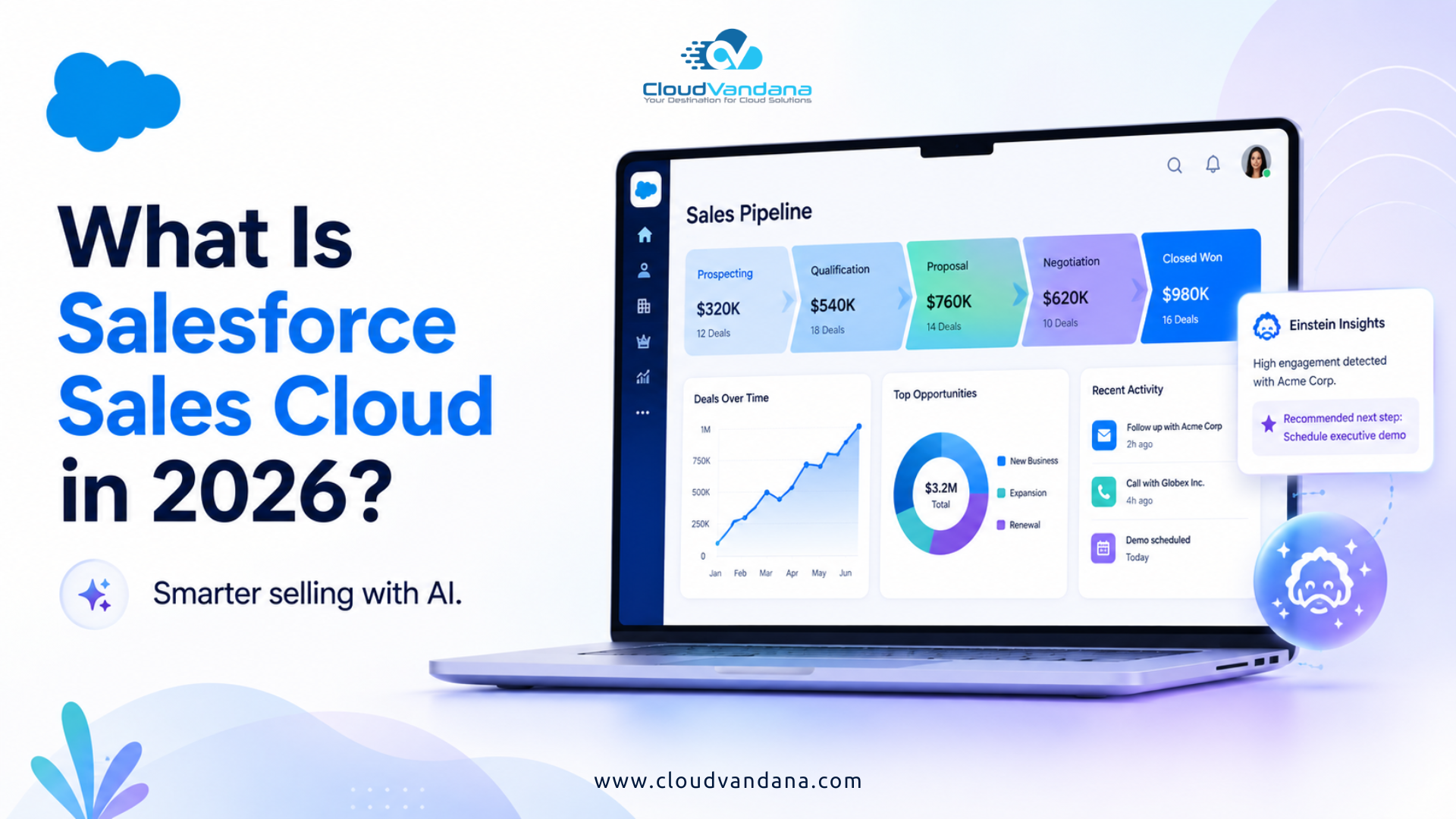
For years, businesses primarily thought about Salesforce Sales Cloud as the digital command center for their sales pipeline.
Leads entered the CRM. Representatives converted them into opportunities. Managers reviewed stages, values, activities, and closing dates. Dashboards provided visibility. Forecasts helped leadership estimate revenue.
That foundation remains important.
But in 2026, it is no longer the whole story.
Sales technology is shifting from recording what salespeople have already done to helping determine what they should do next.
Salesforce itself now refers to Sales Cloud as Agentforce Sales, reflecting a broader transition toward agentic CRM. The platform continues to provide familiar capabilities such as lead management, opportunity management, forecasting, territories, engagement, and account management, but increasingly combines them with AI agents, automation, unified data, analytics, conversation intelligence, and intelligent recommendations.
That distinction matters.
A traditional CRM can tell a salesperson:
“You have 37 open opportunities.”
An intelligent sales platform should help answer:
“Which five opportunities need your attention today, why are they at risk, what changed, and what should you do next?”
That is the direction sales organizations are moving toward in 2026.
The evolution is not simply about adding generative AI to CRM screens. It represents a more fundamental transition from pipeline tracking to smarter selling.
What Is Salesforce Sales Cloud in 2026?
Salesforce Sales Cloud is Salesforce’s platform for managing and improving the complete sales process, including leads, accounts, contacts, opportunities, activities, pipeline, forecasting, sales engagement, analytics, and revenue performance.
In Salesforce’s current terminology, Sales Cloud is now Agentforce Sales. Salesforce describes the platform as supporting the entire sales cycle while using AI agents to take on repetitive and time-consuming work so sellers can concentrate more heavily on strategy, customer relationships, and closing opportunities.
The fundamental CRM components have not disappeared.
Businesses still need reliable account records.
They still need structured opportunities.
Managers still need forecasts.
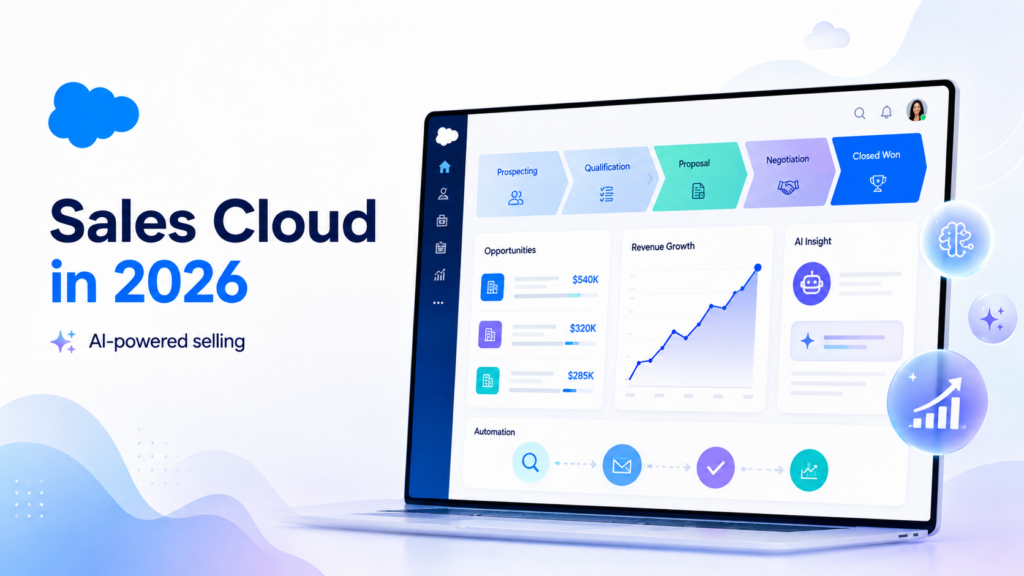
Representatives still need tasks, activities, contacts, quotes, and deal information.
What has changed is the intelligence surrounding those records.
Salesforce is increasingly connecting CRM data with AI agents, customer conversations, external signals, workflow automation, revenue intelligence, and unified customer information.
As a result, Sales Cloud is becoming less passive.
Instead of merely storing information, the platform can increasingly help teams interpret information and act on it.
Sales Cloud Is Now Agentforce Sales
The naming change is significant because it illustrates Salesforce’s broader product direction.
Salesforce documentation confirms that Sales Cloud is now called Agentforce Sales, although references to Sales Cloud remain throughout applications and documentation.
For businesses, however, this does not mean the familiar Salesforce sales platform has vanished.
Think of it as an evolution.
Traditional Sales Cloud established the operational foundation:
- Lead management
- Account and contact management
- Opportunity management
- Pipeline tracking
- Activity management
- Territory management
- Sales forecasting
- Reporting
- Dashboards
- Workflow automation
Agentforce Sales builds intelligence and agency around that foundation.
This distinction is particularly important for organizations planning their Salesforce roadmap. AI agents cannot magically compensate for badly structured opportunities, fragmented customer data, inconsistent processes, or unreliable CRM records.
The smarter Sales Cloud becomes, the more important the underlying CRM foundation becomes.
The Evolution of Sales Cloud: From CRM Records to Intelligent Selling
The first generation of CRM answered a relatively straightforward question:
What is happening with our customers and opportunities?
Sales Cloud helped organizations replace spreadsheets, disparate records, personal notebooks, and isolated contact databases with a centralized sales system.
The next phase introduced automation.
Businesses could create workflows, approval processes, assignment rules, reminders, and eventually Salesforce Flow automations.
Then came predictive intelligence.
Analytics and Einstein capabilities helped organizations identify patterns, evaluate opportunities, improve forecasting, and prioritize work.
Now another transition is underway.
The emerging question is:
What should happen next—and which actions can software perform on behalf of the seller?
That is where AI agents alter the conventional CRM paradigm.
Instead of waiting for a representative to inspect a record and initiate every action manually, agentic systems can interpret authorized information, recommend actions, execute predefined tasks, and interact with sellers or prospects within established guardrails.
CRM is moving from being primarily a system of record toward becoming a more active system of action.
Why Traditional Pipeline Management Is No Longer Enough
Pipeline visibility remains indispensable. But visibility alone does not guarantee revenue.
A sales manager may have a perfectly designed dashboard showing:
- $8 million in open opportunities
- $2.4 million in commit
- $3.1 million in best case
- 87 active opportunities
- 24 opportunities expected to close this month
Those numbers look useful.
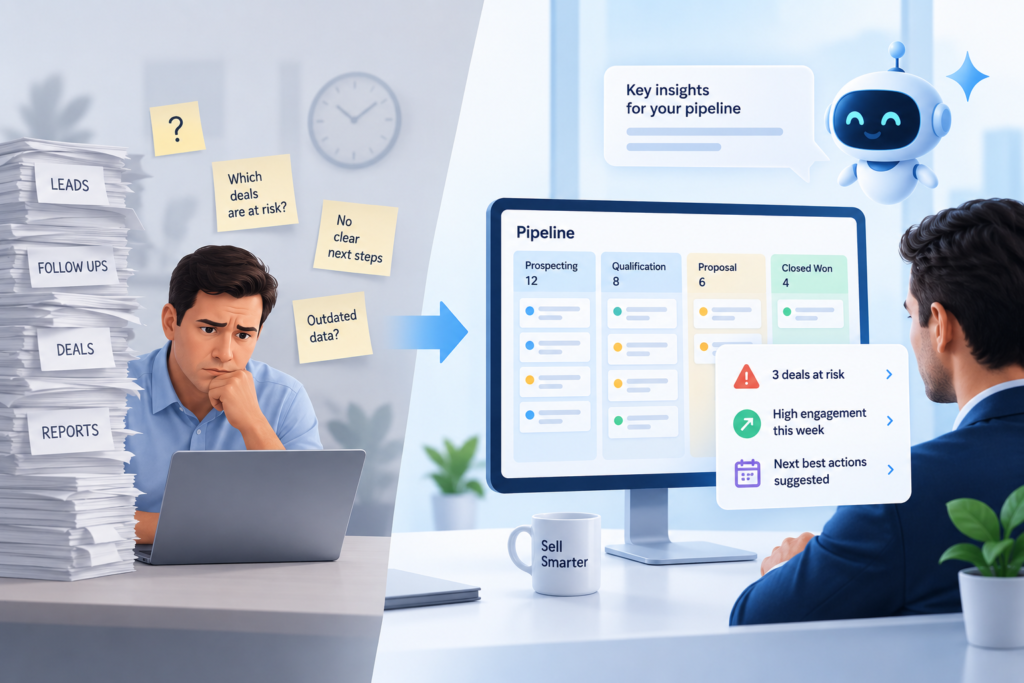
But several crucial questions remain unanswered.
Which deals have genuine customer momentum?
Which opportunities have gone quiet?
Did the economic buyer participate in the latest meeting?
What objections appeared during yesterday’s call?
Has the customer opened the proposal?
Are representatives repeatedly changing close dates?
Which opportunities lack a clear next step?
Which accounts are showing renewed interest?
Where should the manager intervene?
Traditional pipeline tracking tells you where the opportunity is recorded.
Smarter selling attempts to determine what the opportunity actually needs.
Salesforce’s Pipeline Inspection functionality, for example, combines opportunity information, pipeline metrics, week-to-week changes, activity data, and AI-driven insights to give teams a more consolidated view of pipeline health.
That is a much more useful operating model than reviewing static reports once every Monday morning.
What Does Smarter Selling Actually Mean?
Smarter selling does not mean allowing AI to make every sales decision.
It means giving sellers better context, better prioritization, faster execution, and less administrative friction.
In practice, smarter selling means representatives can answer questions such as:
Who should I contact today?
Which opportunity is most likely to slip?
What happened during the customer’s last interaction?
What should my next step be?
Which stakeholders are missing from this deal?
What information should I review before the meeting?
Which accounts appear ready for expansion?
Where is my forecast most vulnerable?
The objective is not to remove the seller from the process.
It is to remove unnecessary cognitive and administrative clutter around the seller.
That distinction becomes increasingly important as AI adoption accelerates.
Salesforce’s 2026 State of Sales research reports that 87% of sales organizations currently use AI, 54% have used AI agents, and 88% plan to use agents by 2027. Salesforce also found top performers were 1.7 times more likely than struggling sellers to use prospecting AI agents.
The competitive question is therefore shifting from “Should sales teams use AI?” toward “Where should AI be incorporated into the sales process?”
The Core Role of Sales Cloud in the Modern Revenue Engine
The modern sales organization rarely operates through one isolated system.
Customer information may originate from:
- Website inquiries
- Marketing automation
- Events
- Customer service
- Product usage
- Commerce platforms
- Phone conversations
- Video meetings
- Partner channels
- ERP platforms
- Contract systems
- Customer success teams
Sales Cloud becomes most powerful when it provides the operational context connecting those signals with the sales process.
That allows organizations to create something more valuable than a contact database.
They can build a revenue operating system.
The CRM becomes the environment where customer context, sales process, automation, analytics, engagement, and AI converge.
Unified Customer Data Gives Sellers Better Context
One of the most consequential changes in modern selling is the widening definition of “sales data.”
Historically, sales data meant fields such as:
Company Name
Opportunity Value
Stage
Expected Close Date
Contact
Last Activity
Next Step
Those fields remain relevant, but they offer only a partial view of the customer.
Imagine a salesperson preparing for a renewal conversation.
The CRM opportunity says everything looks healthy.
But elsewhere in the business:
The customer opened three support cases.
Product usage has declined.
A senior stakeholder attended a webinar about another solution.
Marketing engagement increased around a particular capability.
A service representative recorded a recurring complaint.
Without connected data, the salesperson sees only the opportunity record.
With unified customer context, the seller sees the relationship.
That broader visibility can dramatically alter the quality of conversations.
AI Is Becoming Part of Everyday Selling
The conversation around sales AI used to focus heavily on generating emails.
That remains useful, but it represents only one small application.
In 2026, AI is spreading throughout the selling cycle:
Prospecting → Engagement → Qualification → Opportunity Management → Meeting Preparation → Coaching → Forecasting → Account Growth
Salesforce’s sales AI capabilities now cover areas including prospecting, lead generation, engagement, qualification, pipeline management, account management, and sales coaching.
This matters because sales productivity problems rarely originate from one task.
They accumulate.
Ten minutes researching an account.
Five minutes entering notes.
Another ten preparing an email.
A few minutes updating opportunity fields.
Time spent locating information.
Time spent preparing for pipeline reviews.
Time spent reconstructing what happened during calls.
None seems catastrophic individually.
Together, they create substantial operational drag.
AI becomes valuable when it removes that friction systematically.
Agentforce Changes the Role of Sales Automation
Traditional automation follows predefined logic.
If X happens, perform Y.
For example:
If a lead reaches a certain score, assign it to a salesperson.
If an opportunity exceeds a threshold, request approval.
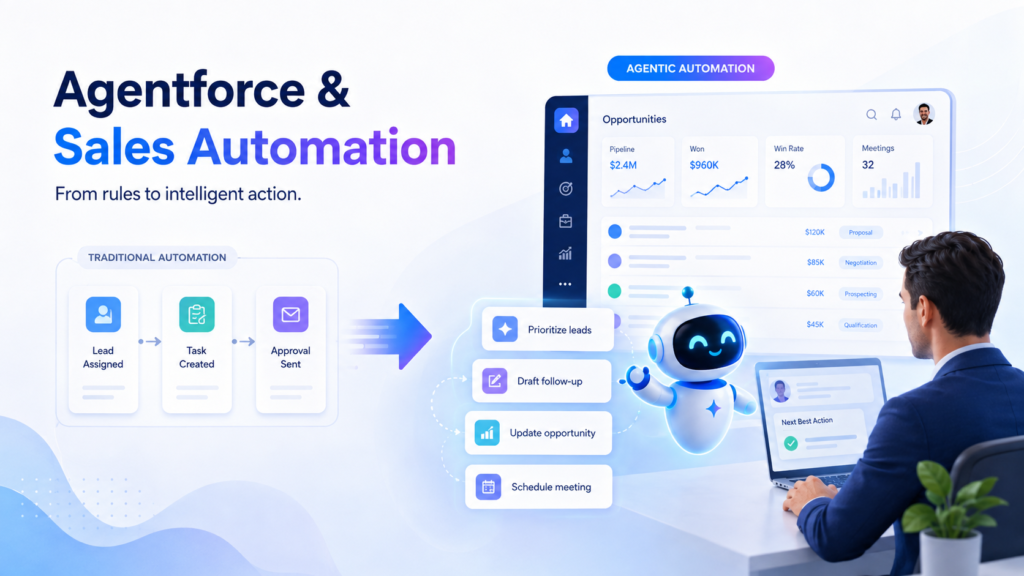
If a deal reaches the proposal stage, create a follow-up task.
Those workflows remain extraordinarily useful.
Agentic automation introduces another layer.
An AI agent can potentially evaluate context, determine an appropriate action within its defined instructions, use approved business information, and execute permitted tasks.
That means the future sales architecture is unlikely to be automation versus AI.
It will be:
Structured CRM + deterministic automation + AI agents + human judgment.
Each component solves a different category of problem.
Smarter Prospecting with AI Agents
Prospecting remains one of the most labor-intensive components of selling.
Representatives identify accounts, review company information, locate contacts, analyze buying signals, research recent developments, and determine whether outreach is worthwhile.
Salesforce’s Agentforce Prospecting capabilities are designed to help generate prioritized account and contact lists while synthesizing CRM information, activities, research context, and other available data.
The practical benefit is prioritization.
Instead of starting every morning with hundreds of accounts and asking, “Who should I research?”, sellers can begin with a more focused group.
Human expertise remains essential.
But the machine handles more of the reconnaissance.
Faster Lead Engagement and Qualification
Lead response time remains one of the most persistent sales problems.
A prospect submits a form at 8:15 p.m.
The salesperson sees it at 10:00 a.m. the next day.
By then, the prospect may already have engaged three competitors.
Agentforce capabilities can help businesses engage website prospects, capture lead details, answer defined questions, qualify interest, and facilitate meeting scheduling.
Salesforce describes its lead-generation agents as offering prospects 24/7 engagement while helping streamline lead intake and reduce manual entry.
That does not mean every prospect should receive an entirely autonomous sales experience.
It means businesses can reduce the gap between buyer intent and seller response.
Personalized Lead Nurturing at Scale
Many organizations do not suffer from a lack of leads.
They suffer from inconsistent follow-up.
Salespeople naturally focus on opportunities that appear closest to revenue.
That makes sense.
But it also means early-stage or lower-intent prospects frequently receive minimal nurturing.
Agentforce Engagement is designed to support customized initial outreach, follow-up messages, answering prospect questions using company information, and handing interested prospects to sellers for meeting booking.
This creates an interesting division of labor.
AI can maintain consistent engagement.
Humans can concentrate their effort where relationships, negotiation, strategy, and trust become decisive.
AI-Powered Pipeline Management
Pipeline hygiene has historically depended heavily on salespeople remembering to update Salesforce.
That model has an obvious weakness.
Salespeople prefer selling.
Managers prefer accurate CRM data.
Those priorities sometimes collide.
In 2026, Salesforce is moving toward pipeline management where AI can analyze data from sources such as notes, emails, voice calls, and video conversations and recommend actions including opportunity field updates, email follow-ups, and meeting requests.
This creates the potential for a more contemporaneous pipeline.
Instead of the CRM being updated primarily before the weekly forecast call, opportunity information can better reflect what is actually happening.
That improves both salesperson productivity and managerial visibility.
Turning Conversations into Actionable Deal Intelligence
One of the largest repositories of sales intelligence has historically been poorly structured:
conversations.
Customers explain priorities during calls.
They mention competitors in emails.
They raise objections during demonstrations.
They describe budget constraints during meetings.
They identify implementation concerns.
They reveal internal stakeholders.
Yet much of that context never enters structured CRM fields.
Salesforce’s Summer ’26 direction emphasizes capturing richer conversation signals and using them as context for sales intelligence and agentic workflows. Salesforce describes its Momentum capability as centralizing sales calls, emails, and meetings inside Salesforce to provide richer context for coaching, insight, and personalized action.
This changes what CRM data can represent.
The CRM is no longer limited to what a salesperson manually types into a field.
Smarter Opportunity Management
Opportunity management traditionally focuses on several fields:
Stage.
Value.
Probability.
Close date.
Next step.
Those fields remain important.
But smarter opportunity management examines the evidence behind the fields.
Suppose an opportunity is marked “Negotiation – 80%.”
The intelligent questions are:
Has anyone from procurement participated?
Has pricing actually been discussed?
When did the customer last respond?
Did the customer confirm the implementation timeline?
Is the decision-maker involved?
Are competitors present?
What changed since last week?
Has the close date moved three times?
This contextual layer helps organizations distinguish between pipeline optimism and pipeline reality.
Pipeline Inspection Gives Managers a Clearer View
Sales managers should not need to open fifty individual opportunity records to understand their team’s quarter.
Pipeline Inspection is designed to consolidate relevant pipeline information and help teams examine changes, opportunity movement, deal alerts, metrics, and activity.
Salesforce’s Summer ’26 updates include the ability to see deal alerts more directly in Pipeline Inspection and greater customization around sales methodologies.
This matters because good sales management is fundamentally an exercise in attention allocation.
Managers have limited coaching time.
The platform should help surface where that time is most valuable.
Sales Methodologies Become Part of the CRM Workflow
MEDDIC.
MEDDPICC.
BANT.
SPICED.
Challenger.
Value Selling.
Every organization has a methodology—or at least an implicit version of one.
The problem is that methodologies often live inside training decks rather than everyday sales execution.
A representative attends enablement training, understands the methodology, and then returns to a CRM built around generic stages.
That creates disconnection.
Salesforce’s 2026 direction includes deeper support for customized methodologies within pipeline workflows, helping organizations incorporate their selling framework more directly into opportunity management.
That can transform methodology from a training concept into an operational discipline.
Predictive and Data-Driven Sales Forecasting
Forecasting has always contained uncertainty.
That will not disappear.
What changes is the quality of evidence available to the forecast.
Instead of depending predominantly on salesperson judgment, modern forecasting can incorporate:
Historical conversion patterns.
Pipeline velocity.
Opportunity movement.
Activity.
Sales cycle length.
Deal characteristics.
Previous performance.
AI-based forecasting insights.
Salesforce Revenue Intelligence combines CRM analytics, pipeline visualization, forecasting capabilities, activity information, and AI-supported insights to help teams better understand pipeline and revenue performance.
The objective is not a magical forecast that is always correct.
It is a forecast that becomes progressively less dependent on intuition alone.
Revenue Intelligence Moves Teams Beyond Static Reports
A dashboard tells you what happened.
Revenue intelligence should help you understand why it happened and where intervention is required.
Sales leaders can examine measures such as:
Pipeline coverage
Win rate
Average deal size
Sales velocity
Quota attainment
Days to close
Commit performance
Pipeline creation
Stage conversion
Representative performance
Opportunity trends
Salesforce’s Revenue Insights capabilities are designed to bring these types of revenue indicators into more actionable sales analytics.
The practical shift is from reporting to decision-making.
“Pipeline is down” is information.
“Pipeline generation in enterprise accounts is 22% below the level needed for next quarter, and the largest gap is concentrated in two territories” is intelligence.
AI-Assisted Account Management
Enterprise sellers spend substantial time researching strategic accounts.
They need to understand:
Company priorities.
Industry conditions.
Recent developments.
Key executives.
Existing relationships.
Open opportunities.
Service issues.
Past conversations.
Products purchased.
Potential whitespace.
Competitive pressure.
Salesforce’s Agentforce Sales Management capabilities can help representatives conduct account research and develop briefings containing organizational context, priorities, performance indicators, industry information, and strategic positioning.
This does not eliminate account strategy.
It accelerates the preparation required to create one.
Better Sales Meeting Preparation
The thirty minutes before an important customer meeting are frequently spent reconstructing context.
What did we discuss last time?
Who is attending?
What products do they already own?
What objections did they raise?
What support cases are open?
Has the opportunity changed?
What did their executive say in the previous call?
When customer data, interactions, conversations, and opportunity information are connected, meeting preparation becomes significantly more efficient.
AI can summarize.
Salespeople can strategize.
That is a far more valuable use of human attention.
Sales Coaching Becomes Continuous
Traditional sales coaching usually happens retrospectively.
A manager reviews performance after a call.
Or during a weekly one-on-one.
Or when the quarter is already in trouble.
AI-enabled coaching introduces the possibility of more continuous guidance.
Agentforce Sales Coach, for example, is designed to provide personalized coaching, communication feedback, and role-play experiences to help sellers prepare for conversations.
Managers remain essential.
AI coaching is most useful as an additional layer—not a replacement for managerial judgment, institutional knowledge, empathy, and experience.
Automating Administrative Work Without Losing Human Judgment
Sales automation has one overriding purpose:
Give sellers more time for work that actually requires sellers.
Research.
Data entry.
Record updates.
Email preparation.
Follow-up tasks.
Meeting summaries.
Pipeline maintenance.
These activities are necessary but frequently consume disproportionate time.
Salesforce’s 2026 State of Sales research reflects this productivity pressure. Sellers expect AI agents to reduce prospect research time by approximately 34% and email drafting time by 36%.
But organizations should resist the temptation to automate simply because automation is available.
The correct question is:
Does automating this task improve speed, consistency, customer experience, or seller capacity without introducing unacceptable risk?
That produces much healthier AI adoption.
Sales Engagement Becomes More Contextual
Sales engagement historically focused on cadence:
Day 1: Email.
Day 3: Call.
Day 5: Follow-up.
Day 8: LinkedIn.
Day 12: Email.
Cadence remains valuable.
But smarter engagement adds context.
What did the prospect ask?
What content did they consume?
Which products are relevant?
What industry are they in?
Did they reply?
Are they already a customer?
Did their intent change?
When engagement incorporates CRM and customer context, outreach becomes less mechanical.
The goal should not be to send more messages.
It should be to generate more relevant interactions.
Bringing Sales Cloud and Slack Closer Together
Sales work does not happen exclusively inside CRM records.
Teams discuss opportunities in Slack.
They ask pricing questions.
Request technical support.
Escalate approvals.
Coordinate demonstrations.
Share competitive intelligence.
Salesforce’s Summer ’26 updates continue bringing Salesforce context into Slack. Salesforce describes “Slack First Sales” as combining CRM context, conversational AI, and Agentforce capabilities so sellers can prospect, engage leads, and manage pipeline closer to where collaborative work happens.
This represents another important shift.
CRM should not become a destination salespeople reluctantly visit.
CRM intelligence should increasingly appear inside the natural flow of work.
Data 360 Becomes Critical to Intelligent Selling
AI is only as useful as the context it can safely access.
That makes unified data increasingly important.
Salesforce describes Data 360 as part of the foundation that can provide AI sales agents with customer, conversation, external, and unstructured information for more contextual interactions and actions.
For sales organizations, this potentially means combining information from multiple domains:
Sales.
Marketing.
Service.
Commerce.
Product usage.
Web behavior.
External systems.
Documents.
Conversations.
When those signals become accessible within a governed data architecture, AI can reason from a richer version of the customer relationship.
Why Data Quality Matters More in the Agentic Sales Era
Bad CRM data has always been expensive.
With AI agents, it becomes even more dangerous.
A duplicate account may create confusing context.
An incorrect industry classification can distort personalization.
A stale opportunity may influence a forecast.
An obsolete contact can trigger inappropriate outreach.
An incorrect product field can produce irrelevant recommendations.
Salesforce’s 2026 State of Sales report found that 46% of sales professionals using agents said data-quality problems hurt their sales, while Salesforce’s stat library reports that 79% of high-performing sales professionals prioritize data hygiene compared with 54% of underperformers.
This is why AI readiness should begin with data readiness.
Before asking:
“Which AI agent should we deploy?”
Ask:
“Can we trust the data the agent will use?”
From Sales Automation to Agentic Workflows
The next stage of Salesforce transformation is likely to involve orchestration between humans, automation, and agents.
Consider a simplified future workflow.
A prospect visits a product page repeatedly.
Customer data indicates strong fit.
An engagement agent initiates an approved conversation.
The prospect asks several questions.
The agent responds using approved business content.
The prospect demonstrates buying intent.
A meeting is scheduled.
The opportunity is created or updated.
The salesperson receives a summarized briefing.
The conversation occurs.
Relevant signals are captured.
The CRM suggests opportunity updates.
A follow-up email is drafted.
Pipeline risk indicators are recalculated.
The manager sees the opportunity in Pipeline Inspection.
The seller continues the human relationship.
No single component transforms the process.
The transformation comes from orchestration.
Human Sellers Still Matter More Than Ever
The rise of AI does not make human selling obsolete.
It makes distinctly human abilities more valuable.
Complex B2B sales still require:
Trust.
Judgment.
Negotiation.
Empathy.
Political awareness.
Commercial creativity.
Industry expertise.
Strategic thinking.
Executive communication.
Understanding nuance.
AI can summarize ten calls.
A skilled salesperson understands what the customer did not say.
AI can draft a proposal.
A skilled salesperson recognizes whether the proposal addresses the political reality of the buying committee.
AI can recommend next steps.
A skilled salesperson determines which step will actually move the relationship forward.
The strongest sales organizations will not choose between human sellers and AI.
They will design a system where each does the work it performs best.
What Sales Leaders Gain from the New Sales Cloud
For sales leaders, smarter Sales Cloud capabilities can provide:
Greater pipeline transparency
Understand opportunity movement and risk without manually examining every record.
Better forecasting
Combine representative judgment with historical and behavioral information.
More consistent execution
Embed methodology, automation, and workflows into the sales process.
Improved coaching
Identify where representatives and deals need intervention.
More seller capacity
Reduce unnecessary administrative effort.
Better revenue decisions
Move from generic dashboards toward actionable intelligence.
What Sales Representatives Gain
For representatives, the transformation can be even more tangible.
Instead of beginning the day with:
“What should I do?”
Sales Cloud can increasingly help answer:
“These are your highest-priority accounts.”
“These opportunities changed overnight.”
“This customer has not responded in eight days.”
“This account needs preparation before tomorrow’s meeting.”
“This opportunity is missing a next step.”
“This conversation suggests the stage should be updated.”
“This prospect appears ready for handoff.”
“This deal may require managerial support.”
Less navigation.
Less reconstruction.
More action.
What Revenue Operations Teams Gain
Revenue Operations sits at the center of modern sales transformation.
RevOps teams can use Salesforce to create greater alignment around:
Pipeline definitions.
Stage criteria.
Forecast categories.
Data governance.
Automation.
Sales methodology.
Territory structures.
Reporting.
Performance measurement.
AI governance.
Lead routing.
Opportunity standards.
Revenue intelligence.
This becomes especially important with AI agents.
Agents require clear processes.
A poorly designed sales process does not become intelligent simply because AI is added.
It becomes a poorly designed process operating faster.
Sales Cloud in 2026 vs. Traditional CRM
| Traditional CRM | Sales Cloud in 2026 |
| Stores opportunity data | Interprets opportunity context |
| Tracks pipeline | Identifies pipeline movement and risk |
| Records activities | Captures richer engagement signals |
| Requires manual updates | Supports AI-assisted updates |
| Shows historical dashboards | Provides more actionable revenue intelligence |
| Supports workflow automation | Combines automation with AI agents |
| Stores customer information | Connects broader customer context |
| Relies heavily on seller research | Accelerates account and prospect research |
| Provides periodic coaching data | Enables more continuous coaching |
| Tracks sales methodology manually | Can embed methodology into workflows |
| Helps users complete tasks | Increasingly recommends or executes permitted actions |
| Functions mainly as a system of record | Moves toward a system of record and action |
Common Challenges Businesses Must Address
Smarter Sales Cloud capabilities are powerful, but they do not remove implementation fundamentals.
Several problems can undermine the entire transformation.
Poor CRM Data
Incomplete, duplicated, or outdated information produces unreliable insights.
Unclear Sales Processes
AI cannot compensate for stages that nobody understands.
Excessive Customization
Years of unnecessary fields, automation, code, and exceptions make Salesforce difficult to evolve.
Low User Adoption
If representatives avoid Salesforce, AI lacks important context.
Disconnected Systems
Customer information trapped across marketing, ERP, service, and operational tools limits visibility.
Automation Without Strategy
Automating every available task can create complexity rather than productivity.
Weak Governance
AI actions need permissions, boundaries, monitoring, security controls, and human escalation paths.
How to Prepare Your Salesforce Org for Smarter Selling
Organizations do not need to transform everything simultaneously.
A structured approach works better.
Step 1: Audit Your Current Sales Process
Map the journey from initial inquiry to closed revenue.
Identify:
Where leads enter.
How they are qualified.
How opportunities are created.
How stages advance.
Which approvals occur.
Where sellers lose time.
Which tasks remain manual.
Where managers lack visibility.
Where data becomes unreliable.
Start with the business process—not the AI feature catalog.
Step 2: Clean and Standardize Salesforce Data
Review:
Duplicates.
Missing fields.
Old opportunities.
Inactive contacts.
Account hierarchy.
Picklist consistency.
Ownership.
Activity capture.
Lead sources.
Required fields.
Validation rules.
Data enrichment.
Archival strategy.
A trustworthy data foundation dramatically increases what you can safely automate.
Step 3: Improve Pipeline Structure and Sales Stages
Every stage should have meaningful entry and exit criteria.
“Proposal” should not mean:
“The salesperson feels like the deal is probably somewhere around proposal.”
Define evidence.
Has discovery occurred?
Has business value been established?
Has the buying process been identified?
Has pricing been discussed?
Has a decision timeline been confirmed?
Structured stages improve reporting, automation, forecasting, coaching, and AI.
Step 4: Automate Repetitive Processes
Before deploying sophisticated agents, eliminate obvious operational friction.
Use Salesforce automation for:
Lead routing.
Task creation.
Approval workflows.
Opportunity notifications.
Record updates.
Renewal reminders.
Customer onboarding handoffs.
Escalations.
Data validation.
Follow-up processes.
Deterministic automation remains one of the most powerful tools inside Salesforce.
Step 5: Connect Customer Data
Evaluate where important customer context currently lives.
Marketing platform?
ERP?
Support software?
Product database?
Data warehouse?
Website?
Document repository?
Commerce platform?
The objective is not necessarily to move every byte into Salesforce.
The objective is to make the right customer context securely available to the right workflows.
Step 6: Introduce AI Where It Creates Measurable Value
Choose specific use cases.
For example:
Reduce prospect research time.
Accelerate inbound lead response.
Increase qualified meetings.
Improve CRM hygiene.
Reduce opportunity update effort.
Improve manager preparation.
Increase forecast accuracy.
Accelerate sales meeting preparation.
Make the success metric explicit.
AI experimentation is useful.
AI experimentation without measurement quickly becomes expensive theater.
Step 7: Build Governance and Human Oversight
Determine:
Which information agents can access.
Which actions they can perform.
When human approval is required.
Which customer interactions can be autonomous.
How outputs are monitored.
How errors are handled.
How permissions are assigned.
How sensitive information is protected.
How performance is evaluated.
Responsible AI implementation is an operating model, not a checkbox.
Key Sales Cloud Metrics to Track in 2026
Technology should ultimately improve commercial outcomes.
Sales organizations should monitor metrics such as:
- Lead response time
- Lead-to-opportunity conversion
- Opportunity-to-win conversion
- Pipeline coverage
- Pipeline velocity
- Sales cycle length
- Win rate
- Average deal size
- Stage conversion rate
- Opportunity age
- Forecast accuracy
- Quota attainment
- Pipeline created per representative
- Selling time
- Administrative time
- Follow-up response rate
- Meeting conversion
- CRM data completeness
- Opportunity next-step coverage
- AI-assisted activity adoption
- Agent handoff success
- Automated process completion
- Expansion and renewal revenue
Avoid measuring AI success merely by how frequently an AI feature is used.
Measure whether it improves the sales system.
The Future of Sales Cloud
The long-term direction is becoming clearer.
Sales CRM will become progressively more proactive.
Instead of users constantly searching databases for information, relevant intelligence will come to the user.
Instead of every workflow waiting for manual initiation, agents will execute selected processes within predefined boundaries.
Instead of customer context being reconstructed before each meeting, it will increasingly be assembled automatically.
Instead of the CRM asking representatives to remember everything, it will help identify what they forgot.
Instead of forecasting relying predominantly on declared confidence, it will incorporate richer evidence.
And instead of measuring CRM value through the number of records stored, businesses will increasingly measure it through decisions improved and actions accelerated.
Salesforce’s own 2026 product direction—spanning Agentforce Sales, Pipeline Management, prospecting agents, engagement agents, Data 360, Revenue Intelligence, Pipeline Inspection, conversation data, and Slack integration—illustrates this transition clearly.
Sales Cloud began by helping companies organize selling.
Its next chapter is about helping companies sell intelligently.
Why Salesforce Strategy Matters More Than Simply Enabling AI
There is a temptation during every technology cycle to start with the newest feature.
That is backwards.
Successful Salesforce transformation should begin with questions such as:
What prevents representatives from selling?
Where does pipeline visibility break down?
Which customer signals are missing?
Why are forecasts inaccurate?
Which activities consume unnecessary time?
Where do leads disappear?
What causes opportunities to stall?
What information do managers need?
Which decisions should remain human?
Which processes can be automated safely?
Once those questions are understood, Salesforce technology can be aligned with the actual business problem.
The companies that gain the most from intelligent CRM will therefore not necessarily be those that activate the largest number of AI features.
They will be the organizations that create the best combination of:
Process + Data + Automation + AI + Human Expertise.
Turn Salesforce Sales Cloud Into a Smarter Revenue Engine with CloudVandana
Salesforce in 2026 offers far more than opportunity tracking.
But unlocking that potential requires more than enabling features.
Your Salesforce environment needs the right data architecture, sales processes, automation, integrations, permissions, reporting, AI use cases, and governance model.
CloudVandana helps businesses transform Salesforce from a CRM database into a scalable sales and revenue platform.
Our Salesforce experts can help you:
- Evaluate your current Sales Cloud environment
- Improve lead and opportunity management
- Redesign inefficient sales processes
- Build Salesforce Flow automation
- Improve CRM data quality
- Integrate Salesforce with business systems
- Configure sales forecasting and pipeline visibility
- Build meaningful dashboards and reporting
- Prepare your Salesforce data for AI
- Identify practical Agentforce use cases
- Automate repetitive seller activities
- Improve Salesforce adoption
- Optimize your existing Salesforce implementation
- Build a roadmap for AI-powered selling
Whether your challenge is poor pipeline visibility, manual sales processes, disconnected data, unreliable forecasting, low Salesforce adoption, or preparing for Agentforce, CloudVandana can help you build a stronger Salesforce foundation.
Ready to Make Your Salesforce Sales Process Smarter?
Connect with CloudVandana today to assess your Sales Cloud environment and build a practical roadmap for smarter selling, automation, and AI-powered revenue growth.
Final Thoughts
Sales Cloud in 2026 represents a significant inflection point in CRM.
Pipeline tracking remains essential.
But tracking alone is no longer enough.
Modern sales organizations need systems that can understand customer context, expose risk, prioritize work, automate administration, support forecasting, capture conversations, guide sellers, and deploy intelligent agents where automation makes commercial sense.
The opportunity is substantial.
So is the responsibility to implement it properly.
AI requires good data.
Automation requires good processes.
Forecasting requires disciplined pipeline management.
Agents require governance.
And none of these replaces experienced sellers who understand customers, negotiate complexity, create trust, and develop strategy.
The strongest Salesforce environments will bring all of those elements together.
That is the real evolution of Sales Cloud.
From recording the pipeline to understanding it.
From managing activity to prioritizing action.
From automating tasks to orchestrating intelligent workflows.
From simply tracking sales to helping teams sell smarter.
Frequently Asked Questions About Salesforce Sales Cloud in 2026
1. What is Salesforce Sales Cloud?
Salesforce Sales Cloud is a CRM platform designed to help businesses manage leads, contacts, accounts, opportunities, pipeline, forecasting, sales activities, analytics, territories, and broader sales processes. Salesforce now refers to Sales Cloud as Agentforce Sales, reflecting its increasing integration with AI agents and intelligent automation. The underlying objective remains the same: help sales organizations manage customer relationships and generate revenue more effectively.
2. Is Salesforce Sales Cloud now called Agentforce Sales?
Yes. Salesforce currently states that Sales Cloud is now Agentforce Sales, although organizations will continue to encounter the Sales Cloud name in Salesforce applications, documentation, online searches, integrations, and existing implementations. The naming change reflects Salesforce’s move toward embedding AI agents and intelligent workflows more deeply throughout the sales lifecycle.
3. What is new about Sales Cloud in 2026?
The biggest change is the movement toward agentic selling. Salesforce is expanding capabilities around AI-powered prospecting, lead engagement, pipeline management, account research, coaching, conversation intelligence, forecasting, Pipeline Inspection, unified data, and Slack-based collaboration. Summer ’26 updates also include new Pipeline Inspection enhancements and deeper integration of Agentforce Sales into collaborative sales workflows.
4. How does Agentforce work with Salesforce Sales Cloud?
Agentforce can use permitted Salesforce data and configured actions to assist with tasks across the sales process. Depending on the implementation, AI agents can support prospecting, lead engagement, qualification, nurturing, meeting preparation, opportunity management, account research, coaching, and other workflows. Businesses still need proper permissions, data quality, workflow design, guardrails, and human oversight.
5. Can Salesforce AI automatically update opportunities?
Salesforce’s Agentforce Pipeline Management capabilities can analyze information from sources such as notes, emails, and sales conversations and provide recommendations for opportunity updates and next actions. Depending on the configuration and permissions, this can reduce the amount of manual pipeline maintenance required from sellers while helping organizations maintain more accurate CRM information.
6. How does Salesforce improve sales forecasting?
Salesforce combines opportunity data, pipeline information, historical performance, analytics, forecasting capabilities, and AI-supported insights to give sales leaders greater visibility into expected revenue. Revenue Intelligence can help teams examine quota attainment, pipeline coverage, trends, deal movement, win rates, sales cycle length, and other factors that influence forecast confidence.
7. What is Salesforce Pipeline Inspection?
Pipeline Inspection gives sales representatives and managers a consolidated view of opportunities, pipeline metrics, changes, activity, and relevant insights. Rather than analyzing deals entirely through separate opportunity records or static reports, teams can use Pipeline Inspection to identify movement, examine potential risks, and focus attention on opportunities that require action.
8. Why is data quality important for Agentforce Sales?
AI agents depend on reliable context. Duplicate accounts, incomplete contact information, inaccurate opportunity stages, stale data, and inconsistent customer records can reduce the quality of recommendations and automated actions. Salesforce’s 2026 State of Sales research found that 46% of sales professionals using agents said data-quality issues negatively affected sales, making CRM hygiene an important prerequisite for AI adoption.
9. Can Agentforce replace sales representatives?
Agentforce is better understood as an augmentation layer rather than a replacement for skilled sellers. AI agents are particularly useful for repetitive research, administration, initial engagement, summarization, record maintenance, and other scalable tasks. Complex sales still depend heavily on human judgment, negotiation, relationship building, strategic thinking, empathy, creativity, and the ability to navigate complicated buying organizations.
10. How can businesses prepare Sales Cloud for AI?
Start by improving the Salesforce foundation. Audit the sales process, remove poor-quality data, standardize opportunity stages, improve CRM adoption, connect relevant customer information, automate repetitive processes, review permissions, and establish AI governance. Only then should businesses identify specific Agentforce use cases with measurable objectives such as reducing lead response time or improving seller productivity.
11. Is Salesforce Sales Cloud suitable for growing businesses?
Yes. Sales Cloud can support organizations ranging from smaller sales teams to complex global enterprises, although the appropriate architecture, edition, features, integrations, and customization vary significantly. Growing companies benefit most when Salesforce is configured around a scalable sales process rather than overloaded with unnecessary customization early in the implementation.
12. How can CloudVandana help optimize Salesforce Sales Cloud?
CloudVandana provides Salesforce consulting, implementation, development, integration, automation, data management, support, and optimization services. Businesses can work with CloudVandana to improve lead and opportunity processes, redesign Salesforce workflows, automate repetitive tasks, strengthen pipeline reporting, integrate business systems, improve CRM data quality, and prepare their Salesforce environment for Agentforce and AI-enabled selling.
Looking to get more value from Salesforce Sales Cloud? Connect with CloudVandana to build a cleaner, smarter, and more automated Salesforce sales environment designed for the way your business sells in 2026 and beyond.

Atul Gupta is CloudVandana’s founder and an 8X Salesforce Certified Professional who works with globally situated businesses to create Custom Salesforce Solutions.
Atul Gupta, a dynamic leader, directs CloudVandana’s Implementation Team, Analytics, and IT functions, ensuring seamless operations and innovative solutions.
YOU MIGHT ALSO LIKE
How MuleSoft Connects Salesforce With ERP, Finance and Business Systems
Salesforce Customer 360: Connecting Sales, Service and Marketing Teams

Salesforce and Anthropic Launch Claudeforce: What It Means for the Future of Enterprise AI

Salesforce AIforce: What It Means for the Future of Enterprise Software

The Biggest Dreamforce 2026 Theme: The Agentic Enterprise