Introduction to the Future of Marketing Automation
Marketing automation is undergoing a profound transformation. What once began as simple email scheduling tools has evolved into sophisticated platforms capable of managing entire customer lifecycles. Businesses are no longer just sending campaigns; they are orchestrating experiences. The focus has shifted from communication to engagement, from campaigns to journeys, and from manual execution to intelligent automation.
Agentforce Marketing represents this new paradigm. Marketing systems are becoming intelligent, adaptive, and predictive. They analyze behavior, recommend actions, personalize experiences, and continuously optimize performance. Marketing is no longer just about promotion. It is about relevance, timing, and customer experience.
The future of marketing automation will not be defined by how many emails a company sends. It will be defined by how intelligently a company communicates with its customers.
The Evolution of Marketing Automation Platforms
Marketing automation did not appear overnight. It evolved gradually as businesses sought better ways to communicate with customers at scale.
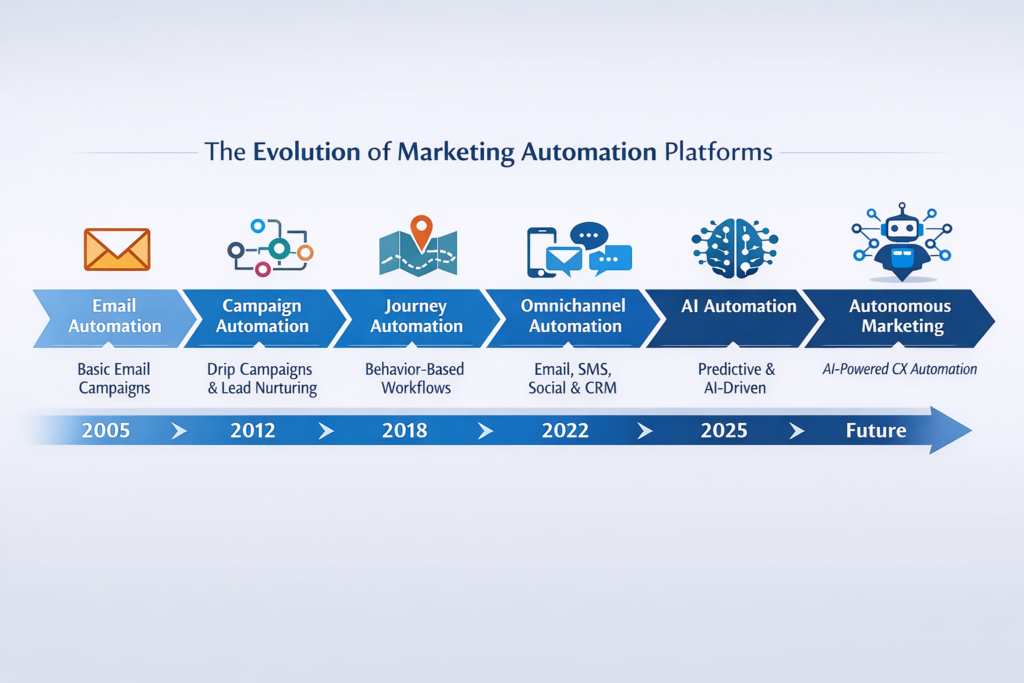
The earliest marketing tools focused primarily on bulk email communication. Companies would upload email lists, send newsletters, and track open rates. The process was simple, but personalization was limited and engagement strategies were basic.
The next stage introduced automation workflows. Marketers began creating drip campaigns, lead nurturing sequences, onboarding emails, and scheduled communications. Automation improved efficiency and ensured consistent communication, but the systems still relied heavily on manual configuration.
Then came customer journey platforms. Businesses began mapping customer lifecycles and designing journeys that responded to customer actions. Marketing automation platforms began triggering emails, SMS messages, and notifications based on behavior such as purchases, website visits, or engagement levels.
Now, marketing automation is entering the intelligence era. Platforms like Agentforce Marketing use artificial intelligence, predictive analytics, and real-time data to optimize campaigns automatically. Automation is no longer just execution. It is becoming decision-making.
From Campaign Automation to Intelligent Automation
Traditional marketing automation platforms were fundamentally campaign-centric in both design and philosophy. Marketers operated within a framework where communication was organized around campaigns rather than around customers. The workflow was largely linear and deterministic. A marketer would build a campaign, define audience segments, create email sequences, set delays between messages, and schedule communications. Once activated, the system would execute the workflow exactly as designed. The automation platform followed instructions, but it did not interpret behavior, learn from outcomes, or adapt dynamically.
This approach improved efficiency compared to fully manual marketing, but it still had significant limitations. Campaigns were static. Segments were predefined. Customer journeys were rigid. If customer behavior changed, marketers had to manually update segments, modify workflows, and relaunch campaigns. The system executed predefined workflows reliably, but it did not truly understand customer behavior or intent. It was automation, but not intelligence.
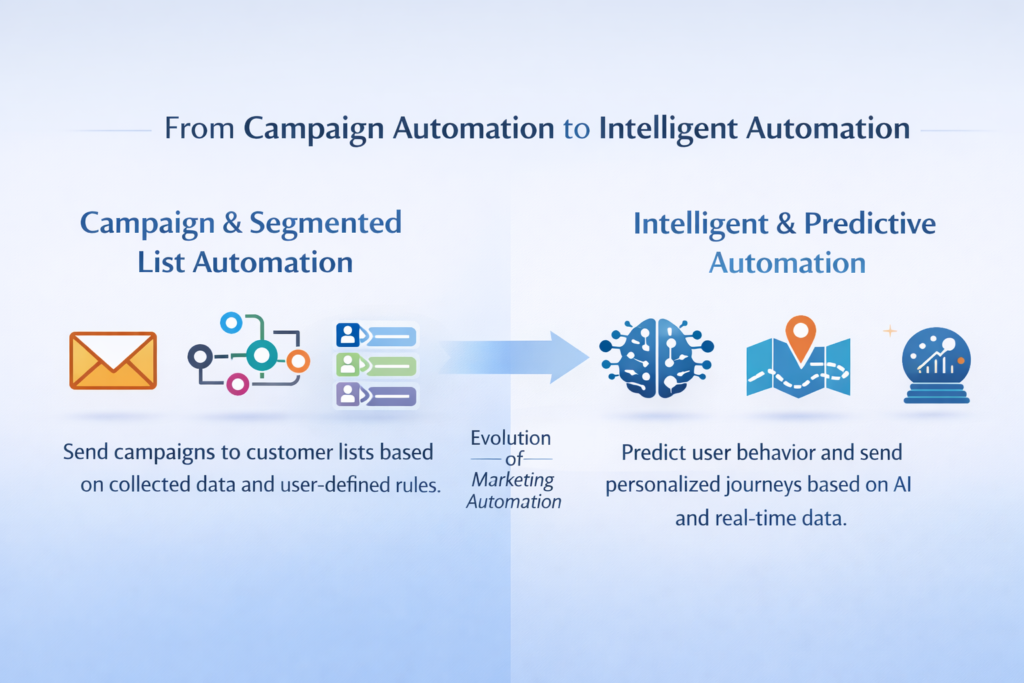
For example, a traditional automation workflow might look like this:
- Send welcome email
- Wait three days
- Send product email
- Wait five days
- Send discount offer
- Add to nurture list
Every customer would move through this sequence regardless of engagement level, interest, or behavior. A highly engaged customer and an uninterested customer might receive the same sequence of emails. The system executed tasks, but it did not make decisions.
Intelligent automation changes everything.
Instead of marketers manually defining every step, intelligent platforms analyze customer behavior continuously and adjust campaigns automatically. Campaigns become dynamic rather than static. Customer journeys become adaptive rather than linear. Marketing automation evolves from a workflow engine into a decision engine.
In intelligent automation environments, the system evaluates customer behavior in real time. It considers engagement patterns, purchase history, browsing activity, communication preferences, and predictive models. Based on this data, the system decides what communication should be sent, when it should be sent, and through which channel.
This transition represents a profound shift in marketing technology. Marketing automation is moving from rule-based workflows to data-driven intelligence.
Intelligent automation enables several important capabilities.
Dynamic segmentation means customer segments are no longer static lists created manually by marketers. Instead, segments update automatically based on customer behavior, engagement, and predictive scoring. A customer can move between segments dynamically without manual intervention. For example, a customer who suddenly becomes highly engaged may automatically move into a high-value segment and begin receiving different communication.
Behavior-based communication ensures that communication is triggered by customer actions rather than by fixed schedules. Instead of sending emails every three days, the system sends communication when customers perform specific actions such as visiting a pricing page, downloading a resource, abandoning a cart, or engaging with previous emails.
Predictive campaign triggers take automation a step further. Instead of waiting for customers to perform actions, predictive systems anticipate behavior. For example, if the system predicts that a customer is likely to churn, it may automatically trigger a retention campaign. If the system predicts that a lead is ready to purchase, it may trigger a sales outreach sequence.
Automated send-time optimization uses artificial intelligence to determine when each individual customer is most likely to open or engage with communication. Instead of sending emails at the same time to everyone, the system sends messages at different times for different customers based on historical engagement patterns.
AI content recommendations help personalize communication at scale. The system may recommend products, content, or offers based on customer behavior and preferences. Instead of sending the same email to all customers, each customer may receive personalized content within the same campaign.
Adaptive customer journeys allow journeys to change dynamically based on engagement and behavior. If a customer opens emails and clicks links frequently, they may move to an advanced journey. If a customer stops engaging, they may be moved to a re-engagement journey. Customer journeys become fluid rather than fixed.
Performance-based campaign adjustments allow the system to optimize campaigns automatically. If a campaign performs poorly, the system may adjust subject lines, timing, content, or targeting. If a campaign performs well, the system may increase its reach or budget.
All of these capabilities illustrate a fundamental shift. Marketing automation is no longer just about automating tasks. It is about automating decisions.
In traditional automation, marketers defined the workflow and the system executed it.
In intelligent automation, marketers define the strategy and the system continuously optimizes execution.
This transition represents one of the most significant changes in modern marketing technology. Marketing platforms are evolving from tools that execute campaigns into platforms that manage customer engagement intelligently. Businesses that adopt intelligent automation will be able to deliver more personalized experiences, improve engagement rates, increase conversions, and operate marketing at a much larger scale with greater efficiency.
The future of marketing automation will not be defined by how many workflows a company builds. It will be defined by how intelligently those workflows adapt, learn, and optimize over time.
What Is Agentforce Marketing?
Agentforce Marketing is Salesforce’s AI-driven marketing automation platform that combines marketing automation, artificial intelligence, customer data, personalization, analytics, and journey orchestration into a unified marketing ecosystem.
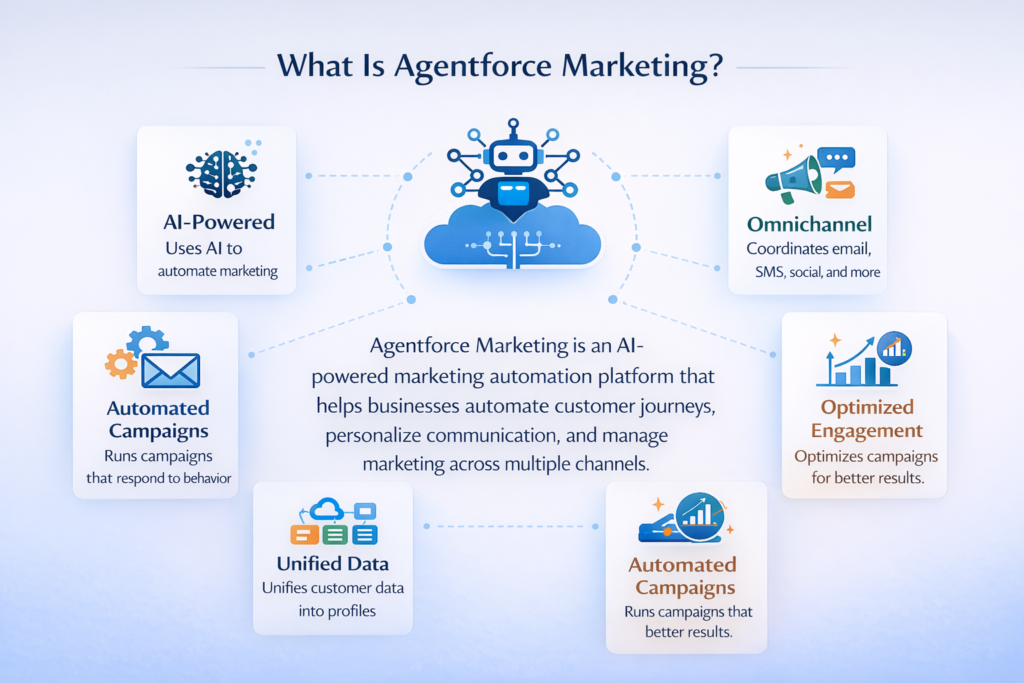
It allows businesses to:
- Automate marketing campaigns
- Build intelligent customer journeys
- Personalize customer communication
- Manage omnichannel marketing campaigns
- Analyze marketing performance
- Use AI to optimize campaigns
- Predict customer behavior
- Automate segmentation
- Generate marketing content
- Integrate marketing with CRM and customer support
Agentforce Marketing moves marketing automation from operational efficiency to strategic intelligence. It transforms marketing platforms into intelligent engagement systems.
Why Marketing Automation Is Entering a New Era
Marketing automation is no longer evolving in small, incremental steps. It is entering an entirely new era, shaped by major technological advances and equally significant changes in customer behavior. What once functioned primarily as a tool for scheduling emails, segmenting lists, and managing campaign workflows is now becoming something far more intelligent, responsive, and experience-driven.
One of the biggest forces behind this shift is the dramatic rise in customer expectations. Modern customers no longer respond well to generic, one-size-fits-all communication. They expect brands to understand their preferences, anticipate their needs, and engage with them in ways that feel relevant and timely. They want personalized recommendations, quicker responses, and interactions that reflect where they are in their journey. As a result, traditional automation built around broad campaigns and static workflows is losing effectiveness. Brands can no longer rely on mass outreach and expect strong engagement.
At the same time, businesses now have access to an enormous volume of customer data. Every visit to a website, email click, app interaction, service request, form submission, and sales conversation generates useful signals. CRM systems, analytics platforms, advertising tools, customer support software, and mobile applications all contribute to a growing pool of behavioral and transactional data. This has changed the role of marketing automation completely. It is no longer just about sending messages automatically. It is about using data intelligently to understand customers more deeply and to make better decisions in real time.
Artificial intelligence has accelerated this transformation even further. AI is no longer a futuristic add-on. It is becoming a practical engine inside modern marketing systems. Businesses can now use AI to predict customer behavior, identify patterns in engagement, recommend the next best action, personalize content, optimize send times, and even generate campaign assets. Instead of marketers manually controlling every rule and sequence, intelligent systems can now adapt based on how customers behave. This creates a more dynamic, responsive, and efficient model of automation.
Another important shift is the move toward unified customer experience platforms. In the past, marketing tools often operated in isolation. Email marketing lived in one platform, CRM data in another, support interactions somewhere else, and analytics in a separate dashboard. That fragmented structure made it difficult to create a complete and consistent customer journey. Today, businesses are increasingly moving toward integrated ecosystems where customer data, engagement history, and operational workflows connect across departments. Marketing automation is becoming part of a larger customer experience strategy rather than a standalone campaign tool.
Taken together, these shifts are fundamentally redefining what marketing automation means. It is moving away from simple campaign execution and toward a model centered on customer experience, intelligent decision-making, and real-time adaptability. The new era of marketing automation is not just about doing tasks faster. It is about creating smarter, more relevant, and more connected interactions at scale.
If you want, I can also expand the next section in the same tone so the full article stays consistent.
The Role of Artificial Intelligence in Marketing Automation
Artificial intelligence is the most important technology driving the future of marketing automation. AI enables marketing platforms to move from automation to intelligence.
AI in marketing automation can:
- Predict which customers are likely to buy
- Predict which customers are likely to churn
- Recommend next best actions
- Optimize customer journeys
- Generate email subject lines
- Generate marketing content
- Optimize campaign timing
- Automatically segment customers
- Forecast campaign performance
- Recommend marketing strategies
- Analyze customer engagement patterns
- Improve marketing ROI over time
Artificial intelligence transforms marketing platforms into learning systems that improve continuously. Marketing automation platforms are no longer static tools; they are becoming intelligent assistants.
Data as the Foundation of Intelligent Marketing
Data is the foundation of modern marketing automation. Without data, automation platforms cannot personalize communication, predict customer behavior, or optimize campaigns. Automation without data is simply sending scheduled messages. Automation with data becomes intelligent, personalized marketing.
Agentforce Marketing relies on unified customer data collected from multiple sources across the customer journey. These data sources typically include:
• CRM data
• Website behavior
• Email engagement
• Purchase history
• Customer support interactions
• Mobile app activity
• Advertising engagement
• Social media interactions
• Event participation
• Customer feedback
Each of these data sources provides valuable insights into customer behavior, preferences, and engagement patterns. When this data is unified into a single customer profile, businesses gain a complete view of each customer instead of fragmented information across different systems.
This unified customer profile enables personalization, predictive analytics, segmentation, and automated customer journeys based on real behavior rather than assumptions. Marketing becomes more relevant, timely, and effective.
Data is not just important for marketing automation. It is the backbone of modern marketing strategy. Companies that manage and use their data effectively can create better customer experiences, improve campaign performance, and make smarter business decisions.
Personalization at Scale in the Agentforce Era
Personalization has become one of the most important aspects of modern marketing. Customers no longer respond well to generic messages sent to large audiences. They expect businesses to understand their preferences, recognize their behavior, and communicate with relevance. Customers want to feel understood, not marketed to. This shift has made personalization a core strategy rather than a marketing tactic.
Agentforce Marketing enables businesses to personalize communication across multiple channels, ensuring that customers receive consistent and relevant experiences wherever they interact with the brand. These channels include:
• Email campaigns
• SMS messages
• Push notifications
• Website content
• Advertisements
• Product recommendations
• Customer journeys
• Offers and promotions
• Customer support communication
Personalization is not just about using a customer’s name in an email. Modern personalization is driven by data and behavior. Communication can be personalized based on multiple factors, including:
• Customer behavior
• Purchase history
• Location
• Interests
• Engagement history
• Customer lifecycle stage
• Industry
• Company size
• Website activity
• Product usage
By using these data points, businesses can send the right message to the right customer at the right time through the right channel. This level of relevance significantly improves marketing effectiveness.
Personalization at scale improves engagement, conversion rates, and customer loyalty. Customers are more likely to open emails, click on offers, respond to campaigns, and continue doing business with companies that communicate in a relevant and meaningful way. Personalization transforms marketing from broadcasting messages to building relationships, and relationship-driven marketing is what defines modern customer experience strategies.
Customer Journeys Are Replacing Campaigns
Modern marketing is shifting from campaign-based communication to journey-based engagement. In traditional marketing automation, businesses would create individual campaigns such as a newsletter, a promotional email, or a seasonal offer and send them to large segments of customers. These campaigns were often isolated and did not always consider where the customer was in their overall relationship with the business.
Today, marketing is becoming more focused on the entire customer journey rather than individual campaigns. Instead of sending one-off messages, businesses design automated customer journeys that respond to customer behavior over time. Marketing becomes a continuous conversation rather than a series of disconnected messages.
Customer journey marketing focuses on different lifecycle stages that a customer moves through while interacting with a business. These lifecycle stages typically include:
• Awareness
• Interest
• Consideration
• Purchase
• Onboarding
• Engagement
• Retention
• Loyalty
• Advocacy
At each stage, customers have different needs, expectations, and questions. Journey-based marketing ensures that communication is relevant to the customer’s current stage rather than sending the same message to everyone.
For example, businesses often create automated journeys such as:
• A welcome journey after signup
• A lead nurturing journey
• A product onboarding journey
• An abandoned cart journey
• A renewal reminder journey
• A re-engagement journey
• A loyalty program journey
These journeys are triggered by customer actions and behaviors rather than fixed campaign schedules. For instance, when a customer signs up, they automatically enter a welcome journey. If a customer abandons a cart, they enter an abandoned cart journey. If a customer becomes inactive, they enter a re-engagement journey.
Customer journeys provide a continuous and personalized customer experience rather than disconnected campaigns. This approach improves customer experience, increases engagement, and helps businesses build long-term relationships instead of focusing only on short-term campaign results.
Omnichannel Marketing Automation
Customers today interact with businesses across multiple channels before making a purchase decision. A typical customer journey is no longer linear. A customer may first see an advertisement, then visit a website, later receive an email, interact with a brand on social media, download a mobile app, and eventually contact customer support or speak with a sales representative before making a purchase. These interactions may happen over days, weeks, or even months.
Because customers move across so many touchpoints, businesses can no longer treat each channel separately. If communication is disconnected, customers receive inconsistent messages and the overall experience feels fragmented. This is why omnichannel marketing automation has become so important.
Omnichannel marketing automation ensures that all customer interactions across different channels are connected, consistent, and based on the same customer data. Instead of each platform working independently, all systems share data and coordinate communication so the customer experiences one continuous journey rather than multiple unrelated interactions.
Agentforce Marketing enables communication and automation across multiple channels, including:
• Email
• SMS
• Push notifications
• Websites
• Mobile apps
• Social media
• Advertising platforms
• CRM systems
• Customer support systems
• Sales teams
When these channels are connected through a unified marketing automation platform, businesses can ensure that customers receive consistent and personalized communication regardless of which channel they use. For example, if a customer clicks an email but does not purchase, they might later see a related advertisement. If they contact support, the support team can see their marketing interactions. If they speak to sales, the sales team already knows their interests and engagement history.
Omnichannel marketing automation creates a seamless customer experience, improves engagement, increases conversion rates, and helps businesses build stronger and more consistent relationships with customers across the entire customer lifecycle.
Predictive Marketing and Customer Behavior Analysis
Predictive marketing uses data and artificial intelligence to predict customer behavior and future actions. Traditional marketing automation reacts to what customers have already done, such as opening an email or visiting a website. Predictive marketing goes one step further. Instead of reacting, businesses can anticipate customer behavior and take action before the customer even makes a decision.
This is possible because modern marketing platforms analyze large amounts of historical and behavioral data using machine learning and predictive analytics. These systems identify patterns in customer behavior and use those patterns to forecast future actions.
Predictive analytics can help businesses identify:
• Customers likely to purchase
• Customers likely to churn
• Leads most likely to convert
• Products customers may buy next
• Best time to contact customers
• Best communication channel
• Customer lifetime value
• Campaign performance predictions
These insights allow marketing and sales teams to work more strategically. Instead of sending campaigns to everyone, businesses can focus on customers who are most likely to convert. Instead of losing customers unexpectedly, businesses can identify customers at risk of leaving and take proactive action. Instead of guessing which campaign will work, teams can use data-driven predictions to make better decisions.
Predictive marketing allows businesses to focus their marketing efforts where they will have the greatest impact. This improves conversion rates, reduces marketing costs, increases customer retention, and helps businesses build more intelligent and efficient marketing strategies.
Autonomous Marketing Workflows
One of the most exciting developments in marketing automation is the rise of autonomous workflows. Traditional marketing automation required marketers to manually create segments, schedule campaigns, define rules, and monitor performance regularly. Modern automation platforms are moving toward autonomous marketing workflows that can run campaigns automatically with minimal human intervention.
Autonomous workflows use artificial intelligence, behavioral data, and performance analytics to make decisions automatically. Instead of marketers manually adjusting campaigns and journeys, the system can analyze performance and optimize marketing activities on its own. This makes marketing automation faster, smarter, and more efficient.
Autonomous workflows can perform a wide range of tasks automatically, including:
• Automatically segment customers
• Launch campaigns based on behavior
• Adjust journeys based on engagement
• Optimize send times
• Recommend content
• Update marketing segments dynamically
• Pause underperforming campaigns
• Scale high-performing campaigns
• Optimize marketing budgets
• Trigger campaigns based on predictive behavior
These capabilities significantly reduce manual work for marketing teams. Instead of spending time managing lists, scheduling campaigns, and analyzing performance manually, marketers can focus on strategy, creativity, messaging, and customer experience design.
Autonomous workflows represent a major shift in marketing automation. Marketing platforms are no longer just tools that execute instructions. They are becoming intelligent systems that can analyze data, make decisions, and optimize campaigns automatically. This allows businesses to scale marketing operations, improve performance, and deliver more personalized customer experiences without increasing workload.
AI Content Generation and Marketing Automation
Content creation is one of the most time-consuming aspects of marketing. Writing emails, creating social media posts, preparing ad copy, building landing pages, and planning campaigns require significant time and effort from marketing teams. Because content is needed across multiple channels and campaigns, content creation often becomes a bottleneck in marketing operations.
Artificial intelligence is transforming marketing automation by allowing platforms to generate content automatically. Instead of writing every email, advertisement, or campaign message manually, marketers can now use AI to generate content ideas, draft messages, and create variations quickly. This allows marketing teams to focus more on strategy, creativity, and campaign planning rather than spending most of their time writing content.
AI can generate a wide range of marketing content, including:
• Email content
• Subject lines
• Social media posts
• Ad copy
• Product descriptions
• Blog outlines
• Landing page content
• SMS messages
• Campaign ideas
AI content generation also makes it easier to test multiple versions of content. Marketing teams can create different subject lines, email versions, ad copies, and landing page messages quickly and run A/B tests to see what performs best. This improves campaign performance and helps businesses continuously optimize their marketing communication.
AI content generation allows marketing teams to run more campaigns, test more variations, and scale marketing operations much faster than traditional content creation processes. Instead of being limited by content production capacity, businesses can now scale personalized marketing communication across multiple channels and customer segments efficiently.
Marketing Automation and Salesforce Data Cloud
Salesforce Data Cloud plays a critical role in Agentforce Marketing. Modern marketing automation depends heavily on data, and Data Cloud acts as a unified customer data platform that collects, connects, and unifies customer data from multiple systems into a single source of truth. Instead of customer data being scattered across CRM systems, marketing platforms, websites, support systems, and external applications, Data Cloud brings all that information together to create a complete customer view.
When customer data is unified, businesses can understand customer behavior more clearly and make better marketing decisions. Marketing teams can see how customers interact with emails, websites, advertisements, sales teams, and customer support in one unified profile rather than looking at separate systems.
Salesforce Data Cloud allows businesses to:
• Create unified customer profiles
• Track customer behavior across systems
• Segment customers based on behavior
• Personalize marketing campaigns
• Analyze customer journeys
• Track marketing attribution
• Improve predictive analytics
• Improve personalization
• Improve marketing ROI
Unified customer data makes marketing automation much more powerful. Instead of sending campaigns based only on basic customer information, businesses can personalize communication based on real customer behavior and engagement across multiple touchpoints. Marketing teams can also understand which campaigns are driving conversions, which channels perform best, and how customers move through the entire customer journey.
Data Cloud makes marketing automation more intelligent, more personalized, and more data-driven. It transforms marketing from campaign execution into a strategic, data-driven customer engagement system.
Sales, Service, and Marketing Alignment Through Automation
One of the biggest advantages of Salesforce platforms is the integration between sales, service, and marketing teams. In many organizations, these departments operate in separate systems, which leads to poor communication, inconsistent customer experiences, and missed opportunities. When marketing, sales, and service systems are connected, businesses can create a more seamless and coordinated customer journey.
Marketing automation does not operate in isolation. It works closely with sales and customer service processes. When these systems are integrated, marketing automation can respond to sales and service activities automatically, ensuring customers receive the right communication at the right time.
Marketing automation can:
• Send leads to sales teams automatically
• Trigger campaigns based on sales pipeline stages
• Send onboarding emails after deals close
• Trigger satisfaction surveys after support cases close
• Send renewal reminders
• Trigger upsell campaigns
• Notify sales teams when leads engage with campaigns
This alignment between marketing, sales, and service teams improves both customer experience and business efficiency. Customers receive consistent communication across departments instead of disconnected messages from different teams. Sales teams receive better-qualified leads, service teams have more context about customers, and marketing teams can run more targeted and effective campaigns.
When all three departments work together on a single platform, businesses can manage the entire customer lifecycle more effectively, from lead generation and sales conversion to customer support, retention, and upselling. This connected approach is one of the key reasons why integrated platforms like Salesforce are so powerful for modern businesses.
Benefits of Agentforce Marketing for Businesses
Agentforce Marketing provides a wide range of capabilities that help businesses automate marketing processes, improve customer engagement, and operate marketing at scale. Modern marketing is no longer just about sending campaigns. It involves managing customer journeys, analyzing data, personalizing communication, and coordinating across multiple channels and teams. Agentforce Marketing brings all these capabilities together in one platform.
Agentforce Marketing offers several benefits for businesses:
• Marketing automation
• Customer journey automation
• Omnichannel marketing
• Personalization
• Predictive marketing
• Campaign optimization
• AI content generation
• Marketing analytics
• CRM integration
• Improved customer engagement
• Higher conversion rates
• Better marketing ROI
• Reduced manual work
• Scalable marketing operations
These capabilities help businesses automate repetitive marketing tasks, deliver personalized customer experiences, and make data-driven marketing decisions. Instead of manually managing campaigns, customer lists, and communication schedules, marketing teams can use automation and AI to manage customer journeys more efficiently.
One of the biggest advantages is scalability. Businesses can run more campaigns, manage more leads, communicate across more channels, and handle larger customer databases without significantly increasing marketing resources or team size. Automation, AI, and predictive analytics allow marketing teams to focus on strategy, creativity, and customer experience rather than operational work.
These benefits allow businesses to operate marketing at scale, improve efficiency, increase conversion rates, and generate better returns on marketing investments. Agentforce Marketing helps transform marketing from a manual, campaign-driven function into an intelligent, automated, and data-driven growth engine.
Challenges in Marketing Automation Adoption
Despite its many benefits, businesses often face several challenges when implementing marketing automation. Many organizations assume that simply purchasing a marketing automation platform will immediately improve marketing performance. However, successful marketing automation depends on data quality, system integration, strategy, and continuous optimization. Without these elements, automation platforms may not deliver the expected results.
Common challenges include:
• Poor data quality
• Disconnected systems
• Complex implementation
• Lack of automation strategy
• Poor segmentation
• Generic campaigns
• Lack of personalization
• Low user adoption
• Integration challenges
• Data governance issues
Poor data quality is one of the most common problems. If customer data is incomplete, outdated, or duplicated, marketing automation cannot personalize communication effectively or generate accurate insights. Disconnected systems are another major issue. When CRM, marketing platforms, support systems, and analytics tools are not integrated, customer data becomes fragmented, which limits automation capabilities.
Many businesses also struggle with complex implementation and lack a clear automation strategy. Marketing automation should be designed around customer journeys and business goals, not just campaigns and email schedules. Poor segmentation and generic campaigns reduce the effectiveness of automation because customers receive irrelevant communication.
Low user adoption is another common challenge. If marketing, sales, and service teams do not fully use the system, the automation platform cannot deliver its full value. Integration challenges and data governance issues can also create problems with data consistency, security, and system performance.
Successful marketing automation requires a combination of strategy, data management, system integration, and continuous optimization. Businesses that focus on these areas can successfully implement marketing automation and fully benefit from intelligent, automated customer engagement.
Best Practices for Implementing Agentforce Marketing
Implementing marketing automation successfully requires more than just setting up a platform and launching campaigns. Businesses need a structured approach that includes strategy, data management, automation design, and continuous optimization. Organizations that follow a structured implementation plan are more likely to see long-term success and higher returns from marketing automation.
Best practices for implementing Agentforce Marketing include:
• Define marketing automation strategy
• Clean and structure customer data
• Integrate CRM and marketing systems
• Design customer journeys
• Implement automation workflows
• Personalize marketing campaigns
• Track campaign performance
• Optimize journeys regularly
• Use AI recommendations
• Train marketing teams
• Maintain data governance
• Continuously optimize marketing automation
The first step is defining a clear marketing automation strategy. Businesses should identify their goals, customer journey stages, key campaigns, and automation opportunities before implementing the platform. Without a clear strategy, automation can become disorganized and ineffective.
Cleaning and structuring customer data is also critical. Marketing automation depends heavily on accurate and well-organized data. Businesses should remove duplicate records, standardize fields, and ensure customer data is complete and reliable.
Integrating CRM and marketing systems ensures that marketing, sales, and service teams work with the same customer data. This integration allows automation to respond to sales activities, customer support interactions, and customer behavior across systems.
Designing customer journeys and implementing automation workflows allows businesses to automate communication across the customer lifecycle, from lead nurturing and onboarding to retention and upselling. Personalization should be included in campaigns to ensure communication is relevant to each customer.
Tracking campaign performance and optimizing customer journeys regularly is essential for long-term success. Marketing automation should be continuously improved based on data, performance metrics, and AI recommendations.
Training marketing teams and maintaining proper data governance ensures that the platform is used correctly and data remains accurate and secure. Marketing automation is not a one-time project. It is an ongoing process that requires continuous optimization and improvement.
A structured implementation approach ensures long-term success and allows businesses to fully benefit from Agentforce Marketing and intelligent marketing automation.
The Future Marketing Team and AI Collaboration
The future marketing team will not be replaced by AI, but marketing teams will work alongside AI systems.
Marketing teams will focus on:
- Strategy
- Customer experience design
- Brand positioning
- Campaign planning
- Data analysis
- Marketing innovation
- Journey design
- Performance optimization
AI will handle repetitive tasks, segmentation, analytics, optimization, and automation workflows.
Marketing professionals will become more strategic and analytical rather than operational.
The Future of Customer Experience with AI Marketing
The future of marketing is no longer just about campaigns, emails, or advertisements. The future of marketing is actually the future of customer experience. Marketing automation platforms are evolving into systems that manage the entire customer experience lifecycle, from the first interaction to long-term customer loyalty and advocacy.
In the past, marketing focused mainly on generating leads and promoting products. Today, businesses must manage the entire customer journey, including onboarding, engagement, support, retention, and upselling. Marketing automation platforms are becoming customer experience platforms that coordinate communication, data, and interactions across all departments and channels.
In the future, customers will experience:
• Personalized communication
• Intelligent product recommendations
• Automated onboarding
• Predictive support
• Proactive communication
• Omnichannel experiences
• Faster responses
• Relevant messaging
• Personalized offers
• Seamless customer journeys
These experiences will be powered by data, artificial intelligence, automation, and unified customer platforms. Instead of customers having to contact businesses for support or information, systems will anticipate customer needs and communicate proactively. Businesses will be able to guide customers through onboarding, recommend products based on behavior, send reminders automatically, and provide support before issues become problems.
Marketing automation will continue to evolve beyond campaign management into full customer lifecycle management. It will connect marketing, sales, service, support, and customer success into one unified experience platform. In the future, the companies that deliver the best customer experience will be the companies that use automation, data, and AI most effectively.
Marketing automation is therefore not just a marketing tool anymore. It is becoming the engine that manages the entire customer experience.
Why Businesses Should Prepare for AI Marketing Now
Businesses that adopt AI marketing early will gain a competitive advantage. They will be able to automate marketing operations, improve customer engagement, increase conversions, improve customer retention, and improve marketing ROI.
Companies that delay adoption may struggle to compete with businesses that use intelligent marketing automation platforms.
The future of marketing will be driven by data, automation, artificial intelligence, and personalization. Businesses should begin preparing for this transition now.
How CloudVandana Helps Businesses Implement Agentforce Marketing
Implementing Agentforce Marketing requires strategy, architecture design, integration, automation workflows, and optimization.
CloudVandana helps businesses:
- Implement Salesforce Marketing Cloud and Agentforce Marketing
- Integrate CRM, Data Cloud, and marketing systems
- Design customer journeys
- Implement marketing automation workflows
- Configure email and SMS campaigns
- Set up marketing analytics and reporting
- Optimize marketing automation
- Provide Salesforce managed services
- Improve marketing ROI
- Scale marketing operations
If your organization is planning to implement Agentforce Marketing or upgrade your marketing automation strategy, CloudVandana can help you design, implement, automate, and optimize your entire marketing automation ecosystem.
Conclusion
Marketing automation is evolving from simple campaign automation to intelligent customer experience management. Agentforce Marketing represents the future of marketing automation where artificial intelligence, automation, data, and personalization come together to create intelligent marketing systems.
The future of marketing will not be about sending more campaigns. It will be about sending the right message, to the right customer, at the right time, through the right channel, automatically and intelligently.
Businesses that adopt intelligent marketing automation platforms early will be better positioned to compete in a data-driven, AI-powered business environment.
Agentforce Marketing is not just the future of marketing automation. It is the future of customer engagement.
FAQs
- What is Agentforce Marketing?
Agentforce Marketing is an AI-powered platform that automates marketing, customer journeys, and personalization across channels. - How is Agentforce Marketing different from traditional marketing automation?
Agentforce Marketing uses AI and unified data, while traditional automation mainly uses rule-based campaigns. - What is marketing automation?
Marketing automation is software that automates campaigns, emails, customer journeys, and marketing tasks. - What is omnichannel marketing automation?
Omnichannel marketing automation connects communication across multiple channels for a consistent customer experience. - What is predictive marketing?
Predictive marketing uses AI and data to predict customer behavior and marketing outcomes. - What is Salesforce Data Cloud?
Salesforce Data Cloud unifies customer data from multiple systems into a single customer profile. - What are customer journeys in marketing automation?
Customer journeys are automated communication flows triggered by customer actions and lifecycle stages. - What are the benefits of marketing automation?
Marketing automation improves efficiency, personalization, engagement, and marketing ROI. - Is marketing automation suitable for small businesses?
Yes, it helps small businesses automate marketing and scale without large teams. - How does AI help marketing automation?
AI helps by predicting behavior, generating content, personalizing campaigns, and optimizing performance. - When should a company implement marketing automation?
Companies should implement marketing automation when managing many leads, customers, and campaigns. - How can CloudVandana help with Agentforce Marketing?
CloudVandana helps implement Agentforce Marketing, integrate systems, and build automated customer journeys.
If your organization is planning to implement Salesforce Marketing Cloud or transition to Agentforce Marketing, CloudVandana can help you build intelligent marketing automation, integrate your CRM and data platforms, design customer journeys, and optimize marketing performance. Contact CloudVandana to start your marketing automation transformation.

Atul Gupta is CloudVandana’s founder and an 8X Salesforce Certified Professional who works with globally situated businesses to create Custom Salesforce Solutions.
Atul Gupta, a dynamic leader, directs CloudVandana’s Implementation Team, Analytics, and IT functions, ensuring seamless operations and innovative solutions.
YOU MIGHT ALSO LIKE
Sales Cloud in 2026: From Pipeline Tracking to Smarter Selling
Agentforce Contact Center: What It Means for Modern Customer Service
Salesforce Flow Automation: 10 Business Processes You Should Automate
Why Clean Salesforce Data Is the Foundation of Successful AI Agents
The Rise of Agentic Workflows: What Businesses Need to Know in 2026