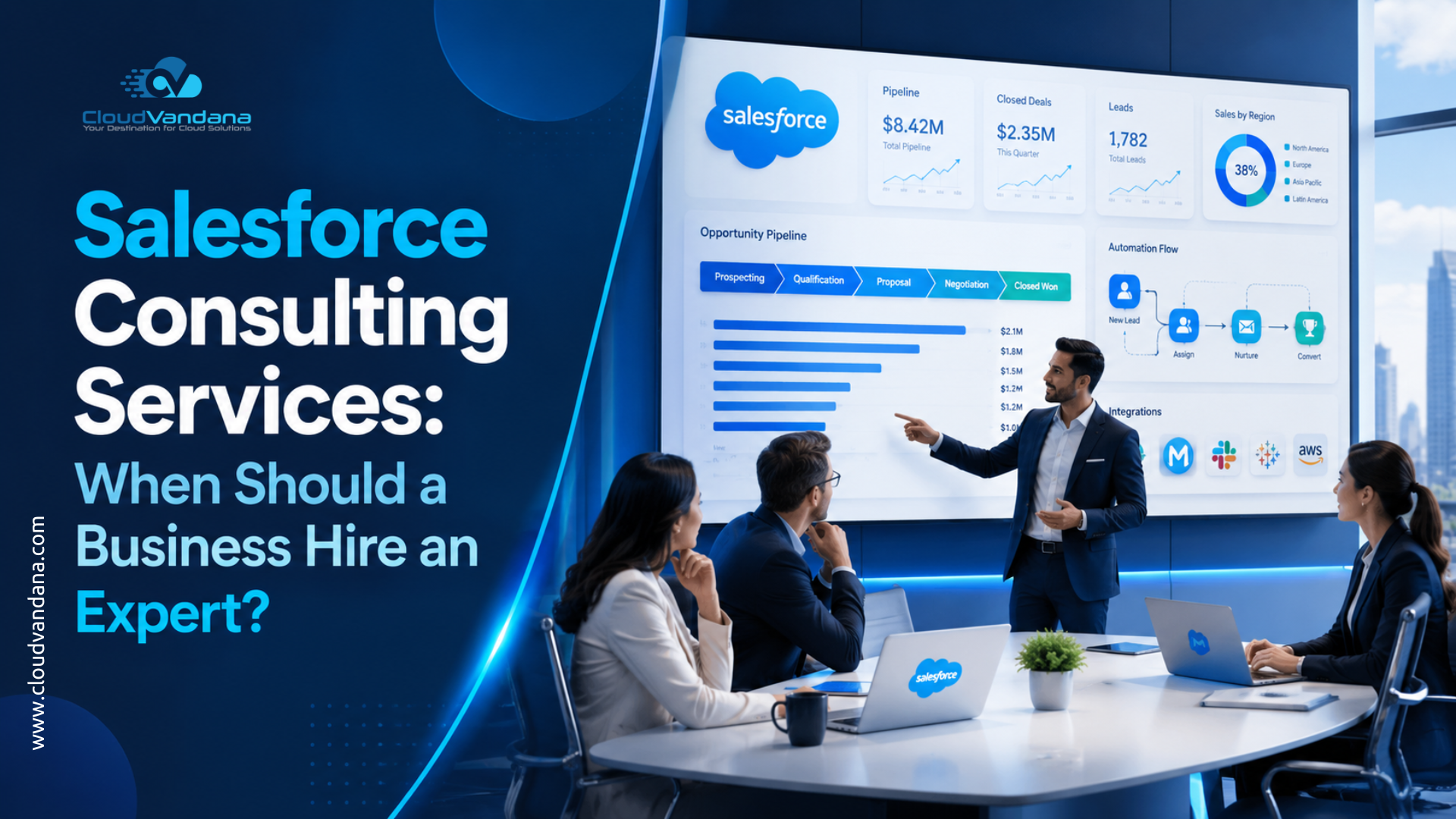
Salesforce is one of the most powerful CRM platforms in the world. It can manage leads, automate sales processes, improve customer service, connect marketing campaigns, unify data, support AI adoption, and give leaders a clearer view of business performance.
But there is one important truth many businesses learn the hard way.
Buying Salesforce is not the same as getting value from Salesforce.
A CRM does not automatically fix broken processes. It does not clean poor data by itself. It does not guarantee team adoption. It does not magically align sales, service, marketing, operations, and leadership. Salesforce can become a growth engine, but only when it is planned, configured, integrated, and optimized around the way a business actually works.
That is where Salesforce consulting services become essential.
A Salesforce consultant helps businesses move beyond basic CRM setup. The consultant studies the business process, identifies operational gaps, designs the right Salesforce architecture, configures the platform, builds automation, manages integrations, improves reporting, trains users, and creates a roadmap for long-term success.
So, when should a business hire a Salesforce expert?
The simple answer is this: a business should hire a Salesforce consultant when Salesforce becomes too important to be handled casually.
If the CRM supports revenue, customer service, pipeline management, leadership decisions, automation, or AI readiness, expert guidance is not a luxury. It is a strategic investment.
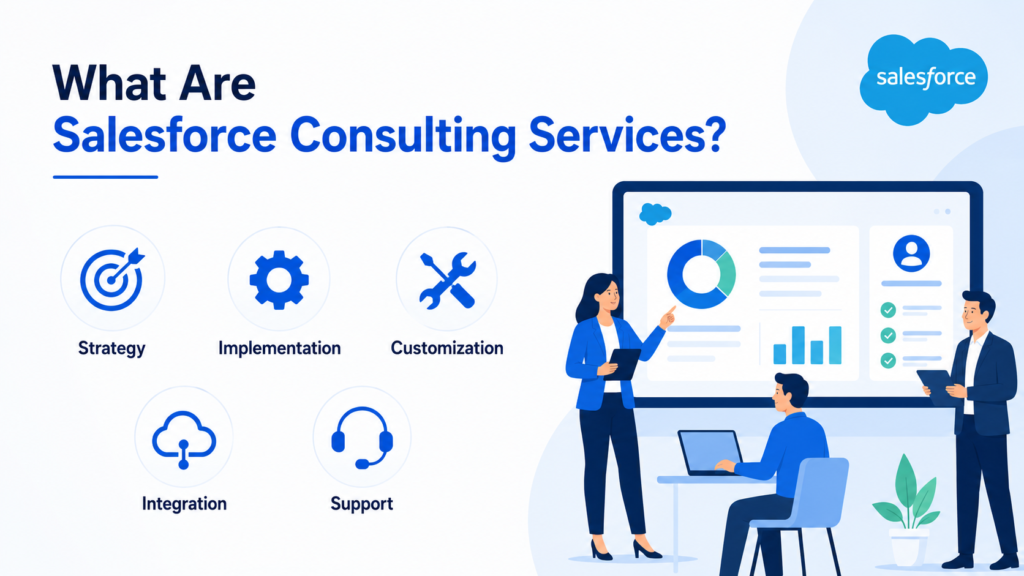
What Are Salesforce Consulting Services?
Salesforce consulting services help businesses plan, implement, customize, integrate, optimize, and support Salesforce according to their specific business needs.
A consultant does not simply “set up Salesforce.” That is a narrow view.
A good Salesforce consultant understands both technology and business operations. They look at how leads move through the funnel, how opportunities are managed, how customer cases are resolved, how data flows between systems, how teams collaborate, and how leadership measures performance.
Then they translate those needs into a functional Salesforce environment.
This can include Sales Cloud setup, Service Cloud configuration, Marketing Cloud alignment, Data Cloud readiness, Agentforce preparation, Salesforce Flow automation, third-party integrations, data migration, custom development, dashboards, reports, security settings, user training, and ongoing managed services.
In short, Salesforce consulting services help businesses turn Salesforce from a software tool into a business operating system.
Salesforce Consulting Beyond Basic Setup
Many companies start Salesforce with a simple goal: organize customer information.
That is a good beginning, but it is not enough.
As the business grows, the CRM must support more sophisticated needs. Sales teams need automated follow-ups. Service teams need case routing. Marketing teams need lead visibility. Operations teams need approvals. Finance teams need accurate opportunity data. Executives need real-time dashboards. Customer-facing teams need one reliable source of truth.
Basic setup cannot handle all of this effectively.
A Salesforce consultant helps build a system that is structured, scalable, and aligned with business outcomes. Instead of adding random fields, scattered automations, and disconnected reports, the consultant creates a cohesive CRM architecture.
That difference matters.
A poorly configured Salesforce org becomes difficult to manage. A well-designed Salesforce org becomes easier to scale.
Why Businesses Struggle with Salesforce Without Expert Guidance
Salesforce is flexible. That flexibility is one of its greatest strengths.
It is also one of the main reasons businesses struggle.
Because Salesforce can be customized in many ways, teams often make decisions without understanding the long-term impact. They create too many fields. They build overlapping automations. They duplicate data. They skip governance. They ignore user experience. They focus on technical setup before business process clarity.
Over time, Salesforce becomes cluttered.
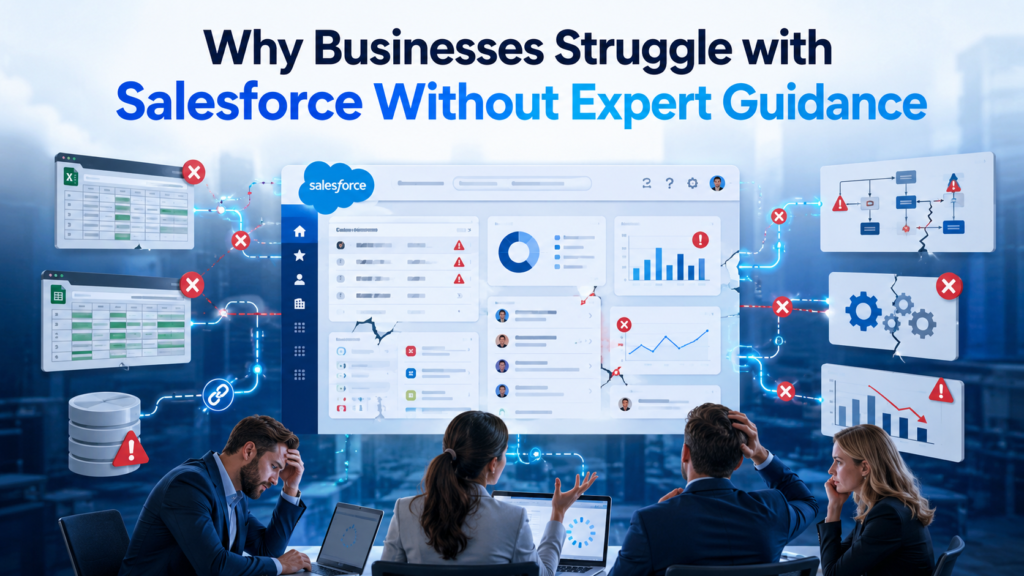
Users lose trust. Reports become unreliable. Admins spend more time fixing issues than improving the system. Leadership starts questioning why the CRM is not delivering the expected return.
Most Salesforce problems do not happen because the platform is weak. They happen because the implementation lacks strategic direction.
Poor Process Mapping
Salesforce should reflect how the business operates.
Unfortunately, many companies implement Salesforce without properly mapping their processes first.
They do not define how a lead should be qualified. They do not clarify when an opportunity should be created. They do not standardize sales stages. They do not document service escalation rules. They do not decide who owns what data.
The result is confusion.
Salesforce becomes a digital version of an unclear process. And when the process is unclear, the CRM cannot create clarity.
A Salesforce consultant starts with discovery. They ask the right questions, examine current workflows, identify bottlenecks, and design a cleaner future-state process before making platform changes.
That sequence is important.
Business clarity must come before technical configuration.
Low User Adoption
Even the best Salesforce setup fails if people do not use it.
Low adoption is one of the most common CRM challenges. Sales reps may feel Salesforce creates extra admin work. Service agents may find the interface confusing. Managers may not trust the reports. Teams may continue using spreadsheets because they feel faster.
This is not just a training problem.
It is often a design problem.
If Salesforce is not intuitive, users avoid it. If fields are unnecessary, users skip them. If automation creates friction, users work around it. If dashboards do not help managers coach better, they stop relying on them.
A Salesforce consultant designs with users in mind. They simplify layouts, reduce manual work, automate repetitive tasks, create role-based dashboards, and train teams based on real workflows.
Adoption improves when Salesforce helps users do their jobs better.
Data Quality Problems
Salesforce is only as valuable as the data inside it.
Duplicate records, incomplete fields, outdated contacts, inconsistent naming, missing opportunity values, and unclean migration data can damage the entire CRM experience.
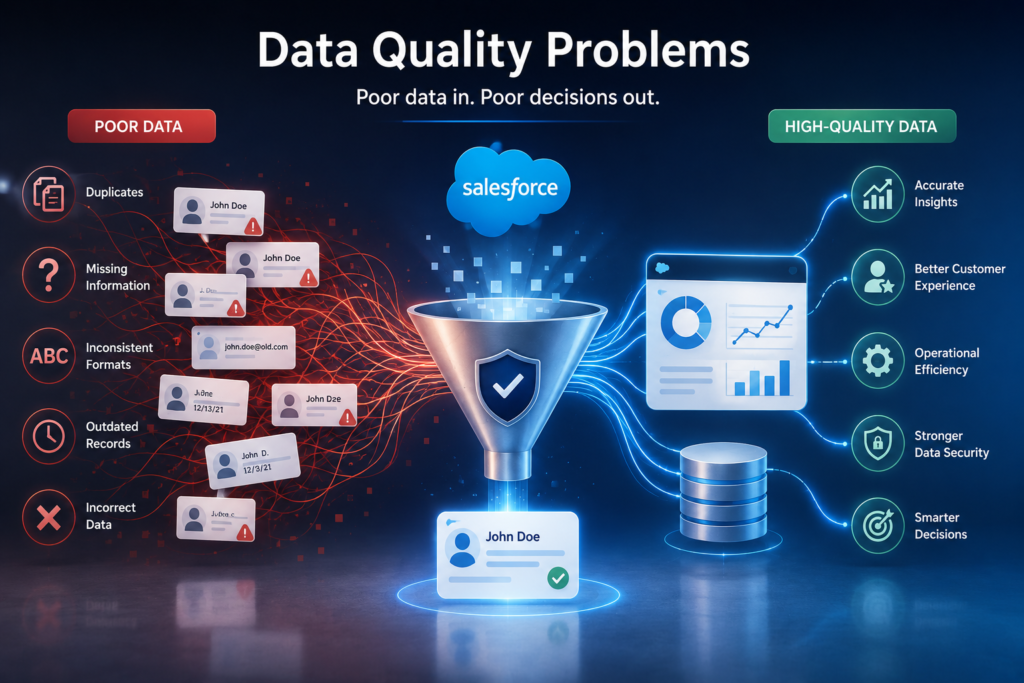
Bad data creates bad reports. Bad reports create bad decisions.
A Salesforce consultant helps businesses define data standards, clean existing records, deduplicate information, plan migration, map fields correctly, validate data, and create governance rules to prevent future decay.
This is especially important for companies preparing for AI-driven CRM. AI depends on trusted data. If the underlying data is fragmented, incomplete, or unreliable, AI outputs will also be unreliable.
Clean data is no longer just an administrative concern. It is a strategic foundation.
Over-Customization and Technical Debt
Salesforce can be customized heavily, but not every customization is wise.
Many businesses build custom objects, fields, workflows, validation rules, triggers, and automations without a long-term architecture plan. Initially, everything seems fine. Later, the system becomes slow, fragile, and difficult to maintain.
This is called technical debt.
Technical debt increases when quick fixes replace thoughtful design. It makes future changes harder. It raises support costs. It creates dependency on specific individuals who understand the old logic.
A Salesforce consultant helps prevent this by choosing the right balance between standard functionality, configuration, automation, and custom development.
The goal is not to customize Salesforce as much as possible.
The goal is to customize it only where it creates business value.
When Should a Business Hire a Salesforce Consultant?
A business should hire a Salesforce consultant when CRM complexity starts affecting growth, productivity, reporting, customer experience, or scalability.
Some companies hire consultants before implementation. That is ideal. Others hire experts after Salesforce has already become messy. That is still useful. The right time depends on the company’s maturity, internal skills, business goals, and urgency.
Here are the clearest signs that it is time to bring in a Salesforce expert.
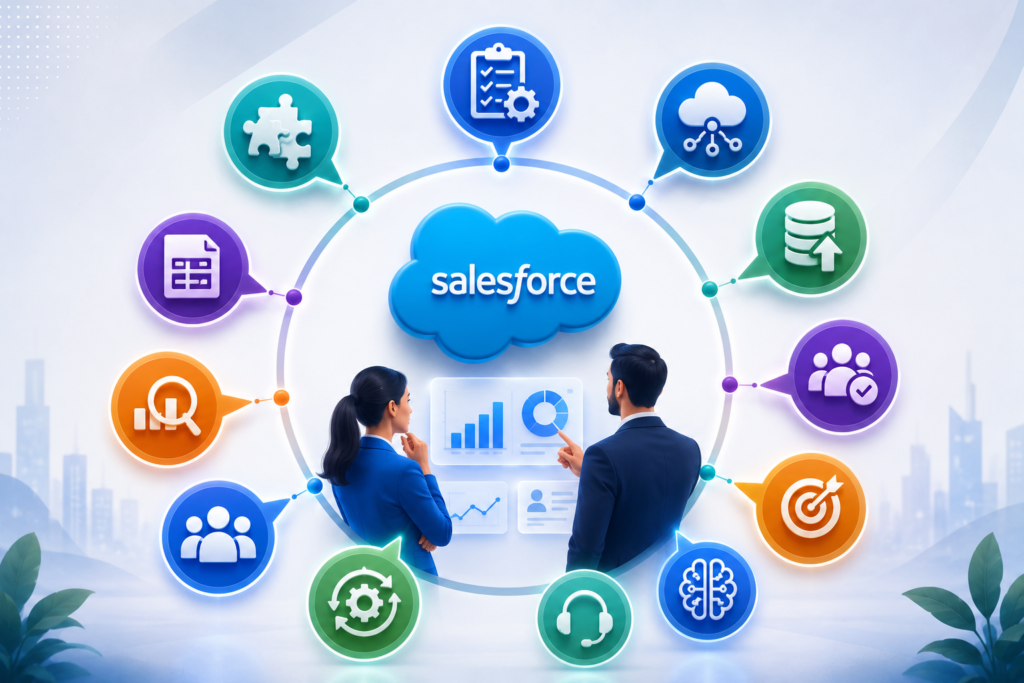
1. Before a New Salesforce Implementation
The best time to hire a Salesforce consultant is before implementation begins.
This helps avoid expensive mistakes from the start.
A consultant can help define the CRM roadmap, select the right Salesforce products, document business requirements, design the data model, configure the system, migrate data, build reports, and train users.
Without expert guidance, many businesses treat implementation as a software installation project. They focus on licenses, fields, and dashboards. But Salesforce implementation should be a business transformation project.
The early decisions matter.
A poorly planned implementation can create years of inefficiency. A well-planned implementation can support growth from day one.
2. When Salesforce Is Not Matching Business Processes
If teams constantly say, “Salesforce does not work the way we work,” that is a warning sign.
It may mean the CRM was configured without enough discovery. It may also mean the business has evolved, but Salesforce has not been updated.
Common symptoms include irrelevant fields, incorrect sales stages, manual workarounds, disconnected approval processes, confusing page layouts, and reports that do not match leadership expectations.
A Salesforce consultant can assess the gap between current Salesforce configuration and actual business processes. Then they can redesign the system so that it supports the way teams operate today, not the way they operated two years ago.
Salesforce should not force unnecessary friction.
It should make the right process easier to follow.
3. When Teams Still Depend on Spreadsheets
Spreadsheets are useful. But when a company has Salesforce and still depends on spreadsheets for pipeline tracking, customer follow-ups, forecasting, case updates, or reporting, something is wrong.
This usually means users do not trust Salesforce.
They may feel the CRM is incomplete, slow, confusing, or inaccurate. Managers may use spreadsheets because Salesforce reports do not answer their questions. Sales reps may track deals separately because Salesforce stages are not useful.
A consultant can identify why teams are working outside the CRM. Then they can improve data structure, automation, reporting, user experience, and adoption.
The goal is not to ban spreadsheets.
The goal is to make Salesforce reliable enough that spreadsheets are no longer the operational backbone.
4. When Reports Do Not Show Reliable Insights
Leadership depends on CRM data to make decisions.
If Salesforce reports are inaccurate, incomplete, or difficult to interpret, decision-making suffers.
For example, sales leaders may not know the true pipeline value. Service leaders may not know case resolution trends. Marketing teams may not see campaign influence. Executives may not know which regions, products, or segments are performing best.
This is not always a reporting problem. Often, it is a data model problem.
A Salesforce consultant reviews how data is captured, where it comes from, how it is structured, and how it should be reported. They create dashboards that are not just visually appealing, but operationally meaningful.
Good dashboards do more than display numbers.
They help leaders act faster.
5. When Sales, Service, and Marketing Teams Work in Silos
Salesforce is designed to connect teams around the customer.
But many businesses still operate in silos.
Marketing captures leads, but sales does not follow up properly. Sales closes deals, but service does not receive enough context. Service identifies upsell opportunities, but sales never sees them. Leadership receives fragmented updates from different departments.
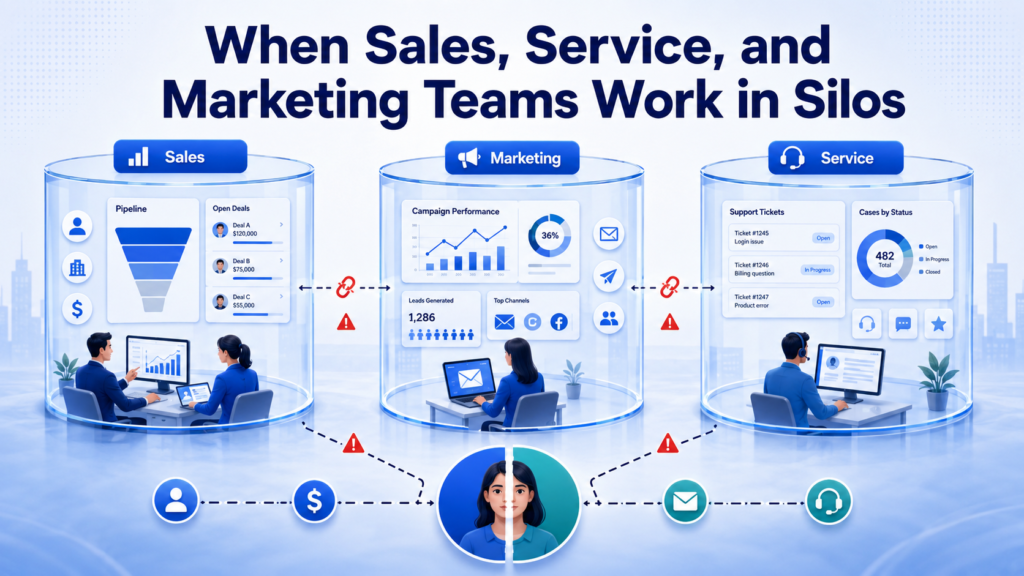
This creates a broken customer experience.
A Salesforce consultant helps align objects, workflows, handoffs, notifications, dashboards, and integrations so teams can collaborate around a single customer view.
This is especially important as businesses move toward AI CRM and connected customer experiences. AI cannot deliver meaningful results if teams and data remain disconnected.
6. When Automations Are Breaking or Becoming Too Complex
Automation is one of Salesforce’s biggest advantages.
But automation needs discipline.
When businesses build automations without planning, they often end up with conflicting rules, duplicate updates, unexpected errors, slow performance, and difficult troubleshooting.
A Salesforce consultant can audit existing automations, simplify logic, migrate legacy workflows where needed, build scalable Salesforce Flow solutions, document automation behavior, and test processes before deployment.
This creates a cleaner automation foundation.
The best automation is not just powerful. It is understandable, maintainable, and aligned with business rules.
7. When Integrations Are Needed
Most businesses use more than one system.
They may use ERP software, accounting tools, marketing automation platforms, customer support systems, eCommerce platforms, document storage tools, telephony systems, payment gateways, data warehouses, or collaboration tools.
If Salesforce does not integrate with these systems, teams waste time on duplicate data entry. Errors increase. Customer information becomes fragmented. Processes slow down.
A Salesforce consultant helps design and implement integrations that move data securely and accurately between systems.
This requires more than technical connection. It requires understanding which system owns which data, how often data should sync, what happens when records conflict, and how errors should be handled.
Good integrations create operational continuity.
Bad integrations create silent chaos.
8. When Data Migration Feels Risky
Data migration is one of the most delicate parts of Salesforce projects.
Moving data from spreadsheets, legacy CRMs, or disconnected systems into Salesforce requires careful planning. Fields must be mapped correctly. Records must be cleaned. Duplicates must be removed. Relationships between accounts, contacts, opportunities, cases, and custom objects must be preserved.
A poor migration can damage user trust immediately.
If users log in and see missing records, incorrect values, duplicate accounts, or broken history, they may reject Salesforce before adoption even begins.
A Salesforce consultant reduces this risk by creating a migration plan, validating sample data, running test migrations, checking data integrity, and preparing rollback options where necessary.
Migration is not just a technical task.
It is the foundation of CRM credibility.
9. When User Adoption Is Weak
If users are avoiding Salesforce, the business needs to investigate quickly.
Weak adoption can come from poor training, confusing layouts, excessive fields, lack of automation, irrelevant dashboards, slow processes, or a perception that Salesforce is used only for management surveillance.
A consultant can help reposition Salesforce as a productivity tool.
They can simplify screens, create guided processes, automate repetitive updates, build useful reports, provide role-based training, and collect user feedback.
Adoption improves when users see personal value.
Sales reps need faster follow-ups. Service agents need better case context. Managers need coaching dashboards. Executives need reliable insights.
Every user group should have a reason to trust the system.
10. When Leadership Cannot Measure CRM ROI
Salesforce is a major business investment.
Leadership should be able to measure whether it is improving productivity, revenue visibility, customer experience, response times, conversion rates, forecast accuracy, or operational efficiency.
If ROI is unclear, a consultant can help define success metrics and build reporting around them.
This may include pipeline velocity, lead conversion rate, average sales cycle, case resolution time, customer satisfaction trends, campaign influence, automation savings, data completeness, adoption rate, and forecast accuracy.
CRM ROI is not just about how many people log in.
It is about whether Salesforce helps the business perform better.
11. When AI, Agentforce, or Data Cloud Readiness Becomes a Priority
Salesforce is moving rapidly toward AI-powered CRM.
With Agentforce, Data 360, Einstein, automation, and unified data capabilities, businesses have more opportunities to use AI across sales, service, marketing, and operations.
But AI readiness depends on CRM readiness.
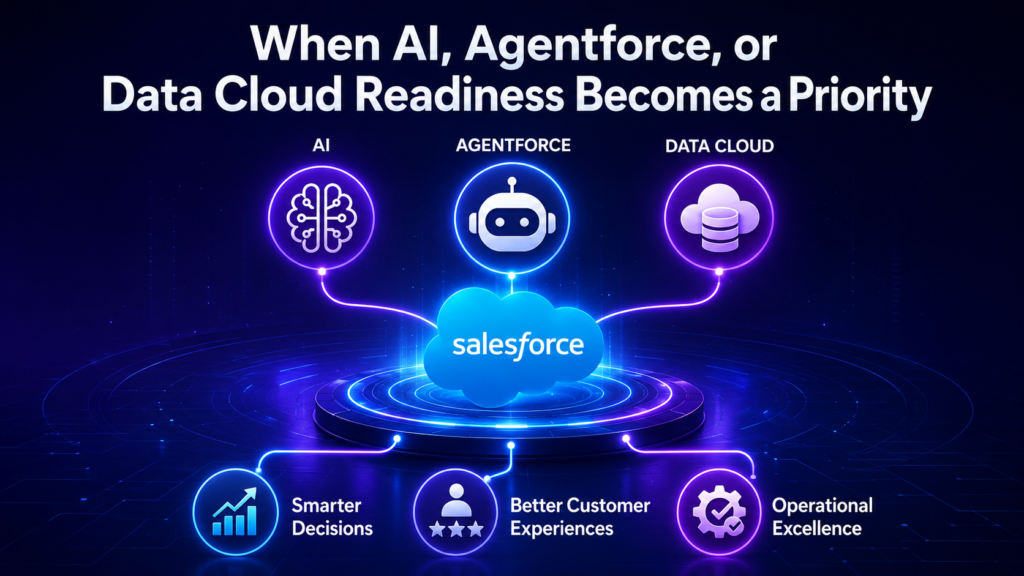
Before implementing AI agents or advanced intelligence, businesses need clean data, clear processes, secure access controls, connected systems, reliable automation, and well-defined use cases.
A Salesforce consultant can help assess whether the org is ready for AI. They can identify data gaps, process inconsistencies, governance risks, integration needs, and automation opportunities.
AI should not be layered on top of CRM disorder.
It should be built on a trusted operational foundation.
12. When the Internal Team Needs Long-Term Support
Not every company needs a full-time Salesforce admin, developer, architect, and consultant in-house.
Many businesses need flexible expertise.
They may need help with enhancements, troubleshooting, releases, reports, user requests, integrations, automation updates, or ongoing optimization.
Salesforce consulting services can provide that support without the overhead of building a large internal team.
This is especially useful for growing businesses that need expertise on demand.
The internal team can focus on business priorities while the consulting partner handles technical execution and platform improvement.
What Does a Salesforce Consultant Actually Do?
A Salesforce consultant plays multiple roles.
They are part strategist, part business analyst, part solution architect, part implementation expert, part adoption advisor, and part long-term optimization partner.
Their work depends on the business need, but most consulting engagements include the following areas.
Business Process Discovery
Discovery is where successful Salesforce consulting begins.
The consultant studies how the business currently works. They speak with stakeholders, review existing tools, identify manual work, document pain points, and understand business goals.
This phase prevents assumption-based configuration.
Instead of building Salesforce around generic best practices, the consultant builds around real operational needs.
Good discovery answers questions like:
What happens when a lead enters the system?
How is a deal qualified?
Who approves discounts?
How are customer cases assigned?
What information does leadership need every week?
Where does data come from?
What tasks should be automated?
What problems are users facing today?
Without discovery, Salesforce becomes guesswork.
With discovery, Salesforce becomes intentional.
Salesforce Architecture Planning
Architecture defines the structure of the Salesforce org.
This includes objects, fields, relationships, record types, page layouts, permissions, automation strategy, integration design, reporting structure, and long-term scalability.
A consultant ensures the architecture is not just functional today, but sustainable tomorrow.
This matters because businesses change. Teams grow. Products expand. Processes evolve. New systems are added. AI capabilities become relevant.
A strong architecture allows Salesforce to adapt without becoming fragile.
Configuration and Customization
Configuration uses Salesforce’s standard tools to tailor the platform.
This may include custom fields, page layouts, Lightning apps, record types, validation rules, permissions, reports, dashboards, queues, assignment rules, and approval processes.
Customization goes deeper. It may include custom objects, Lightning Web Components, Apex development, advanced integrations, or specialized user experiences.
A consultant helps decide when configuration is enough and when customization is truly needed.
That decision protects the business from unnecessary complexity.
Automation with Flow
Salesforce Flow allows businesses to automate repetitive work and guide users through processes.
A consultant can use Flow to automate lead assignment, task creation, approval routing, case escalation, renewal reminders, onboarding steps, data updates, notifications, and more.
But Flow needs structure.
An expert consultant builds automations that are tested, documented, scalable, and aligned with business logic.
This prevents automation sprawl.
It also makes future maintenance easier.
Data Migration and Cleanup
Data migration requires planning, precision, and validation.
A consultant helps prepare the data, map fields, remove duplicates, define ownership, preserve relationships, test migration batches, and verify final results.
They also help create ongoing data governance rules so the system stays clean after migration.
This is critical because data quality affects everything else: reporting, automation, personalization, customer service, and AI readiness.
Third-Party Integrations
Salesforce often needs to connect with other business systems.
A consultant helps design integrations that are secure, reliable, and strategically sound.
This may include integrations with email platforms, ERP systems, accounting tools, document storage platforms, marketing automation tools, customer support systems, communication tools, payment systems, or external databases.
The consultant also helps define the data flow.
Which system is the source of truth?
What data should sync?
How frequently should it sync?
What happens if an update fails?
Who receives error notifications?
These questions matter.
Integration is not just about moving data. It is about protecting business continuity.
User Training and Adoption
Salesforce training should not be generic.
Users need to understand how Salesforce helps them in their specific role.
A consultant can create role-based training for sales reps, service agents, managers, admins, and executives. They can also provide documentation, walkthroughs, adoption dashboards, and feedback loops.
Training should answer practical questions:
How do I update a lead?
How do I move an opportunity?
How do I log a call?
How do I escalate a case?
How do I read my dashboard?
How does Salesforce help me save time?
When users understand the “why,” adoption becomes easier.
Optimization and Managed Services
Salesforce is never truly finished.
After implementation, the business will need improvements, new reports, new automations, bug fixes, release updates, user support, security reviews, and process refinements.
A consultant or managed services partner can help keep Salesforce healthy over time.
This ensures the platform continues to evolve with the business.
A CRM should not become stagnant.
It should keep improving.
Benefits of Hiring a Salesforce Consulting Expert
Hiring a Salesforce consultant is not just about completing tasks faster.
It is about reducing risk, improving quality, increasing adoption, and building a CRM that supports real business outcomes.
Faster Implementation
An experienced consultant knows how to structure the project.
They understand dependencies, common mistakes, configuration options, testing requirements, and deployment steps. This helps the business move faster without sacrificing quality.
Speed matters.
But controlled speed matters more.
A rushed implementation can create long-term problems. A guided implementation helps the business launch with confidence.
Better CRM Adoption
Consultants improve adoption by designing Salesforce around user needs.
They remove unnecessary complexity, automate repetitive steps, simplify layouts, create useful dashboards, and train teams properly.
When Salesforce feels useful, people use it.
When people use it, data improves.
When data improves, leadership gains visibility.
Adoption is the bridge between CRM investment and CRM value.
Cleaner Data and Better Reports
Consultants help businesses create data standards and reporting structures that support decision-making.
This improves trust.
Sales teams trust pipeline reports. Service leaders trust case metrics. Executives trust dashboards. Marketing teams trust attribution. Operations teams trust process visibility.
Clean data makes Salesforce more than a record-keeping tool.
It makes Salesforce a decision engine.
Scalable Automation
Automation should save time without creating confusion.
A consultant builds automation that supports scale. This includes clear logic, proper testing, naming conventions, documentation, exception handling, and governance.
This reduces errors and maintenance headaches.
It also prepares the business for more advanced automation and AI use cases in the future.
Stronger Security and Governance
Salesforce contains sensitive customer and business data.
A consultant helps configure profiles, permission sets, sharing rules, field-level security, role hierarchy, data access, and compliance-supporting processes.
Good governance prevents accidental exposure, unauthorized access, and operational inconsistency.
Security should not be added at the end.
It should be designed from the beginning.
Better Long-Term ROI
Salesforce ROI improves when the system is aligned with business goals.
A consultant helps ensure Salesforce supports measurable outcomes such as higher conversion rates, faster response times, better forecasting, improved customer retention, reduced manual work, and stronger team productivity.
The return does not come from owning Salesforce.
It comes from using Salesforce well.
Salesforce Consulting vs Hiring an In-House Salesforce Admin
An in-house Salesforce admin is valuable for daily support, user management, basic configuration, reporting, and ongoing maintenance.
A Salesforce consultant is often better for strategic projects, complex implementations, integrations, architecture planning, automation design, data migration, and optimization.
Many businesses need both at different stages.
For example, a company may hire a consultant for implementation and then rely on an internal admin for daily operations. Another company may use a consulting partner for ongoing managed services instead of hiring a full-time internal team.
The right choice depends on complexity, budget, growth stage, and internal capability.
If Salesforce is simple and stable, an admin may be enough.
If Salesforce is strategic, complex, or underperforming, consulting expertise becomes essential.
Salesforce Consulting vs Salesforce Managed Services
Salesforce consulting is often project-based.
It may focus on implementation, migration, customization, integration, or a major optimization initiative.
Salesforce managed services are ongoing.
They provide continuous support, improvements, monitoring, enhancements, troubleshooting, and platform administration.
A business may start with consulting and later move into managed services.
This is often the best model.
The consultant helps build the foundation. Managed services help maintain and improve it.
Salesforce success is not only about launch.
It is about what happens after launch.
How to Choose the Right Salesforce Consulting Partner
Choosing the right Salesforce consulting partner is a critical decision.
The best partner should understand both technology and business strategy. They should not immediately jump into configuration. They should ask about goals, processes, users, data, reporting, and growth plans.
Look for a partner with:
Proven Salesforce expertise
Experience across implementation, customization, integration, and support
Strong business process understanding
Clear communication
Transparent project planning
Data migration experience
Automation expertise
User adoption focus
Post-launch support
Industry awareness
Scalable architecture thinking
A practical approach to ROI
Also, pay attention to how they ask questions.
A good consultant does not simply ask, “What fields do you need?”
They ask, “What business outcome are you trying to achieve?”
That difference is everything.
Common Mistakes Businesses Make Before Hiring a Consultant
Many businesses wait too long before hiring a Salesforce expert.
They try to solve complex issues internally, even when the team does not have enough Salesforce experience. This can lead to expensive rework later.
Some common mistakes include:
Implementing Salesforce without process discovery
Migrating dirty data into the new org
Creating too many custom fields
Building automation without documentation
Ignoring user training
Using reports without data standards
Skipping security planning
Treating Salesforce as an IT-only project
Adding integrations without architecture
Waiting until users lose trust
The earlier a business brings in expert guidance, the easier it is to prevent these issues.
But even if the Salesforce org is already messy, it can still be improved.
A good consultant can audit the current setup, identify root causes, prioritize fixes, and create a practical roadmap.
Why CloudVandana Is the Right Salesforce Consulting Partner
Salesforce should help a business operate better every day.
That is the principle behind CloudVandana’s Salesforce consulting services.
CloudVandana helps businesses implement, customize, integrate, optimize, automate, and support Salesforce with a practical focus on long-term value. The goal is not just to launch a CRM. The goal is to build a Salesforce environment that users trust, managers rely on, and leadership can scale with confidence.
CloudVandana can help with:
Salesforce consulting
Salesforce implementation
Salesforce customization
Salesforce development
Salesforce integration
Salesforce data migration
Salesforce automation using Flow
Sales Cloud and Service Cloud setup
Salesforce administration
Salesforce managed services
Salesforce support and maintenance
AppExchange app development
Lightning Web Component development
Data Cloud and AI CRM readiness
Agentforce preparation
Reporting and dashboard strategy
Whether a business is implementing Salesforce for the first time, fixing an underperforming org, preparing for AI, migrating from legacy systems, or looking for long-term Salesforce support, CloudVandana brings the expertise needed to move with clarity.
The right Salesforce partner does not just configure screens.
The right partner helps a business make better decisions, reduce manual work, improve customer experiences, and unlock more value from the platform.
Get More Value from Salesforce with CloudVandana
If Salesforce feels complicated, underused, disconnected, or difficult to scale, it may be time to bring in an expert.
CloudVandana helps businesses turn Salesforce into a cleaner, smarter, and more reliable CRM system. From implementation and integration to automation, data migration, managed services, and AI readiness, CloudVandana works with teams to build Salesforce around real business goals.
Do not let Salesforce become just another tool your team struggles to maintain.
Make it a system your business can trust.
Connect with CloudVandana today to discuss your Salesforce goals and discover how expert consulting can help you improve adoption, streamline operations, and maximize CRM ROI.
Conclusion
Salesforce can transform the way a business manages customers, sales, service, marketing, operations, and leadership reporting.
But transformation does not happen automatically.
It requires the right strategy, the right architecture, the right data, the right automation, and the right adoption plan.
A business should hire a Salesforce consultant when the CRM becomes central to growth, productivity, customer experience, or decision-making. That may be before implementation. It may be during a major optimization project. It may be when integrations become necessary. It may be when reporting becomes unreliable. It may be when the business is preparing for AI, Agentforce, or Data Cloud.
The timing may vary.
The principle does not.
If Salesforce is important to the business, it deserves expert attention.
A skilled Salesforce consultant helps convert complexity into clarity. They help teams stop fighting the system and start using it with confidence. They help leaders see what is happening. They help businesses build a CRM that is not just functional, but valuable.
Salesforce is powerful.
With the right consulting partner, it becomes purposeful.
FAQs
1. What are Salesforce consulting services?
Salesforce consulting services help businesses plan, implement, customize, integrate, optimize, and support Salesforce. These services can include business process discovery, CRM setup, automation, data migration, reporting, user training, and ongoing managed services.
2. When should a business hire a Salesforce consultant?
A business should hire a Salesforce consultant before a new implementation, during a major optimization project, when reports are unreliable, when users are not adopting Salesforce, when integrations are needed, or when the CRM is not supporting business processes effectively.
3. Is a Salesforce consultant only needed for large companies?
No. Small and mid-sized businesses can also benefit from Salesforce consulting services. In fact, expert guidance at an early stage can help smaller businesses avoid costly mistakes and build a scalable CRM foundation.
4. What problems can a Salesforce consultant solve?
A Salesforce consultant can solve problems related to poor setup, low adoption, duplicate data, broken automations, weak reporting, disconnected systems, inefficient processes, security gaps, and lack of CRM ROI.
5. Can a Salesforce consultant help with data migration?
Yes. Salesforce consultants help plan and execute data migration from spreadsheets, legacy CRMs, or other systems. They handle data mapping, cleanup, deduplication, validation, test migration, and final migration support.
6. Can Salesforce consulting services improve user adoption?
Yes. Consultants improve adoption by simplifying layouts, automating repetitive tasks, creating role-based dashboards, providing training, and aligning Salesforce with real user workflows.
7. What is the difference between Salesforce consulting and Salesforce managed services?
Salesforce consulting is usually project-based and focuses on implementation, customization, migration, or optimization. Salesforce managed services provide ongoing support, administration, enhancements, troubleshooting, and continuous improvement.
8. Does every business need a full-time Salesforce admin?
Not always. Some businesses need a full-time admin, while others can rely on a Salesforce consulting or managed services partner for flexible support. The right model depends on CRM complexity, user count, budget, and business goals.
9. Can a Salesforce consultant help with integrations?
Yes. Salesforce consultants can integrate Salesforce with ERP systems, accounting tools, marketing platforms, support systems, document storage tools, communication platforms, payment systems, and other business applications.
10. How does Salesforce consulting help with AI readiness?
Salesforce AI readiness depends on clean data, clear processes, secure access, connected systems, and reliable automation. A consultant can assess the current Salesforce org and prepare it for AI tools, Agentforce, Data Cloud, and advanced automation.
11. How do I choose the right Salesforce consulting partner?
Choose a partner with strong Salesforce expertise, business process knowledge, integration experience, data migration skills, automation capability, clear communication, and post-launch support. The right partner should focus on business outcomes, not just technical setup.
12. Why choose CloudVandana for Salesforce consulting services?
CloudVandana provides end-to-end Salesforce consulting services, including implementation, customization, development, integration, data migration, automation, managed services, and ongoing support. CloudVandana helps businesses build Salesforce systems that are practical, scalable, and aligned with long-term growth.

Atul Gupta is CloudVandana’s founder and an 8X Salesforce Certified Professional who works with globally situated businesses to create Custom Salesforce Solutions.
Atul Gupta, a dynamic leader, directs CloudVandana’s Implementation Team, Analytics, and IT functions, ensuring seamless operations and innovative solutions.
YOU MIGHT ALSO LIKE

Financial Services Cloud: A Complete Guide for Banking and Wealth Management
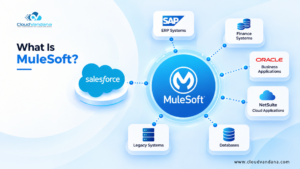
How MuleSoft Connects Salesforce With ERP, Finance and Business Systems
Salesforce Customer 360: Connecting Sales, Service and Marketing Teams
Salesforce and Anthropic Launch Claudeforce: What It Means for the Future of Enterprise AI

Salesforce AIforce: What It Means for the Future of Enterprise Software