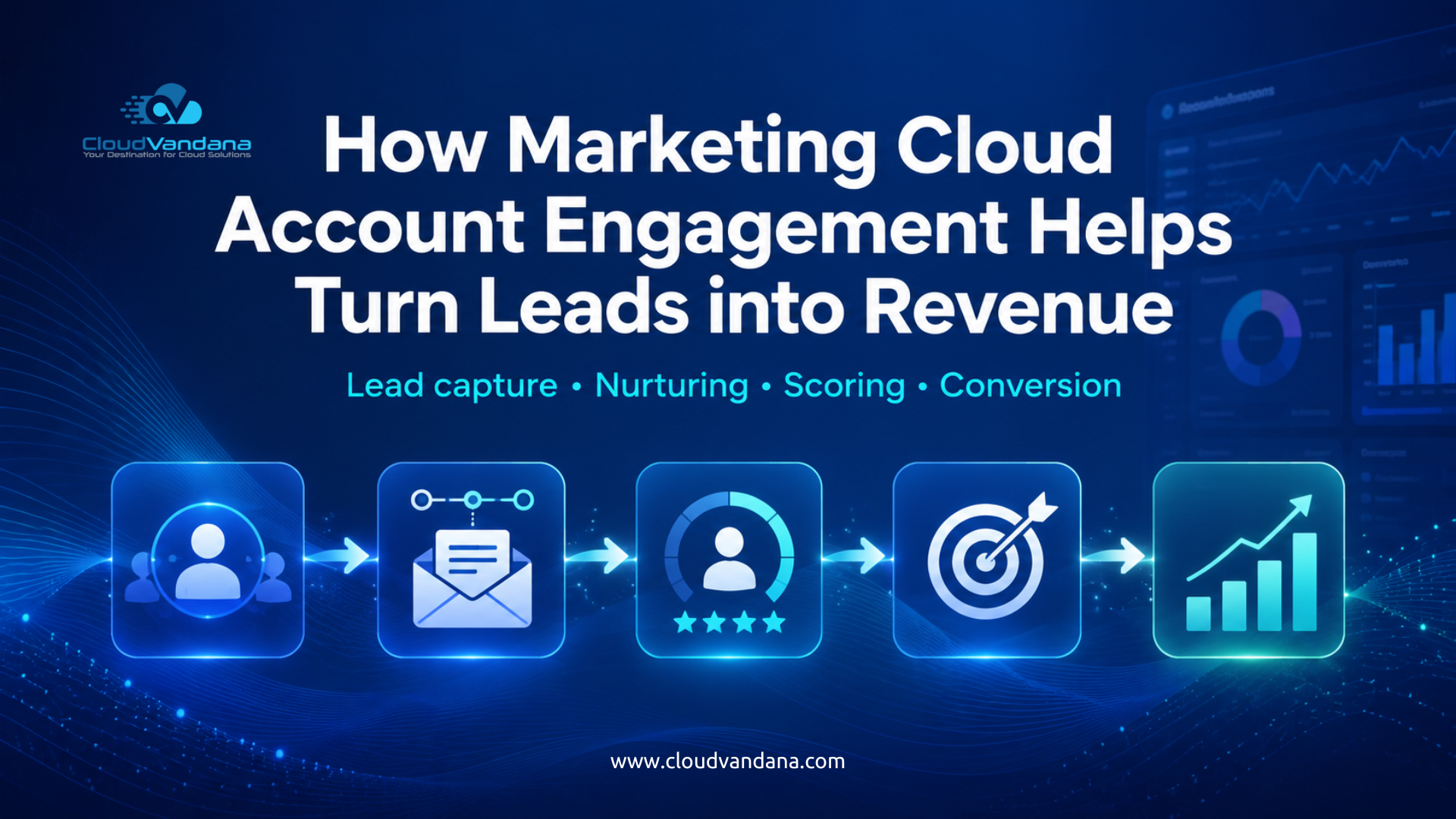
Introduction: Why Lead Generation Alone Is Not Enough
Every business wants more leads.
More form fills. More inquiries. More newsletter subscribers. More demo requests. More names entering the CRM.
But here is the uncomfortable truth: leads do not automatically become revenue.
A lead is only the beginning of the commercial conversation. It is a signal, not a sale. It tells you someone showed interest, downloaded something, attended a webinar, visited a page, or submitted a form. But that action alone does not confirm readiness, intent, budget, authority, or fit.
This is where many B2B organizations quietly lose revenue.
Marketing teams work hard to generate leads, but sales teams often receive incomplete, cold, or poorly qualified contacts. Sales representatives spend time chasing people who are not ready. Good prospects get ignored because their buying signals are hidden inside disconnected systems. Follow-ups happen late. Campaign data stays in marketing tools. Sales conversations happen in CRM. The customer journey becomes fragmented.
Marketing Cloud Account Engagement, formerly known as Pardot, helps solve this exact problem.
It gives B2B teams a structured way to capture, nurture, score, qualify, and hand off leads to sales at the right moment. Salesforce describes Marketing Cloud Account Engagement as a B2B marketing automation platform built to support lead generation, lead nurturing, sales alignment, account-based marketing, and marketing ROI.
In simple terms, it helps businesses move from “we have leads” to “we know which leads are ready to convert.”
That shift matters. Because revenue does not come from volume alone. Revenue comes from timing, relevance, trust, and alignment.
What Is Marketing Cloud Account Engagement?
Marketing Cloud Account Engagement is Salesforce’s B2B marketing automation platform designed to help companies build stronger relationships with prospects, nurture leads over time, and connect marketing activity directly with sales outcomes.
It is especially useful for businesses with longer sales cycles, multiple decision-makers, high-value products or services, and a need for tight sales and marketing collaboration.
Instead of treating marketing as a series of isolated campaigns, Account Engagement creates a connected system. It helps marketers capture leads through forms and landing pages, track prospect behavior, automate email journeys, assign lead scores, apply lead grades, and pass qualified prospects to sales teams inside Salesforce.
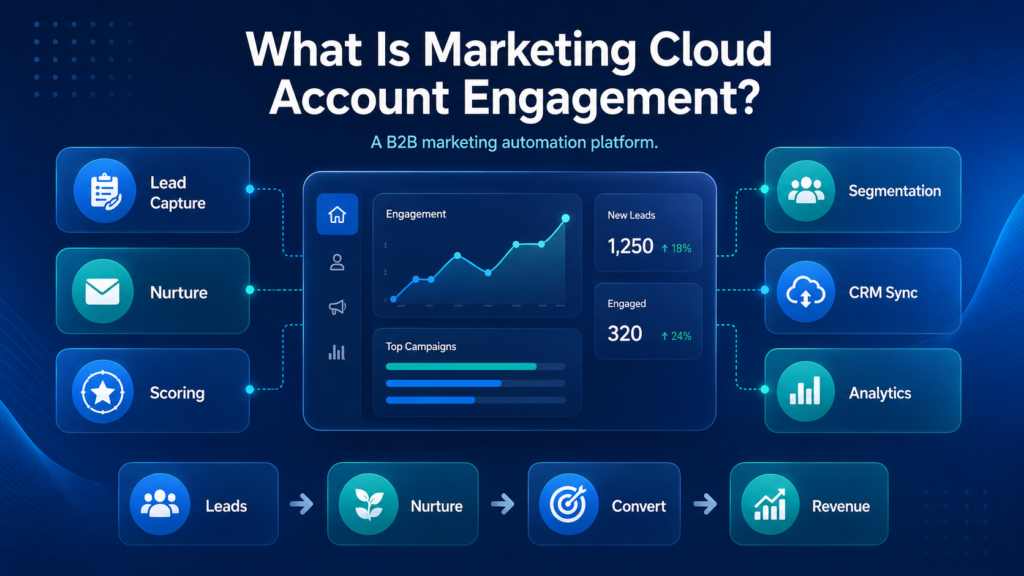
Salesforce positions Account Engagement as a platform that helps B2B companies generate and nurture leads, drive sales and marketing alignment, prioritize qualified prospects, manage campaigns, execute account-based marketing, and maximize marketing ROI.
That makes it more than an email automation tool.
It is a revenue enablement layer for B2B marketing.
When implemented well, it gives marketing teams visibility into what prospects are doing and gives sales teams context on why a lead matters. A salesperson can see whether someone opened multiple emails, downloaded a guide, visited a pricing page, registered for a webinar, or requested a demo.
That context changes the conversation.
Instead of saying, “Just checking in,” sales can say, “I noticed you were exploring ways to improve lead management. Would it be helpful to discuss how teams usually structure this inside Salesforce?”
That is the difference between interruption and relevance.
Why B2B Revenue Growth Needs Better Lead Management
B2B buying is rarely linear.
A prospect may discover your company through a blog, leave, return weeks later through a LinkedIn post, download a guide, attend a webinar, visit your pricing page, and then finally submit a demo request. In between, multiple stakeholders may be researching silently.
Without a proper lead management system, these signals remain scattered.
Marketing sees campaign engagement. Sales sees CRM records. Leadership sees pipeline reports. But no one sees the full journey clearly.
This creates several problems.
First, sales teams may receive leads too early. A person who downloads a beginner guide may not be ready for a sales call. Pushing too hard too soon can create friction.
Second, sales teams may receive leads too late. A high-intent prospect may visit important pages several times, but if no alert or score threshold exists, the opportunity may go unnoticed.
Third, marketing may not know which campaigns influence revenue. A campaign may generate many leads, but those leads may never convert. Another campaign may generate fewer leads but produce better pipeline. Without attribution and reporting, budget decisions become guesswork.
Marketing Cloud Account Engagement helps businesses manage this complexity by organizing lead data, engagement signals, qualification rules, and sales handoff processes in one connected ecosystem.
The goal is not simply automation.
The goal is better commercial judgment.
The Difference Between Leads, Qualified Leads, and Revenue-Ready Prospects
Not every lead deserves the same level of attention.
That may sound simple, but it is one of the most important principles in B2B revenue operations. Many businesses make the mistake of treating every new inquiry as equally valuable. Every form fill gets pushed to sales. Every download is considered interest. Every contact is assumed to be a potential buyer.
But in reality, a lead is not always a buying signal.
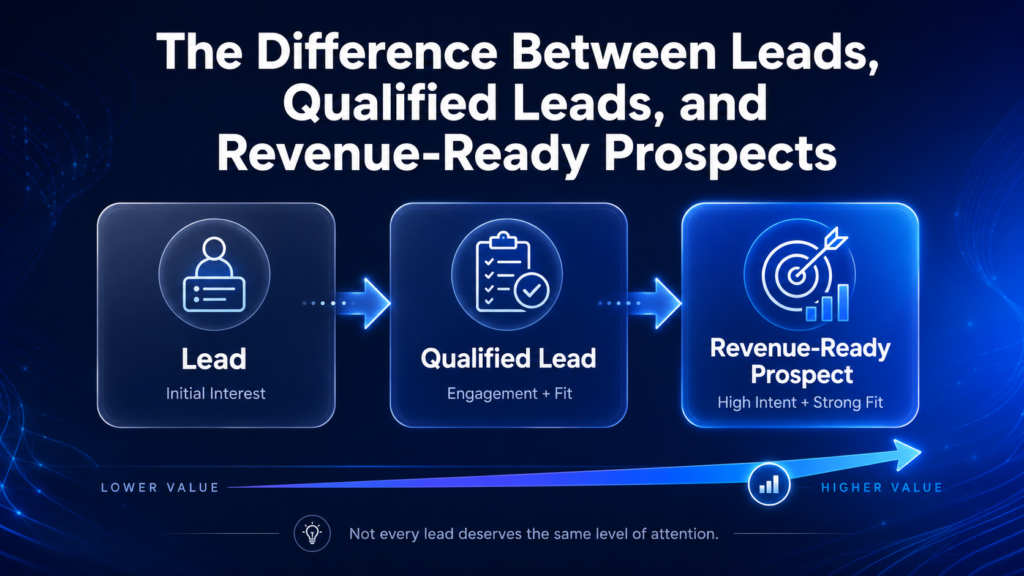
Sometimes, a lead is just curiosity. Sometimes, it is research. Sometimes, it is a competitor checking your content. Sometimes, it is a student downloading a resource. Sometimes, it is a genuine decision-maker quietly evaluating your solution.
The challenge is knowing the difference.
As the well-known sales principle goes:
“Not all leads are created equal. The value is not in the contact information, but in the intent behind it.”
This is exactly where Marketing Cloud Account Engagement becomes valuable. It helps businesses move beyond the surface-level definition of a lead and understand whether that person is truly ready for sales engagement.
A Lead Is Only the Starting Point
A lead is usually someone who has shared basic information with your business.
They may have:
- Filled out a contact form
- Downloaded an eBook or whitepaper
- Registered for a webinar
- Subscribed to a newsletter
- Clicked on a paid ad
- Visited a product or service page
- Requested access to a gated resource
At this stage, the business knows who they are, but not necessarily how serious they are.
That distinction is critical.
A person downloading a beginner-level guide may simply be exploring the topic. They may not have budget. They may not have decision-making authority. They may not even work for a company that fits your ideal customer profile.
So, while the lead is valuable, it may not be sales-ready yet.
This is where many organizations create unnecessary friction. They send every new lead directly to sales, hoping for quick conversion. But sales teams quickly realize that many of these leads are not ready for a conversation.
The result?
- Sales representatives waste time on poor-fit contacts
- Genuine prospects receive delayed attention
- Marketing lead quality gets questioned
- Follow-up becomes inconsistent
- Conversion rates remain low despite high lead volume
A lead should be seen as the beginning of a relationship, not the end of the marketing process.
A Qualified Lead Shows Stronger Signals
A qualified lead is different.
This is someone who meets certain engagement and fit criteria. They have shown more than casual interest. They have taken actions that suggest relevance, need, or buying intent.
For example, a qualified lead may have:
- Downloaded multiple resources
- Opened and clicked several emails
- Visited high-intent pages such as pricing, services, or demo pages
- Attended a webinar
- Returned to the website multiple times
- Matched the company’s target industry
- Used a business email address
- Held a relevant job title
- Submitted a form with specific service interest
This is where the lead starts becoming more meaningful.
The person is not just visible. They are engaged.
But even then, engagement alone is not enough.
A lead can be highly active but still not be a good business fit. For example, a student may download five resources for academic research. A freelancer may explore enterprise-level services out of curiosity. A competitor may read multiple pages to understand positioning.
That is why qualification must include both behavior and fit.
Marketing Cloud Account Engagement helps businesses measure both.
Through scoring, it tracks how engaged a prospect is.
Through grading, it evaluates how closely the prospect matches the company’s ideal customer profile.
Together, these two signals help teams answer a practical question:
“Is this person simply interested, or are they likely to become a real business opportunity?”
A Revenue-Ready Prospect Deserves Sales Attention
A revenue-ready prospect is a lead who has shown enough intent and alignment to justify direct sales involvement.
This is the stage where marketing should confidently pass the lead to sales.
A revenue-ready prospect usually has three qualities:
- They are engaged
They have interacted with your campaigns, emails, content, or website in a meaningful way. - They are a good fit
Their role, company size, industry, geography, or business need matches your ideal customer profile. - They show intent
Their behavior suggests they may be evaluating a solution, not just casually browsing.
For example, imagine two people download the same whitepaper.
The first is a student using a personal email address. They download one guide and never return.
The second is a Director of Operations from a target industry. They download the guide, visit your pricing page, read a case study, register for a webinar, and return to your website three times in one week.
Both are technically leads.
But only one looks revenue-ready.
This difference matters because sales capacity is finite. Sales teams do not have unlimited time, energy, or attention. Every hour spent chasing an unqualified lead is an hour not spent with a serious buyer.
A revenue-ready prospect deserves faster follow-up, deeper personalization, and a more consultative sales approach.
Why Treating Every Lead Equally Hurts Revenue
When every lead is treated as urgent, sales teams become overloaded.
They may spend too much time calling people who are not ready, not relevant, or not interested enough. Over time, this creates frustration. Sales starts losing trust in marketing-generated leads.
On the other hand, when every lead is treated as passive, opportunities are missed.
A high-intent prospect may be actively comparing solutions, but if the business fails to recognize the signal, the lead may go cold or choose a competitor.
This is the central challenge of lead management:
- Move too early, and you create pressure.
- Move too late, and you lose momentum.
- Move without context, and the conversation feels generic.
- Move with the right insight, and the buyer feels understood.
Marketing Cloud Account Engagement helps businesses find that balance.
It separates casual curiosity from meaningful intent.
How Account Engagement Identifies the Difference
Marketing Cloud Account Engagement helps businesses classify leads more intelligently through several connected capabilities.
1. Scoring Measures Engagement
Scoring helps determine how active a prospect is.
A prospect may receive points for actions such as:
- Opening marketing emails
- Clicking links
- Submitting forms
- Visiting important website pages
- Downloading content
- Registering for webinars
- Attending events
- Returning to the website repeatedly
The more meaningful the action, the more weight it can carry.
For example, visiting a pricing page may deserve a higher score than opening a newsletter. Requesting a demo may deserve more weight than downloading a general awareness guide.
Scoring answers the question:
“How interested is this prospect based on their behavior?”
2. Grading Measures Fit
Grading helps determine whether the prospect matches your ideal customer profile.
A prospect may receive a stronger grade based on factors such as:
- Job title
- Department
- Industry
- Company size
- Country or region
- Business email domain
- Product or service interest
- Seniority level
- Account type
This prevents businesses from confusing activity with opportunity.
A highly engaged but poor-fit lead may not deserve immediate sales attention. A strong-fit lead with moderate engagement may be worth nurturing carefully.
Grading answers the question:
“Is this the kind of prospect we actually want to sell to?”
3. Segmentation Groups Leads by Relevance
Segmentation helps divide leads into meaningful groups.
Instead of sending the same message to everyone, businesses can create segments such as:
- New leads
- Cold leads
- Webinar attendees
- High-intent visitors
- Enterprise prospects
- Industry-specific prospects
- Product-specific interest groups
- Inactive leads
- Sales-ready prospects
This allows marketing to communicate with more precision.
A CEO does not need the same message as a technical admin. A new lead does not need the same content as someone comparing vendors. A prospect interested in Salesforce consulting does not need the same journey as someone exploring marketing automation.
Segmentation makes communication feel relevant instead of random.
4. Automation Moves Leads Through the Right Journey
Automation helps ensure leads are nurtured consistently.
For example:
- A new lead downloads a guide and enters an educational nurture sequence.
- A webinar attendee receives a follow-up email with related resources.
- A high-scoring prospect triggers a sales notification.
- An inactive lead enters a re-engagement journey.
- A poor-fit lead stays in a long-term awareness campaign instead of going to sales.
This reduces manual work and improves timing.
The right prospect receives the right message at the right stage.
5. CRM Integration Gives Sales the Full Context
Because Marketing Cloud Account Engagement connects with Salesforce CRM, sales teams can see the prospect’s engagement history.
This may include:
- Which emails they opened
- Which links they clicked
- Which forms they submitted
- Which pages they visited
- Which campaigns they engaged with
- What their score and grade look like
- Which topic or solution they seem interested in
This gives sales teams a much stronger starting point.
Instead of reaching out blindly, they can begin with context.
For example:
“I noticed your team was exploring our Salesforce automation resources. Many businesses come to us at this stage when they are trying to reduce manual follow-ups and improve lead visibility. Would it be helpful to discuss what that could look like for your team?”
That type of outreach feels far more relevant than a generic sales pitch.
The Real Value: Better Prioritization
The biggest benefit of this distinction is prioritization.
Marketing Cloud Account Engagement helps teams understand which leads need nurturing, which leads need more education, and which leads need immediate sales involvement.
This creates a healthier revenue process.
- Marketing can nurture early-stage leads without rushing them.
- Sales can focus on prospects with stronger buying signals.
- Leadership can see better lead quality and pipeline movement.
- Prospects receive communication that matches their journey.
- Revenue teams waste less time and act with more precision.
In B2B sales, timing is everything.
A prospect contacted too early may feel pressured.
A prospect contacted too late may already be speaking with competitors.
A prospect contacted with the wrong message may ignore the outreach.
A prospect contacted at the right time with the right context may become an opportunity.
That is the difference Account Engagement helps create.
Simple Comparison: Lead vs Qualified Lead vs Revenue-Ready Prospect
| Stage | What It Means | Example | Best Next Action |
| Lead | Someone has shown basic interest | Downloaded one beginner guide | Add to nurture journey |
| Qualified Lead | Someone shows engagement and/or fit | Opens emails, visits service pages, matches target profile | Continue nurturing or monitor closely |
| Revenue-Ready Prospect | Someone shows strong intent and business fit | Visits pricing page, reads case studies, attends webinar, matches ICP | Notify sales for timely outreach |
The goal is not to collect the largest number of leads.
The goal is to identify the right leads and move them forward intelligently.
Marketing Cloud Account Engagement helps businesses do exactly that. It gives teams the tools to separate curiosity from intent, engagement from fit, and form fills from real revenue opportunities.
Because in B2B marketing, success is not measured by how many people enter the funnel.
It is measured by how many of the right people move through it.
How Account Engagement Connects Marketing Activity to Sales Outcomes
One of the strongest advantages of Marketing Cloud Account Engagement is its ability to connect marketing activity with sales visibility.
In many organizations, marketing and sales are technically working toward the same goal, but they often operate from different versions of the customer journey.
Marketing knows who opened emails, clicked campaign links, downloaded resources, submitted forms, or attended webinars. Sales knows which leads were contacted, which opportunities were created, and which deals moved forward.
The problem is that these two views do not always meet.
That creates a weak bridge between engagement and revenue.
Account Engagement helps strengthen that bridge by syncing prospect activity with Salesforce. This means marketing teams can continue building campaigns, nurture programs, landing pages, and email journeys, while sales teams can see how each prospect has interacted before outreach happens.
For example, instead of seeing only a name, email address, and company name in the CRM, a sales representative can understand:
- Which campaign brought the prospect in
- Which emails they engaged with
- Which forms they submitted
- Which pages they visited
- Which resources they downloaded
- How engaged they are based on score
- How closely they match the ideal customer profile based on grade
That context makes follow-up much stronger.
A salesperson is no longer approaching the prospect with a cold, generic message. They can start the conversation around the prospect’s visible interest.
For example:
“I noticed you were exploring our resources around marketing automation and lead nurturing. Many teams come to us when they are trying to improve lead quality and reduce manual follow-ups. Would it be helpful to discuss what that could look like inside Salesforce?”
This kind of outreach feels relevant because it is based on actual behavior.
It also creates a more accountable revenue process.
Marketing is no longer measured only by the number of leads generated. It can also be evaluated by the quality of those leads, the campaigns that influenced pipeline, the engagement created across the funnel, and the contribution made to revenue outcomes.
Sales is no longer forced to work from cold CRM records. It receives behavioral context that helps prioritize outreach and personalize conversations.
Leadership also gets better visibility into what is working. Instead of asking only, “How many leads did this campaign generate?” leaders can ask better questions, such as:
- Which campaigns influenced real pipeline?
- Which sources generated the most qualified prospects?
- Which nurture journeys moved leads closer to sales-readiness?
- Which content assets created meaningful engagement?
- Where are leads dropping off before conversion?
This is where Account Engagement becomes more than a marketing automation tool.
It becomes a revenue connection layer between marketing effort and sales execution.
When marketing activity, prospect behavior, Salesforce data, and sales follow-up work together, the business gets a clearer view of the full journey from first touch to opportunity creation. That clarity helps teams make better decisions, improve campaign performance, and focus on the leads most likely to become revenue.
Lead Capture: Turning Website Visitors into Known Prospects
Most website visitors are anonymous.
They browse your pages. They compare your services. They read a blog, check a solution page, maybe look at a case study, and then leave without speaking to anyone.
This is normal buyer behavior, especially in B2B. Prospects often research quietly before they are ready to contact sales. The challenge is that if your website only attracts traffic but does not capture meaningful information, a large part of that interest remains invisible.
Marketing Cloud Account Engagement helps turn anonymous traffic into known prospects through forms, landing pages, tracking, gated content, and campaign engagement.
For example, a visitor may land on your website after searching for a topic like Salesforce marketing automation or lead nurturing. At first, they are anonymous. But if they download a guide, register for a webinar, or submit a consultation form, Account Engagement can create or update their prospect profile.
From that point, the journey becomes much clearer.
Instead of seeing only website traffic numbers, your business can begin to understand individual engagement patterns, such as:
- Which form the prospect submitted
- Which landing page converted them
- Which campaign brought them in
- Which content offer attracted their interest
- Which emails they opened later
- Which links they clicked
- Which pages they returned to
- Whether their activity increased over time
This profile becomes more valuable with every interaction.
A single form submission may show basic interest. But repeat visits, email clicks, webinar attendance, content downloads, and visits to high-intent pages create a stronger picture of buyer intent.
That matters because B2B sales is built on context.
A sales team does not just need a name and email address. It needs to understand what the prospect cares about, how serious they appear to be, where they are in the buying journey, and what problem they may be trying to solve.
For example, there is a big difference between these two visitors:
| Visitor Type | Behavior | What It May Indicate |
| Visitor A | Reads one beginner blog and leaves | Early-stage research |
| Visitor B | Downloads a guide, attends a webinar, visits the service page, and returns twice | Stronger buying intent |
Both may enter your database as leads, but their level of priority should not be the same.
This is where Account Engagement becomes useful. It helps capture those signals, organize them into a prospect profile, and make them available for marketing and sales teams.
Marketing can use that information to place the prospect into the right nurture journey. Sales can use it to personalize outreach when the lead becomes ready. Leadership can use it to understand which campaigns and website assets are creating meaningful engagement.
In simple terms, Account Engagement helps businesses move from anonymous traffic to actionable buyer intelligence.
That shift is important.
Because website visits alone do not create revenue. Known prospects with clear intent signals create better opportunities.
Forms and Landing Pages: The First Revenue Touchpoint
Forms and landing pages are often treated as basic marketing assets.
A landing page is created for a campaign. A form is added to collect names, emails, and phone numbers. The campaign goes live, leads come in, and the data moves somewhere into the system.
But in a revenue-focused marketing setup, forms and landing pages are much more than digital placeholders.
They are conversion infrastructure.
A well-built landing page does three important things. It explains the value of the offer, captures the prospect’s interest, and guides them toward the next meaningful action. That action could be downloading a guide, registering for a webinar, requesting a demo, booking a consultation, or showing interest in a specific service.
A form then turns that interest into usable business data.
With Marketing Cloud Account Engagement, forms and landing pages can support a much more structured lead capture process. They do not just collect information. They can help qualify the prospect, update Salesforce fields, trigger automation, send confirmation emails, notify sales teams, and enroll the prospect into the right nurture journey.
For example, a prospect who fills out a general newsletter form may enter an educational nurture sequence. But a prospect who fills out a “Request a Consultation” form may trigger a sales notification immediately.
That difference matters.
Not every conversion action carries the same level of intent.
What Forms and Landing Pages Can Be Used For
Account Engagement forms and landing pages can support several types of campaigns, including:
- Webinar registrations
- Demo requests
- Content downloads
- Event sign-ups
- Newsletter subscriptions
- Consultation requests
- Product interest forms
- Service inquiry forms
- Case study downloads
- Free assessment or audit requests
Each one serves a different purpose in the buyer journey.
A webinar registration may show educational interest. A pricing inquiry may show stronger buying intent. A consultation request may indicate that the prospect is ready for a conversation.
The system should recognize these differences.
Every Form Field Should Have a Purpose
The key is to avoid collecting data randomly.
Every form field should help the business understand, segment, qualify, or follow up with the prospect more effectively.
Useful fields may include:
- Name
- Business email
- Company name
- Job title
- Industry
- Company size
- Country or region
- Product or service interest
- Current challenge
- Timeline for implementation
- Preferred contact method
But more fields do not always mean better data.
If a form asks too many questions too early, visitors may abandon it. If a form asks too few questions, the business may not have enough information to qualify the lead properly.
This is the balance every revenue-focused team needs to manage.
A good form should feel easy for the prospect, but useful for the business.
How Form Data Supports Better Follow-Up
The information collected through forms can directly improve segmentation, scoring, grading, and sales outreach.
For example:
| Form Field | How It Helps |
| Job Title | Helps identify decision-makers, influencers, or technical users |
| Industry | Supports industry-specific segmentation and messaging |
| Company Size | Helps determine whether the prospect fits the ideal customer profile |
| Product Interest | Routes the prospect into the right nurture journey |
| Timeline | Helps sales prioritize urgent opportunities |
| Country or Region | Supports regional follow-up and campaign targeting |
This makes the follow-up more relevant.
Instead of sending every lead the same generic email, Account Engagement can help route prospects based on what they actually shared.
A prospect interested in Marketing Cloud Account Engagement can receive automation-focused content. A prospect interested in Salesforce implementation can enter a different journey. A prospect requesting a consultation can be sent to sales faster.
That is how forms become part of the revenue process.
Landing Pages Should Match Buyer Intent
A landing page should not simply describe an offer. It should match the prospect’s intent.
Someone visiting a landing page from a beginner-level blog may need education and reassurance. Someone clicking a retargeting ad for a demo may need proof, clarity, and a direct CTA. Someone coming from a webinar campaign may need a focused explanation of the topic and the value of attending.
Strong landing pages usually include:
- A clear headline
- A direct explanation of the offer
- Benefits that speak to the prospect’s problem
- Trust signals such as testimonials, logos, numbers, or case studies
- A simple form
- A strong call to action
- Minimal distractions
- Clear next steps after submission
The page should answer one simple question quickly:
“Why should I give you my information right now?”
If the value is unclear, the form will feel like friction. If the value is strong, the form feels like a fair exchange.
The Best Setup Balances Experience and Intelligence
The best forms and landing pages balance two priorities: user experience and revenue intelligence.
From the user’s perspective, the process should be simple, clear, and worth the effort.
From the business perspective, the submission should provide enough information to support qualification, segmentation, and follow-up.
Marketing Cloud Account Engagement helps bring both sides together.
It allows teams to create conversion points that are not only attractive to prospects but also useful for sales and marketing operations.
That is why forms and landing pages should not be treated as afterthoughts.
They are often the first serious revenue touchpoint.
And when they are designed well, they help turn anonymous interest into qualified pipeline.
Prospect Tracking: Understanding Buyer Intent Before Sales Outreach
Prospect tracking is one of the most useful capabilities in Account Engagement because it helps businesses understand behavior beyond the form fill.
A prospect’s actions can reveal intent long before they speak to sales.
Someone who opens one educational email may still be early in the journey. Someone who repeatedly visits service pages, pricing pages, integration pages, or case studies may be closer to decision-making.
Salesforce’s own explanation of lead scoring highlights that lead activity can include actions such as time spent on product pages, pricing page visits, collateral downloads, demo requests, and requests for more information.
This behavioral intelligence is powerful.
It helps sales teams approach prospects based on actual interest instead of assumption.
A cold call becomes a contextual conversation. A generic email becomes a relevant follow-up. A random outreach attempt becomes a timely commercial touchpoint.
That is how intent data supports revenue.
Lead Nurturing: Guiding Prospects Through the Buying Journey
Lead nurturing is the process of building trust with prospects until they are ready to buy.
In B2B marketing, this is extremely important because most prospects are not ready to speak with sales the first time they interact with your business. They may download a guide, visit a service page, or register for a webinar, but that does not always mean they are ready to make a purchasing decision.
Sometimes, they are still exploring the problem.
Sometimes, they are comparing vendors.
Sometimes, they are gathering information for an internal discussion.
Sometimes, they need budget approval before moving forward.
Sometimes, they are interested, but the timing is not right.
This is why immediate sales follow-up cannot be the only strategy. If every new lead is pushed directly to sales, many good prospects may feel rushed. On the other hand, if a business does not continue communicating with them, those prospects may forget the brand completely.
Lead nurturing fills that gap.
It keeps the conversation alive in a useful, relevant, and non-intrusive way.
As Salesforce explains, lead nurturing is about offering valuable resources and incentives that guide prospects through the sales journey until they are ready to make a purchase. In simple terms, it is not about chasing leads. It is about helping them move forward with confidence.
Why Lead Nurturing Matters in B2B
B2B buying decisions usually involve more thought, more people, and more time than simple consumer purchases.
A prospect may need to answer several questions before they are ready to buy:
- What problem are we trying to solve?
- Is this problem urgent enough?
- What are the available solutions?
- Which vendor understands our industry?
- What will implementation look like?
- How much will it cost?
- Will leadership approve the budget?
- Will the team actually use the solution?
- What risks should we consider?
- What results can we expect?
These questions are not answered in one email or one phone call.
They require education, proof, reassurance, and repeated value.
That is why nurturing is so important. It allows businesses to stay present while the prospect moves through their internal decision-making process.
How Account Engagement Supports Lead Nurturing
Marketing Cloud Account Engagement helps businesses create automated nurturing journeys that guide prospects step by step.
These journeys can be based on behavior, interest, engagement level, form submissions, campaign source, product interest, or lifecycle stage.
For example, a prospect who downloads a beginner-level guide may enter an educational journey. A prospect who attends a webinar may receive deeper resources. A prospect who visits a pricing or consultation page may be moved closer to sales follow-up.
The journey can adjust based on how the prospect behaves.
If they keep engaging, their score increases.
If they stop engaging, they can enter a re-engagement path.
If they show high intent, sales can be notified.
If they are not ready yet, marketing can continue nurturing them.
This makes the experience feel more natural.
The prospect is not pushed too early, but they are not ignored either.
Example of a Simple Lead Nurturing Journey
Here is how a basic nurturing journey may look:
| Stage | Prospect Action | Account Engagement Response |
| First interaction | Prospect downloads a guide about Salesforce implementation | Sends a thank-you email with the guide |
| Education stage | Prospect opens the email | Sends a related checklist a few days later |
| Consideration stage | Prospect clicks the checklist link | Sends a case study or success story |
| Deeper engagement | Prospect visits a service page | Increases lead score |
| High intent | Prospect registers for a webinar | Adds them to a webinar nurture sequence |
| Sales-ready stage | Prospect reaches a score threshold | Notifies sales for follow-up |
This journey is useful because it responds to the prospect’s behavior.
It does not treat every lead the same way. It watches for signals and moves the person forward based on interest.
What Good Nurturing Content Looks Like
Good nurturing content should help the prospect make a better decision.
It should not feel like constant selling.
Strong nurturing content may include:
- Educational blogs
- Checklists
- Buyer guides
- Case studies
- Comparison resources
- Webinar invitations
- Industry insights
- Product explainers
- ROI-focused content
- Implementation guides
- Common mistake articles
- Customer success stories
Each piece should answer a question the prospect may have at that stage of the journey.
For example, an early-stage prospect may need a guide like “What Is Salesforce Marketing Automation?” A middle-stage prospect may need “How to Choose the Right Salesforce Marketing Automation Tool.” A late-stage prospect may need “What to Expect During a Marketing Cloud Account Engagement Implementation.”
The more relevant the content, the stronger the nurturing journey becomes.
Nurturing Builds Trust Before the Sales Conversation
One of the biggest benefits of lead nurturing is that it makes the eventual sales conversation warmer.
By the time a nurtured prospect speaks with sales, they may already understand the brand, the solution, the value proposition, and the business problem being solved.
That changes the tone of the conversation.
Sales does not need to start from zero. The prospect is already educated. They have consumed useful resources. They may have seen proof through case studies or webinars. They may already trust the company more than they did at the first touchpoint.
This is why nurturing is not just a marketing activity.
It directly supports sales productivity.
A well-nurtured lead is easier to speak with, easier to qualify, and often easier to move forward.
Good Nurturing Does Not Pressure. It Progresses.
The best nurturing journeys do not feel aggressive.
They feel helpful.
They give prospects the information they need at the moment they need it. They create familiarity. They answer doubts. They build confidence. They keep the business visible without overwhelming the buyer.
That is the difference between pressure and progression.
Pressure says, “Are you ready to buy now?”
Progression says, “Here is something useful that may help you make a better decision.”
Marketing Cloud Account Engagement helps businesses create that kind of progression at scale.
It allows teams to educate prospects, monitor engagement, increase scores, trigger sales alerts, and move leads forward without manually managing every touchpoint.
In B2B revenue growth, this matters deeply.
Because many leads do not convert immediately.
But with the right nurturing, they do not have to be lost.
Email Automation: Sending the Right Message at the Right Time
Email automation is one of the most visible features of Account Engagement, but its real value depends on strategy.
Sending more emails is not the goal.
Sending timely, relevant, stage-specific communication is the goal.
Account Engagement can help teams automate email programs based on prospect behavior, segmentation, form submissions, campaign engagement, and lead status. This makes it possible to deliver different messages to different audiences without manually managing every interaction.
For example, a prospect interested in Salesforce consulting should not receive the same email sequence as someone exploring marketing automation. A C-level executive may need business impact content. A technical admin may need configuration details. A new lead may need education. A warm lead may need proof.
This is where automation becomes more nuanced.
It allows teams to scale personalization without creating operational chaos.
Segmentation: Why Personalization Starts with Better Data
Personalization is often misunderstood.
It is not just adding a first name to an email or changing the subject line slightly. Real personalization means sending communication that feels relevant to the prospect’s role, interest, stage, and intent.
That starts with segmentation.
Marketing Cloud Account Engagement allows teams to segment prospects using data points such as:
- Job title
- Industry
- Geography
- Company size
- Campaign source
- Product or service interest
- Email engagement
- Website behavior
- Lifecycle stage
- Lead score and grade
When segmentation is done well, campaigns become sharper. Instead of sending one broad message to the entire database, marketers can create focused journeys for different types of prospects.
For example, a new lead who downloaded an introductory guide should not receive the same message as a high-intent prospect who visited a pricing page. Similarly, a Salesforce admin may care about configuration and usability, while a business leader may care more about ROI, efficiency, and revenue impact.
As a simple rule:
“The more relevant the message, the less it feels like marketing.”
A strong segmentation strategy helps answer important questions:
- Who is ready for sales?
- Who still needs education?
- Who is interested in a specific service?
- Who belongs to a target account?
- Who has gone inactive?
- Who should enter a re-engagement journey?
- Who should be excluded from a campaign?
This level of control improves both user experience and campaign performance.
Better segmentation leads to better messaging.
Better messaging leads to better engagement.
Better engagement leads to better conversion.
That is why segmentation should not be treated as a small marketing task. In Account Engagement, it becomes a revenue accelerator.
It helps teams stop speaking to everyone the same way and start communicating based on actual buyer context.
Lead Scoring: Identifying the Most Engaged Prospects
Lead scoring helps teams measure engagement.
In Account Engagement, scores typically increase when prospects take meaningful actions such as opening emails, clicking links, submitting forms, visiting pages, downloading assets, or engaging with campaigns.
Salesforce Trailhead provides dedicated training on scoring and grading in Account Engagement, including how teams can evaluate and prioritize leads more effectively.
The purpose of scoring is simple: help teams identify which prospects are showing buying interest.
A prospect who has visited your website once may not need immediate sales attention. A prospect who has interacted with five high-intent assets may deserve priority.
Lead scoring also helps marketing teams measure engagement momentum.
If scores increase over time, the nurture strategy may be working. If scores stagnate, the messaging may need improvement. If many low-quality leads accumulate high scores, the scoring model may need adjustment.
A good scoring model is not static.
It should evolve based on real sales feedback and conversion patterns.
Lead Grading: Measuring Fit, Not Just Activity
Scoring measures interest.
Grading measures fit.
That distinction is essential because engagement alone does not always mean opportunity.
A lead may open every email, download multiple resources, attend a webinar, and visit several pages on your website. On paper, that person looks active. But activity does not always equal sales potential.
For example, the lead may be:
- A student researching a topic for academic work
- A competitor studying your content
- A job seeker exploring your company
- A freelancer comparing tools
- A very small business outside your target market
- A professional from an industry you do not serve
- Someone without buying authority
This is why lead grading matters.
Marketing Cloud Account Engagement grading helps businesses evaluate whether a prospect matches their ideal customer profile. Instead of asking only, “Is this person engaged?” grading helps answer a deeper question:
“Is this the kind of prospect our sales team should spend time on?”
What Lead Grading Actually Measures
Lead grading is based on explicit information about the prospect.
This information may come from form submissions, CRM fields, enrichment data, or known account details. In Account Engagement, grades can help sales and marketing teams create a shared understanding of lead quality.
A lead’s grade can reflect criteria such as:
- Job title
- Industry
- Company size
- Location
- Department
- Annual revenue range
- Product or service interest
- Seniority level
- Business email domain
- Buying authority
- Fit with the ideal customer profile
For example, a Director of Marketing at a mid-sized B2B company may receive a stronger grade than a student using a personal email address. Both may have shown interest, but they do not represent the same revenue potential.
That is the core value of grading.
It helps separate attention from alignment.
Why Fit Matters as Much as Interest
A highly engaged lead can still be a poor fit.
This is one of the most common mistakes in B2B marketing automation. Teams see strong activity and assume the lead is ready for sales. But if the person does not match the target audience, sales may end up spending time on a conversation that has little chance of converting.
On the other hand, a strong-fit prospect with moderate engagement may be very valuable.
For example, a VP of Sales from a target account may only download one guide. But if the company size, industry, and business need are aligned, that prospect may deserve careful nurturing or sales awareness.
This is why scoring and grading should work together.
A strong score tells sales:
“This person is actively engaging.”
A strong grade tells sales:
“This person looks like the type of buyer we want.”
Together, they create a much clearer qualification model.
Simple Example: Score vs Grade
| Prospect | Engagement Score | Lead Grade | What It Means |
| Student researching marketing automation | High | Low | Interested, but poor fit |
| Marketing Director from target industry | High | High | Strong sales opportunity |
| CEO from target company with low activity | Low | High | Good fit, needs nurturing |
| Personal email subscriber with no company data | Medium | Low | Needs more qualification |
This helps sales and marketing avoid a common trap: treating every active lead as a priority.
Activity matters, but fit decides whether that activity is commercially meaningful.
How Grading Improves Sales and Marketing Alignment
Lead grading also improves alignment between marketing and sales.
Without grading, sales may complain that marketing is sending too many unqualified leads. Marketing may respond by pointing to engagement numbers. Both teams may be looking at different definitions of “quality.”
Grading creates a shared language.
Sales and marketing can agree on what a good-fit lead looks like before the handoff happens. That agreement may include details such as target industries, minimum company size, relevant job roles, geographic markets, and preferred customer profiles.
Once those criteria are built into Account Engagement, lead qualification becomes more consistent.
The result is a cleaner handoff.
Marketing does not simply send “active” leads to sales. It sends leads that show both interest and fit.
The Revenue Value of Better Grading
Good grading protects sales time.
And in B2B, sales time is expensive.
If sales teams spend too much time chasing poor-fit leads, the entire pipeline slows down. High-potential prospects may receive delayed follow-up, while low-potential contacts consume attention.
Lead grading helps prevent that.
It allows businesses to:
- Prioritize best-fit prospects
- Reduce poor-quality sales handoffs
- Improve lead qualification accuracy
- Create better nurture paths
- Segment messaging by customer profile
- Support account-based marketing
- Improve conversion rates from MQL to SQL
- Build stronger trust between sales and marketing
The goal is not to reject every imperfect lead immediately. Some may still be worth nurturing. But grading helps decide the right level of attention.
A poor-fit lead may stay in a long-term educational campaign.
A medium-fit lead may need more information before routing.
A high-fit lead may deserve closer monitoring.
A high-fit, high-score lead may be ready for sales.
Scoring + Grading: The Revenue Qualification Engine
Scoring and grading are valuable individually.
Together, they are transformative.
A high score with a poor grade may indicate strong interest but weak fit. A strong grade with a low score may indicate a good-fit account that needs more nurturing. A high score and high grade may indicate a sales-ready prospect.
This combination helps teams prioritize intelligently.
For example:
High score + high grade = send to sales quickly.
High score + low grade = nurture carefully or disqualify.
Low score + high grade = continue education and awareness.
Low score + low grade = low priority.
This model prevents sales teams from chasing every form fill equally. It also helps marketing prove that lead qualification is based on logic rather than intuition.
When sales and marketing agree on scoring and grading rules, the lead handoff becomes more precise.
And precision is where revenue improves.
Sales and Marketing Alignment: Ending the Lead Handoff Problem
One of the biggest revenue leaks in B2B organizations is the lead handoff.
Marketing generates leads. Sales receives leads. Then the complaints begin.
Sales says the leads are not qualified.
Marketing says sales is not following up.
Leadership says pipeline is inconsistent.
Prospects experience delayed or irrelevant communication.
Account Engagement helps reduce this friction by creating shared definitions and automated processes.
Marketing can define qualification criteria. Sales can receive alerts when prospects meet specific thresholds. CRM records can show engagement history. Campaign influence can be tracked. Follow-up can become more timely.
This does not magically solve alignment. Technology never replaces communication.
But it gives teams a shared operating system.
When both teams can see the same prospect data, the conversation becomes more objective.
Instead of debating lead quality emotionally, teams can review evidence: score, grade, activity history, source, campaign engagement, and opportunity outcomes.
Salesforce CRM Integration: Why Native Alignment Matters
Account Engagement’s connection with Salesforce CRM is one of its most important strengths.
B2B revenue teams already rely on Salesforce for leads, contacts, accounts, opportunities, activities, reports, and pipeline management. When marketing automation works closely with CRM, teams can reduce data fragmentation and create a more seamless revenue process.
Salesforce describes Account Engagement as built on the world’s number one CRM, helping companies unite customer data and scale account relationships.
This matters because revenue data should not live in silos.
A marketer should know which campaigns influence opportunities. A salesperson should know which content a prospect consumed. A manager should know whether marketing-qualified leads are converting into pipeline. A leadership team should know which channels generate real revenue, not just engagement.
When Account Engagement is configured well with Salesforce, teams can create a closed-loop system.
Marketing activity feeds sales insight.
Sales outcomes improve marketing strategy.
Campaign reporting informs budget decisions.
Pipeline data validates marketing performance.
That is the foundation of revenue accountability.
Campaign Reporting: Connecting Marketing Effort to Pipeline
Personalization is often misunderstood.
It is not just adding a first name to an email or changing the subject line slightly. Real personalization means sending communication that feels relevant to the prospect’s role, interest, stage, and intent.
That starts with segmentation.
Marketing Cloud Account Engagement allows teams to segment prospects using data points such as:
- Job title
- Industry
- Geography
- Company size
- Campaign source
- Product or service interest
- Email engagement
- Website behavior
- Lifecycle stage
- Lead score and grade
When segmentation is done well, campaigns become sharper. Instead of sending one broad message to the entire database, marketers can create focused journeys for different types of prospects.
For example, a new lead who downloaded an introductory guide should not receive the same message as a high-intent prospect who visited a pricing page. Similarly, a Salesforce admin may care about configuration and usability, while a business leader may care more about ROI, efficiency, and revenue impact.
As a simple rule:
“The more relevant the message, the less it feels like marketing.”
A strong segmentation strategy helps answer important questions:
- Who is ready for sales?
- Who still needs education?
- Who is interested in a specific service?
- Who belongs to a target account?
- Who has gone inactive?
- Who should enter a re-engagement journey?
- Who should be excluded from a campaign?
This level of control improves both user experience and campaign performance.
Better segmentation leads to better messaging.
Better messaging leads to better engagement.
Better engagement leads to better conversion.
That is why segmentation should not be treated as a small marketing task. In Account Engagement, it becomes a revenue accelerator.
It helps teams stop speaking to everyone the same way and start communicating based on actual buyer context.
Account-Based Marketing with Account Engagement
B2B buying often happens at the account level, not the individual level.
A single person may download a whitepaper, but the actual decision may involve leadership, finance, IT, operations, procurement, and end users.
Account-Based Marketing, or ABM, focuses on targeting high-value accounts and engaging multiple stakeholders within those accounts.
Account Engagement supports ABM by helping teams segment target accounts, personalize communication, track engagement, and coordinate sales follow-up.
For example, if multiple people from the same company engage with your content, that may signal growing account-level interest. Sales can use this insight to start a more strategic conversation.
ABM is especially useful for businesses selling complex solutions, enterprise services, Salesforce consulting, implementation projects, or high-value B2B platforms.
Instead of chasing isolated leads, teams can focus on accounts with real revenue potential.
AI and Data-Driven Engagement in the Modern B2B Funnel
The B2B funnel is becoming more intelligent.
Modern buyers expect relevance. They do not want generic sequences, repetitive messaging, or disconnected conversations. They want vendors to understand their needs before the first call.
Salesforce has continued expanding Account Engagement capabilities with newer functionality connected to Data Cloud, Agentforce, cross-object merge fields, and SMS. Salesforce notes that some of these capabilities require Data Cloud to be provisioned and connected to Account Engagement.
This direction matters because B2B marketing is moving from basic automation to smarter engagement.
The future is not only “send this email after this form submission.”
The future is richer data, better personalization, AI-supported recommendations, stronger account intelligence, and more adaptive customer journeys.
For businesses using Salesforce, Account Engagement can become a key part of that transformation.
It helps create the foundation: clean prospect data, engagement tracking, segmentation, automation, scoring, grading, and CRM alignment.
Without that foundation, AI has little to work with.
Common Revenue Leaks Account Engagement Helps Fix
Revenue leaks are small process gaps that quietly reduce conversion.
They often go unnoticed because no single failure looks dramatic. But together, they create serious pipeline loss.
Account Engagement can help fix several common revenue leaks.
Slow Follow-Up
When a high-intent lead submits a form and waits days for a response, the opportunity cools down. Automation can notify sales quickly when a prospect reaches a threshold or submits a high-value form.
Poor Lead Qualification
Without scoring and grading, sales teams may waste time on low-fit leads. Account Engagement helps define qualification rules more clearly.
Generic Nurturing
If every lead receives the same emails, relevance suffers. Segmentation and automation help deliver more targeted content.
Lost Engagement Signals
Prospects often show interest before they contact sales. Tracking helps reveal those signals earlier.
Weak Marketing Attribution
If teams cannot connect campaigns to pipeline, budget decisions become difficult. Reporting helps identify what contributes to revenue.
Sales and Marketing Misalignment
Disconnected systems create blame. Shared data creates accountability.
Inactive Lead Databases
Old leads often sit untouched. Re-engagement campaigns can revive dormant interest.
Manual Operational Work
Manual list updates, follow-ups, and campaign actions consume time. Automation improves consistency and scale.
Each of these leaks may seem small.
But in a long B2B sales cycle, small leaks can become large revenue gaps.
Best Practices for Turning Leads into Revenue with Pardot
Marketing Cloud Account Engagement is powerful, but success depends on implementation quality.
Here are the best practices businesses should follow.
Define the Revenue Journey Before Building Automation
Do not begin with tools. Begin with the buyer journey.
Map how prospects move from awareness to consideration to decision. Identify the content, touchpoints, questions, and objections at each stage. Then build automation around that journey.
Align Sales and Marketing on Lead Definitions
A Marketing Qualified Lead should mean the same thing to both teams.
Define what makes a lead sales-ready. Include score, grade, behavior, fit, and business context.
Build a Practical Scoring Model
Do not overcomplicate scoring at the beginning.
Start with key actions such as form submissions, pricing page visits, demo requests, webinar attendance, and high-value content downloads. Adjust over time based on conversion data.
Use Grading to Protect Sales Time
A high score does not always mean a good lead.
Use grading to identify whether the lead fits your target customer profile.
Segment by Intent and Need
Avoid sending the same emails to everyone.
Segment based on industry, role, service interest, engagement stage, and lifecycle status.
Create Content for Every Funnel Stage
Early-stage prospects need education. Mid-stage prospects need comparison and proof. Late-stage prospects need demos, case studies, pricing clarity, and implementation confidence.
Monitor Campaign Influence
Track which campaigns create real pipeline movement.
Lead volume is useful, but revenue influence is more meaningful.
Keep Salesforce Data Clean
Account Engagement performs best when Salesforce data is structured, accurate, and maintained. Poor CRM hygiene weakens automation and reporting.
Review and Optimize Regularly
Automation should not be “set and forgotten.”
Review nurture performance, lead quality, sales feedback, conversion rates, and campaign attribution.
When Businesses Should Consider Marketing Cloud Account Engagement
Marketing Cloud Account Engagement is especially valuable for businesses that have a structured B2B sales process and want to improve how leads move from first interaction to closed revenue. It is a strong fit when the buying journey is longer than a simple transaction and prospects need multiple touchpoints before they are ready to speak with sales.
A business should consider Account Engagement when it is already generating leads but struggling to convert them consistently. This often happens when marketing and sales teams are not fully aligned, follow-up is inconsistent, or Salesforce CRM contains lead records without enough engagement context. In such cases, sales teams may know who the prospect is, but not what they are interested in, how active they have been, or whether they are truly ready for outreach.
It is also useful for companies that need lead nurturing at scale. As the database grows, manual follow-ups become difficult to manage. Account Engagement helps businesses create automated journeys that educate prospects, track engagement, and move them closer to sales-readiness over time. This allows marketing teams to stay connected with leads without overwhelming sales too early.
For sales teams, the platform becomes valuable because it improves lead prioritization. Instead of treating every lead equally, teams can focus on prospects who show stronger intent and better fit. For leadership, it provides clearer visibility into marketing performance, campaign influence, and the connection between marketing activity and revenue outcomes.
Account Engagement is not only for large enterprises. Growing B2B companies can also benefit from it if they have enough lead volume, sales complexity, and revenue ambition to justify a structured marketing automation platform. When the goal is not just to collect leads but to convert the right leads more efficiently, Account Engagement becomes a practical and powerful choice.
How CloudVandana Helps Businesses Implement Account Engagement
Marketing Cloud Account Engagement can become a powerful revenue engine, but only when it is planned, configured, and connected correctly.
Many businesses invest in marketing automation tools but use only a small part of what the platform can actually do. They send emails, collect leads, create a few basic workflows, and maybe track form submissions. But the bigger opportunity often remains untouched: connecting marketing activity directly to sales readiness, pipeline movement, and revenue outcomes.
That is where expert implementation makes a real difference.
CloudVandana helps businesses design, implement, and optimize Salesforce solutions that support practical business growth. For companies using or planning to use Marketing Cloud Account Engagement, this means building more than a basic email automation setup. It means creating a structured lead-to-revenue system where every important touchpoint has a purpose.
From marketing automation strategy and Account Engagement setup to lead scoring, grading, forms, landing pages, nurture journeys, campaign reporting, CRM field mapping, and sales handoff workflows, CloudVandana helps businesses create a cleaner and more connected process. The focus is not only on configuring the platform, but also on making sure marketing and sales teams can actually use it in their daily work.
A strong implementation also depends on data quality. If Salesforce CRM contains incomplete fields, duplicate records, unclear lifecycle stages, or inconsistent campaign structures, marketing automation will not perform at its best. CloudVandana helps businesses clean, organize, and map CRM data so Account Engagement can support better segmentation, qualification, reporting, and follow-up.
The objective is not just to “set up Pardot.”
The objective is to build a connected revenue system where marketing attracts the right leads, nurtures them intelligently, measures their intent, and passes them to sales when they are ready for a meaningful conversation.
For businesses investing in account-based marketing, lead nurturing, or stronger campaign visibility, CloudVandana can also help create workflows that support better targeting, better engagement, and better revenue clarity.
If your business is generating leads but struggling to convert them into qualified pipeline, CloudVandana can help turn scattered marketing activity into a structured revenue engine.
Conclusion
Marketing Cloud Account Engagement helps businesses solve one of the most important challenges in B2B growth: turning interest into revenue.
Generating leads is important, but it is only the first step. A form submission, content download, or webinar registration does not automatically mean a prospect is ready to buy. Businesses need a clear way to understand intent, measure engagement, identify fit, and move the right prospects toward sales at the right time.
That is where Account Engagement creates real value.
It connects lead capture, nurturing, scoring, grading, segmentation, CRM visibility, campaign reporting, and sales alignment into one structured process. Instead of leaving marketing and sales teams to work from disconnected data, it gives both sides a clearer view of the buyer journey.
The platform is not valuable simply because it automates emails or workflows.
It is valuable because it helps teams understand which prospects matter, what they care about, how engaged they are, where they are in the buying journey, and when sales should step in with a meaningful conversation.
In a competitive B2B environment, that clarity is priceless.
When businesses can separate curiosity from intent, activity from fit, and lead volume from lead quality, they make better revenue decisions. Marketing becomes more accountable. Sales becomes more focused. Leadership gets better visibility into what is actually driving pipeline.
Lead generation fills the funnel.
Marketing Cloud Account Engagement helps turn that funnel into a revenue system.
FAQs
1. What is Marketing Cloud Account Engagement?
Marketing Cloud Account Engagement is Salesforce’s B2B marketing automation platform. It helps businesses generate leads, nurture prospects, score and grade leads, align sales and marketing, and connect marketing campaigns with Salesforce CRM outcomes.
2. Is Marketing Cloud Account Engagement the same as Pardot?
Yes. Pardot was renamed Marketing Cloud Account Engagement. Many users still refer to it as Pardot because the original name was widely used for years.
3. How does Account Engagement help turn leads into revenue?
It helps businesses capture leads, nurture them with relevant communication, track engagement, score activity, grade fit, and notify sales when prospects become sales-ready. This improves timing, prioritization, and conversion.
4. What is lead scoring in Account Engagement?
Lead scoring measures a prospect’s engagement level. Scores can increase when prospects open emails, click links, submit forms, download assets, visit important pages, or take other meaningful actions.
5. What is lead grading in Account Engagement?
Lead grading measures how well a prospect fits your ideal customer profile. It can consider factors like job title, company size, industry, location, and other explicit data.
6. Why are scoring and grading both important?
Scoring shows interest. Grading shows fit. A lead with high engagement and strong fit is usually more valuable than a lead with only one of those signals.
7. Can Account Engagement integrate with Salesforce CRM?
Yes. One of its strongest advantages is its Salesforce CRM alignment. This allows marketing and sales teams to share prospect data, campaign activity, engagement history, and pipeline visibility.
8. Is Account Engagement only for large enterprises?
No. It is useful for many B2B organizations, especially those with longer sales cycles, multiple decision-makers, regular lead generation, and a need for structured nurturing and sales alignment.
9. Can Account Engagement support account-based marketing?
Yes. Account Engagement can support ABM strategies by helping teams segment target accounts, track engagement, personalize communication, and coordinate sales outreach around high-value accounts.
10. What types of campaigns can be built in Account Engagement?
Businesses can build lead nurture campaigns, webinar campaigns, demo request workflows, re-engagement campaigns, event follow-ups, onboarding sequences, product interest journeys, and account-based campaigns.
11. What are common mistakes businesses make with Account Engagement?
Common mistakes include weak scoring models, poor CRM data hygiene, generic email journeys, unclear lead qualification rules, lack of sales alignment, and failing to review campaign performance regularly.
12. How can CloudVandana help with Marketing Cloud Account Engagement?
CloudVandana can help businesses plan, implement, configure, and optimize Account Engagement. This includes lead scoring, grading, nurture journeys, Salesforce integration, reporting, campaign setup, and ongoing optimization.

Atul Gupta is CloudVandana’s founder and an 8X Salesforce Certified Professional who works with globally situated businesses to create Custom Salesforce Solutions.
Atul Gupta, a dynamic leader, directs CloudVandana’s Implementation Team, Analytics, and IT functions, ensuring seamless operations and innovative solutions.
YOU MIGHT ALSO LIKE

Financial Services Cloud: A Complete Guide for Banking and Wealth Management
How MuleSoft Connects Salesforce With ERP, Finance and Business Systems
Salesforce Customer 360: Connecting Sales, Service and Marketing Teams

Salesforce and Anthropic Launch Claudeforce: What It Means for the Future of Enterprise AI

Salesforce AIforce: What It Means for the Future of Enterprise Software