Introduction: The Evolution of Slack
Slack began as a simple workplace messaging tool. It entered organizations as a remedy to the chaos of fragmented email threads, endless reply-all chains, and disconnected conversations. Teams embraced it because it felt intuitive. Messages were instant. Context was preserved. Collaboration became fluid instead of forced.
It was faster. Cleaner. More human.
But that framing, while once accurate, is now incomplete.
The role Slack plays inside modern organizations has expanded far beyond communication. It is no longer just a place where work is discussed. It is increasingly becoming the place where work actually happens.
Today, Slack operates as the operational nervous system of forward-thinking businesses. Decisions are not drafted in documents and circulated over days. They are made in channels, in real time, often within minutes. Approvals are no longer buried in inboxes waiting for attention. They are surfaced, acted upon, and resolved within active conversations. Critical updates do not sit passively inside CRM dashboards. They are pushed into the flow of work, where teams can react immediately.
What used to live inside systems of record is now surfacing inside systems of engagement.
This is a profound shift.
Consider how traditional workflows were structured. Data lived inside applications. To access it, users had to log in, navigate interfaces, search for records, and manually interpret what needed to be done next. The system dictated the experience. The user adapted to the tool.
That model is quietly dissolving.
In its place, a new paradigm is emerging. One where work is no longer application-centric, but conversation-centric. Instead of forcing users to move toward systems, systems are moving toward users. Data is no longer something you go looking for. It comes to you, embedded within the context of a conversation, precisely when it is needed.
Slack sits at the center of this transformation.
It bridges structured systems like Salesforce with the unstructured, dynamic nature of human collaboration. It allows teams to interact with data in the same way they interact with each other, through dialogue, context, and immediacy. A deal update becomes a conversation. A customer issue becomes a shared thread. A pipeline review becomes a live, collaborative discussion rather than a static report.
This is not just an evolution of a tool. It is a redefinition of how digital work environments function.
Because when conversations become the interface, speed increases. Friction decreases. Adoption improves. And most importantly, decisions happen closer to real time, where they have the greatest impact.
That is why Slack is no longer just a communication layer.
It is becoming the interface through which businesses engage with their most critical systems.
And that is precisely why its evolution into a CRM interface is not only logical, but inevitable.
From Messaging Platform to Business Hub
Slack’s transformation into a business hub has been anything but incidental. It reflects a calculated evolution, guided by a clear thesis: work should happen where people already communicate. Over time, Slack has systematically expanded its capabilities—layering in integrations, workflow automation, app ecosystems, and AI-driven intelligence—until the boundary between “conversation” and “execution” has almost disappeared.
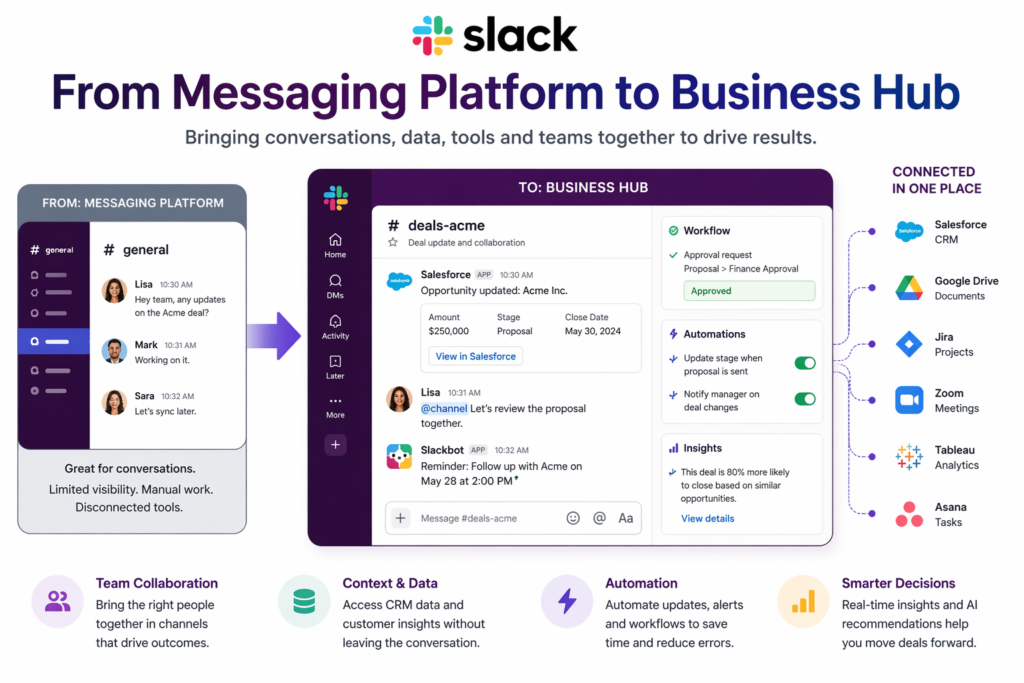
This progression has redefined what a workplace interface looks like.
Where teams once had to jump between multiple systems—opening a CRM to update a record, switching to a project tool to assign tasks, checking dashboards for insights—they can now perform those same actions within a single, continuous flow. Data can be pulled into a channel in seconds. Records can be updated through commands or embedded actions. Workflows can be triggered automatically based on context. Collaboration happens alongside execution, not after it.
The experience feels seamless because the friction has been engineered out.
But the real significance lies deeper than convenience. This convergence is fundamentally reshaping how enterprise software is consumed. Traditional enterprise tools were built around structured navigation—menus, modules, dashboards. Users had to learn the system, adapt to its logic, and operate within its constraints. Productivity was often limited by how efficiently someone could move between these digital silos.
That model is now being quietly overturned.
Slack represents a shift toward interaction-driven software, where the interface adapts to human behavior rather than the other way around. Conversations become the primary layer. Actions emerge naturally from those conversations. Systems no longer sit behind logins waiting to be accessed; they surface proactively, delivering information and enabling decisions in real time.
This is a subtle but powerful inversion.
Instead of employees adapting to systems, systems are adapting to how employees already think, communicate, and collaborate. The result is not just faster workflows, but a more intuitive way of working—one where intent translates into action without unnecessary steps, and where the distance between discussion and execution continues to shrink.
In that sense, Slack is not just expanding its feature set. It is redefining the very concept of a business interface.
What Does “Slack as a CRM Interface” Mean?
A CRM interface has traditionally been defined by structure. Dashboards, forms, tabular views, and neatly organized records inside platforms like Salesforce. Every interaction followed a predictable path. Log in. Navigate to a module. Open a record. Update fields. Save changes.
It was systematic. It was controlled. But it was also rigid.
That rigidity is exactly what modern teams are starting to outgrow.
Enter Slack—and with it, a fundamental shift in how CRM is experienced.
Slack does not replace the CRM. It redefines how users interact with it.
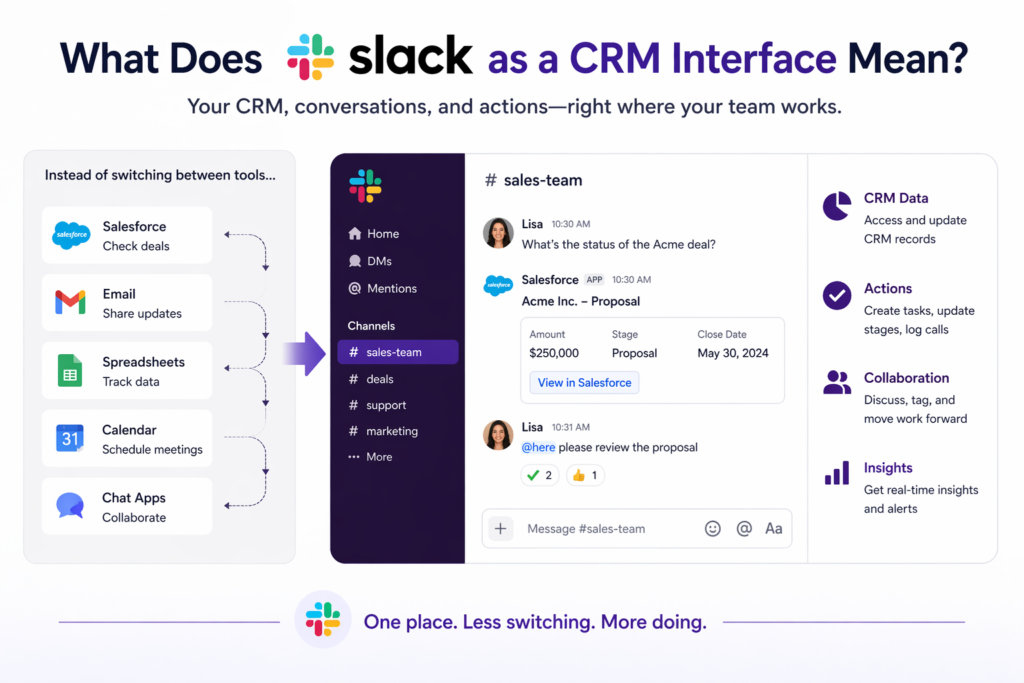
A Slack-based CRM interface moves away from static screens and toward dynamic, conversational interactions. Instead of navigating through layers of menus, users engage with CRM data in the natural flow of work. Information surfaces where conversations are already happening. Actions are triggered in context, not in isolation.
This changes everything.
Viewing CRM data is no longer a task that requires deliberate effort. A deal update, a lead detail, or a case status can be pulled instantly into a channel, visible to everyone who needs it. Context is shared by default, not reconstructed manually.
Updating records becomes frictionless. Instead of opening forms and editing fields, users can execute commands or trigger workflows directly from Slack. A deal stage can be advanced. A task can be assigned. A note can be logged—all without leaving the conversation.
Real-time alerts introduce immediacy into CRM interactions. Teams no longer rely on periodic check-ins or outdated dashboards. Changes to deals, leads, or support cases are pushed instantly, allowing teams to respond when it matters most, not after the fact.
Collaboration, which was once external to the CRM, is now embedded within it. Opportunities are no longer managed in isolation by individuals. They are discussed, refined, and progressed within shared channels, where insights from multiple stakeholders converge in real time.
Automation adds another layer of intelligence. Actions can be triggered based on conversations themselves. A message can initiate a workflow. A keyword can trigger an update. A decision can cascade into multiple automated steps without manual intervention.
What emerges from this model is a clear separation of roles.
The CRM remains the system of record—structured, reliable, and authoritative. It stores data, enforces consistency, and powers reporting.
Slack becomes the system of engagement—the interface through which humans interact with that data. It is where decisions are made, actions are initiated, and collaboration unfolds.
In essence, the interface is no longer a place you go to. It becomes a layer that comes to you.
And that is the paradigm shift redefining CRM in the modern enterprise.
The Rise of Conversational Workflows
Business workflows are no longer confined to rigid systems and predefined steps. They are becoming conversational—fluid, dynamic, and embedded within the natural flow of communication. This shift reflects a deeper understanding of how work actually happens inside organizations.
Traditionally, executing even a simple CRM task required multiple steps. Users had to log into platforms like Salesforce, navigate through layers of menus, locate the relevant record, and manually update fields. Each action introduced friction. Each step created a delay.
That model is steadily being replaced.
With platforms like Slack, workflows are no longer something you “go to.” They unfold within conversations. The interface disappears into the background, and actions become a natural extension of dialogue.
Instead of structured navigation, teams now operate through real-time interaction:
- Discussing deals in channels
Sales conversations are no longer isolated within CRM records. Teams collaborate in shared channels, aligning on strategy, sharing updates, and resolving blockers in real time. Context is preserved, and decisions are made collectively rather than in silos. - Triggering updates via commands
Actions that once required multiple clicks can now be executed instantly. A simple command can update a deal stage, assign ownership, or log activity. The gap between intent and execution shrinks dramatically. - Automating follow-ups through bots
Repetitive tasks—sending reminders, updating statuses, notifying stakeholders—are handled by bots. These automated agents operate in the background, ensuring consistency without requiring manual effort. - Surfacing data contextually
Instead of searching for information, relevant data appears within the conversation itself. Deal details, customer history, or case updates are brought into the channel at the moment they are needed. - Enabling real-time decision loops
Conversations, data, and actions exist in the same space. Teams can discuss, decide, and execute without switching contexts, creating a continuous workflow loop.
This evolution delivers tangible benefits.
Friction is reduced because unnecessary steps are eliminated. Teams no longer waste time navigating systems. Actions happen faster because they are triggered in the moment, not deferred. And perhaps most importantly, adoption improves because the system aligns with how people naturally communicate.
Humans think in conversations, not in forms. They collaborate through dialogue, not through isolated data entry.
Conversational workflows embrace this reality.
They transform CRM from a static system of record into a living, responsive layer of interaction—one that moves at the speed of conversation and adapts to the rhythm of real work.
Why Traditional CRM Interfaces Are Failing Users
Traditional CRM interfaces were built with a clear priority: structure over speed. They were designed to ensure that data is captured accurately, organized systematically, and reported consistently. In platforms like Salesforce, this manifests as carefully defined fields, standardized workflows, and hierarchical navigation models.
From a data governance perspective, this makes perfect sense.
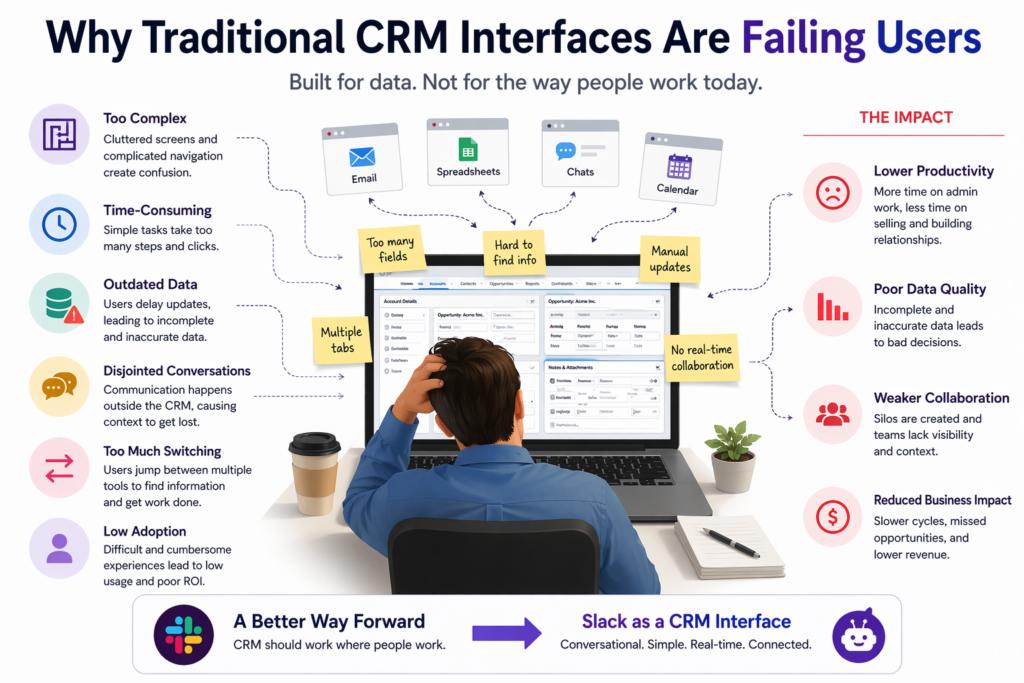
These systems excel at:
- Data accuracy
Every interaction is logged, every field is structured, and every update follows a defined format. This ensures reliability, which is critical for reporting and forecasting. - Reporting consistency
Standardized inputs lead to predictable outputs. Dashboards, forecasts, and analytics depend on this consistency to deliver meaningful insights. - Hierarchical navigation
Information is organized in layers—accounts, opportunities, contacts, cases—allowing users to drill down into structured datasets.
But while these strengths serve the organization, they often come at the cost of user experience.
And that is where the friction begins.
Traditional CRM interfaces frequently struggle with:
- User adoption
Sales reps, in particular, often perceive CRM updates as administrative overhead rather than value-driven tasks. The effort required to log activities or update records feels disconnected from immediate outcomes. - Real-time collaboration
CRM systems are not inherently designed for live, dynamic interaction. Collaboration typically happens outside the system—in emails, calls, or messaging platforms—leading to fragmented context. - Ease of interaction
Even simple updates can require multiple steps: navigating to a record, editing fields, saving changes. Over time, this creates resistance and delays.
The consequences are visible across teams.
Sales representatives delay updates or skip them altogether because the process feels cumbersome. Support teams struggle to keep case data current, especially during high-volume scenarios. Managers, in turn, rely on dashboards that often reflect lagging information rather than real-time reality.
The system remains structured—but the data within it becomes stale.
This is precisely the gap that Slack begins to close.
By embedding CRM interactions directly into daily workflows, Slack removes the need to step خارج the flow of work. Instead of treating CRM as a separate destination, it becomes an integrated layer within conversations. Updates happen in real time, within context. Collaboration is no longer external to the system—it becomes part of the interaction itself.
In doing so, Slack does not replace the structure of CRM. It complements it.
It preserves the integrity of data while transforming how that data is created, updated, and acted upon—shifting CRM from a system people have to use into one they naturally engage with.
The Need for Real-Time Collaboration in CRM
Modern sales cycles are no longer linear. They are intricate, multi-threaded, and often unpredictable. A single deal can involve sales representatives, solution engineers, finance teams, legal stakeholders, and executive sponsors—all contributing at different stages, often simultaneously.
In such an environment, speed is not a luxury. It is a competitive necessity.
Decisions need to be made quickly. Context needs to be shared instantly. Alignment cannot wait for scheduled meetings or delayed updates inside platforms like Salesforce.
And this is precisely where traditional, static CRM interfaces begin to show their limitations.
They were built for documentation, not for dynamic collaboration. They capture what has happened, but they struggle to facilitate what needs to happen next. By the time information is updated, the moment for action may already have passed.
This is where Slack introduces a fundamentally different approach.
Instead of treating collaboration as something external to CRM, Slack embeds it directly into the workflow. It transforms deal management from a static record into a continuous, real-time interaction.
This shift is powered by a few critical capabilities:
- Instant collaboration
Teams no longer need to wait for updates or schedule calls to align. Conversations happen in real time, with all stakeholders contributing simultaneously. Questions are answered instantly. Decisions are accelerated. - Shared visibility
Information is no longer siloed within individual users or buried inside CRM records. Everyone involved in a deal has access to the same context, the same updates, and the same discussions. Transparency becomes the default. - Real-time context
Data, conversations, and decisions coexist in the same space. A deal update is not just a field change—it is accompanied by discussion, reasoning, and supporting information. This creates a richer, more actionable context. - Continuous deal progression
Instead of periodic updates, deals evolve continuously. Every interaction contributes to forward momentum, reducing delays between stages. - Cross-functional alignment
Sales, legal, finance, and leadership can collaborate within a single channel, eliminating fragmented communication and ensuring faster consensus.
The outcome is transformative.
A deal is no longer just a static entry in a system. It becomes a living conversation—dynamic, evolving, and constantly enriched by real-time input. Context is never lost. Momentum is never stalled. And decisions are made at the speed of collaboration.
This is not just an improvement in workflow efficiency.
It is a redefinition of how modern sales organizations operate.
Slack’s Role in Modern Sales and Service Teams
Slack is no longer just a communication layer sitting alongside business operations. It is actively redefining how teams function, interact, and execute work on a daily basis. What makes this transformation powerful is not just the features Slack offers, but how seamlessly it embeds itself into the rhythm of organizational workflows.
Instead of being an external tool used occasionally, Slack becomes the environment where work continuously unfolds.
For sales teams, this shift is particularly impactful. Sales is inherently dynamic—deals evolve quickly, priorities shift, and alignment is critical. Slack brings all of this into a single, shared space:
- Tracking deal progress in real time
Sales teams no longer need to rely solely on CRM dashboards to understand pipeline movement. Updates are shared instantly within channels, making deal progression visible as it happens. - Collaborating on proposals and strategy
Complex deals often require input from multiple stakeholders—solution engineers, pricing teams, leadership. Slack channels act as collaborative workspaces where ideas are refined, objections are addressed, and strategies are aligned without delay. - Sharing updates instantly
Whether it’s a client response, a negotiation breakthrough, or a potential risk, updates are communicated immediately. This ensures that everyone involved stays informed and can act quickly.
At the same time, support teams experience a similar transformation.
Customer support requires speed, coordination, and clarity—especially when handling escalations or high-priority cases. Slack enables:
- Instant case escalation
Critical issues can be surfaced immediately in dedicated channels, ensuring that the right teams are alerted without delay. - Coordinated resolution workflows
Support agents, engineers, and product teams can collaborate in real time to diagnose and resolve issues, reducing back-and-forth and accelerating resolution times. - Continuous performance monitoring
Service metrics, alerts, and updates can be streamed into Slack, allowing teams to stay proactive rather than reactive.
But the true value of Slack extends beyond individual teams.
It acts as the connective tissue that binds the entire organization together. Sales, support, marketing, product, and leadership are no longer operating in isolated silos. Instead, they are connected through shared conversations, shared context, and shared visibility.
Information flows freely. Decisions are made collectively. Execution becomes faster and more aligned.
In this environment, Slack is not just facilitating communication—it is orchestrating collaboration.
And in doing so, it becomes an essential layer in how modern organizations operate, bridging the gap between teams, systems, and outcomes.
Native Integrations with CRM Platforms
One of the most powerful forces behind Slack’s evolution into a business-critical interface is integration. Not superficial connectivity, but deep, operational integration that brings systems and workflows into a single, cohesive environment.
At the center of this is the seamless connection between Slack and platforms like Salesforce.
This integration is not just about syncing data. It is about embedding functionality directly into the flow of work.
Instead of treating CRM as a separate destination, Slack turns it into an accessible layer within everyday conversations. The result is a more fluid interaction model where users can engage with data without disrupting their workflow.
This is enabled through several key capabilities:
- Record previews within conversations
Users can instantly view CRM records—opportunities, accounts, cases—directly inside Slack. There is no need to open another tab or navigate through a dashboard. Context is surfaced exactly where it is needed. - Automated notifications in real time
Important updates, such as deal stage changes, new leads, or case escalations, are pushed into relevant channels automatically. Teams stay informed without actively checking systems, ensuring faster responses and better alignment. - Workflow triggers from within Slack
Actions can be initiated directly from conversations. Whether it is updating a deal, assigning a task, or triggering an automation, workflows can be executed without leaving Slack. - Bidirectional data interaction
Data does not just flow into Slack—it flows back into the CRM. Conversations can lead to updates, decisions can trigger actions, and interactions can be recorded seamlessly.
The impact of these integrations is profound.
They eliminate silos that have traditionally existed between communication tools and business systems. Information is no longer trapped inside applications, accessible only through deliberate effort. Instead, it becomes part of the conversational fabric of the organization.
Data flows naturally into conversations, providing context and clarity. At the same time, conversations actively shape data—driving updates, triggering workflows, and influencing outcomes.
This creates a continuous feedback loop.
Systems inform conversations. Conversations inform systems.
And in that loop, the gap between insight and action begins to disappear.
Deep Dive: Slack + Salesforce Integration
The integration between Slack and Salesforce represents more than just a technical connection. It marks a fundamental shift in how businesses interact with their most critical data.
For years, structured data and unstructured communication existed in separate worlds. CRM systems stored information in a controlled, structured format, while collaboration happened elsewhere—emails, calls, chat tools. The two rarely intersected in real time.
This integration changes that dynamic entirely.
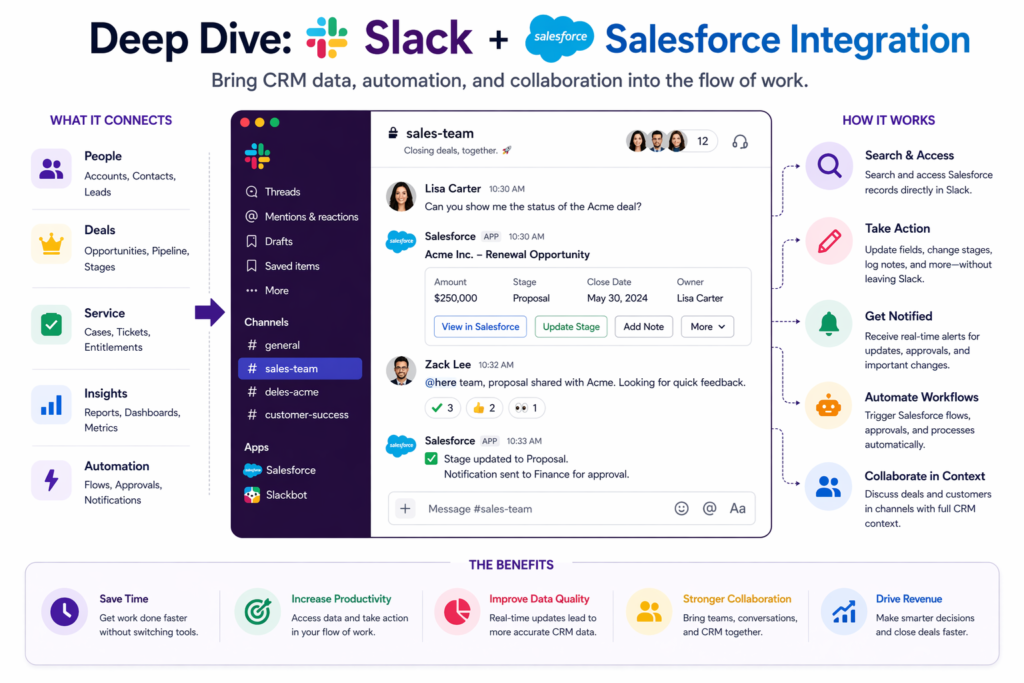
It brings structured data into the flow of conversation, and allows conversations to directly influence that data. The result is a more connected, responsive, and intelligent way of working.
At a functional level, this integration enables:
- Viewing Salesforce records directly inside Slack
Users can access opportunity details, account information, or case data without leaving Slack. Records are surfaced contextually within conversations, eliminating the need to switch platforms. - Updating opportunities without leaving Slack
Sales reps can modify deal stages, add notes, or update key fields through Slack-based actions or commands. This reduces friction and increases the likelihood of real-time updates. - Receiving alerts for deal changes
Notifications for important events—such as stage progression, new leads, or risk indicators—are automatically pushed into relevant channels. Teams stay aligned without actively monitoring dashboards. - Collaborating through shared channels
Opportunities can be discussed within dedicated Slack channels, bringing together stakeholders across sales, finance, legal, and leadership. Decisions are made collaboratively, with full visibility and context. - Embedding workflows into conversations
Actions like approvals, task assignments, or follow-ups can be triggered directly from Slack, turning discussions into immediate execution.
The strategic significance of this integration lies in how it bridges two fundamentally different paradigms.
On one side, Salesforce represents structured data—organized, reliable, and essential for reporting and forecasting. On the other, Slack represents unstructured communication—dynamic, contextual, and essential for collaboration.
By connecting these two layers, businesses no longer have to choose between structure and speed.
They gain both.
Data becomes more timely because it is updated within the flow of work. Conversations become more meaningful because they are enriched with real-time context. And decisions become faster because they are made where information and collaboration naturally converge.
This is not just an integration.
It is the convergence of systems of record and systems of engagement into a unified operational experience.
Slack Channels as Deal Rooms
Channels are evolving into deal rooms.
Each high-value opportunity can have its own dedicated Slack channel where:
- Sales reps discuss strategies
- Managers provide guidance
- Stakeholders align decisions
This creates a centralized space for deal execution.
No more scattered emails. No more lost context.
Automating CRM Updates Through Slack
Manual data entry is one of the biggest inefficiencies in CRM usage.
Slack enables automation through:
- Slash commands
- Workflow builders
- Integration triggers
A simple command can update a deal stage, log an activity, or assign a task.
This reduces friction and improves data accuracy.
Slack Bots and AI-Driven CRM Interactions
Bots are rapidly transforming Slack into something far more powerful than a messaging platform—they are turning it into an intelligent, responsive CRM interface. What was once a static layer of communication is now evolving into an active decision-support system, driven by AI and automation.
At the heart of this transformation are AI-powered bots that act as intermediaries between users and systems like Salesforce. These bots do not just retrieve information—they interpret context, anticipate needs, and initiate actions.
This fundamentally changes how users interact with CRM.
Instead of manually navigating systems, users can simply ask, command, or trigger actions within a conversation. The experience becomes intuitive, conversational, and immediate.
AI-powered bots enable several high-impact capabilities:
- Fetching CRM data on demand
Users no longer need to search for records manually. A simple query can surface deal details, customer history, or pipeline insights instantly within Slack. Information becomes accessible in seconds, without disrupting workflow. - Suggesting next-best actions
Based on deal stage, past interactions, or historical patterns, bots can recommend what should happen next. Whether it is scheduling a follow-up, escalating a risk, or prioritizing a lead, guidance becomes proactive rather than reactive. - Automating follow-ups and routine tasks
Repetitive actions—sending reminders, updating statuses, notifying stakeholders—can be handled automatically. Bots ensure consistency and timeliness without requiring manual intervention. - Providing insights based on behavioral patterns
AI can analyze trends across deals, customer interactions, and team activity to surface meaningful insights. For example, identifying stalled opportunities, highlighting high-priority leads, or flagging anomalies in pipeline movement. - Triggering workflows through natural interaction
Conversations themselves can initiate actions. A message can trigger an update. A command can launch a workflow. This reduces the gap between decision and execution.
The impact of these capabilities is profound.
CRM systems have traditionally functioned as repositories—places where data is stored, updated, and later analyzed. While essential, they are inherently passive. They depend on users to input data, interpret it, and decide what to do next.
Bots change that equation.
They transform CRM from a passive system of record into an active system of assistance. Instead of waiting for users to act, the system participates in the workflow. It guides decisions, automates actions, and ensures that nothing falls through the cracks.
This is a shift from interaction to intelligence.
And as AI continues to evolve, these bots will become even more autonomous—moving from assisting users to executing entire workflows independently.
In that future, Slack will not just be where teams communicate or access CRM data.
It will be where intelligent systems and human teams work side by side to drive outcomes.
Real-Time Notifications and Decision-Making
Timing is critical in sales and support.
Slack enables real-time notifications for:
- Deal updates
- Lead assignments
- Case escalations
This ensures that teams act immediately, not retrospectively.
Customer Support Workflows Inside Slack
Support teams experience one of the most immediate and tangible impacts from integrating Slack with CRM and service platforms like Salesforce Service Cloud. In environments where response time and coordination directly influence customer experience, even small inefficiencies can compound quickly.
Slack removes many of those inefficiencies by bringing support workflows into a real-time, collaborative environment.
Instead of relying on ticket queues alone or switching between multiple systems, support teams can operate within a unified interface where communication, data, and action coexist.
This enables several critical improvements:
- Automatic ticket routing
Incoming cases can be intelligently routed to the right channels or team members based on predefined rules. Whether it’s priority level, issue type, or customer segment, tickets reach the right people instantly—without manual triaging. - Instant issue escalation
High-priority or complex cases can be escalated in real time. Dedicated Slack channels can be triggered automatically, pulling in relevant stakeholders such as engineers, product teams, or senior support agents. This eliminates delays caused by back-and-forth communication. - Cross-team collaboration
Resolving customer issues often requires input from multiple departments. Slack enables support, engineering, product, and operations teams to collaborate within a single thread, ensuring alignment and reducing miscommunication. - Context-rich discussions
Case details, customer history, and system data can be surfaced directly within Slack. This ensures that every participant has the necessary context without needing to search across systems. - Faster decision-making under pressure
Real-time communication allows teams to diagnose problems, propose solutions, and take action immediately—especially critical during outages or high-impact incidents.
The result is a more agile and responsive support operation.
Resolution times decrease because bottlenecks are removed. Communication becomes clearer because all stakeholders share the same context. And customers experience faster, more consistent service because issues are addressed proactively rather than reactively.
Ultimately, Slack transforms support from a reactive function into a coordinated, real-time operation.
And in a landscape where customer expectations continue to rise, that shift directly translates into higher satisfaction, stronger retention, and a more resilient service experience.
Internal Alignment Across Teams Using Slack
Sales, marketing, and support often operate in silos.
Slack breaks these silos by enabling shared visibility.
Teams can:
- Align on goals
- Share insights
- Coordinate actions
This improves overall business performance.
Reducing Context Switching with Slack-Based CRM
Context switching is one of the most underestimated drains on productivity. It rarely appears in reports or dashboards, yet it quietly erodes efficiency across every team. Each time a user moves between tools—opening a CRM, checking emails, switching to a project app—there is a cognitive reset. Focus breaks. Momentum slows. And over the course of a day, these small interruptions compound into significant lost time.
Traditional workflows almost depend on this behavior. A sales rep might review a deal in Salesforce, jump to email for communication, switch to a collaboration tool for internal alignment, and then return to update records. The work itself is fragmented across systems, forcing the user to constantly reorient.
This fragmentation does more than waste time. It dilutes attention.
Every switch requires mental recalibration—remembering context, reloading information, and refocusing on the task. Over time, this leads to slower execution, increased errors, and decision fatigue.
Slack addresses this challenge by collapsing these interactions into a single, unified interface.
Instead of navigating across multiple platforms, users can:
- Access CRM data, updates, and insights directly within Slack
- Communicate with stakeholders in real time without leaving the context
- Trigger workflows, assign tasks, and update records from the same place
- Receive notifications and alerts without actively checking different systems
This consolidation creates a continuous workflow environment.
The user remains in one space. Context is preserved. Actions follow naturally from conversations. There is no need to pause, switch, and restart.
The impact is immediate.
- Reduced cognitive load
Users no longer need to juggle multiple interfaces or remember where information resides. - Faster execution
Actions are completed in the moment, without delays caused by tool-switching. - Improved accuracy
With context intact, the likelihood of errors decreases. - Sustained focus
Teams can stay immersed in their work, maintaining momentum throughout the day.
Slack does not just simplify workflows—it aligns them with how people naturally operate. Work becomes less about navigating systems and more about progressing tasks.
Less switching. More doing.
And in a world where speed and focus define performance, that difference is not incremental—it is transformative.
Security, Permissions, and Governance
As Slack becomes a CRM interface, security becomes critical.
Organizations must ensure:
- Proper access controls
- Data privacy compliance
- Secure integrations
Governance frameworks are essential to maintain control.
Challenges of Using Slack as a CRM Interface
Despite its advantages, there are challenges:
- Information overload
- Lack of structured data visibility
- Dependency on integrations
These challenges must be addressed through thoughtful implementation.
Best Practices for Implementing Slack-Driven CRM Workflows
Successful implementation of Slack as a CRM interface is not just about enabling integrations or turning on features. It requires intentional design. Without it, the very flexibility that makes Slack powerful can quickly turn into noise, fragmentation, and confusion.
Structure is what transforms Slack from a messaging tool into an operational system.
At the core of a successful setup is clarity in how communication is organized. Channels should not be created randomly or reactively. They need to follow a logical framework—whether by team, function, deal stage, or customer segment. When users know exactly where conversations belong, information becomes easier to find, follow, and act upon.
Equally important is workflow definition. Simply bringing conversations into Slack is not enough. Organizations must define how actions are triggered, how decisions are documented, and how updates flow back into systems like Salesforce. Without this layer, conversations remain disconnected from execution, and the value of integration diminishes.
Automation then acts as the force multiplier.
Well-designed automation strategies ensure that repetitive tasks—notifications, updates, reminders, escalations—happen consistently without manual effort. But automation must be purposeful. Too little, and teams revert to manual work. Too much, and channels become cluttered with unnecessary alerts, reducing signal-to-noise ratio.
Another critical pillar is user adoption and enablement.
Even the most well-structured system fails if teams do not understand how to use it effectively. Training should not focus only on features, but on real workflows—how to manage deals, escalate issues, collaborate across teams, and trigger actions within Slack. When users see direct value in their daily tasks, adoption becomes natural rather than enforced.
Finally, governance cannot be overlooked.
Slack thrives on flexibility, but without guardrails, that flexibility leads to chaos—duplicate channels, inconsistent naming conventions, fragmented discussions, and lost context. Establishing guidelines for channel creation, usage, and lifecycle management ensures that the workspace remains organized as it scales.
In essence, Slack’s strength lies in its adaptability. But that adaptability must be guided.
Without structure, Slack becomes just another stream of messages.
With structure, it becomes a disciplined, high-velocity system where communication, data, and execution operate in perfect alignment.
Use Cases Across Industries
Slack-based CRM workflows are applicable across industries:
- SaaS: Deal collaboration and onboarding
- Healthcare: Patient coordination
- Retail: Customer engagement
- Finance: Compliance-driven workflows
The flexibility of Slack makes it universally applicable.
The Role of AI and Automation in Slack CRM Evolution
AI is accelerating this transformation.
Future capabilities include:
- Predictive insights
- Automated decision-making
- Intelligent recommendations
CRM will become proactive, not reactive.
Future Trends: Conversational CRM and Autonomous Workflows
The future of CRM is not defined by better dashboards or more detailed reports. It is defined by how naturally humans can interact with systems. And that future is unmistakably conversational.
For decades, CRM platforms like Salesforce have required users to adapt—to learn interfaces, navigate structures, and manually execute tasks. But that model is steadily giving way to something far more intuitive.
Systems are beginning to understand people, not the other way around.
In this new paradigm, CRM evolves into an intelligent layer that responds to intent, context, and conversation in real time. The interaction model becomes fluid, almost invisible, as technology integrates seamlessly into how teams already communicate.
This evolution is driven by three defining capabilities:
- Understanding natural language
Users no longer need to think in terms of fields, filters, or commands. They can simply ask questions or express intent in plain language. Whether it’s “What’s the status of the Acme deal?” or “Show me high-priority cases,” the system interprets and responds instantly. - Executing commands automatically
Actions that once required multiple steps can now be triggered conversationally. Updating a deal stage, assigning a task, or initiating a workflow becomes as simple as expressing the intent. The system translates language into execution. - Providing real-time, contextual insights
Instead of static dashboards, insights are delivered dynamically within conversations. Systems analyze patterns, detect risks, and surface recommendations exactly when they are needed—turning data into immediate, actionable intelligence.
At the forefront of this transformation is Slack.
Slack is not just enabling conversational workflows—it is becoming the environment where this new model thrives. It sits at the intersection of communication, data, and execution, making it the ideal interface for this evolution.
Within Slack, conversations become commands. Commands become actions. Actions generate data. And that data feeds back into the conversation.
It is a continuous, intelligent loop.
This is the direction CRM is heading toward: not as a system users interact with occasionally, but as an ever-present, responsive layer that works alongside them—understanding, assisting, and executing in real time.
And in that future, the interface is no longer a screen.
It is a conversation.
Why Businesses Are Adopting Slack as a CRM Layer
Businesses are adopting Slack because it:
- Improves productivity
- Enhances collaboration
- Accelerates decision-making
- Increases CRM adoption
It aligns technology with human behavior.
Conclusion: CRM is Moving to Where Work Happens
The shift is clear.
CRM is no longer confined to dashboards and forms. It is moving into conversations.
Slack represents this transformation.
It brings CRM closer to where work actually happens.
And that is where the future lies.
Transform Your CRM Experience with CloudVandana
At CloudVandana, we help businesses reimagine how CRM works.
From Slack integrations to Salesforce optimization, we design systems that align with how your teams actually operate.
- Automate workflows
- Integrate Slack with CRM seamlessly
- Enable real-time collaboration
- Unlock AI-driven insights
If your CRM still feels like a system you “have to use,” it’s time to transform it into a system that works for you.
👉 Explore how CloudVandana can help you build a smarter, faster, and more connected CRM experience.
FAQs
1. What is Slack CRM integration?
Slack CRM integration allows users to access and interact with CRM data directly within Slack.
2. Can Slack replace a CRM system?
No. Slack acts as an interface layer, while the CRM remains the system of record.
3. How does Slack improve CRM adoption?
By embedding CRM actions into daily workflows, Slack reduces friction and increases usage.
4. Is Slack integration secure for CRM data?
Yes, with proper permissions and governance controls in place.
5. Which CRM platforms integrate with Slack?
Salesforce is the most prominent, along with others through APIs and connectors.
6. What are Slack deal rooms?
Dedicated channels where teams collaborate on specific sales opportunities.
7. Can Slack automate CRM updates?
Yes, through workflows, bots, and integrations.
8. How does Slack reduce context switching?
By centralizing communication and CRM interactions in one interface.
9. What role does AI play in Slack CRM?
AI enables automation, insights, and predictive recommendations.
10. What industries benefit from Slack CRM workflows?
All industries, especially SaaS, retail, healthcare, and finance.
11. What are the challenges of Slack as a CRM interface?
Information overload and dependency on integrations.
12. How can businesses get started?
By integrating Slack with their CRM and defining structured workflows.

Atul Gupta is CloudVandana’s founder and an 8X Salesforce Certified Professional who works with globally situated businesses to create Custom Salesforce Solutions.
Atul Gupta, a dynamic leader, directs CloudVandana’s Implementation Team, Analytics, and IT functions, ensuring seamless operations and innovative solutions.
YOU MIGHT ALSO LIKE

Financial Services Cloud: A Complete Guide for Banking and Wealth Management
How MuleSoft Connects Salesforce With ERP, Finance and Business Systems

Salesforce Customer 360: Connecting Sales, Service and Marketing Teams

Salesforce and Anthropic Launch Claudeforce: What It Means for the Future of Enterprise AI

Salesforce AIforce: What It Means for the Future of Enterprise Software