
Introduction: Relationships Are the Real Currency in Financial Services
Financial services has always been a relationship-driven industry.
A bank may offer competitive products. A wealth management firm may offer sophisticated investment advice. An insurance provider may offer flexible coverage. But in the end, clients stay where they feel understood, protected, and guided.
That is where the challenge begins.
Modern financial clients expect more than periodic calls, static account updates, and generic service responses. They expect their financial institution to know their history, anticipate their needs, recognize their goals, and respond with speed. They want convenience without losing trust. They want personalization without compromising security. They want digital access, but they still value human judgment.
For financial firms, this creates a delicate balancing act.
Teams must deliver high-touch service while managing compliance, fragmented data, complex households, changing life stages, multiple product lines, and growing client expectations. A simple CRM is often not enough.
This is where Salesforce Financial Services Cloud becomes a strategic advantage.
Salesforce positions Financial Services Cloud as a purpose-built CRM platform for banks, wealth managers, insurers, lenders, and other financial institutions. It is designed to help firms unify customer data, personalize engagement, streamline financial workflows, and deepen trusted client relationships across business lines.
At its best, Financial Services Cloud does not merely store client information. It helps financial firms turn information into insight, insight into action, and action into stronger relationships.
What Is Salesforce Financial Services Cloud?
Salesforce Financial Services Cloud is an industry-specific CRM solution built for financial services organizations. Unlike a generic CRM, it includes financial services data models, relationship intelligence, household views, financial account structures, client goals, interaction history, compliance-supporting workflows, and capabilities tailored for banking, wealth management, insurance, and lending.

Salesforce explains that Financial Services Cloud comes with the capabilities of Sales Cloud and Service Cloud, plus an industry-specific data model, objects, and processes built for financial services firms.
That distinction matters.
A traditional CRM may track names, emails, calls, opportunities, and cases. Financial Services Cloud goes deeper. It can help firms manage:
- Client and household relationships
- Financial accounts
- Goals and life events
- Referrals and centers of influence
- Policies, claims, and service requests
- Onboarding workflows
- Advisor books of business
- Client interaction history
- Compliance-related processes
- Personalized service journeys
Salesforce documentation also notes that Financial Services Cloud gives users a single view where they can monitor financial accounts, visualize personal and household relationships, manage goals, and review activity history.
In simple terms, Financial Services Cloud helps financial firms answer three crucial questions:
- Who is this client?
- What matters to them right now?
- What should we do next to strengthen the relationship?
That final question is where real business value begins.
Why Traditional CRMs Fall Short for Financial Firms
Generic CRMs are useful. They help teams organize contacts, track activities, manage pipelines, and report on sales performance.
But financial services is not generic.
A financial advisor does not only manage an individual contact. They may manage an entire household, including spouses, children, trusts, businesses, beneficiaries, accountants, attorneys, and other influencers.
A banking relationship manager does not simply manage a company account. They may need visibility into deposits, lending needs, treasury services, branch interactions, service issues, and expansion opportunities.
An insurance team does not only manage policyholders. They may need to understand policies, coverage gaps, claims history, risk profiles, renewals, and life events.
This is where traditional CRMs become strained.
They often require heavy customization to represent financial relationships accurately. Teams begin adding custom objects, fields, spreadsheets, notes, and manual workarounds. Over time, the CRM becomes a digital filing cabinet instead of a relationship intelligence engine.
The result is predictable:
- Client data becomes fragmented
- Advisors lack complete context
- Service teams repeat questions
- Follow-ups become inconsistent
- Compliance becomes harder to manage
- Cross-sell opportunities remain hidden
- Client experience feels disconnected
In financial services, disconnected data does not just slow teams down. It weakens trust.
And trust, once diluted, is difficult to rebuild.
The Client Relationship Challenge in Financial Services
Financial firms today are not only competing with other financial institutions. They are competing with every seamless digital experience their clients encounter elsewhere.
Clients compare their bank, advisor, or insurer not only with other firms, but with the convenience of digital retail, the responsiveness of modern apps, and the personalization of consumer platforms.
At the same time, financial relationships are deeply personal.
A client may be planning retirement, protecting family wealth, buying a home, managing business risk, recovering from a claim, or preparing for generational wealth transfer. These are not ordinary transactions. They are moments filled with consequence.
That is why financial services relationships require more than efficiency. They require context.
A strong client relationship is built when a firm can say:
“We understand where you are, where you want to go, and what needs attention before it becomes urgent.”
Financial Services Cloud helps firms move closer to that standard by connecting data, workflows, service, sales, and engagement in one financial services-specific environment.
How Financial Services Cloud Creates a Unified Client View
Consolidating Fragmented Client Data
One of the biggest challenges in building strong client relationships is scattered data.
In many financial firms, client information is spread across multiple systems: core banking platforms, policy management tools, wealth management software, spreadsheets, emails, service portals, and legacy databases. Each system holds one piece of the client story, but rarely the full picture.
The advisor may see one version of the client.
The service team may see another.
The operations team may be working with a completely different set of details.

But from the client’s perspective, the firm is one organization. They do not care which system stores which detail. They simply expect every interaction to feel connected, informed, and seamless.
Salesforce Financial Services Cloud helps solve this by bringing relevant client information into a unified CRM environment. It allows financial firms to connect financial data, transaction history, CRM activity, service records, household details, goals, and relationship context in one place.
This gives teams a clearer, more complete understanding of every client.
Instead of switching between platforms or relying on incomplete notes, advisors and service teams can access a consolidated client profile that shows what matters most: accounts, interactions, open tasks, service requests, family or business relationships, financial goals, and previous conversations.
That kind of visibility changes the quality of engagement.
When teams understand the full client picture, conversations become more relevant, service becomes faster, and relationships become stronger.
Connecting Households, Relationships, and Financial Accounts
Financial relationships rarely exist in isolation.
A wealth client may be part of a household. A business owner may also be a personal banking client. A policyholder may have dependents, beneficiaries, and advisors. A lending client may also have investment and insurance needs.
Financial Services Cloud is designed to represent these nuanced relationships more naturally than a generic CRM.
Salesforce offers components that help visualize groups and relationships in Lightning pages, making it easier for teams to understand how people, households, and entities connect.
This relationship-centric structure helps financial firms serve clients with more precision.
For example:
- A wealth advisor can understand household goals and family dynamics
- A banker can identify related businesses and decision-makers
- An insurance agent can see policyholder relationships and coverage dependencies
- A service team can understand who is authorized, involved, or influential
This context prevents awkward conversations and missed opportunities.
It also helps teams move from account management to relationship stewardship.
Giving Advisors and Service Teams Instant Context
A client should not have to explain their situation every time they interact with a firm.
Yet this happens constantly when systems are disconnected.
Financial Services Cloud helps reduce that friction by giving advisors, bankers, agents, and service representatives a more complete view before they engage.
A relationship manager can walk into a meeting knowing:
- Recent interactions
- Open service issues
- Financial goals
- Key household members
- Product holdings
- Upcoming milestones
- Potential next-best actions
That level of context creates a more thoughtful client experience.
It says, “We are paying attention.”
And in financial services, attentiveness is a competitive advantage.
Personalized Client Engagement at Scale
Understanding Client Needs Before the Next Interaction
Personalization in financial services should not feel superficial.
Adding a first name to an email is not personalization. Recommending a relevant next step based on a client’s financial life is.

Financial Services Cloud supports deeper personalization because it organizes client data around relationships, goals, accounts, and interactions. When this data is clean and well-governed, firms can identify meaningful engagement moments.
For example:
- A client approaching retirement may need portfolio review
- A young family may need insurance planning
- A business owner may need lending support
- A high-net-worth household may need estate planning coordination
- A policyholder with recent claims activity may need proactive service
Salesforce states that Financial Services Cloud helps firms predict what customers want before they ask, deliver personalized service, and deepen trusted client relationships across banking, investment, and insurance services.
That is the real promise: not just reacting faster, but anticipating better.
Tailoring Conversations Based on Financial Goals
Financial conversations are most effective when they are anchored in goals.
A client does not wake up thinking, “I need a product.”
They think, “Can I retire comfortably?”
“Can I protect my family?”
“Can I grow my business?”
“Can I manage risk?”
“Can I fund my child’s education?”
Financial Services Cloud allows teams to document and manage goals as part of the client relationship. This helps advisors and relationship managers shift the conversation from product pushing to outcome planning.
That shift is vital.
Clients are more likely to trust firms that understand their aspirations, anxieties, and constraints. When goals are visible inside the CRM, every interaction can become more relevant.
Instead of generic follow-ups, teams can discuss progress.
Instead of fragmented notes, firms can build continuity.
Instead of one-off transactions, the relationship becomes a guided journey.
Creating More Relevant Experiences Across Channels
Financial clients now interact through many channels: branches, mobile apps, websites, email, contact centers, advisor meetings, and digital portals.
The danger is fragmentation.
A client may start a conversation online, continue it with a service agent, and later speak to an advisor. If each channel lacks shared context, the experience feels broken.
Financial Services Cloud helps firms create more consistent engagement by connecting client data and workflows across teams.
This enables:
- More informed service responses
- Better sales and service handoffs
- More relevant campaign segmentation
- Faster escalation handling
- Consistent client messaging
- Improved relationship continuity
When clients feel that every part of the firm understands them, trust compounds.
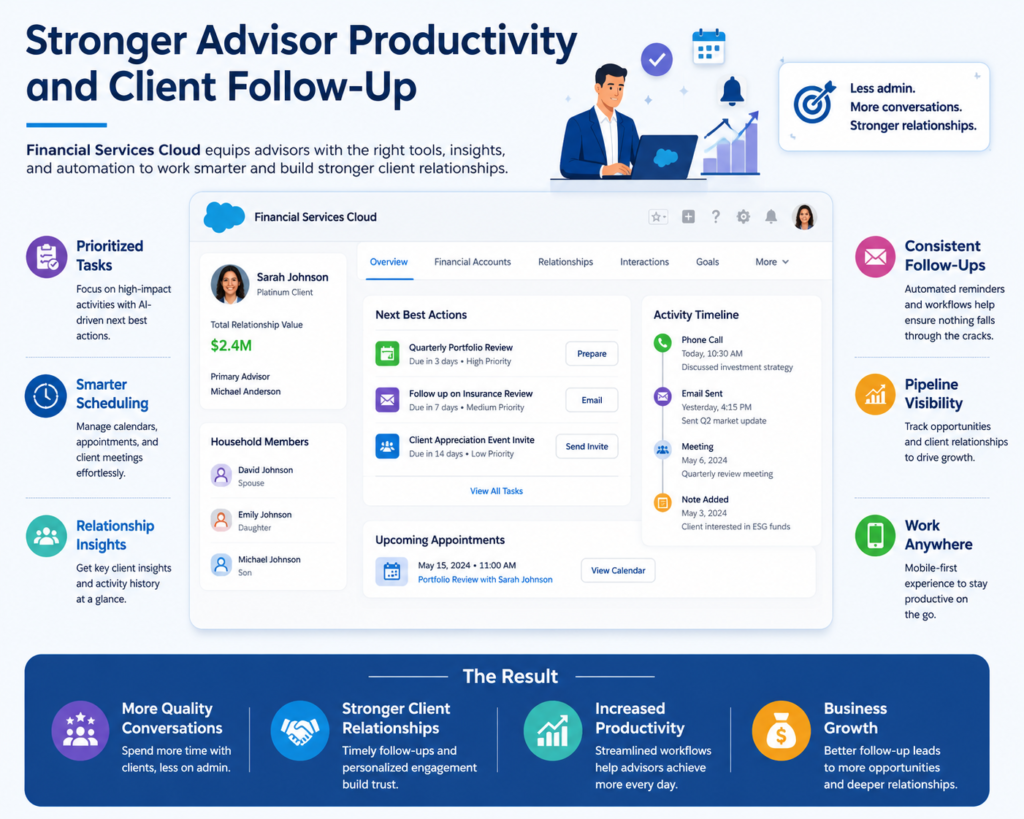
Stronger Advisor Productivity and Client Follow-Up
Action Plans for Repeatable Client Processes
Financial services teams often manage repeatable processes: onboarding, annual reviews, loan applications, claims intake, policy renewals, account opening, compliance checks, and client review meetings.
Without structure, these processes become inconsistent.
One advisor follows every step. Another misses a task. A service agent forgets a document. A compliance step gets delayed. The client feels the friction.
Financial Services Cloud supports action plans that allow firms to define repeatable task templates and process steps. Salesforce documentation explains that action plan templates can generate action plans for different objects depending on available products and licenses.
For client relationships, this is powerful.
Action plans can help firms ensure that important steps happen every time, not only when someone remembers.
Task Automation for Consistent Service
Strong relationships are built through consistency.
A client who receives timely follow-ups, accurate updates, and proactive communication feels valued. A client who has to chase the firm for every answer feels neglected.
Financial Services Cloud helps reduce manual effort through workflow automation and structured task management.
This can support:
- Follow-up reminders
- Onboarding tasks
- Client review preparation
- Service case routing
- Document collection
- Internal approvals
- Compliance-related checklists
- Renewal workflows
Automation does not replace the human relationship. It protects it.
It ensures that administrative lapses do not damage client confidence.
Reducing Administrative Drag
Financial professionals often spend too much time on low-value administration.
They search for data, update spreadsheets, chase documents, send reminders, duplicate notes, and move between systems. This reduces the time available for meaningful client engagement.
Financial Services Cloud helps minimize that drag by centralizing data, guiding workflows, and surfacing relevant information.
The business impact is significant.
When advisors and service teams spend less time navigating internal complexity, they can spend more time advising, listening, solving, and building trust.
That is not just productivity.
That is relationship capacity.
Better Relationship Mapping for Wealth, Banking, and Insurance Teams
Seeing Family, Business, and Professional Connections
In financial services, the most important opportunity may not sit inside a single client record. It may exist in the relationship network around that client.
A wealth advisor may need to understand a client’s spouse, children, trust, attorney, accountant, and business entities.
A commercial banker may need to understand ownership structures, subsidiaries, guarantors, and influencers.
An insurance advisor may need to understand family members, beneficiaries, and business risks.
Financial Services Cloud helps teams visualize these relationships so they can serve clients more intelligently.
This relationship mapping supports more sophisticated conversations.
It also helps teams avoid treating complex clients like simple contact records.
Identifying Influence Networks
Financial decisions are often influenced by people beyond the primary client.
A financial decision is rarely made by one person alone.
A business owner may depend on a CFO before approving a major ba nking decision. A high-net-worth client may involve an attorney, tax consultant, or estate planner. A family may include several decision-makers across generations. An insurance buyer may rely on a broker, risk advisor, or business consultant before choosing the right coverage.
These surrounding relationships matter.
Relationship mapping in Salesforce Financial Services Cloud helps firms understand the broader influence network around each client. It shows who is involved, who has decision-making authority, who provides advice, and who may shape the final outcome.
This is important because strong client relationships are not always built around a single individual. In financial services, trust often lives within an entire ecosystem of people, advisors, family members, business partners, and professional contacts.
When a firm understands that ecosystem, communication becomes more thoughtful. Teams can involve the right stakeholders, avoid missing key influencers, coordinate conversations more effectively, and reduce the risk of relationship blind spots.
The result is a more informed, connected, and resilient client relationship.
Supporting Multi-Generational Client Relationships
Wealth transfer and generational engagement are major priorities for many financial firms.
A firm may have a strong relationship with one generation but little connection with the next. When assets transfer, relationships can disappear.
Financial Services Cloud can help firms document family structures, goals, relationships, and next-generation contacts. This gives advisors a better foundation for long-term relationship continuity.
For wealth firms especially, this is crucial.
Client retention is not only about serving today’s account holder. It is about becoming relevant to the family’s future.
Faster Onboarding and Client Servicing
Streamlining Intake and Documentation
Client onboarding is one of the most important moments in a financial relationship.
It is also one of the most vulnerable.
If onboarding is slow, repetitive, paper-heavy, or confusing, the client’s confidence weakens before the relationship matures.
Financial Services Cloud can help streamline onboarding by organizing tasks, data collection, documentation, approvals, and service workflows in a more structured way. Salesforce highlights onboarding and workflow automation as key areas where Financial Services Cloud for Service can help financial firms improve operations.
A smoother onboarding process creates a better first impression.
It signals professionalism, reliability, and operational maturity.
Reducing Back-and-Forth Communication
Clients dislike repetitive information requests.
They have already submitted a document.
They have already explained the issue.
They have already provided the same details to another team.
When firms lack shared visibility, clients experience unnecessary back-and-forth.
Financial Services Cloud helps reduce this by making relevant information more accessible to authorized teams. When everyone works from the same client context, service becomes more coherent.
This improves both efficiency and trust.
Clients feel that the firm is organized.
Teams feel less overwhelmed.
Processes move faster.
Improving First Impressions
The first few interactions with a financial firm shape the entire relationship.
A client evaluates more than the product. They evaluate responsiveness, clarity, professionalism, and confidence.
Financial Services Cloud supports better first impressions by helping teams:
- Capture client information cleanly
- Assign tasks quickly
- Monitor onboarding progress
- Track service requests
- Coordinate internal teams
- Follow up at the right time
- Personalize early communication
A strong onboarding experience gives clients a reason to believe they made the right decision.
AI, Data, and Predictive Engagement in Financial Services Cloud
Moving from Reactive Service to Proactive Advice
Financial services is shifting from reactive support to proactive guidance.
Reactive service waits for the client to ask.
Proactive advice identifies what the client may need next.
Salesforce describes AI and automation as major forces in financial services, helping firms improve customer experience, discover opportunities faster, and scale personalization.
This is especially important in relationship management.
A firm that only responds to requests may deliver acceptable service. But a firm that anticipates needs can become a trusted advisor.
Examples include:
- Alerting advisors before a client milestone
- Identifying clients who may need policy review
- Surfacing potential retention risks
- Recommending next-best conversations
- Flagging service patterns that need attention
- Supporting agents with AI-driven responses
The goal is not to remove human judgment. It is to make human judgment better informed.
Using AI to Identify Client Needs Faster
Salesforce has increasingly positioned financial services around CRM, AI, data, and trust. It has also highlighted industry-specific AI agents and prebuilt templates for banking, wealth, insurance, compliance, lending, and collections.
For financial firms, AI has real relationship value when it helps teams understand clients faster.
AI can support:
- Faster service summaries
- Suggested next actions
- Intelligent routing
- Proactive alerts
- Client segmentation
- Knowledge recommendations
- Advisor productivity
However, AI is only as valuable as the data foundation beneath it.
That is why Financial Services Cloud’s industry-specific data structure matters. Clean, connected, contextual data is what allows AI-driven engagement to become useful rather than generic.
Scaling Personalization Without Losing the Human Touch
Financial services clients want personalization, but they do not want to feel processed by a machine.
This is the paradox.
Firms need scale. Clients need warmth.
Financial Services Cloud helps bridge this gap by allowing firms to automate routine work while preserving human attention for meaningful moments.
For example:
- AI can summarize an interaction, but the advisor decides how to respond
- Automation can trigger a review workflow, but the banker leads the conversation
- Data can identify an opportunity, but the relationship manager builds trust
- Service tools can route a case, but the agent provides reassurance
The most successful firms will not use technology to remove humanity. They will use it to make humanity easier to deliver consistently.
Compliance, Trust, and Data Governance
Why Trust Must Be Operationalized
Trust is not a slogan in financial services. It is an operating requirement.
Clients trust firms with sensitive financial data, long-term goals, personal risks, and major life decisions. That trust must be protected through secure systems, governed processes, and compliant behavior.
Salesforce emphasizes that data security and privacy are essential to maintaining customer trust, including breach prevention, data loss protection, compliance support, and honoring consumer preferences.
Financial Services Cloud can support this trust framework by helping firms standardize processes, centralize client records, define access controls, and manage regulated workflows.
Supporting Regulated Workflows
Financial services firms operate within complex regulatory environments.
Banking, insurance, wealth management, lending, and investment advisory businesses all face scrutiny around data handling, disclosures, suitability, privacy, documentation, and auditability.
Financial Services Cloud can help firms create more consistent workflows around regulated processes.
This may include:
- Standardized onboarding steps
- Document collection tasks
- Approval workflows
- Client communication tracking
- Case management
- Audit-friendly activity history
- Process compliance checks
Salesforce also provides compliance-focused capabilities and examples for financial services, including tools for creating, managing, and tracking compliance processes.
The goal is not only to move faster. It is to move faster without losing control.
Protecting Sensitive Financial Data
Financial firms must treat data protection as a strategic priority.
Salesforce maintains a compliance site that highlights its certifications and attestations connected to its Trust value. Salesforce has also discussed privacy needs for financial services institutions dealing with regulations such as GDPR, GLBA, and CCPA.
For firms implementing Financial Services Cloud, this means security should be part of the architecture from the beginning.
Important considerations include:
- Role-based access
- Field-level security
- Data retention policies
- Consent management
- Audit trails
- Integration governance
- Encryption strategy
- Sensitive data classification
A well-implemented Financial Services Cloud environment helps teams serve clients confidently while protecting the information that underpins trust.
Industry Use Cases of Financial Services Cloud
Banking
Banks manage diverse client relationships across retail banking, commercial banking, lending, deposits, cards, service, and advisory interactions.
Financial Services Cloud can help banks create a clearer view of each customer or business relationship.
Use cases include:
- Relationship manager productivity
- Customer 360 for banking teams
- Loan and account servicing
- Personalized product recommendations
- Complaint and case management
- Client onboarding
- Branch and digital service alignment
- Cross-sell and wallet-share expansion
Salesforce notes that Financial Services Cloud can help banking service teams unite fragmented core systems and transaction data into a single screen, reducing swivel-chair work and enabling proactive service.
For banks, stronger relationships come from being faster, more informed, and more coordinated.
Wealth Management
Wealth management depends heavily on trust, timing, and personal context.
Advisors need to understand not only accounts and assets, but also goals, households, family relationships, life events, risk tolerance, and long-term plans.
Financial Services Cloud supports wealth firms by helping advisors:
- View household relationships
- Track financial goals
- Manage client review cycles
- Coordinate referrals
- Identify life events
- Prepare for meetings
- Follow up consistently
- Support multi-generational planning
Salesforce also highlights account planning, stakeholder mapping, whitespace analysis, and action plans as ways for sellers to deepen relationships and expand wallet share.
For wealth firms, the CRM becomes more than a record system. It becomes a client intelligence platform.
Insurance
Insurance relationships often intensify during moments of stress.
A claim, renewal, coverage gap, or life event can either strengthen or weaken the client relationship.
Financial Services Cloud can help insurers improve service by connecting policyholder information, claims workflows, service interactions, and agent activity.
Salesforce describes insurance use cases such as uniting disconnected core systems to create a 360-degree policyholder view, automating workflows like First Notice of Loss intake, claims management, and policy administration.
For insurers, this means teams can respond faster and with more empathy.
That matters because insurance clients often judge the relationship most strongly when something goes wrong.
Lending
Lending relationships require speed, accuracy, and transparency.
Borrowers want clear communication. Lenders need complete information. Internal teams need structured workflows.
Financial Services Cloud can support lending processes by helping teams manage:
- Borrower relationships
- Application intake
- Document collection
- Approval workflows
- Follow-up tasks
- Status visibility
- Cross-team collaboration
- Ongoing relationship management
A smoother lending experience can improve both conversion and client satisfaction.
In a market where borrowers compare options quickly, responsiveness can become a differentiator.
Financial Services Cloud vs Generic CRM
| Area | Generic CRM | Salesforce Financial Services Cloud |
| Data model | General-purpose contacts, accounts, opportunities | Industry-specific financial services data model |
| Relationship view | Basic account and contact relationships | Household, group, entity, and relationship visualization |
| Client goals | Usually customized manually | Goal and financial planning context can be structured |
| Advisor productivity | Activity tracking and pipeline management | Action plans, client context, books of business, relationship insights |
| Service workflows | Generic case management | Financial services workflows for banking, insurance, wealth, and service |
| Compliance support | Requires more custom configuration | Better suited for regulated financial services processes |
| Personalization | Depends heavily on custom data design | Built around financial client context |
| Speed to value | May require extensive customization | Purpose-built capabilities reduce unnecessary reinvention |
The core difference is simple.
A generic CRM helps firms manage customers.
Financial Services Cloud helps financial firms manage relationships.
That distinction becomes important as firms scale, compliance pressure increases, and client expectations rise.
Implementation Considerations for Financial Firms
Financial Services Cloud can be transformative, but success depends on implementation quality.
A poor implementation can reproduce old problems inside a new platform. A strong implementation can reshape how teams work.
Financial firms should consider the following before implementation.
1. Data Readiness
Financial Services Cloud depends on clean, structured, reliable data.
Before implementation, firms should assess:
- Data sources
- Duplicate records
- Data ownership
- Field quality
- Integration requirements
- Historical records
- Client segmentation
- Data governance rules
Without data readiness, the CRM may look impressive but fail in daily use.
2. Business Process Alignment
Technology should support the way the firm wants to operate.
Before configuration, teams should map key processes such as:
- Client onboarding
- Annual reviews
- Service requests
- Relationship management
- Compliance checks
- Claims handling
- Loan processing
- Referral management
This ensures that Financial Services Cloud reflects real business workflows, not abstract system design.
3. User Adoption
Even the best CRM fails if users avoid it.
Advisors, bankers, service agents, and operations teams must understand why the platform matters.
Adoption improves when the system:
- Reduces work
- Provides useful insights
- Fits daily routines
- Simplifies follow-up
- Improves client conversations
- Avoids unnecessary complexity
The platform should feel like an advantage, not an obligation.
4. Integration Strategy
Financial firms often rely on multiple systems.
A strong implementation should define how Financial Services Cloud connects with:
- Core banking platforms
- Portfolio systems
- Policy administration systems
- Document management tools
- Marketing platforms
- Data warehouses
- Communication systems
- Compliance tools
Integration is not a technical afterthought. It is central to the client experience.
5. Governance and Security
Financial Services Cloud implementations must be designed with governance from day one.
This includes:
- Permission sets
- Sharing rules
- Audit requirements
- Data retention
- Consent management
- Compliance workflows
- Integration controls
- Change management
In financial services, governance is not bureaucracy. It is infrastructure for trust.
Common Mistakes to Avoid
Mistake 1: Treating Financial Services Cloud Like a Generic CRM
Financial Services Cloud is purpose-built. Firms should not flatten it into a basic contact management tool.
The value comes from using its industry-specific capabilities, relationship models, workflows, and client context.
Mistake 2: Over-Customizing Too Early
Some firms customize before understanding what the platform already provides.
This can create unnecessary complexity.
A better approach is to evaluate standard Financial Services Cloud capabilities first, then customize where there is a genuine business need.
Mistake 3: Ignoring the Data Model
The data model is the foundation.
If households, financial accounts, relationships, and entities are poorly structured, reporting and client visibility will suffer.
Mistake 4: Underestimating Change Management
Financial professionals are busy.
They will not adopt a system simply because leadership selected it. They need training, workflow relevance, and clear value.
Mistake 5: Forgetting the Client Experience
The end goal is not a beautiful CRM dashboard.
The end goal is a better client relationship.
Every implementation decision should connect back to client experience, advisor productivity, trust, and business growth.
How CloudVandana Helps Financial Firms Implement Salesforce Financial Services Cloud
Salesforce Financial Services Cloud has the potential to transform how financial firms manage client relationships, but the platform must be implemented with strategy, precision, and industry awareness.
CloudVandana helps businesses design, implement, optimize, and scale Salesforce solutions that align with real business outcomes.
For financial firms, that means focusing on:
- Strong discovery and process mapping
- Financial services data model planning
- Client and household relationship design
- Salesforce configuration and customization
- Workflow automation
- Integration planning
- User adoption support
- Reporting and dashboard setup
- Security and access configuration
- Long-term optimization
The goal is not simply to “set up Salesforce.”
The goal is to help financial firms create a CRM foundation that supports stronger relationships, better service, smarter decisions, and scalable growth.
A well-implemented Financial Services Cloud environment helps teams move from fragmented interactions to coordinated client engagement.
That is where the real transformation begins.
Final Thoughts
Financial services may be evolving at a rapid pace, but the heart of the industry has not changed.
Clients still choose firms they can trust.
They still value guidance that feels personal.
They still remember how quickly someone responded when they needed help.
They still stay loyal to teams that understand their goals, their concerns, their families, and their financial journey.
Digital convenience matters, but it does not replace relationships. It raises the standard for them.
Salesforce Financial Services Cloud helps financial firms meet that standard with greater confidence. It brings client data, relationship intelligence, service workflows, automation, AI-driven insights, and compliance-supporting processes into one connected platform. Instead of working from scattered systems and incomplete information, teams can finally see the full client picture.
That visibility changes everything.
Advisors can have more meaningful conversations.
Service teams can respond with better context.
Leaders can identify growth opportunities earlier.
Operations teams can reduce friction.
And clients can feel the difference in every interaction.
In a relationship-driven industry, Financial Services Cloud is not just a technology upgrade. It is a smarter way to build trust, deliver value, and create long-term client loyalty.
Ready to Strengthen Client Relationships with Salesforce Financial Services Cloud?
CloudVandana helps financial firms implement, customize, and optimize Salesforce solutions that are built around real business outcomes.
Whether you want to unify client data, improve advisor productivity, streamline service workflows, or create a more connected financial services experience, our Salesforce experts can help you build the right foundation.
Partner with CloudVandana to turn Salesforce Financial Services Cloud into a powerful relationship engine for your business.
FAQs
1. What is Salesforce Financial Services Cloud?
Salesforce Financial Services Cloud is a CRM platform designed specifically for financial services firms such as banks, wealth management firms, insurers, lenders, and financial advisors. It includes financial services-specific data models, relationship views, workflow capabilities, and client engagement tools.
2. How does Financial Services Cloud improve client relationships?
It improves relationships by giving teams a unified client view, helping them understand households and financial goals, automating follow-ups, personalizing engagement, and making service interactions more informed and consistent.
3. Is Financial Services Cloud only for wealth management firms?
No. Financial Services Cloud supports multiple financial sectors, including banking, wealth management, insurance, lending, and asset management.
4. How is Financial Services Cloud different from Sales Cloud?
Sales Cloud is a general-purpose sales CRM. Financial Services Cloud includes Sales Cloud capabilities but adds financial services-specific objects, data models, relationship intelligence, and industry workflows.
5. Can Financial Services Cloud help with client onboarding?
Yes. It can support structured onboarding workflows, task assignments, document collection, approvals, and progress tracking to reduce friction and improve the client’s first experience.
6. Does Financial Services Cloud support household relationship management?
Yes. One of its major strengths is helping firms view households, groups, relationships, and related financial accounts more clearly.
7. Can banks use Salesforce Financial Services Cloud?
Yes. Banks can use it to improve customer visibility, streamline service, support relationship managers, manage onboarding, and personalize engagement.
8. How does Financial Services Cloud help advisors?
It gives advisors better client context, household visibility, goal tracking, activity history, action plans, and productivity tools so they can spend more time on meaningful client conversations.
9. Does Financial Services Cloud support compliance?
Financial Services Cloud can support regulated workflows, audit-friendly processes, secure access structures, and compliance-related task management. Compliance success depends on proper configuration and governance.
10. Can Financial Services Cloud integrate with core banking or policy systems?
Yes. Salesforce can integrate with external systems through APIs, MuleSoft, and other integration approaches. The right strategy depends on the firm’s architecture, data sources, and business goals.
11. Is AI available for financial services use cases in Salesforce?
Salesforce has been expanding AI capabilities for financial services, including industry-specific AI agents and prebuilt templates for areas like banking, wealth, insurance, lending, compliance, and collections.
12. Why should financial firms choose CloudVandana for Salesforce implementation?
CloudVandana helps businesses implement Salesforce with a focus on process alignment, automation, integration, user adoption, and long-term scalability. For financial firms, this means building a Salesforce environment that supports stronger client relationships and measurable business outcomes.

Atul Gupta is CloudVandana’s founder and an 8X Salesforce Certified Professional who works with globally situated businesses to create Custom Salesforce Solutions.
Atul Gupta, a dynamic leader, directs CloudVandana’s Implementation Team, Analytics, and IT functions, ensuring seamless operations and innovative solutions.
YOU MIGHT ALSO LIKE

How MuleSoft Connects Salesforce With ERP, Finance and Business Systems

Salesforce Customer 360: Connecting Sales, Service and Marketing Teams

Salesforce and Anthropic Launch Claudeforce: What It Means for the Future of Enterprise AI

Salesforce AIforce: What It Means for the Future of Enterprise Software

The Biggest Dreamforce 2026 Theme: The Agentic Enterprise